
TikTok Ads for E-commerce: A Complete Guide to Formats, Cost, and Setup
TikTok Ads for e-commerce works as a paid promotion system that helps online stores reach buyers through short-form video on one of the fastest-growing platforms…

Running TikTok Ads means setting up a campaign in TikTok Ads Manager, choosing an ad format, targeting an audience, and managing a budget that fits your goal. The process works for both small businesses and large brands, and it gives you control over every part of the campaign from creative to spend. TikTok Ads Manager lets you launch a campaign in under an hour once your account is verified and your payment method is connected.
Before you launch a campaign, you need to know how much it will cost. TikTok Ads sets a minimum daily budget at the campaign and ad group level, and your total cost depends on the bidding strategy you pick. Small businesses often start with a modest daily budget and scale up once they see which ad sets perform well.
Strategy matters just as much as budget. The businesses that get the best results treat TikTok Ads as a testing platform first and a scaling platform second. They run several creative variants, watch the data closely in the first few days, and cut what does not work fast.
Below, we walk through the process, from understanding what TikTok Ads is to reading real campaign results. We also cover common questions people ask once they already understand the basics, like how TikTok Ads compares to Facebook Ads and when a rented ad account makes sense.
TikTok Ads is a paid advertising system built into the TikTok platform that lets businesses show ads to users based on their interests, behavior, and demographics. It works through TikTok Ads Manager, where advertisers pick a campaign objective, upload creative, and set a budget.
To understand how TikTok Ads works in practice, you need to look at the two building blocks that shape every campaign: the ad format you choose and the objective you set.
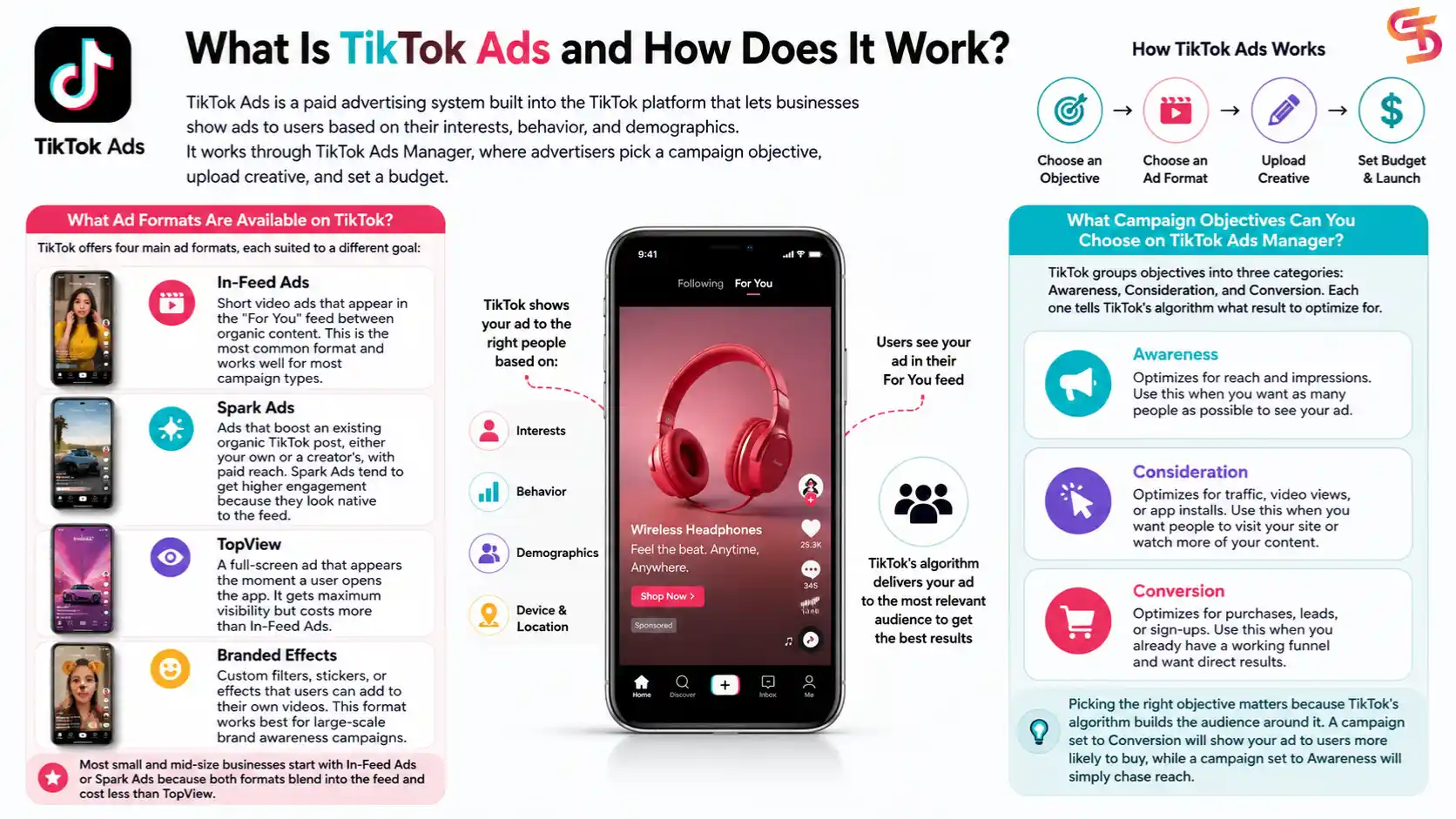
As an expert at GDT Agency with years of experience working with TikTok ads and TikTok ad accounts, I could say that TikTok offers four main ad formats, each suited to a different goal:
Most small and mid-size businesses start with In-Feed Ads or Spark Ads because both formats blend into the feed and cost less than TopView.
TikTok groups objectives into three categories: Awareness, Consideration, and Conversion. Each one tells TikTok's algorithm what result to optimize for.
Picking the right objective matters because TikTok's algorithm builds the audience around it. A campaign set to Conversion will show your ad to users more likely to buy, while a campaign set to Awareness will simply chase reach.
You set up and launch a TikTok Ads campaign in three main steps: create a TikTok Ads Manager account, define your targeting, and install the TikTok Pixel to track results. Most advertisers can complete all three steps in a single session.
Once your account exists, the setup process moves fast, but each step below needs attention because mistakes here carry through the whole campaign.
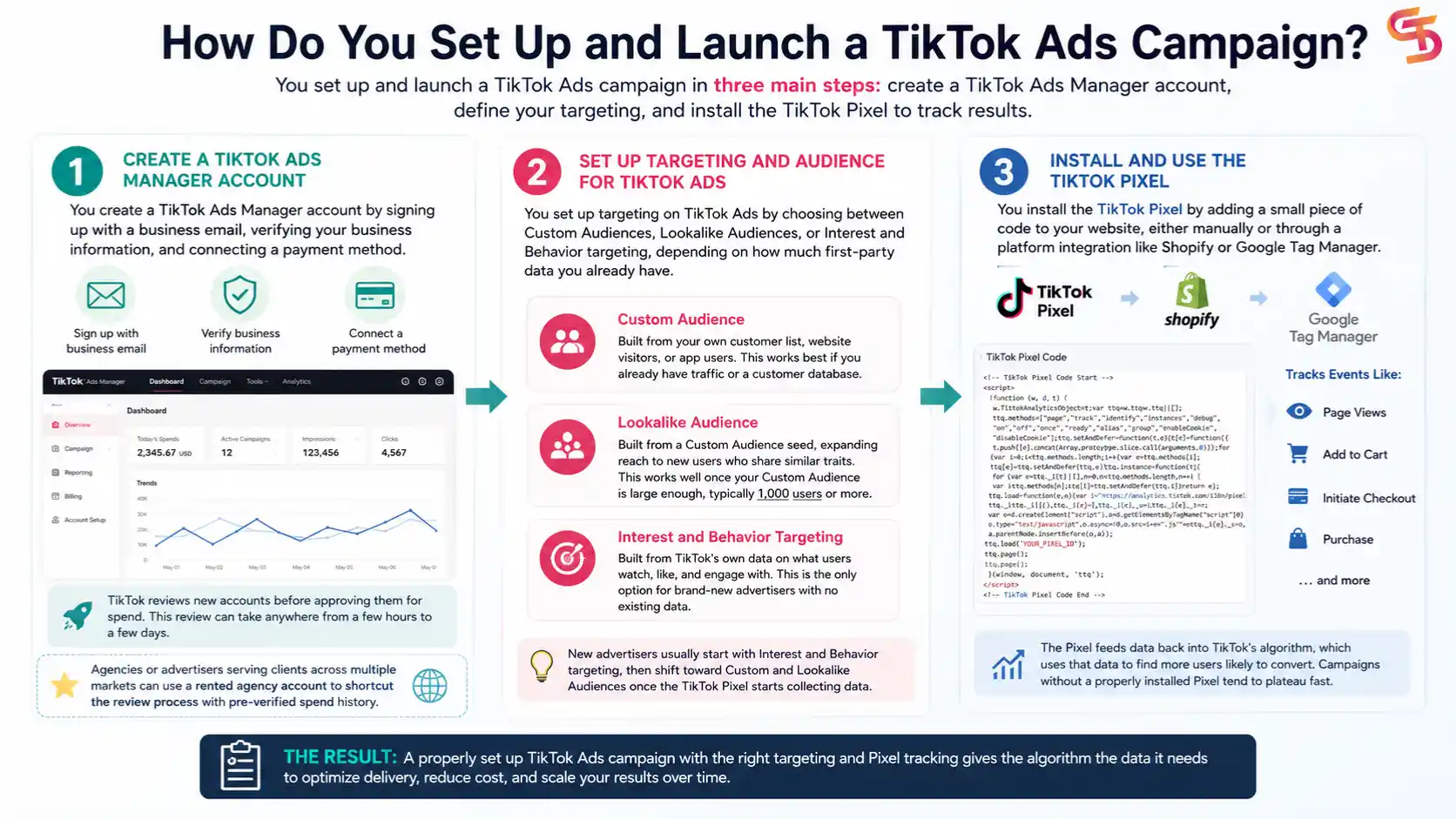
You create a TikTok Ads Manager account by signing up with a business email, verifying your business information, and connecting a payment method. TikTok reviews new accounts before approving them for spend, and this review can take anywhere from a few hours to a few days.
For agencies or advertisers who serve clients across multiple markets, a rented agency account can shortcut this review process since the account already carries verified spend history. This is common for advertisers working across 18 or more countries who need faster account access than a fresh registration allows.
You set up targeting on TikTok Ads by choosing between Custom Audiences, Lookalike Audiences, or Interest and Behavior targeting, depending on how much first-party data you already have.
New advertisers usually start with Interest and Behavior targeting, then shift toward Custom and Lookalike Audiences once the TikTok Pixel starts collecting data.
You install the TikTok Pixel by adding a small piece of code to your website, either manually or through a platform integration like Shopify or Google Tag Manager. Once installed, the Pixel tracks events like page views, add-to-cart actions, and purchases.
The Pixel matters because it feeds data back into TikTok's algorithm, which uses that data to find more users likely to convert. Campaigns running without a properly installed Pixel tend to plateau fast because the algorithm has nothing to learn from.
Running TikTok Ads costs a minimum daily budget of around 20 USD at the ad group level, though most businesses spend more once they find a working ad set. Your total cost depends heavily on the bidding strategy you choose.
Cost on TikTok Ads is not fixed. It shifts based on your industry, your targeting, and how competitive your ad auction is.
TikTok requires a minimum daily budget at both the campaign level and the ad group level. Campaign-level minimums tend to sit lower, while ad group budgets need enough room to exit the learning phase, which usually requires around 50 conversion events per week per ad set.
Businesses that set budgets too low often see their campaigns stall in the learning phase, since TikTok's algorithm never gathers enough data to optimize delivery.
TikTok Ads offers three main bidding strategies: Cost Cap, Bid Cap, and Lowest Cost.
Most advertisers start a new campaign with Lowest Cost bidding to gather data fast, then switch to Cost Cap once they have a clear target number in mind.
Budget and bidding work together, not separately. A daily budget that is too small will not let the Lowest Cost strategy find enough winning placements, and a Cost Cap set too low will choke delivery before the algorithm gathers enough data. The safest approach for a first campaign is to start wide with Lowest Cost, run three to five days without major changes, then narrow the strategy once real numbers come in.
The best strategy to optimize TikTok Ads performance combines strong native-style creative, a structured testing process, and disciplined use of TikTok's own creative tools. Campaigns that follow this approach tend to exit the learning phase faster and hold a lower cost per result over time.
Optimization on TikTok works differently than on other platforms because creative fatigue sets in fast. What performs well in week one often needs a refresh by week three.
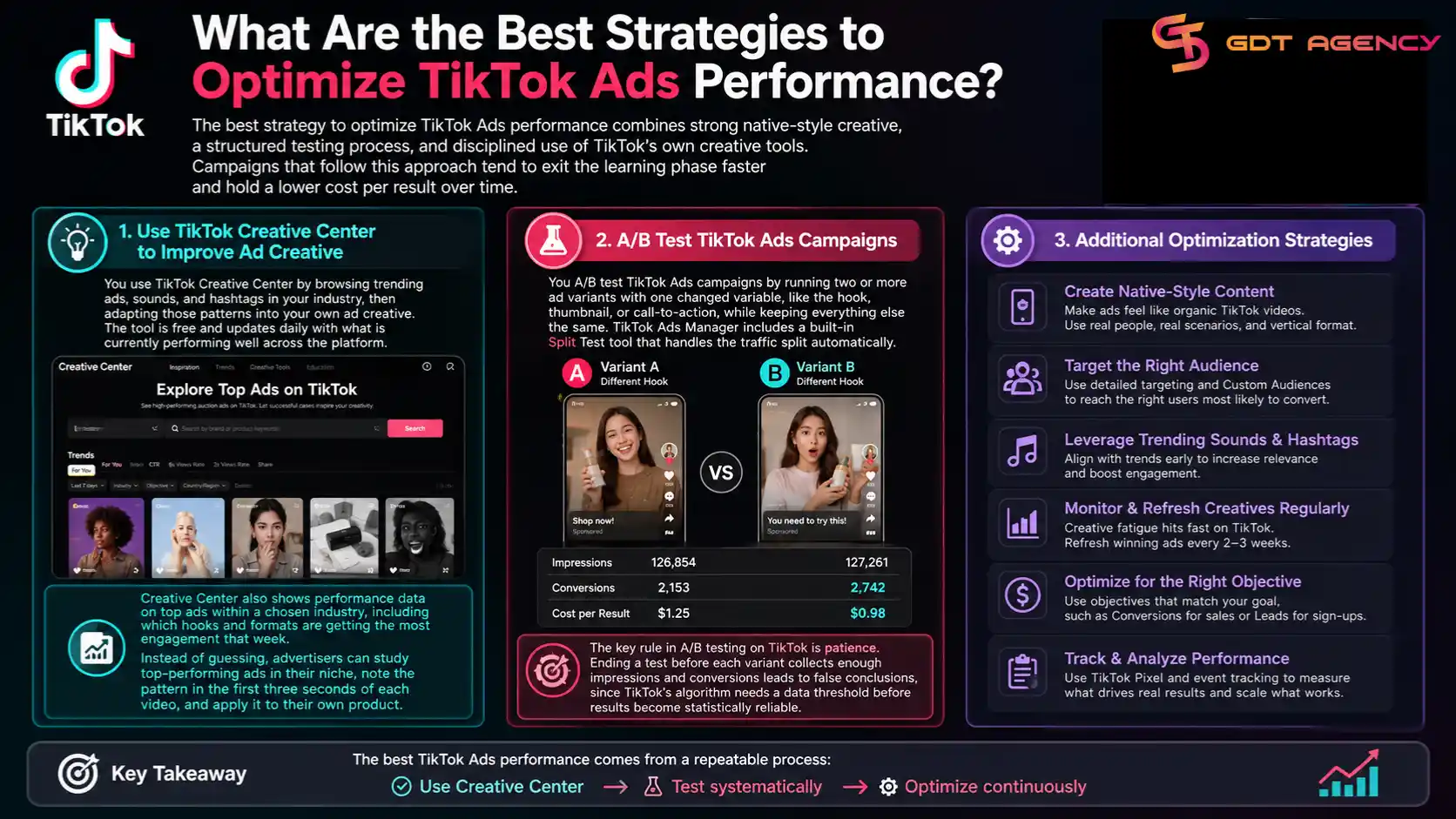
You use TikTok Creative Center by browsing trending ads, sounds, and hashtags in your industry, then adapting those patterns into your own ad creative. The tool is free and updates daily with what is currently performing well across the platform.
Advertisers who check Creative Center before building new ads tend to catch trends early, which matters on TikTok since content that looks outdated gets skipped fast by users scrolling their feed.
Creative Center also shows performance data on top ads within a chosen industry, including which hooks and formats are getting the most engagement that week. Instead of guessing, advertisers can study top-performing ads in their niche, note the pattern in the first three seconds of each video, and apply it to their own product.
You A/B test TikTok Ads campaigns by running two or more ad variants with one changed variable, like the hook, thumbnail, or call-to-action, while keeping everything else the same. TikTok Ads Manager includes a built-in Split Test tool that handles the traffic split automatically.
The key rule in A/B testing on TikTok is patience. Ending a test before each variant collects enough impressions and conversions leads to false conclusions, since TikTok's algorithm needs a data threshold before results become statistically reliable.
TikTok Ads differs from Facebook and Google Ads mainly in targeting method and content style. TikTok relies more on interest and behavior signals inferred from watch time, while Facebook leans on demographic and interest data, and Google Ads targets active search intent.
Understanding this difference helps advertisers decide where to put their next dollar of ad spend, since each platform rewards a different kind of content and targeting approach.
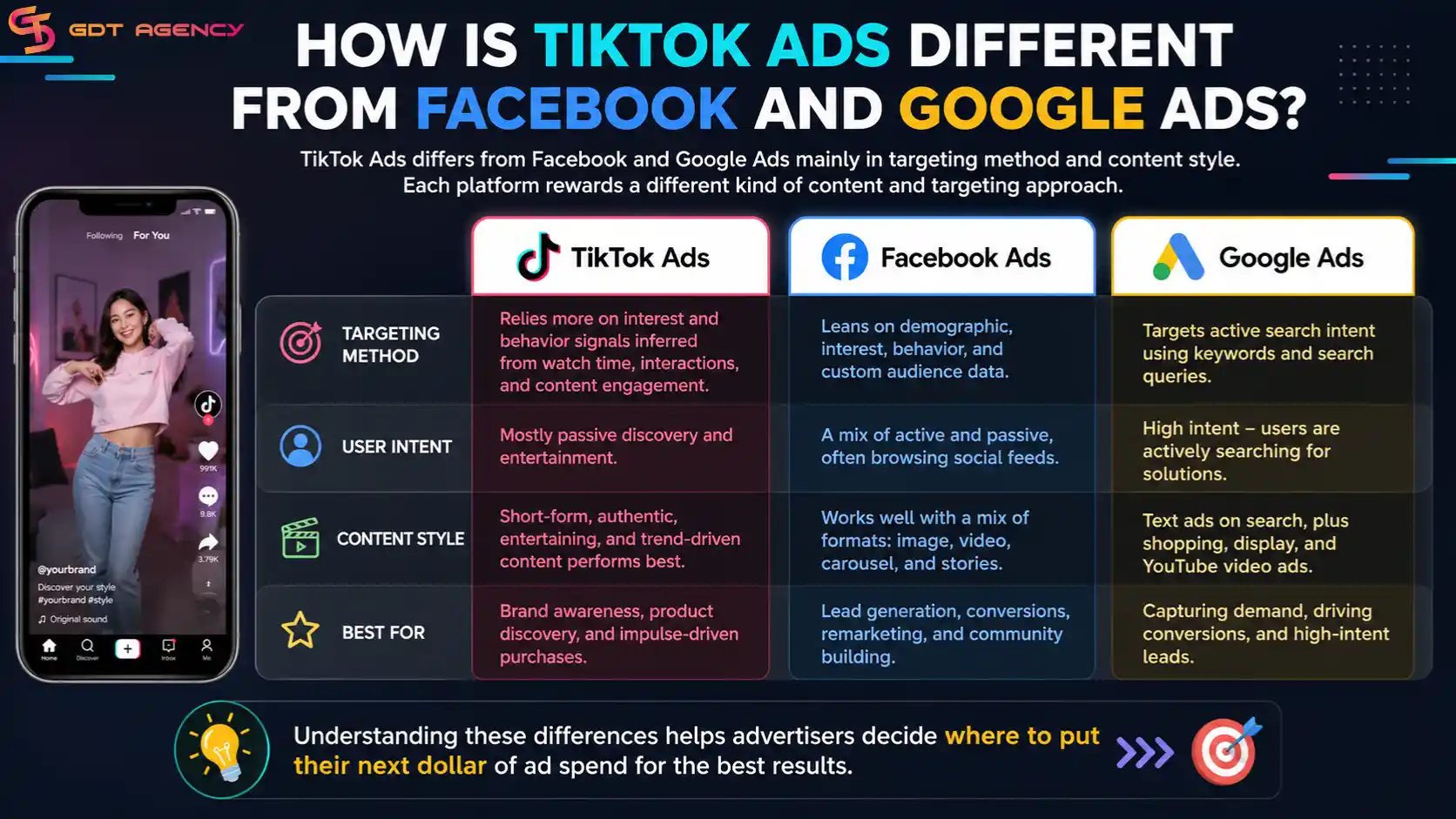
TikTok Ads tend to reward native, entertaining video content and often cost less per impression for younger audiences, while Facebook Ads gives advertisers more precise demographic targeting and a longer track record of stable delivery. The tradeoff is that TikTok content needs a faster creative refresh cycle, while Facebook allows creative to run longer before fatigue sets in.
Budget efficiency also differs between the two platforms depending on the audience age and the product category. Younger, impulse-driven products tend to see a lower cost per result on TikTok, while higher-ticket items with a longer decision process often perform better on Facebook, where retargeting tools are more mature.
Yes, you can run TikTok Shop Ads as a separate campaign type built specifically to drive purchases from TikTok's in-app shopping feature. TikTok Shop Ads connect directly to product listings, letting users buy without leaving the app, unlike standard TikTok Ads that send traffic to an external site.
A rented TikTok Ads agency account is an ad account managed by an agency that already carries verified spend history and higher account limits. Advertisers typically need one when their own account faces restrictions, when they need faster account access across multiple countries, or when they want to bypass the review delay that comes with a brand-new account.
TikTok Ads performance varies by industry: e-commerce campaigns tend to perform well with Spark Ads and Shop Ads since users can buy directly in-app, while financial services campaigns often need a longer Consideration-stage funnel before a Conversion campaign works well, since financial products usually require more trust-building before a purchase decision.
Running TikTok Ads well comes down to three things: picking the right objective for your goal, giving your campaign enough budget to exit the learning phase, and refreshing creative before fatigue sets in. Businesses that treat the platform as a fast testing ground, rather than a set-and-forget channel, get the best return on their ad spend over time.
Most campaigns need about 50 conversion events within a 7-day window to exit the learning phase and reach stable delivery.
Yes, small businesses can start with a modest daily budget and scale up once an ad set proves it can convert consistently.
No, TikTok Ads generally perform better with native-style, user-generated content than with polished, high-production video.
No. You need a TikTok Business Account and access to TikTok Ads Manager before you can create and launch advertising campaigns. Once your account is approved and a payment method is added, you can start running ads.
Most TikTok ads are reviewed within 24 hours, although some reviews may take longer if additional checks are required. Ads that comply with TikTok's advertising policies are typically approved more quickly.
A good click-through rate (CTR) varies by industry and campaign objective, but many advertisers aim for a CTR above 1%. Strong hooks, engaging creatives, and relevant targeting usually lead to higher CTRs.
No. You can run TikTok Ads without the TikTok Pixel, but installing it is highly recommended for conversion campaigns. The Pixel tracks user actions on your website and helps TikTok optimize ad delivery based on conversion data.
TikTok Ads for e-commerce works as a paid promotion system that helps online stores reach buyers through short-form video on one of the fastest-growing platforms…

Running TikTok ads for an MMO academy takes more careful planning than most niches. TikTok’s ad platform rewards fast-moving, high-engagement content, so an MMO academy…

Financial service brands can run ads on TikTok, but the platform holds these advertisers to a stricter standard than most industries. Banks, insurance companies, lenders,…