


Facebook Ad Formats: A Comprehensive Guide to Boost ROI in 2026


Choosing the right Facebook ads format is often the difference between a high-converting campaign and a wasted budget. With Meta constantly updating its platform, it is not enough to just post a nice image, but you also need to understand how different layouts influence user behavior. In this comprehensive guide on Facebook ad formats, we will break down the primary ad formats available on Facebook today and show you exactly when to use each one to get the best results for your brand.

Facebook Ad Formats: Image Ads
Single-image ads are still one of the most reliable formats inside Facebook and Instagram ecosystems.
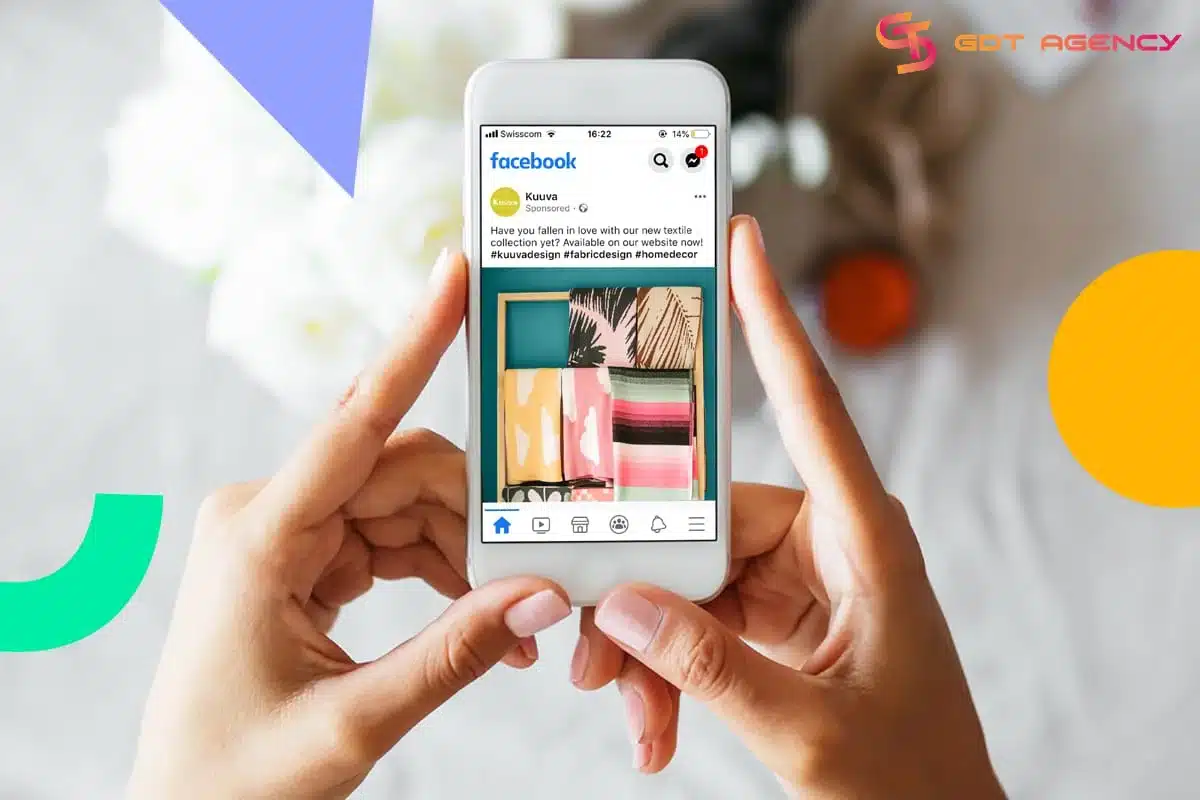
They are easy to create and load quickly. You can use your own images or create an ad with stock photos to tell your story. Image ads are perfect for driving traffic to a specific landing page. They often generate strong click-through rates (CTR) when the creative is sharp.
→ Image ads reduce production cost and allow fast testing. Lower cost plus quick optimization cycles usually mean better cost per acquisition and stronger ROI, especially in retargeting.
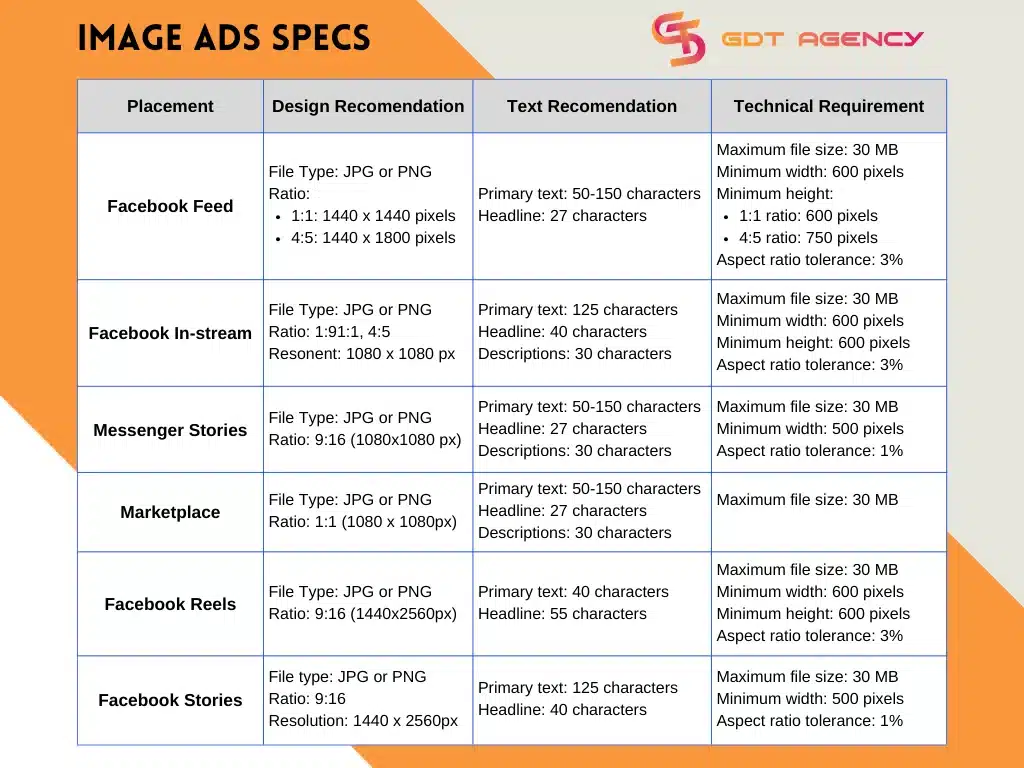
Facebook Image Ads Specification
In 2026, a clear message and one strong visual can outperform complex creatives when targeting warm audiences or retargeting traffic. Here are the specifications of design and text recommendations, as well as technical requirements for you to refers:
When Are Facebook Image Ads Are Best Options?
It would not be exaggerated to claim that Image ads remain the backbone of Facebook advertising. Image ads are very suitable when you need a direct response or want to stretch a tight budget. Here is a breakdown of when image ads are your best option.
1. When You Have a Simple, Direct Offer
If your message can be understood in under two seconds, or your goal is a direct sale for a straightforward product, image ads are a good option with a static image that allows the user to see the product, the price, and the “Buy Now” button all at once. Image ads are best for:
- Flash Sales: “50% Off Everything” works better as a bold graphic than a 15-second video.
- Clear Value Props: If you are a local plumber and your ad says “Emergency Repairs – Available 24/7,” a high-quality photo of your van and a clear headline are all you need.
- Promoting a Single Hero Product: A crisp, professional shot of a beautiful watch or a pair of shoes often converts better than a video that distracts from the product itself.
2. When You Are Retargeting “Warm” Leads
When someone has already visited your site or added an item to their cart, they don’t need a brand story, but they need a push.
- Reminder Ads: A simple image of the item they left behind with a “Complete Your Order” button is highly effective.
- Social Proof: A static image featuring a 5-star review and a photo of the product is a powerful “trust signal” for someone who is already considering a purchase.
3. When You Need to Test Messaging Quickly:
Because image ads are easy to create, they are perfect for A/B testing. You can use AI tools to generate 20 or 30 variations of a single image to see which specific “hook” resonates with an audience.
- Testing Multiple Angles: You can create and launch 10 different image variations in the time it takes to edit one video.
- Repeating Quickly: If an ad isn’t working, you can swap out the photo or the background color in minutes to see if performance improves.
4. When You Want to Minimize “Friction.”
As static images load instantly, even on slower mobile connections, therefore, they are the superior choice for:
- Lead Generation Forms: Since the goal is to get the user to click a “Sign Up” button as fast as possible, a clean image that clearly explains the “lead magnet” (like a free PDF or discount code) keeps the focus on the form.
- Information-Heavy Offers: If you need the user to see a list of features or a “Before and After” comparison, a static image allows them to study the details at their own pace without the “timer” of a moving video.
Facebook Video Ads: Capturing Attention
Video remains dominant across Meta platforms and is still the most engaging Facebook ad format. Whether it is a short 15-second Reel or a longer brand story, video allows you to show your product in action and drives stronger engagement and longer attention spans.
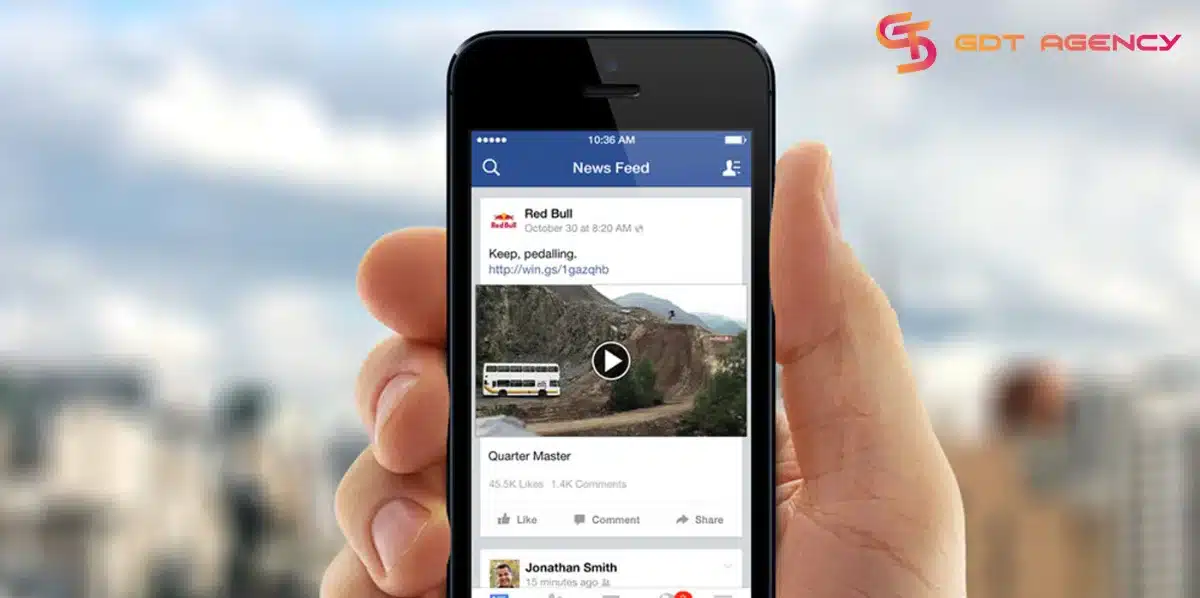
In 2026, users expect motion. Static content competes against dynamic feeds. Video helps demonstrate product value, tell stories, and build credibility faster.
→ Video increases engagement and trust, which improves conversion rates over time. Even if CPM is slightly higher, stronger conversion lifts overall ROI.
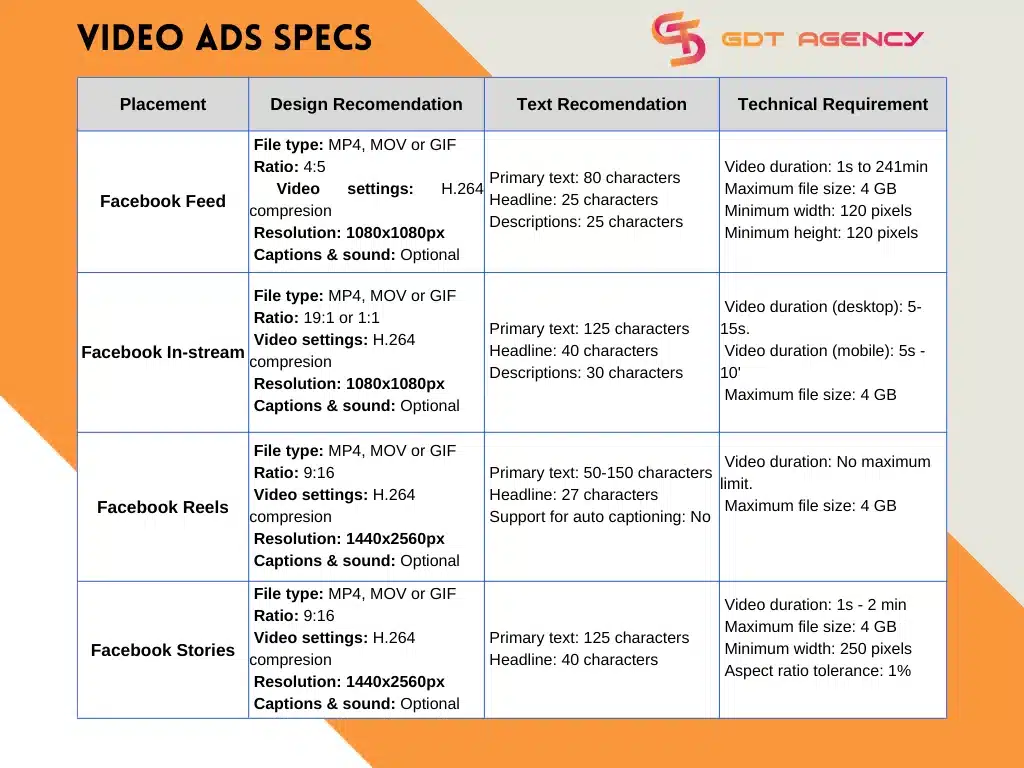
Facebook Video Ads Specification
Video ads can show off product features and draw people in with sound and motion. You can upload a video you created or create one in Ads Manager with video creation tools. Here are the specifications of Facebook Video Ads:
When Are Video Ads Are Best Options?
Whether it’s through social video ad formats (such as Feed, Stories, and Reels) or online video content where in-stream ads appear, you can reach people where they’re spending their time through video on Facebook.
Here is a breakdown of when video ads are your best option:
1. When Your Product Needs a Demonstration:
If you are selling something new, complex, or a problem-solver, a static image often isn’t enough. Video is the best option for:
- Showcasing “Aha!” moments: Showing the exact second a product solves a frustration.
- Tutorials: Quickly teaching someone how to use an app or a tool.
- Unboxings: Letting customers see the physical quality and scale of what they are buying.
2. When You Need to Build Fast Trust:
In a feed full of “too good to be true” offers, video feels more human. It is the superior choice for:
- Customer Testimonials: Seeing and hearing a real person talk about their experience is far more convincing than a text quote.
- Behind-the-Scenes: Showing your team, your office, or your manufacturing process removes the “faceless corporation” feel.
- User-Generated Content (UGC): Videos that look like they were filmed on a phone by a regular customer tend to get higher engagement because they don’t look like “ads.”
3. When Your Goal is Brand Awareness
Video is a powerful “top of the funnel” tool. It is ideal for:
- Storytelling: Communicating your brand’s values or mission.
- Stopping the Scroll: Movement naturally catches the eye more than a still image.
- Brand Recall: People generally remember brand names and messages better after watching a video than after seeing a static graphic.
4. When You Want to Build a Retargeting Audience
One of the best technical reasons to use video is how Meta tracks it. You can create “Custom Audiences” based on how much of a video someone watched (e.g., people who watched 50% or 75%).
→ This allows you to filter out casual scrollers and only spend your “conversion” budget on people who showed genuine interest by staying for the whole video.
5. When You’re Targeting Mobile-Heavy Placements
According to Demansaga, as of early 2026, Facebook has approximately 3.22 billion monthly active users, with approximately 81.8% (2.63 billion) of users accessing Facebook via a mobile device.
Since most Facebook and Instagram users are on mobile, vertical video formats like Reels and Stories are often the most effective. They take up the entire screen, removing distractions and making your message the only thing the user sees.
Facebook Carousel Ads: Showcasing Variety
Carousel ads allow you to display up to 10 images or videos within a single ad, each with its own link. Instead of relying on one message, you can show features, benefits, testimonials, and offers all at once.
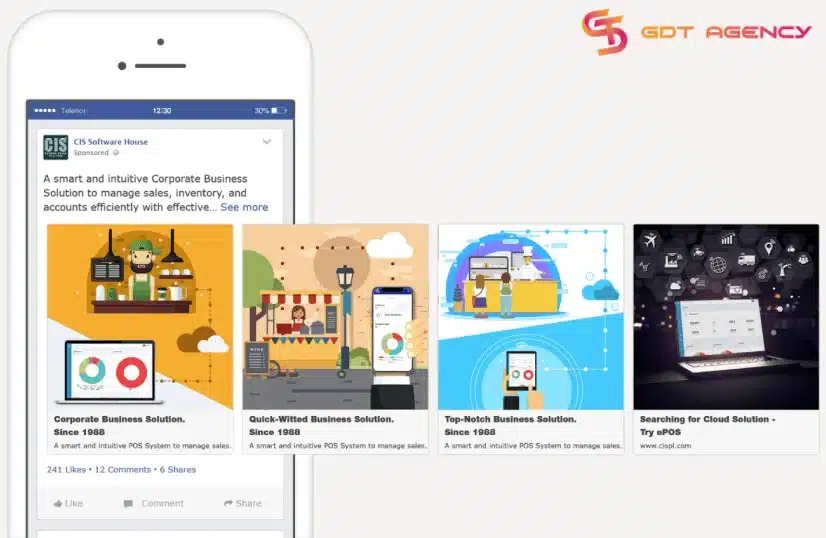
This format works well for: E-commerce products, Service breakdowns, Before-and-after transformations, Step-by-step explanations, … You can also analyze which card gets the most clicks and refine your messaging.
→ Carousel ads improve click-through rate and allow data-driven creative optimization, which helps reduce wasted spend and increase return per campaign.
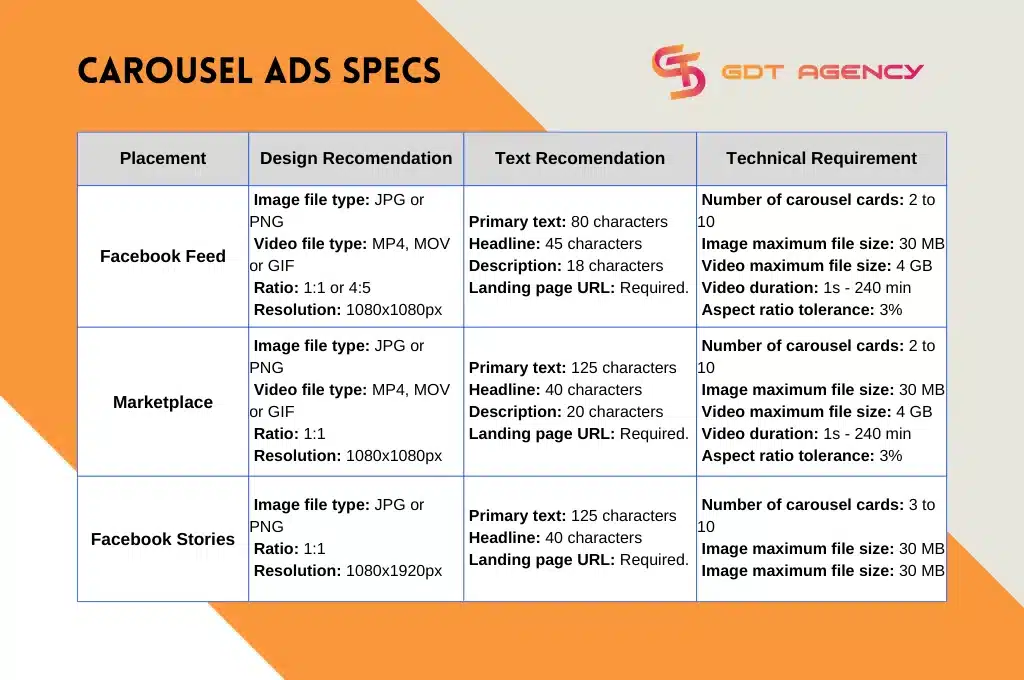
Facebook Carousel Ads Specification
Use carousel ads to show different images of the same product, or create one long photo that people can swipe. Here is the carousel ads specification:
When Are Carousel Ads Are Best Options?
Carousel ads occupy the middle ground between a single image and a full video. They are the best option when you have multiple things to say but want the user to control the pace of the information.
You can think of a carousel as a mini-catalog or a storyboard that lives right in the feed. Here is when they are your most effective choice.
1. When You Have a Product Collection
If you run an e-commerce store, showing just one product is a missed opportunity. Carousels are the best option for:
- Product Variations: Showing the same shirt in five different colors.
- Related Items: If someone is looking at hiking boots, use the other cards to show wool socks, a backpack, and a water bottle.
- “Best Sellers” Lists: Displaying your top five products in a single ad unit to see which one gets the most clicks.
2. When You Need to Explain a Process (Step-by-Step)
Some services or products are too complex for one image but don’t necessarily need a 30-second video.
- The “How-To”: Card 1 is the problem, Cards 2-4 are the steps to fix it using your product, and Card 5 is the result.
- Onboarding: Showing a user exactly how easy it is to sign up for your app (e.g., “Download,” “Create Profile,” “Start Saving”).
3. When You Want to Tell a Visual Story
You can use the “continuous image” trick, where one long panoramic photo is split across multiple cards. This encourages the user to swipe to see the rest of the picture.
- Large-Scale Products: Perfect for showing the interior of a car, a wide-angle view of a real estate property, or a detailed piece of furniture.
- Narrative Flow: Leading the user through a “Before and After” sequence that feels more interactive than a static split-screen.
4. When You Are Testing Creative Hooks
Facebook allows you to automatically show the best-performing cards first. This is a massive advantage for data-gathering:
- You can put 5 different headlines or 5 different lifestyle photos in one ad.
- Facebook’s algorithm will figure out which specific card is getting the most engagement and move it to the front.
- This tells you exactly what your audience cares about without you having to run five separate ads.
5. When Your Goal is a Lower “Cost Per Click” (CPC)
Because carousels are interactive, they often invite more “micro-engagements” (swipes).
More engagement usually tells the Facebook algorithm that your ad is high-quality.
This can lead to a lower CPM (cost per 1,000 impressions) and a higher overall click-through rate compared to a single static image.
Facebook Collection Ads
Collection ads combine a video or image with a product catalog below it. When clicked, they open an instant storefront experience inside the platform.
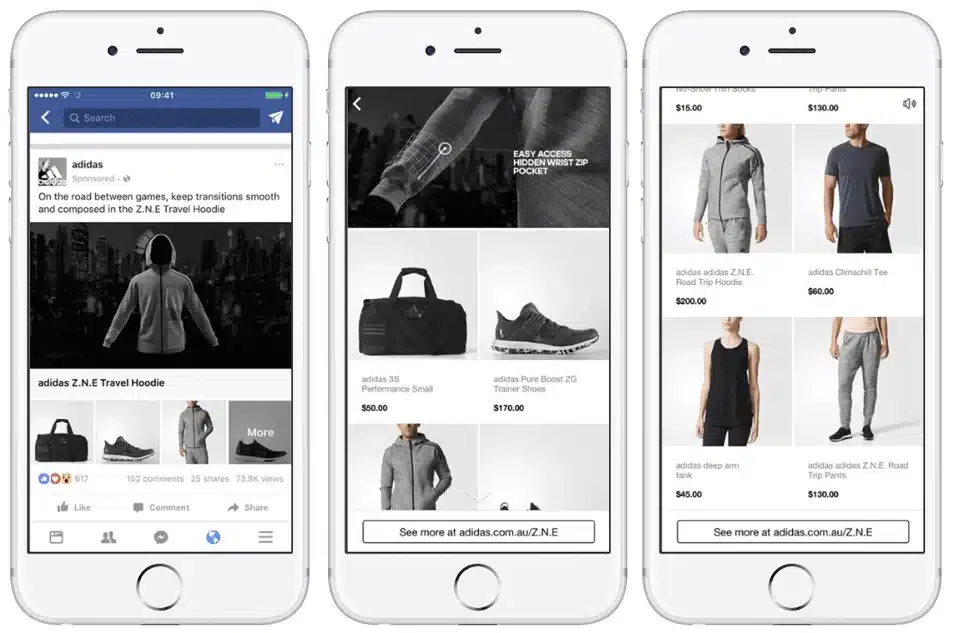
In 2026, mobile dominates even more. Reducing friction is everything. The fewer users who have to wait or leave the platform, the higher the conversion rate.
→ Collection ads shorten the path to purchase. Lower friction leads to higher conversion rates, which directly improves ROI.
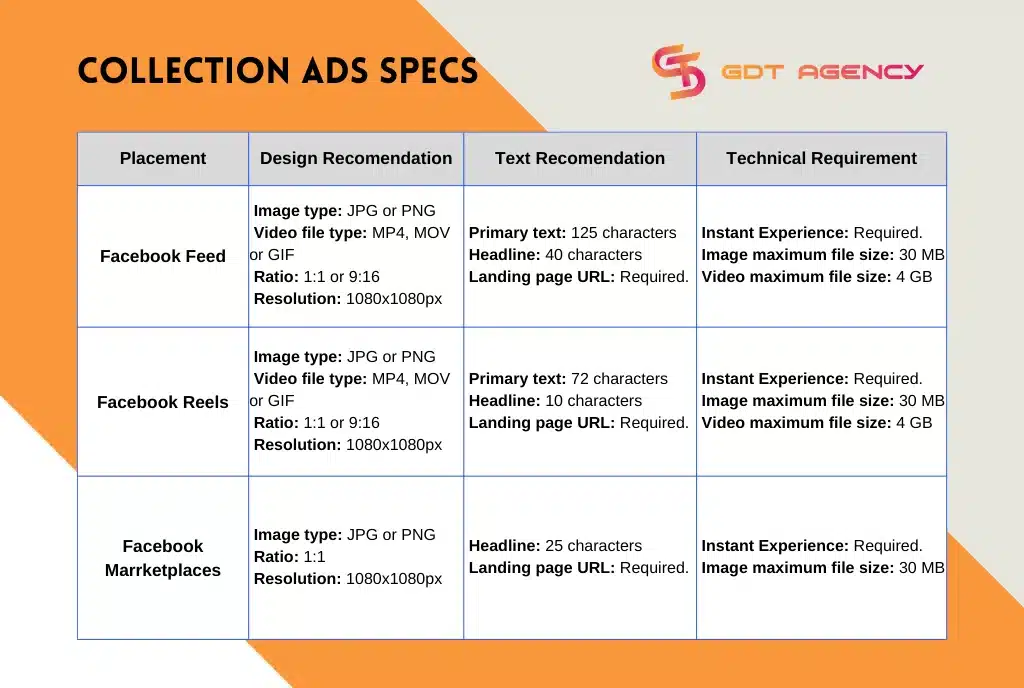
Facebook Collection Ads Specification
Collection ads are a mobile-only format that features a primary video or image with four smaller accompanying images in a grid layout. Here is the Facebook collection ads specifications:
When Are Collection Ads Are Best Options?
Collection ads are essentially a “mini-storefront” built directly into the Facebook or Instagram app. They are almost always the best option for mobile-heavy e-commerce brands that have a large product catalog and want to reduce the friction of mobile shopping.
In 2026, when mobile traffic accounts for the vast majority of ad impressions, collection ads are the standard for high-performance retail campaigns.
1. When You Want to Reduce “Mobile Friction.”
Mobile websites can be slow or clunky, causing users to drop off before they buy. Collection ads solve this by using an Instant Experience:
- Instant Loading: When a user taps the ad, it opens a full-screen catalog that loads up to 15 times faster than a standard mobile website.
- In-App Browsing: Customers can browse dozens of your products without ever leaving the Facebook or Instagram app.
- Seamless Transition: They only head to your actual website once they are ready to hit the “checkout” button.
2. When You Have a Large or Diverse Catalog
If you sell many related items, showing just one is a wasted opportunity. Collection ads are ideal for:
- Themed Sets: Grouping products together, like a “Summer Essentials” kit or a “Home Office” bundle.
- Product Discovery: Letting users scroll through a grid of items to find the specific style or color they prefer.
- Lookbooks: Using a “hero” lifestyle video at the top to show the products in action, with the exact items used in the video listed directly underneath.
3. When Your Goal is a High “Return on Ad Spend” (ROAS)
Because these ads are so deeply integrated with your product catalog, they tend to be highly efficient.
- Higher Intent: A user who clicks through a collection ad and then clicks a specific product is showing very high intent to buy.
- Dynamic Content: You can set the ad to automatically show the products from your catalog that a specific user is most likely to be interested in based on their past behavior.
- Improved Metrics: In 2026, brands using collection ads often see a 20-30% increase in conversion rates compared to standard image ads.
4. When You Want to Combine Storytelling with Sales
Collection ads allow you to have the best of both worlds:
- The Hero Asset: You can use a high-quality 15-second video (like an unboxing or a brand film) as the main “hook.”
- The Product Grid: Below that video, four smaller product tiles provide an immediate path to purchase. This captures the user’s emotion with the video and their logic with the product grid simultaneously.
Conclusion
Facebook ad format is the layout of an ad that determines how the ad will look and how many images or videos the ad will contain. Facebook ad formats are diverse, designed to suit different marketing goals, from brand awareness to conversion.
Whether you want to use video, images, or words, or a combination of those elements, there’s always a Facebook ad format that fits your business story. Hope that this article on Facebook ad formats can help you have a clear look at Facebook ad formats.
If you have any questions, need additional helps or want to rent Facebook agency account, feel free to contact GDT Agency. Our expert team with seasoned experience is always ready to help you achieve every marketing goal.

Follow if you find it useful


You can contact us, with our experience in successfully deploying thousands of conversion advertising campaigns, GDT Agency confidently believes we can help you optimize effectiveness and maximize cost savings with advertising operations.

How To Create A Facebook Prepaid Ad Account In 5 Minutes (2026)
A Facebook prepaid ad account is a manual payment account that requires advertisers to add
15/06/2026

Facebook Postpaid Ad Account: How It Works and When You Should Use It
A Facebook postpaid ad account is a billing model that lets advertisers run campaigns first
15/06/2026

Facebook BM2500: What It Really Means And How To Get It 2026
Facebook BM2500, also known as Business Manager 2500, is a high-level Meta Business Manager account
13/06/2026


