


Facebook Ads Circumventing System: What It Means & How To Fix


When you see the message “your account violated the circumventing system’s policy”, your ad account has been alarmed. Seeing a “circumventing system” warning on your Facebook Ads Manager means that Facebook has detected that you are engaging in activities that are contrary to the advertising terms, or your ad is trying to dodge advertising terms. In this guide on Facebook Ads circumventing systems, we’ll explain everything you need to know to keep your ad accounts safe.
Circumventing System Policy in Facebook Ads
Before we go further to discover what triggers this violation, as well as the way to fix it, let’s take a quick look at what policy is and what it means in Facebook ads.
What Does Circumventing Systems Mean in Facebook Ads?
“Circumventing Systems” refers to every purposeful act that advertisers might carry out to bypass, deceive, or manipulate the platform’s ad review processes, algorithms, or enforcement mechanisms in any way. This policy is designed to maintain trust and ensure that ads comply with Meta’s guidelines, preventing deceptive practices that could harm users or the ecosystem.
Facebook regards this matter with utmost seriousness, as its system is structured in such a way that it keeps ads safe, compliant, and trustworthy. If anyone tries to break the rules, Facebook may permanently disable the ad account, Business Manager, or even the entire profile.
How Can I Know If My Facebook Ad Was Flagged By the Circumventing System?
The bad news is that though Facebook always notifies advertisers about policy violations or ad disapprovals, Facebook does not explicitly inform advertisers whether their ads get flagged for circumventing system or when their ads will get flagged.
However, at GDt agency, as one of the leading agencies with over 5 years of experience in the Facebook advertising industry, we’ll show you some signs of this policy violation to help you find the answer to your question: Whether my Facebook ad was flagged by the circumventing system or not. Here is the list of some common signs:
- Frequent ad disapprovals
- Account restrictions
- Abrupt changes in ad performance without clear reasons
Above are the 3 common signs you can look for and compare to your ads. Don’t forget to monitor the ad metrics and keep an eye on notifications in Ads Manager to detect potential issues.
How Does Violating the Circumvention System Policy Affect My Facebook Ads?
Violating Facebook’s Circumventing Systems policy can have serious and often irreversible effects on your advertising activity. The following are the common actions taken by Facebook once it finds out that your account or ads were trying to trick its systems:
Your Facebook Ad Has Been Rejected
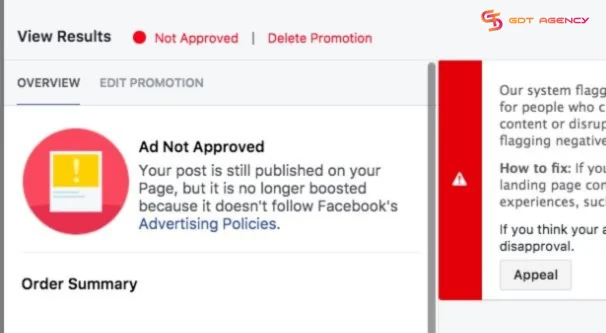
If Facebook detects the user’s activity that looks like an attempt to dodge its review process or policies, it might take the action of automatically rejecting your ads. For instance, editing text or links to hide restricted content, or creating new ads after rejections.
Your Facebook Ad Account Disabled
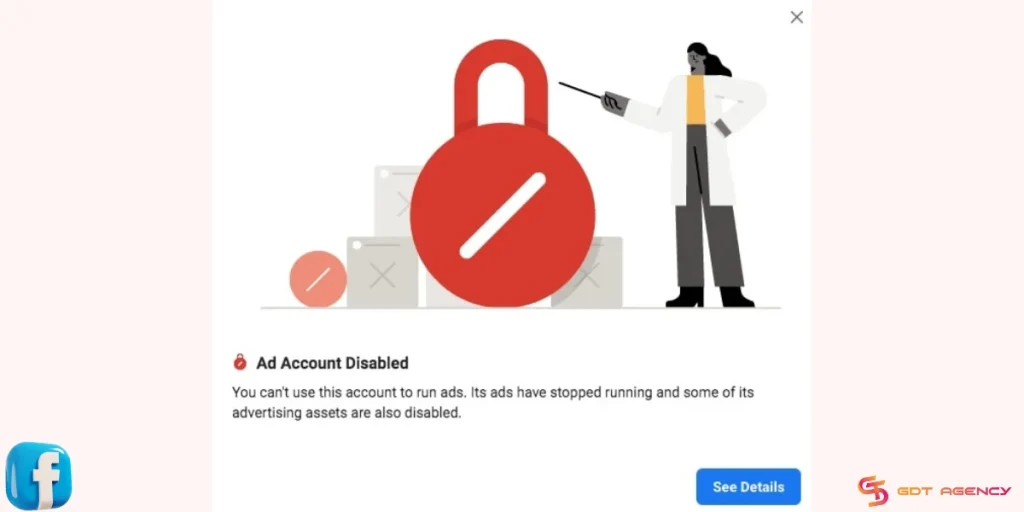
The most common consequence is your ad account being disabled. When your account is marked for circumventing, Facebook rarely reinstates it, since it treats this as a deliberate policy violation, not a mistake. After your ad account is disabled, you will lose access to all campaigns, performance data, and payment methods linked to the account.
Worst, circumventing systems is categorized as a “high-risk” offense. Facebook may mark all assets (payment methods, domains, IPs, and even emails) associated with the violator as untrustworthy, which will cause any future ad accounts linked to them to be prohibited automatically.
>>> Read Now: How To Fix Facebook Ad Account Disabled For Policy Violation
Your Business Manager, Page, and Personal Profile Restriction
If the violation is serious, your Business Manager, Facebook Page or even your Instagram account may also face restrictions. Facebook may block you from creating new ad accounts or connecting assets under the same identity.
Not only that, but Facebook can limit your personal profile’s ability to run or manage ads. This means that even new Business Managers or Pages you create could be automatically restricted.
Reasons For Violating “Facebook Ads Circumventing Systems”
1 year ago, GDT Agency used to work with a fashion ecommerce client named UrbanFit Store. They rented our Facebook agency account and spent about $18,000 a month on ads. After launching a new landing page for a new streetwear brand that used four redirects before the final product page, Facebook flagged their campaigns for “circumventing systems” and stopped roughly $600 a day in spending.
After they reached out to us, we reviewed the funnel, found that the chained redirects looked like masked URLs, and cleaned everything down to one direct tracking link. After sending an appeal with clear screenshots, Facebook restored the account within three days.
From this case, we realize that Facebook ads circumventing systems is also a notable problem when running ads, so we have discussed together and consolidated the most common reasons to help other advertisers avoid them in the future:

Cloaking:
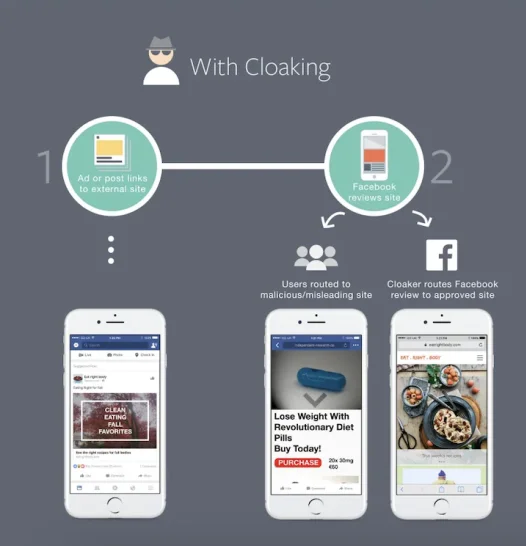
Cloaking in Facebook ads is a deceptive tactic showing different content to reviewers than to the public (e.g., reviewers see a benign landing page while users are sent to prohibited content). This method aims to deceive the review process by showing the compliance content, but leads users to non-compliant or unrelated content when the ad is live.
Content Obfuscation
Content obfuscation is related to the act of advertisers who have found a way to conceal potentially restricted content by:
1. In an attempt to avoid the review process, the advertiser is hiding words or phrases in the ad text by using Unicode characters or symbols to deliberately misspell the names of brands or celebrities to attract clicks.
For example, if you want to advertise Nike shoes, but you don’t want to be penalized by Facebook, you write your ad with the word “NIke” with a bigger I or the word “NikE” with a bigger “e”.
2. Using unclear or indistinct images in advertisements makes it difficult for viewers to perceive or understand the image’s content.
In short, these practices violate platform policies as they aim to deceive the system, compromising transparency and undermining the integrity of the advertising platform.
Redirect users too many times to the landing page
If you’re trying to redirect users to too many different URLs, there’s a high chance you’ll get banned by Facebook or have your account suspended.

Facebook’s bot works to scan all advertising content. Also the landing pages. If you make users redirect multiple times to different domains. It will think that you are masking the malicious URL. And, naturally, you get fined. You’re better off not using redirects on landing pages or any URLs when you don’t need them.
Repeated policy violation
The basic thing you need to know is that Facebook will not be able to ignore Facebook advertising policy violations. You can violate several times, then request an appeal to get your ad account back. But over a while, your repeated violations of Facebook’s regulations, rules, and policies will put your advertising account at a dangerous level.
If you violate 2 3 different types of policies, there is still some hope of getting your Facebook Ads account and ad account money back. But if you violate ONE kind of policy for the 3rd or 4th time, your ad account is done.
We recommend that you follow Facebook’s advertising policies. Be honest and follow the policies if you want to develop long-term on this platform.
Create a new account and continue to violate
If you try to create new accounts and continue to use ads that violate Facebook’s terms and policies. You continue to find and use new and unconventional methods for violating terms. Then you will continue to spend more time and money on this.
Currently, Facebook in general and Facebook Ads in particular are extremely developed in terms of algorithms. If you’re trying to say “I can ignore all Facebook Ads terms and policies”. Then that is not possible. Maybe it will help in the short term. Very short, of course. But if you want to grow strong and go further in the field of online business and advertising, then you cannot do so.
Other Actions Lead To Facebook Ads Circumventing System Violation
Besides these reasons above, there are still some other actions that can lead to Facebook ads circumventing. We have consolidated them in the list below:
- Re-posting the same ad that is not allowed, with small changes to escape being caught or to refresh the enforcement history.
- Misclassifying the ad objective, industry, or creative to bypass the category-specific rules (for example, treating a political ad as a general awareness ad).
- Using several accounts, pages, or ad accounts to run the same campaign after enforcement on the main account.
- Concealed or misleading targeting to show an ad to very specific groups to dodge broad-targeting restrictions or to indirectly target protected classes.
- Manipulating metadata: changing tracking URLs, redirects, or parameters so that reviewers cannot see the actual destination or content.
- Coordinated inauthentic behavior: utilizing a network of pages or accounts to boost content while concealing the actual coordination or origin.
>>> Related article: How to fix Facebook Ad Account Disabled?
How To Solve Facebook Ads Circumventing Systems?
Now that you understand the basic information about Facebook ads circumventing systems, as well as the reasons that lead to violating Facebook ads circumventing systems. In this section, we will walk you through the ways to solve this problem.

Relaunch the Advertisement
Relaunching the ad with several crucial modifications is the easiest and most profitable solution for you. To do this, the first thing you have to do is carefully review both your ad content as well as the linked website.
You will need to review your ad copy, image, and targeting to comply with Facebook’s Advertising Policies and Community Standards. Address or remove any discrepancies or misleading information present. Besides, you also need to ensure the content of the linked website aligns with your ad.
Once you have made the fix, relaunch your advertisements.
Delete the Advertisement
If you have been made the significant address, relaunch the ad and still be rejected, deleting the advertisement from your ad account seems to be the best choice. Repeatedly facing too many times of ad rejections can lower the trust score of your account, which leads to more restrictions in the future.
Request a Review
If you believe you have not violated Meta policies, you can request a review of your advertisement. This ensures that a human reviewer will view your ad and determine its eligibility on the platform.
Contact Support
Please contact Facebook’s support team to present information such as your business, business website, products, or services that your business is providing. The more information with high transparency, the higher your chances of getting your account back.
6 Essential Tips to Avoid Facebook Ads Circumventing Systems in The Future
To help advertisers avoid this situation in the future, here are 6 essential tips to avoid the Facebook ads circumventing system that have been summarized directly from our experiences in Facebook advertising.
- Be explicit concerning the advertisement’s creativity, the landing pages, and the business’s identity.
- Follow the rules regarding content and audience of ads, and do not try to hide the disallowed content.
- Apply the right objectives for the campaign and provide the correct metadata.
- Correct policy violations on the original advertisement/account instead of recreating campaigns under new accounts.
- Stay truthful with the redirects: guarantee that both reviewers and users are shown the same endpoint.
- Set the targeting wide enough so as not to take advantage of loopholes that might be understood as indirectly targeting protected characteristics.
FAQs
1. What does “Circumventing Systems” mean for Facebook ads?
Circumventing Systems” means the act of trying to bypass Facebook’s ad review process or enforcement systems in any way. This can include operations such as concealing prohibited content, manipulation of ad delivery, or the usage of deceptive tactics in order to facilitate the approval of ads that would normally be rejected.
2. What are common examples of circumventing systems?
- Link shorteners or cloaking to hide the real destination of an ad should not be used.
- Misspell or alter prohibited words with the intention of not being detected
- Manipulate trademarks or logos in the ad text or on the landing pages
- Create multiple ad accounts or business managers to run the same ads after a ban.
- Redirect users through several URLs in order to hide the final landing page.
3. How does Facebook detect circumventing systems?
Facebook relies on automated systems to examine ads and landing pages for any kind as suspicious activities like repeated violations, cloaking, or an attempt to deceive the review process. When the system identifies accounts or ads that have patterns of going around the rules, it flags them.
4. What happens if my ad is flagged for circumventing systems?
- Ads can be refused or disapproved.
- Ad Accounts or business managers may be suspended or banned.
- If it is a very serious case, the profile may be limited.
5. How can I fix a circumventing systems violation?
- Review all ad content and landing pages for compliance.
- Removal of cloaking, redirects, or deceptive methods entirely.
- Do not use several accounts to run similar ads
- Only submit new ads after fixing the flagged issues.
6. Can I appeal a circumventing systems ban?
It is possible to appeal via Facebook support channels. However, you need to prove that you have fixed the infringements and that you conform to their policies now.
Conclusion
We hope that our guide on Facebook ads circumventing system can provide enough information to help you understand more about circumventing system violations. If you have questions about advertising, advertising campaigns, or advertising accounts, please contact GDT Agency immediately. Our team of experts will assist you in the fastest and most accurate way.
GDT Agency – Get 10x ROAS with Agency Ad Accounts

Follow if you find it useful


You can contact us, with our experience in successfully deploying thousands of conversion advertising campaigns, GDT Agency confidently believes we can help you optimize effectiveness and maximize cost savings with advertising operations.

How To Create A Facebook Prepaid Ad Account In 5 Minutes (2026)
A Facebook prepaid ad account is a manual payment account that requires advertisers to add
15/06/2026

Facebook Postpaid Ad Account: How It Works and When You Should Use It
A Facebook postpaid ad account is a billing model that lets advertisers run campaigns first
15/06/2026

Facebook BM2500: What It Really Means And How To Get It 2026
Facebook BM2500, also known as Business Manager 2500, is a high-level Meta Business Manager account
13/06/2026


