How To Boost Your Facebook Return On Ad Spend for New 2026 Ad Account

Advertisers boost Facebook return on ad spend for new ad accounts in 2026 by consolidating campaigns into a single CBO structure and running broad targeting from the start. You also need server-side tracking, since the algorithm can only optimize as well as the data you feed it. Strong UGC creative drives most of the conversions once you pair it with high-value lookalike audiences, and you scale budgets by 20 percent every few days, but only after a campaign hits clear KPI targets.
Before scaling anything, you need a stable foundation. That means both your Pixel and Meta’s Conversions API run together, since browser tracking alone misses a large share of events due to privacy rules and ad blockers.
A simple, consolidated CBO structure comes next. Splitting your budget across too many campaigns spreads your data too thin, and thin data slows the algorithm down instead of speeding it up. One campaign with a few ad sets gathers enough signal to exit the learning phase faster than five fragmented ones ever will.
Broad targeting and UGC creative round out the strategy. Once your account has data and your creative earns real engagement, letting Meta’s AI find your audience beats manually picking interests every time. Below, we break down the seven strategies that build this foundation, then cover how ROAS is calculated, what drives it, and what counts as a good benchmark in 2026.
Key Takeaways:
- You must set up both Pixel and Meta Conversions API to improve data accuracy and help the algorithm learn faster.
- You should start with a simple, consolidated CBO structure to avoid fragmented data and unstable performance.
- Broad targeting works best when supported by strong creatives and enough conversion data, not in isolation.
- UGC-style creatives with strong hooks drive most of your performance by increasing engagement and conversion rates.
- You should choose the right optimization event early, starting higher in the funnel if you lack purchase data.
- Budget concentration is critical because spreading the spend too thin prevents the algorithm from learning effectively.
- You should scale based on real performance signals, not fixed rules, to maintain stability and protect ROAS.
- ROAS depends on the full funnel, including creative, targeting, data tracking, and landing page experience, not just ads alone.
- 7 Key Strategies to Boost Facebook Return on Ad Spend for New Ad Accounts
- 1. Implement Server-Side Tracking for Data Precision
- 2. Consolidate Campaigns Using CBO
- 3. Utilize Broad Targeting and High-Value Lookalikes
- 4. Focus on UGC That Hooks Fast and Feels Native
- 5. Choose the Right Optimization Event Early
- 6. Concentrate Budget to Drive Meaningful Data
- 7. Scale Based on Data, Not Fixed Rules
- What is The Return On Ad Spend On Facebook?
- How To Find Return On Ad Spend?
- Factors That Affect Facebook Return On Ad Spend
- Why Does ROAS Matter In Facebook Ads?
- It Powers Meta’s “Maximize ROAS” AI
- Evaluate Campaign Performance:
- An Important Signal for Scaling
- It Filters Out “Vanity” Metrics
- It Identifies “Creative Fatigue”
- What Is A Good ROAS For Facebook Ads?
- Conclusion
- FAQs
- 1. Is Return On Ad Spend The Same As ROI?
- 2. How To Check ROAS On Facebook Ads
- 3. How long should I wait before scaling a new ad account?
- 4. Why is server-side tracking necessary for a high ROAS?
- 5. Should I use Campaign Budget Optimization (CBO) or Ad Set Budget Optimization (ABO)?
- 6. What is the safest way to increase my daily budget?
- 7. Is creative testing still important with broad targeting?
7 Key Strategies to Boost Facebook Return on Ad Spend for New Ad Accounts
As an expert at GDT Agency who has spent more than 5 years working with Facebook ads and Facebook ad agency accounts, I learned that a new Facebook ad account does not fail because of bad luck, but it fails because it lacks data, structure, and clear signals.
Before chasing scale, you need to focus on building a strong foundation. The strategies below show you how to guide the algorithm, control your budget, and turn early data into consistent return on ad spend.
1. Implement Server-Side Tracking for Data Precision
You need to set up the Meta Conversions API alongside your pixel to improve data reliability. Because browser tracking misses a large portion of events due to privacy restrictions and ad blockers, this setup helps recover some lost signals from browser restrictions, but it does not restore full tracking accuracy.
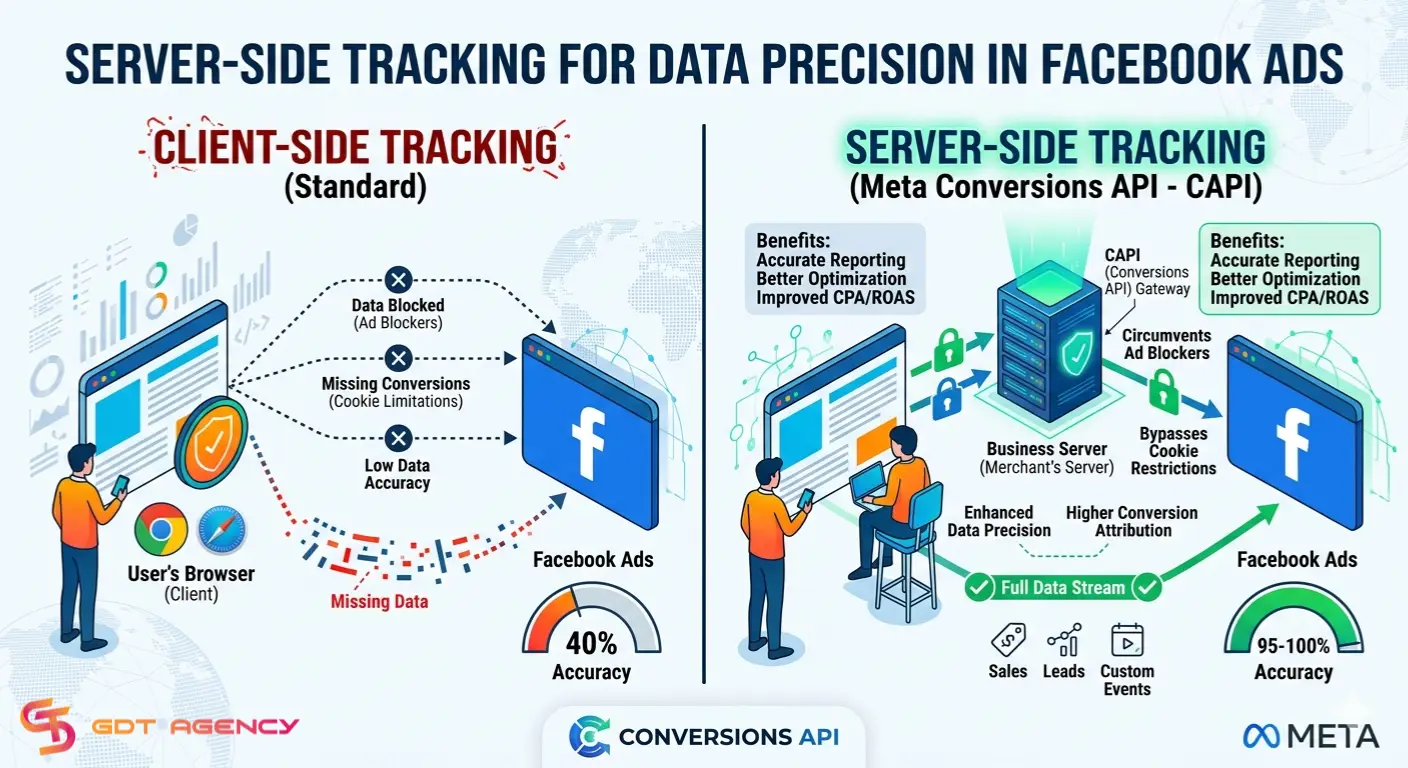
Besides, the algorithm depends on conversion signals to learn. Server-side tracking sends events directly from your backend, so more conversions get recorded. More complete data helps the system identify patterns between users who convert and users who do not.
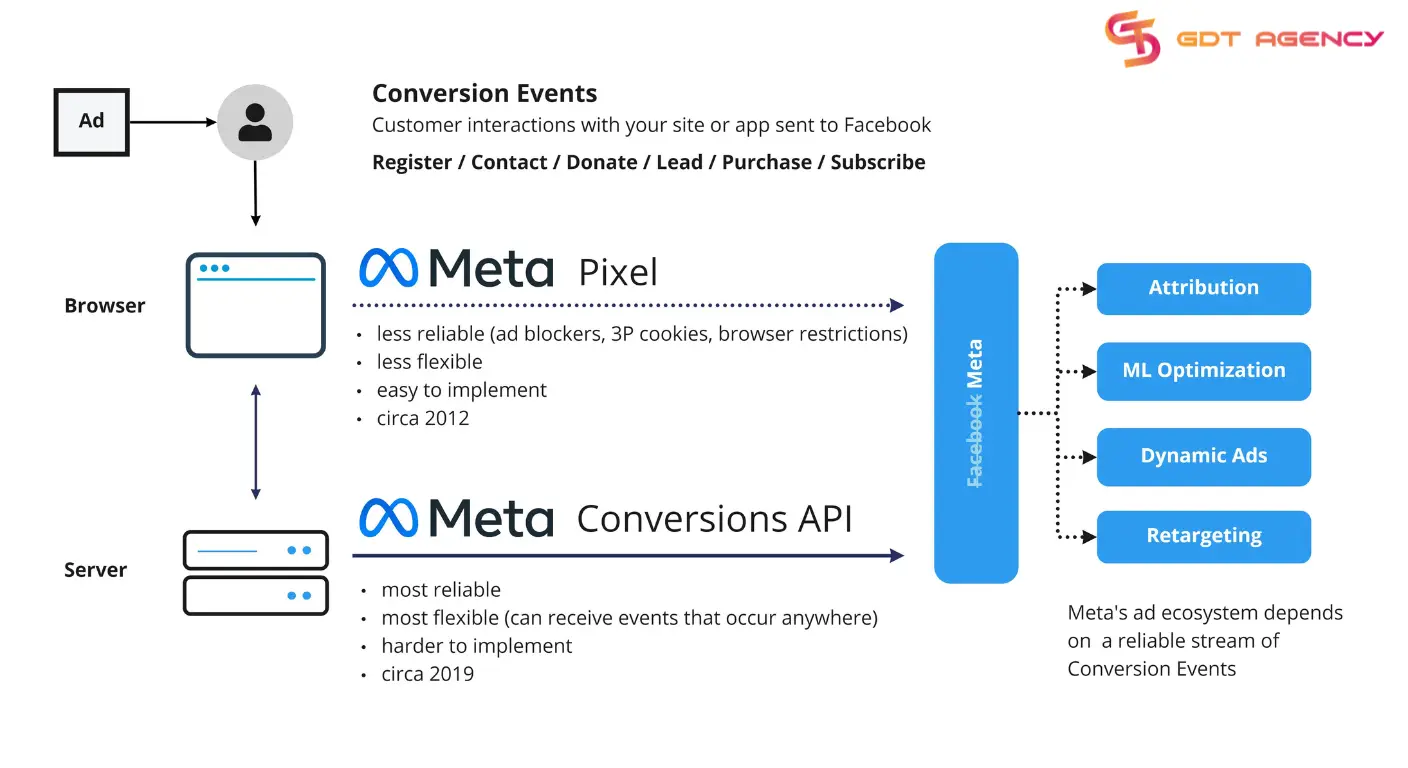
You should verify your domain, prioritize key events, and test event firing inside Events Manager. Clean data gives the algorithm a better chance to optimize, but you still need strong inputs from your campaigns.
2. Consolidate Campaigns Using CBO
You should begin with a simple campaign setup using Campaign Budget Optimization (CBO). Meta’s system learns faster with larger data pools. When you split the budget across too many campaigns or ad sets, each one collects weak signals. Weak signals slow down learning and create unstable results.
While one campaign with a few ad sets gives the algorithm enough data to learn faster. You let the AI distribute your spend to the most effective ad sets in real-time. A consolidated setup forces more data into fewer places, so the algorithm reaches optimization faster.
This method prevents audience overlap and reduces the time your account spends in the learning phase. Once you find winning creatives or audiences, you can separate testing to protect performance and scale campaigns.
3. Utilize Broad Targeting and High-Value Lookalikes
The 2026 algorithm performs best when you trust broad targeting or top-tier high-value lookalike audiences. You allow the creative assets to do the targeting by speaking directly to customer pain points.
My advice for you is that you should only rely on broad targeting or high-quality lookalike audiences if your creatives are strong and your account has some conversion data. Because broad targeting gives the system more freedom to explore and find cheaper conversions outside narrow definitions, and it works best when the algorithm has enough signals to learn from.
Therefore, if your account is new and data is limited, or your data or creatives are weak, the system has no clear direction. You can support the system with light interest targeting instead of going fully broad from day one.
4. Focus on UGC That Hooks Fast and Feels Native
Based on my experience, most successful campaigns currently rely on high-quality user-generated content (UGC) to build immediate rapport with new audiences.
You must produce relatable, authentic videos that demonstrate the product in a real-world context with strong hooks, clear problem statements, and simple storytelling to drive most of your results and grab attention in the first few seconds.

Because users decide in seconds whether to keep watching or scroll. Strong hooks stop the scroll and increase watch time, which improves delivery and lowers CPM. Higher engagement tells the algorithm that people care about your content, so it pushes your ads to more similar users who are likely to convert.
You should test multiple angles, formats, and messages in each ad set. The goal is to find which message connects, not just which video looks good. Testing multiple UGC angles helps you find the “winning” creative that lowers your acquisition costs.
5. Choose the Right Optimization Event Early
You should not always start with Purchase if your account has no data, because the algorithm needs a minimum number of events to learn effectively. Purchase events are the most valuable, but they are also the hardest to generate at the start. If you optimize for Purchase without enough volume, the system struggles and performance stalls.
You can begin with Add to Cart or View Content because they can give the algorithm enough data to learn faster.
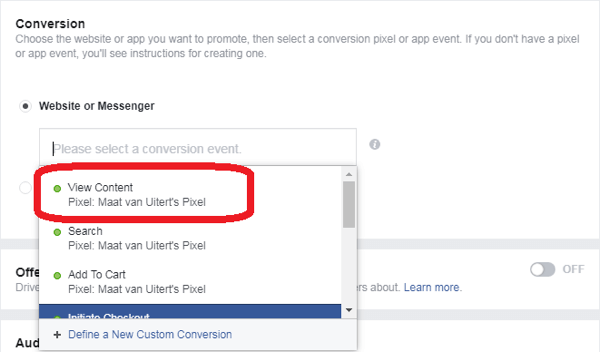
Once the system understands your audience, you see consistent conversions, you can move toward Purchase for better quality conversions. This approach helps you exit the learning phase faster and improves overall efficiency.
6. Concentrate Budget to Drive Meaningful Data
You should avoid spreading your budget across too many ad sets because if you spread your budget too thin, no ad set gets enough data to exit the learning phase and stabilize performance.
If thin budget distribution slows everything down and hurts ROAS, concentrated spending, in contrast, increases the speed of data collection, which allows the algorithm to learn faster, improves decision-making, and reduces randomness in results.
→ Concentrating your budget helps Meta gather enough data to optimize performance, but increasing your budget requires a structured approach once your campaigns become profitable. If you want to grow your spend without hurting performance, read our guide on How to Scale Your Facebook Ad Account Budget Without Losing ROAS, where we explain safe budget increases, horizontal versus vertical scaling, and how to maintain stable results as your campaigns grow.
7. Scale Based on Data, Not Fixed Rules
Based on my experience, scaling based on real performance keeps your campaigns stable and protects your ROAS as you grow.
You should increase the budget only when performance is stable and meets your targets. Rapid, emotional budget hikes often destabilize performance and lead to a crash in ROAS. Patience during the scaling phase protects your profit margins as the account grows.
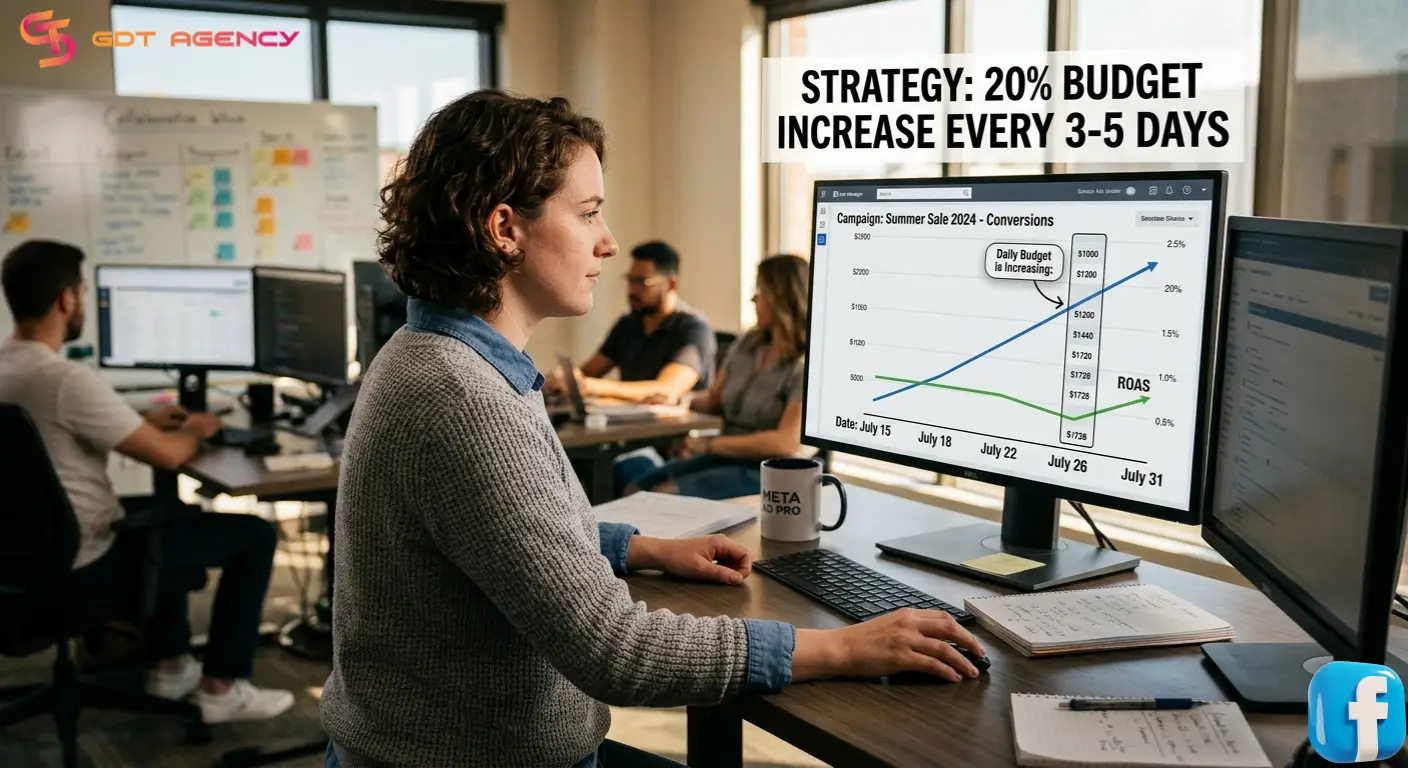
You should increase budgets by 20% every 3 to 5 days only after the campaign meets its KPI targets. You should watch CPA and conversion volume closely before making changes. This conservative approach prevents the algorithm from re-entering the learning phase and spiking your costs.
→ Before increasing your budget, make sure your campaigns are delivering consistently. Scaling a campaign that struggles to spend often leads to unstable performance and misleading ROAS data. If your ads are active but receive few or no impressions, read our guide on Facebook Ads Not Spending: 10 Main Reasons & How To Fix It Quickly to identify and resolve the underlying delivery issues first.
What is The Return On Ad Spend On Facebook?
Facebook Return on Ad Spend (ROAS) is a marketing metric that measures how much revenue your business earns for every dollar spent on Facebook advertising.
How To Find Return On Ad Spend?
ROAS is usually expressed as a ratio or a percentage. The higher the ratio is, the more successful your campaigns are.
ROAS can be calculated based on the formula: “Facebook ROAS = Revenue from Facebook ads / Total Facebook ad costs”
Example: If you spend $1,500 to promote your app with Facebook ads and gain $6,000 in revenue. Based on the formula above, your ROAS is 4.0 (often written 4:1 or 400%), which means for every $1 you gave to Facebook, you got $4 back in revenue.
Factors That Affect Facebook Return On Ad Spend
To hit a high ROAS today, advertisers have to move beyond basic settings. Meta’s AI now does most of the heavy lifting, so your job is to provide the right fuel and signals. Here are the 4 pillars of a profitable campaign:
Creative as Targeting
In 2026, your “creative” is your targeting. Instead of just looking “professional,” your ads need to speak directly to a specific customer problem. High-end production is often outperformed by UGC (User-Generated Content) and “Lo-Fi” Reels that feel authentic.
GDT used to have a skincare brand use high-quality videos showcasing their products on models to promote, but didn’t receive the results they expected.
After applying the advice from GDT, switch to using a simple phone video of a customer showing a “30-day transformation” instead to make the content resonate. Meta’s AI naturally finds more people with similar skin concerns, lowering costs and boosting ROAS.
Broad Targeting & Advantage+
It would not be exaggerated to claim that the day of micro-managing interests like “golf” or “luxury watches” is mostly over. Detailed targeting often limits the algorithm’s ability to learn.
Currently, modern advertisers use Advantage+ Audience or Broad Targeting. They just give Meta a location and an age range, and let the AI find the buyers based on who interacts with your ad.
Another customer of GDT, a sporting goods company, used to target their audience specifically as men between 24 and 45 who love sports, but then realized its ads didn’t perform well.
After following the advice of GDT Agency to move away from strict “Men 25-45” targeting and going Broad, the AI discovered a huge pocket of female buyers purchasing gifts. That is a segment the company would have missed manually, resulting in a surge in total revenue.
Data Signals (Conversion API)
ROAS is only as good as the data you feed the system. With privacy changes and cookie limitations, the “Pixel” alone isn’t enough anymore.
Implementing the Conversions API (CAPI) is now mandatory for high ROAS because it sends server-side data directly to Meta, ensuring that every sale is tracked and attributed correctly.
And of course, better data means the AI learns faster. It stops wasting your budget on people who already bought your product and focuses on high-value “lookalike” prospects.
Landing Page Experience & Offer
You can have a perfect ad, but if your website is slow or your offer is confusing, your ROAS will tank. ROAS is a “full-funnel” metric. In 2026, top brands focus on AOV (Average Order Value) by using upsells and bundles on their landing pages.
A retailer notices a 2.0 ROAS. Instead of changing the ad, they add a “Buy 2, Get 1 Free” bundle on the product page. This increases the total amount spent per customer, instantly jumping the ROAS to 3.5 without spending an extra dime on ads.
Why Does ROAS Matter In Facebook Ads?
More than just a reporting metric, ROAS in 2026 has become the primary “language” that Meta’s AI uses to decide who sees your ads. Here is why ROAS is critical for any business running Facebook ads today.
It Powers Meta’s “Maximize ROAS” AI
Meta recently shifted its focus from simply getting as many conversions as possible to maximizing conversion value. In the past, the algorithm would hunt for any sale, even if it was a $5 item that cost $10 to sell.
Now, with the “Maximize ROAS” delivery goal, you are telling the AI to specifically find customers who will spend more. The algorithm now weighs the cost of the bid against the predicted value of the buyer, prioritizing efficiency over raw volume.
Evaluate Campaign Performance:
ROAS provides a specific look at the efficiency of your ad campaigns, helping you understand if your creative, targeting, and budget are actually driving sales or just generating “vanity” metrics like likes and clicks.
By assessing this metric, you can identify which ones to scale and which ones should be adjusted or paused.
An Important Signal for Scaling
Scaling a budget is the most dangerous part of Facebook advertising. By analyzing ROAS, you can identify which one drives the most profits to scale up, which one should be paused, and which one should be addressed.
Without tracking ROAS, you might spend more and see sales go up, but actually lose money because your costs rise faster than your revenue.
Based on more than 6 years of experience working with Facebook ads since 2019, here is the stability-first approach that I often advise GDT’s customers: the 20% rule.
- If your ROAS is healthy (e.g., 20-30% above your breakeven point), it’s a green light to increase your budget by 15-20% every few days.
- If ROAS dips, you know immediately to stop and fix your creative or targeting.
It Filters Out “Vanity” Metrics
Metrics like Click-Through Rate (CTR) or Cost Per Click (CPC) can be deceiving.
You might have an ad with a massive CTR because it’s funny or controversial, but if those people don’t buy, your ROAS will be 0.
ROAS forces you to ignore “cheap” traffic that doesn’t convert, ensuring you only care about the metric that actually pays the bills: revenue.
It Identifies “Creative Fatigue”
In the 2026 “Andromeda” algorithm era, creative assets (videos and images) do the heavy lifting. When you see a steady decline in ROAS over two weeks, it is usually the first signal that your audience is tired of your current ads.
What Is A Good ROAS For Facebook Ads?
There’s no fixed answer for the good Facebook ROAS for businesses. According to the latest information released by Inbeat, a strong Facebook Ads ROAS in 2025 typically falls between 2.0x and 4.0x, depending on your industry, margins, and growth goals.
The overall median ROAS across industries is 2.19, but benchmarks vary widely. You can take a look at the table below:
| Industry | Average ROAS | Top 25% ROAS | Bottom 25% ROAS |
| Finance & Insurance | 3.50 | 6.00 | 0.20 |
| Retail | 2.30 | 5.00 | 0.30 |
| Technology | 2.30 | 5.00 | 0.10 |
| Real Estate | 2.10 | 4.00 | 0.50 |
| E-commerce | 2.00 | 4.50 | 0.10 |
| Health & Wellness | 1.80 | 3.40 | 0.00 |
| Education | 1.50 | 3.20 | 0.00 |
| Travel & Hospitality | 1.00 | 2.00 | 0.00 |
| Marketing & Advertising | 0.90 | 1.50 | 0.00 |
| Other | 0.80 | 1.40 | 0.00 |
| Food & Beverage | 0.50 | 1.20 | 0.00 |
Conclusion
Facebook return on ad spend is a crucial metric that businesses should not miss when strategizing and executing their campaigns because it’s the metric that evaluates your campaign’s direct profitability. By implementing the strategies outlined in this article, you can optimize your ads and get profits for your new ad account.
If you have any questions, need expert guidance to elevate your campaigns, or want to cooperate with a trustworthy provider to rent Facebook agency accounts, don’t hesitate to reach out to GDT. Our team of experienced professionals is ready to provide tailored solutions and support to help you achieve your advertising goals.
FAQs
1. Is Return On Ad Spend The Same As ROI?
No, return on ad spend is not the same as ROI.
- Return on ad spend measures how much revenue you generate for every dollar spent on ads. ROI looks at overall profit after all costs, including product, operations, and marketing.
- In simple terms, return on ad spend focuses only on ad performance, while ROI tells you if your business is actually making money.
2. How To Check ROAS On Facebook Ads
You can easily check your Facebook ad ROAS in Ads Manager by following these steps:
- Go to Facebook Ads Manager.
- Click Columns to open the dropdown menu.
- Select Customize columns.
- Type return on ad spend in the search bar and select Purchase ROAS.
- Hit Apply to save your changes.
Now you can get real-time reports and save time calculating your ROAS.
3. How long should I wait before scaling a new ad account?
Advertisers must wait at least seven days or until the campaign receives 50 conversion events before making budget adjustments. The 2026 algorithm requires this data to exit the “learning phase” and stabilize performance. You should avoid the urge to tweak settings daily, as every change resets the machine learning process. Patience during this initial window is the most effective way to prevent a spike in acquisition costs.
4. Why is server-side tracking necessary for a high ROAS?
Standard browser-based pixels often miss over 30% of conversion data due to ad blockers and privacy restrictions. You must implement the Conversions API (CAPI) to send data directly from your server to Meta for maximum accuracy. This technical setup provides the algorithm with a cleaner “signal” to identify high-value buyers. Without this precision, your ROAS might appear lower than it actually is, leading to poor scaling decisions.
5. Should I use Campaign Budget Optimization (CBO) or Ad Set Budget Optimization (ABO)?
You should use ABO for the initial testing of new creatives or audiences to ensure every variation receives an equal share of the budget. Once you identify winning assets, you must move them into a consolidated CBO campaign for efficient scaling. CBO allows the AI to distribute funds dynamically to the top-performing ad sets in real-time. This transition from human-led testing to AI-led scaling maximizes your overall return on investment.
6. What is the safest way to increase my daily budget?
Successful advertisers increase their budgets by 20% every three to five days only when performance meets their target KPIs. You should avoid large jumps, such as doubling a budget overnight, as this often destabilizes the delivery system. A gradual approach keeps the campaign within the optimized “sweet spot” while expanding reach. Monitoring frequency and ROAS during these increments ensures that your scaling remains profitable.
7. Is creative testing still important with broad targeting?
Creative assets have become the primary method of targeting in 2026 because the algorithm uses ad content to find the right audience. You must continuously test diverse formats like user-generated content (UGC), vertical videos, and static images to see which “hooks” resonate best. Broad targeting works most effectively when your creative clearly defines the solution for a specific customer problem. High-quality creative signals allow the AI to bypass traditional interest-based constraints.