Buy Agency BM Access: Verified Facebook Business Managers for Media Buyers and Affiliate Teams

Buying agency BM access gives media buyers and affiliate teams a direct path to verified Facebook Business Managers with high spending limits, admin rights, and stable infrastructure – without waiting weeks for Meta’s own verification process. Agency-tier BM accounts come with elevated platform trust scores, multi-account management capability, and pixel sharing built in. These are not standard BMs that self-serve advertisers create from scratch. They are pre-verified, ready-to-run accounts designed for people who spend serious money on Facebook ads and cannot afford downtime.
The market for agency BM access splits into several tiers – BM1, BM5, BM25, and Unlimited – each serving a different scale of operation. A solo affiliate running one or two offers needs different infrastructure than an agency managing 15 clients across multiple GEOs. Understanding which tier matches your actual spend level and campaign volume is the difference between a stable setup and a constant cycle of account replacements.
Not every advertiser needs agency BM access, but the people who do tend to share the same problem: standard Business Managers hit spending caps too fast, get restricted too easily, and lack the pixel and multi-account tools that professional campaigns require. Media buyers running CPA offers, affiliate teams, testing creatives across several funnels, and ecommerce agencies managing multiple client accounts all fit this profile.
After you buy, how you use the account determines how long it lasts. BM warming, backup account strategy, and choosing between shared versus dedicated BM setups all affect account longevity. Below, this guide covers everything from what agency BM access actually includes to where you buy it safely and how to protect it after purchase.
- What Is Agency BM Access and Why Does It Matter for Facebook Advertisers?
- What Does “Verified” Mean for a Facebook Business Manager?
- What Admin Access Comes With an Agency BM Purchase?
- What Types of Agency BM Access Can You Buy?
- BM1 vs BM5 vs BM25 vs Unlimited – Which Tier Fits Your Ad Spend?
- Does Agency BM Access Include Pixel Sharing Capability?
- Who Should Buy Agency BM Access and Who Should Not?
- Why Media Buyers Need Agency-Level BM Over a Standard Account
- Why Affiliate Teams Benefit from Verified Agency BM Access
- Where Can You Buy Verified Agency BM Access Safely?
- What to Check Before Buying Agency BM Access From Any Provider
- How Much Does Agency BM Access Cost – and What Affects the Price?
- How Do You Protect Your Agency BM Access After Purchase?
- What Is BM Account Warming and Why Does It Matter After You Buy?
- Should You Use a Shared Agency BM or a Dedicated One for Your Campaigns?
- Is It Safe to Use Agency BM Access With Anti-Detect Browsers or Cloaking Tools?
- What Happens If Your Agency BM Gets Disabled – and How Do You Recover?
- Final Thoughts
- Frequently Asked Questions About Agency BM Access
What Is Agency BM Access and Why Does It Matter for Facebook Advertisers?
Agency BM access is a verified Facebook Business Manager account at the agency tier – a tool for managing ad accounts, pages, pixels, and team members from one dashboard, with higher trust scores and spending limits than a standard self-created BM.
The key distinction is not just the BM itself – it is the verification status and what that unlocks. A standard BM that any advertiser creates on business.facebook.com starts with low trust and tight restrictions. An agency-tier BM carries Meta-recognized business verification, which gives it access to higher daily spend limits, more ad account slots, and stable delivery that unverified accounts simply cannot match. For anyone running at scale, this matters on day one.
What Does “Verified” Mean for a Facebook Business Manager?
A verified Facebook Business Manager is one where the business owner submitted legal documentation to Meta – typically a business registration document, tax ID, or government-issued ID – and Meta confirmed the business is real. This process is called business verification, and it is different from simply verifying a personal Facebook profile.
Verification moves a BM from the lowest platform trust tier to a higher one. Meta uses this trust score to determine how much a Business Manager can spend per day, how many ad accounts it can create, and whether it qualifies for advanced features like WhatsApp Business API. A verified BM can access spending limits of $10,000 or more per day. An unverified BM typically starts at $25 to $50 per day and scales slowly – if it scales at all without hitting restrictions.
Two terms get confused here, and the difference is significant:
- Verified by Meta (business verification): The BM is backed by legal business documents submitted to and approved by Meta. This is the highest trust level and what “agency BM” typically refers to.
- Email verified: The account owner confirmed their email address. This is the minimum baseline and provides no meaningful trust score improvement.
When a provider advertises a “verified BM for sale,” buyers should confirm which type of verification applies before purchasing. Legitimate agency BM providers sell Meta business-verified accounts, not just email-confirmed ones.
What Admin Access Comes With an Agency BM Purchase?
Admin access in a Facebook Business Manager gives the account holder full control over every asset connected to that BM. When you buy agency BM access with admin rights, you receive the ability to manage ad accounts, add and remove users, connect and disconnect Facebook Pages, create and share pixels, assign roles to team members, and access billing settings.
This is meaningfully different from employee-level access, which limits what a user can see and control. Employee access inside a BM restricts ad account creation, hides certain settings, and prevents the user from managing other people’s permissions. Admin access removes those restrictions entirely.
For media buyers running their own campaigns, admin access means full autonomy – no waiting for someone else to approve changes or add a payment method. For agencies managing client accounts, admin access means the ability to onboard new clients, assign their assets, and maintain clean account separation under one dashboard.
→ Before renting an agency ad account, read the Facebook Ad Account Rental Agreement to understand the contract structure, billing terms, and account responsibilities.
What Types of Agency BM Access Can You Buy?
There are four main types of agency BM access available on the market – BM1, BM5, BM25, and Unlimited – categorized by two primary variables: the number of ad accounts the BM can create and the daily spending limit attached to it.
Understanding these tiers before buying prevents two common mistakes: overpaying for capacity you do not need, and underpurchasing a tier that cannot support your actual spend. Below is a breakdown of each type and the context where each one performs best.
BM1 vs BM5 vs BM25 vs Unlimited – Which Tier Fits Your Ad Spend?
The table below compares the four main tiers across the metrics that matter most to media buyers and affiliate teams. Use this to match your current operation to the right tier before purchasing.
| Tier | Ad Account Slots | Typical Daily Spend Limit | Pixel Creation | Best For | Price Range |
| BM1 | 1 ad account | $250/day | No (can receive, not create) | Solo affiliates testing a single offer | $50 – $150 |
| BM5 | Up to 5 ad accounts | $1,000 – $5,000/day | Yes (create and share) | Solo media buyers running multiple campaigns | $200 – $500 |
| BM25 | Up to 25 ad accounts | $5,000 – $10,000+/day | Yes | Small agencies managing multiple clients | $500 – $1,500 |
| Unlimited | 10+ (no cap on spend) | $10,000+/day | Yes | Large agencies, high-volume affiliate teams | $1,500+ |
This table shows daily spend limits and ad account slots across BM tiers, along with the advertiser profile each tier serves best and the typical price range you can expect from reputable providers.
- BM1 is the entry point. It works for someone testing a single offer on a limited budget who needs a stable verified account but does not yet require multiple ad account slots.
- BM5 is the most popular tier among solo media buyers because it covers the most common use case: running parallel campaigns across different creatives or audiences while keeping them separated into distinct ad accounts.
- BM25 and Unlimited are built for agencies where client isolation, high aggregate spend, and multi-pixel management are operational requirements.
One note on scaling: a BM purchased at the BM5 level does not automatically scale to the BM25 capacity over time. If your operation grows, you typically need to purchase a higher-tier account or add accounts to your infrastructure separately.
Does Agency BM Access Include Pixel Sharing Capability?
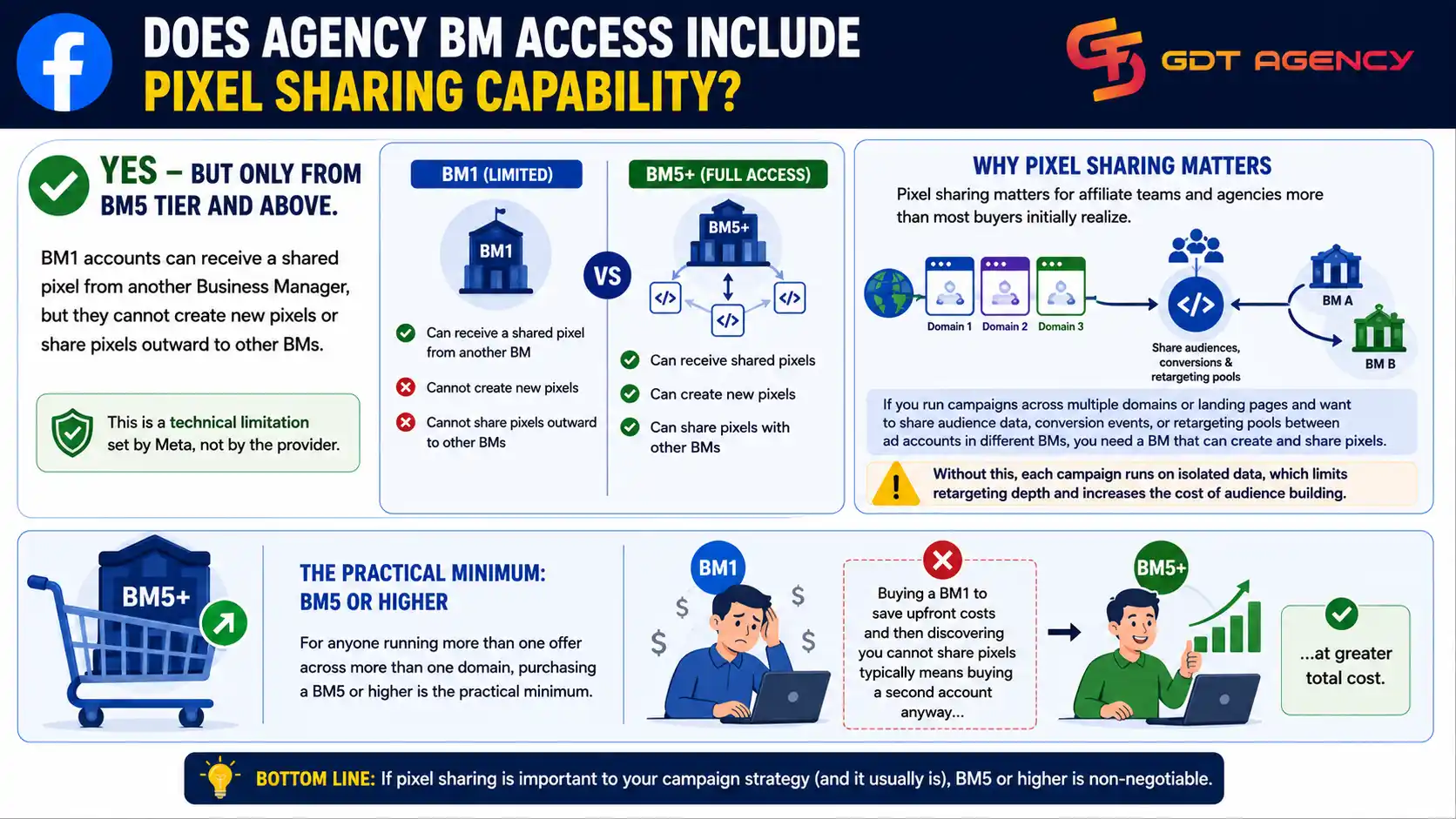
Yes – but only from BM5 tier and above. BM1 accounts can receive a shared pixel from another Business Manager, but they cannot create new pixels or share pixels outward to other BMs. This is a technical limitation set by Meta, not by the provider.
Pixel sharing matters for affiliate teams and agencies more than most buyers initially realize. If you run campaigns across multiple domains or landing pages and want to share audience data, conversion events, or retargeting pools between ad accounts in different BMs, you need a BM that can create and share pixels. Without this, each campaign runs on isolated data, which limits retargeting depth and increases the cost of audience building.
For anyone running more than one offer across more than one domain, purchasing a BM5 or higher is the practical minimum. Buying a BM1 to save upfront costs and then discovering you cannot share pixels typically means buying a second account anyway – at greater total cost.
Who Should Buy Agency BM Access and Who Should Not?
Many advertisers believe that agency BM access is unnecessary for most advertisers because a standard Business Manager already allows businesses to run ads, manage assets, and oversee campaigns. They believe agency BM access adds extra cost and complexity without providing meaningful benefits.
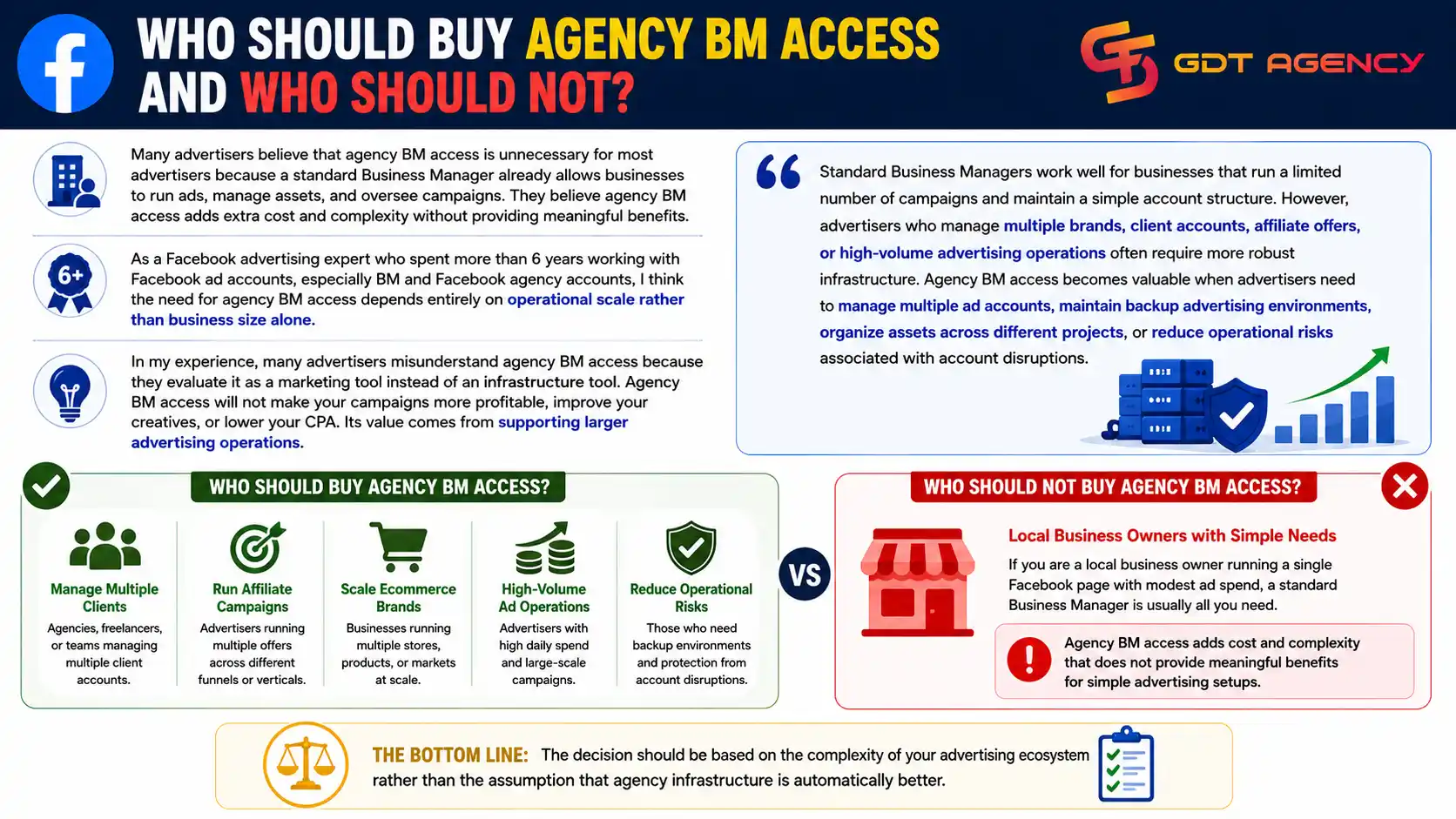
As the CEO and the founder of GDT Agency, who has spent more than a decade working with Facebook ad accounts, especially BM and Facebook agency accounts, I think the need for agency BM access depends entirely on operational scale rather than business size alone.
“Standard Business Managers work well for businesses that run a limited number of campaigns and maintain a simple account structure. However, advertisers who manage multiple brands, client accounts, affiliate offers, or high-volume advertising operations often require more robust infrastructure. Agency BM access becomes valuable when advertisers need to manage multiple ad accounts, maintain backup advertising environments, organize assets across different projects, or reduce operational risks associated with account disruptions.”
In my experience, many advertisers misunderstand agency BM access because they evaluate it as a marketing tool instead of an infrastructure tool. Agency BM access will not make your campaigns more profitable, improve your creatives, or lower your CPA. Its value comes from supporting larger advertising operations.
- If you are a local business owner running a single Facebook page with modest ad spend, a standard Business Manager is usually all you need.
- On the other hand, if you manage multiple clients, operate affiliate campaigns, run ecommerce brands at scale, or depend heavily on Facebook advertising for revenue, agency BM access can become a practical part of your operational setup.
The decision should be based on the complexity of your advertising ecosystem rather than the assumption that agency infrastructure is automatically better.
Why Media Buyers Need Agency-Level BM Over a Standard Account
A standard Facebook Business Manager – the kind any user creates through business.facebook.com – starts with a $25 to $50 daily spending limit and almost no trust score. Scaling that account takes weeks or months of consistent spend history, verified payment methods, and clean policy compliance. For a media buyer who needs to test five ad sets at $200 each from day one, that timeline is not viable.
Agency-level BM accounts remove the warm-up bottleneck. They come with spending limits already established – often $1,000 to $10,000+ per day – so buyers can run real budgets from day one without waiting for Meta’s gradual trust-building process. This matters most for:
- CPA affiliates who need to test creatives quickly at meaningful spend before a payout window closes
- Media buyers managing client campaigns who cannot explain to a client why their ads are capped at $50 a day
- Performance marketers running arbitrage who need multiple parallel campaigns running simultaneously
The backup consideration is equally important. Standard BMs, especially new ones, face a higher risk of restriction when spending ramps up quickly. Agency-tier BMs with established trust scores tolerate higher spend velocity better. Having a second agency BM ready as a backup – which most serious media buyers maintain – requires purchasing accounts, not farming them from scratch over months.
Why Affiliate Teams Benefit from Verified Agency BM Access
Affiliate teams benefit from agency BM access for three specific operational reasons: multi-account management, pixel sharing across offers, and spending stability across multiple GEOs.
An affiliate team running five offers across three GEOs needs five separate ad accounts to keep data clean and avoid policy spillover between offers. Managing five ad accounts from one BM dashboard – rather than five separate logins – reduces operational friction significantly. With a BM25 or Unlimited account, the team can add, pause, or archive ad accounts without losing the campaign history or pixel data tied to the BM.
Pixel sharing enables a second efficiency that solo advertisers rarely think about until they scale: audience pooling. If an affiliate team tests a supplement offer in the US, a finance offer in the UK, and a software offer in Australia, the audiences and behavioral data from each campaign can inform the others – but only if the pixels can share data through the same BM. BM5 and above makes this possible.
The third benefit – spending stability – is harder to quantify but real. Verified agency BMs with history and documentation behind them trigger fewer automated reviews at high spend levels than fresh or unverified accounts. A team spending $20,000 per day across multiple ad accounts needs that stability, because a 48-hour account review at peak campaign performance is a serious revenue problem.
Where Can You Buy Verified Agency BM Access Safely?
You can buy verified agency BM access safely by evaluating providers on five criteria: verification level (Meta business-verified vs. email-only), account source (aged vs. fresh), delivery speed, replacement guarantee terms, and support channel availability.
The market includes both direct vendors and marketplace models. Each has tradeoffs worth understanding before you commit to a provider.
What to Check Before Buying Agency BM Access From Any Provider
Before purchasing, run through this checklist with any provider you are considering:
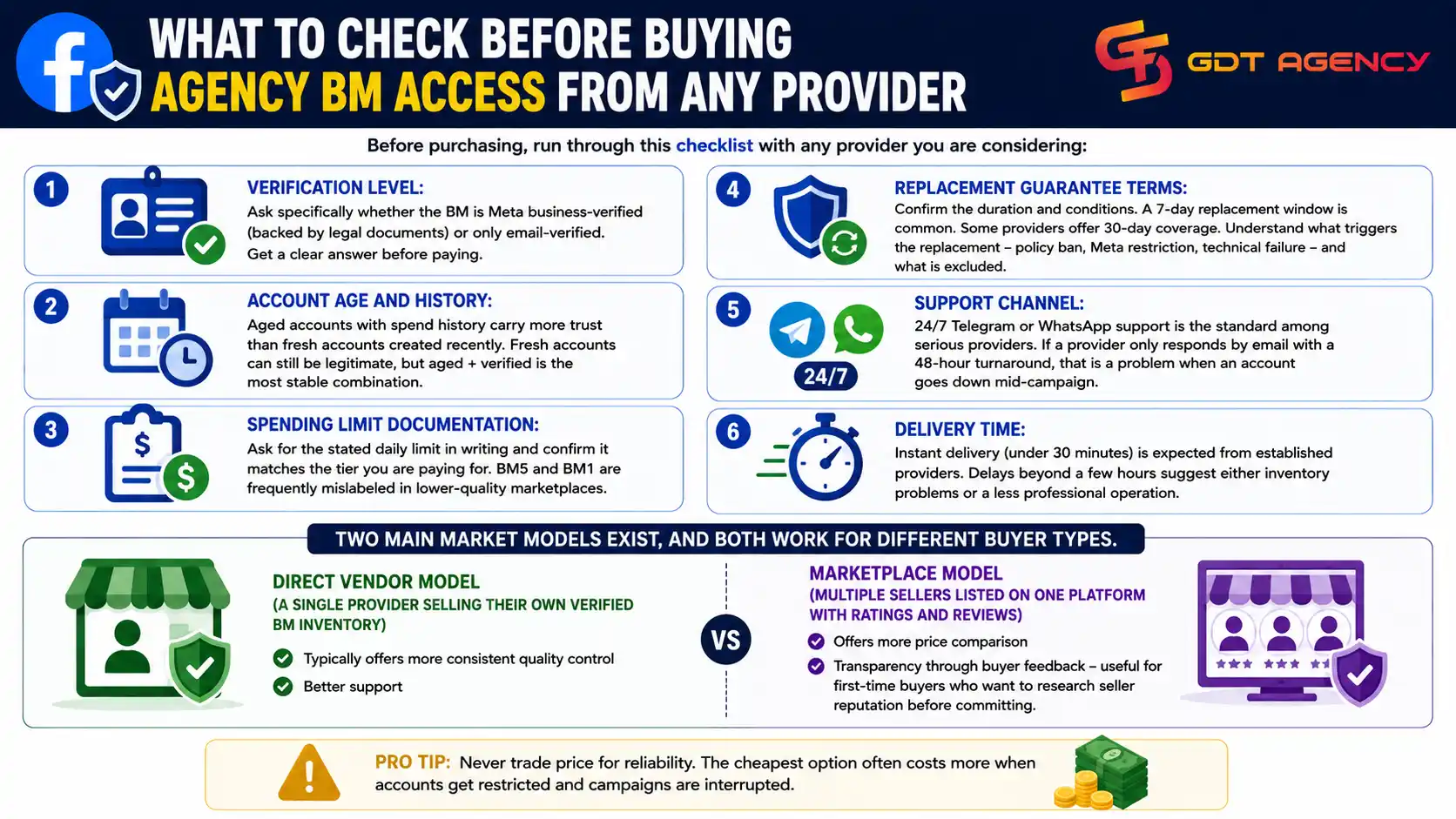
- Verification level: Ask specifically whether the BM is Meta business-verified (backed by legal documents) or only email-verified. Get a clear answer before paying.
- Account age and history: Aged accounts with spend history carry more trust than fresh accounts created recently. Fresh accounts can still be legitimate, but aged + verified is the most stable combination.
- Spending limit documentation: Ask for the stated daily limit in writing and confirm it matches the tier you are paying for. BM5 and BM1 are frequently mislabeled in lower-quality marketplaces.
- Replacement guarantee terms: Confirm the duration and conditions. A 7-day replacement window is common. Some providers offer 30-day coverage. Understand what triggers the replacement – policy ban, Meta restriction, technical failure – and what is excluded.
- Support channel: 24/7 Telegram or WhatsApp support is the standard among serious providers. If a provider only responds by email with a 48-hour turnaround, that is a problem when an account goes down mid-campaign.
- Delivery time: Instant delivery (under 30 minutes) is expected from established providers. Delays beyond a few hours suggest either inventory problems or a less professional operation.
Two main market models exist, and both work for different buyer types. The direct vendor model (a single provider selling their own verified BM inventory) typically offers more consistent quality control and better support. The marketplace model (multiple sellers listed on one platform with ratings and reviews) offers more price comparison and transparency through buyer feedback – useful for first-time buyers who want to research seller reputation before committing.
How Much Does Agency BM Access Cost – and What Affects the Price?
Agency BM access costs between $50 and $2,500+ depending on tier, verification level, account age, and provider reputation. The table below shows typical price ranges across tiers as of 2025.
| BM Tier | Price Range | Key Price Drivers |
| BM1 | $50 – $150 | Fresh vs. aged, email-verified vs. Meta-verified |
| BM5 | $200 – $500 | Verification level, pixel setup included or not |
| BM25 | $500 – $1,500 | Account age, spend history, number of included ad accounts |
| BM Unlimited | $1,500 – $2,500+ | Agency-tier documentation, spend level, provider |
This table shows typical price ranges for each BM tier, along with the main variables that push prices up or down within each tier.
Three variables have the biggest impact on price within any given tier. First, Meta business verification versus email verification can double the price for the same tier – and the premium is justified because verified accounts are substantially more stable. Second, account age adds value: a BM with 12 months of clean spend history is worth more than one created last week because it carries a trust signal that new accounts take months to build. Third, included setup – some providers bundle pixel setup, profile connection, and a setup guide into the purchase price; others sell access only and leave configuration to the buyer.
The cheapest option within any tier is almost always a fresh, email-verified account. The most expensive is an aged, Meta business-verified account from a provider with replacement guarantees and active support. For serious media buyers and affiliate teams, the price difference between the two is a small fraction of what a 48-hour account restriction costs in lost revenue.
How Do You Protect Your Agency BM Access After Purchase?
You protect agency BM access after purchase by following a gradual spend ramp-up, understanding the difference between shared and dedicated BMs, knowing when anti-detect tools create compliance risk, and having a recovery plan ready before you need it.
Most BM restrictions after purchase are not caused by the account itself – they are caused by how the buyer uses it in the first 7 to 14 days. Meta’s automated systems monitor new spending patterns closely. An account that goes from zero to $5,000 per day in 48 hours looks like a compromised account, even if the advertiser and the campaigns are fully legitimate.
What Is BM Account Warming and Why Does It Matter After You Buy?
BM account warming is the process of gradually increasing your daily ad spend over the first one to two weeks after purchasing a new Business Manager – rather than immediately running at the account’s maximum limit.
Even a verified agency BM with a $10,000 daily limit carries risk if you hit that ceiling on day one. Meta’s fraud detection systems use spend velocity as one signal among many. A sudden large spend from an account with no recent history of that spend level can trigger automated holds, billing freezes, or ad delivery reviews. These are not permanent bans, but a 24 to 72-hour review window during an active campaign is a real operational problem.
A practical warming schedule looks like this:
- Days 1-3: Spend 10-20% of your stated daily limit. For a $5,000/day BM, that means starting at $500-$1,000 per day.
- Days 4-7: Increase to 40-50% of the daily limit if no flags appear.
- Days 8-14: Move to 70-80% of capacity.
- Day 15+: Run at full intended spend level.
This schedule is not a Meta-published rule – it is a best practice derived from observed behavior patterns. Accounts that warm gradually have a meaningfully better track record of long-term stability than those pushed to full spend immediately after purchase.
Should You Use a Shared Agency BM or a Dedicated One for Your Campaigns?
A dedicated agency BM – one you purchase and use exclusively for your own campaigns – is safer for production campaigns with real budgets. A shared BM, where multiple advertisers operate within the same Business Manager, is lower cost but carries a risk that dedicated accounts eliminate: another user’s policy violation can affect your ad account.
Here is how that risk works in practice. Inside a shared BM, multiple users or ad accounts exist under the same Business Manager identity. If one advertiser in that shared BM runs a policy-violating ad – or gets their ad account flagged for suspicious activity – Meta’s systems sometimes restrict the entire BM, not just the individual offending account. Everyone operating inside that BM gets affected.
The tradeoff looks like this:
| Shared BM | Dedicated BM | |
| Cost | Lower ($50-150 less) | Higher |
| Risk from other users | Yes – policy violation by others can affect your account | No – you control all accounts in the BM |
| Best for | Low-budget testing, new campaigns before scaling | Production campaigns, client accounts, high daily spend |
| Control over BM settings | Limited (you are a user, not the sole admin) | Full admin access |
This table compares shared and dedicated BM access across cost, risk exposure, and use case, to help buyers decide which model fits their current campaign stage.
The recommendation is straightforward: test new offers with shared BM access if budget is a constraint, then move production-level campaigns to a dedicated BM once you have validated the offer and are ready to scale spend.
→ To make the onboarding process easier, we recommend reading How to Access a Rented Facebook Agency Ad Account before requesting access.
Is It Safe to Use Agency BM Access With Anti-Detect Browsers or Cloaking Tools?
This requires a direct answer: using agency BM access with anti-detect browsers does not automatically violate Meta’s Terms of Service, but combining it with cloaking – serving a different landing page to Meta’s review crawlers than you show to real users – is a clear violation that can result in permanent BM restriction.
Anti-detect browsers (tools that mask browser fingerprints to prevent platforms from linking multiple accounts to the same device) are used widely in digital advertising for legitimate account separation. Running multiple ad accounts across multiple devices or browser profiles is operationally common. The browser tool itself is not the compliance risk.
The risk comes from what you do inside that environment. If you use an anti-detect setup to run campaigns with misleading ad creative, promote prohibited products, or redirect Meta’s review traffic to a compliant page while real users see something different, you are violating policy – and a verified agency BM does not protect you from that outcome. Meta’s detection systems have improved significantly, and policy-violating campaigns get flagged regardless of the browser setup used to manage them.
For GDT Agency clients: agency BM access is built for legitimate scaled advertising. Using it within Meta’s advertising policies – even for aggressive affiliate offers – is the sustainable approach. The account quality you pay for only holds its value if the campaigns running through it stay compliant.
What Happens If Your Agency BM Gets Disabled – and How Do You Recover?
If your agency BM gets disabled, you have two parallel paths: file an appeal with Meta directly, and activate your replacement guarantee with the provider you purchased from. Both should happen within the first 24 hours of the restriction.
The Meta appeal process works as follows. When a BM gets restricted, Meta typically sends a notification to the Business Manager’s primary admin email explaining the reason – or stating that no specific reason can be provided due to automated systems. You can submit an appeal through Meta’s Business Help Center, providing the BM ID and any supporting documentation. Response times range from 24 hours to several weeks, and outcomes are inconsistent. Verified BMs with a clean history before the restriction have better appeal success rates than unverified accounts.
Simultaneously, contact your BM provider to initiate the replacement process. Most reputable providers have a 7 to 30-day replacement window. They will need the BM ID, proof of restriction (a screenshot of the disabled notice), and, in some cases, your account credentials to verify the account status.
The most important pre-purchase protection is not the replacement guarantee itself – it is building backup BM infrastructure before you need it. Every serious affiliate team and media buying operation runs at least two agency BMs simultaneously: one primary, one backup. When the primary goes down, the backup carries on campaigns while the appeal or replacement process runs. Relying on a single BM for all campaign infrastructure is the operational mistake that turns a 48-hour restriction into a 2-week revenue problem.
Final Thoughts
Agency BM access is not a shortcut – it is infrastructure. The media buyers and affiliate teams who get the most out of verified Business Managers are the ones who treat account setup as the beginning of a longer operational practice, not a one-time purchase.
For GDT Agency clients looking to rent agency-level ad accounts rather than purchase outright, the same principles apply. The account quality, spending stability, and support behind the rental matter as much as the access itself. Start with the right tier, run compliant campaigns, and treat your BM infrastructure as a long-term investment in your advertising operation.
Frequently Asked Questions About Agency BM Access
- What is the difference between an agency BM and a standard Facebook Business Manager?
An agency BM is a Meta business-verified Business Manager with higher daily spending limits, more ad account slots, and pixel sharing capability. A standard BM is one any advertiser creates themselves through business.facebook.com – it starts with low trust, tight spending caps, and no pixel creation rights until Meta gradually extends them over weeks or months of clean account history.
- How long does it take to receive agency BM access after purchase?
Most established providers deliver within 15 to 30 minutes of payment. Instant delivery is the standard among reputable vendors. If a provider quotes 24 hours or more for delivery, that typically signals either low inventory or a less professional operation.
- Can I run any type of ad campaign through an agency BM?
You can run any campaign that complies with Meta’s Advertising Policies. Agency BM access does not exempt your campaigns from policy review. Prohibited products, misleading creatives, and policy-violating landing pages will still get flagged regardless of BM tier or verification status.
- What happens to my campaigns if the agency BM gets restricted?
All ad accounts and campaigns inside the BM pause immediately when the BM is restricted. This is why backup infrastructure matters. A second agency BM with a duplicate campaign structure lets you restore delivery within hours rather than waiting days for an appeal outcome.
- Is a BM5 enough for a small affiliate team running 3 to 5 offers?
Yes – a BM5 covers up to 5 ad accounts, which is sufficient for running 3 to 5 separate offers with clean account separation. The more important variable is whether the BM5 you buy is Meta business-verified, since verified accounts handle higher spend velocity without triggering automated reviews.
- Can I add team members to an agency BM I purchased?
Yes. If you received admin access with your purchase – which any reputable provider should include – you can add team members, assign roles, and manage permissions just like any other Business Manager. Admin access gives you full control over user management inside the BM.
- What is the refund policy if an agency BM stops working?
Refund policies vary by provider. Most established providers offer a replacement guarantee rather than a cash refund – typically 7 to 30 days from purchase date. Before buying, confirm the replacement terms in writing: what triggers eligibility, how long the window is, and what documentation you need to submit.
- Do I need a separate agency BM for each client I manage?
Not necessarily. A BM25 or Unlimited account lets you manage multiple clients’ ad accounts from one BM dashboard. However, many agencies prefer one dedicated BM per major client for cleaner separation and to prevent one client’s policy issue from affecting another’s account.