Facebook Ad Account Rental Agreement: Key Terms, Fees & Policy Clauses Every Advertiser Must Verify

A Facebook ad account rental agreement is a written service contract between an advertiser and a Meta-certified agency that grants account access in exchange for fees, under conditions set by both parties and Meta’s Commercial Terms, and signing one without reading every clause is the single most common reason advertisers lose campaigns, budgets, and audience data mid-flight.
The fee structure inside these agreements follows three distinct models: fixed monthly retainer ($300-$1,500), percentage of ad spend (5-10%), or a margin applied on top of each deposit, and each model creates a different financial exposure when account performance drops or a suspension occurs. Providers charging below 3% of ad spend typically signal shared accounts or thin support infrastructure.
Policy compliance responsibility sits with both parties simultaneously – the agency owns the Business Manager infrastructure and must keep it clean at the account level, while the advertiser owns every creative, product category, and targeting decision that triggers Meta’s enforcement systems. The rental contract must draw that line explicitly, or disputes over suspension liability become unresolvable, with the advertiser absorbing the financial damage by default.
Beyond fees and compliance, the agreement governs three assets advertisers consistently undervalue until they lose them: the Pixel, custom audiences built during the rental period, and historical spend data that determines daily budget limits. The following breakdown covers every clause, fee model, and policy rule that requires verification before a signature goes on the document.
- What Is a Facebook Ad Account Rental Agreement?
- How Does a Facebook Ad Account Rental Agreement Work in Practice?
- Is Renting a Facebook Ad Account Legal Under Meta’s Terms of Service?
- What Are the Key Terms Every Facebook Ad Account Rental Agreement Must Include?
- What Does a Standard Fee Structure Look Like in a Facebook Ad Account Rental Contract?
- What Refund and Replacement Terms Should the Agreement Clearly Define?
- What Access Rights and Restrictions Does the Rental Agreement Grant the Advertiser?
- How Does the Agreement Define Data Ownership and Asset Separation?
- What Policy Compliance Clauses Should Every Advertiser Verify Before Signing?
- Which Ad Categories and Verticals Does the Agreement Permit or Restrict?
- What Happens to the Agreement If the Account Gets Suspended or Banned?
- What Is the Verification Checklist Before Signing a Facebook Ad Account Rental Agreement?
- How Do You Verify the Account History and Legitimacy of the Provider?
- What Documents Should a Legitimate Agency Provide Before You Sign?
- How Does a Facebook Ad Account Rental Agreement Differ From Buying or Self-Managing an Ad Account?
- What Are the Risks of a Rental Agreement That Standard Ad Account Users Never Face?
- How Do Penalty Clauses in Facebook Ad Account Rental Agreements Work?
- What Should the Termination Clause in a Facebook Ad Account Rental Agreement Cover?
- Final Thoughts
- Frequently Asked Questions
- 1. What is the minimum information a Facebook ad account rental agreement must contain?
- 2. Can a Facebook ad account rental agreement protect the advertiser if the account gets banned?
- 3. What fee model in a Facebook ad account rental agreement costs the least over time?
- 4. Does a Facebook ad account rental agreement override Meta’s own Terms of Service?
- 5. What happens to custom audiences and Pixel data when a Facebook ad account rental agreement ends?
What Is a Facebook Ad Account Rental Agreement?
A Facebook ad account rental agreement is a service contract in which an agency retains Business Manager ownership while granting the advertiser an admin or advertiser role inside that BM – a structural distinction that Meta’s Commercial Terms (2024) require, since ad accounts cannot be legally transferred or resold between parties.
The operational difference between this model and account purchase or credential sharing is not a technicality. When an agency adds you as an admin inside their Business Manager, Meta’s ownership records stay with the agency, your campaigns run under their account trust history, and you receive access – not title. If any provider hands you login credentials to a personal Facebook profile and frames that as an “agency account rental,” both parties are in direct violation of Meta’s Terms, and the advertiser carries the greater enforcement risk.
How Does a Facebook Ad Account Rental Agreement Work in Practice?
The process moves in 4 steps: sign the service agreement, deposit the advertising budget (minimum $100 per account per top-up at most providers), submit business registration information to Meta for account approval (up to 24 working hours), and receive access as an admin or advertiser role inside the agency’s Business Manager.
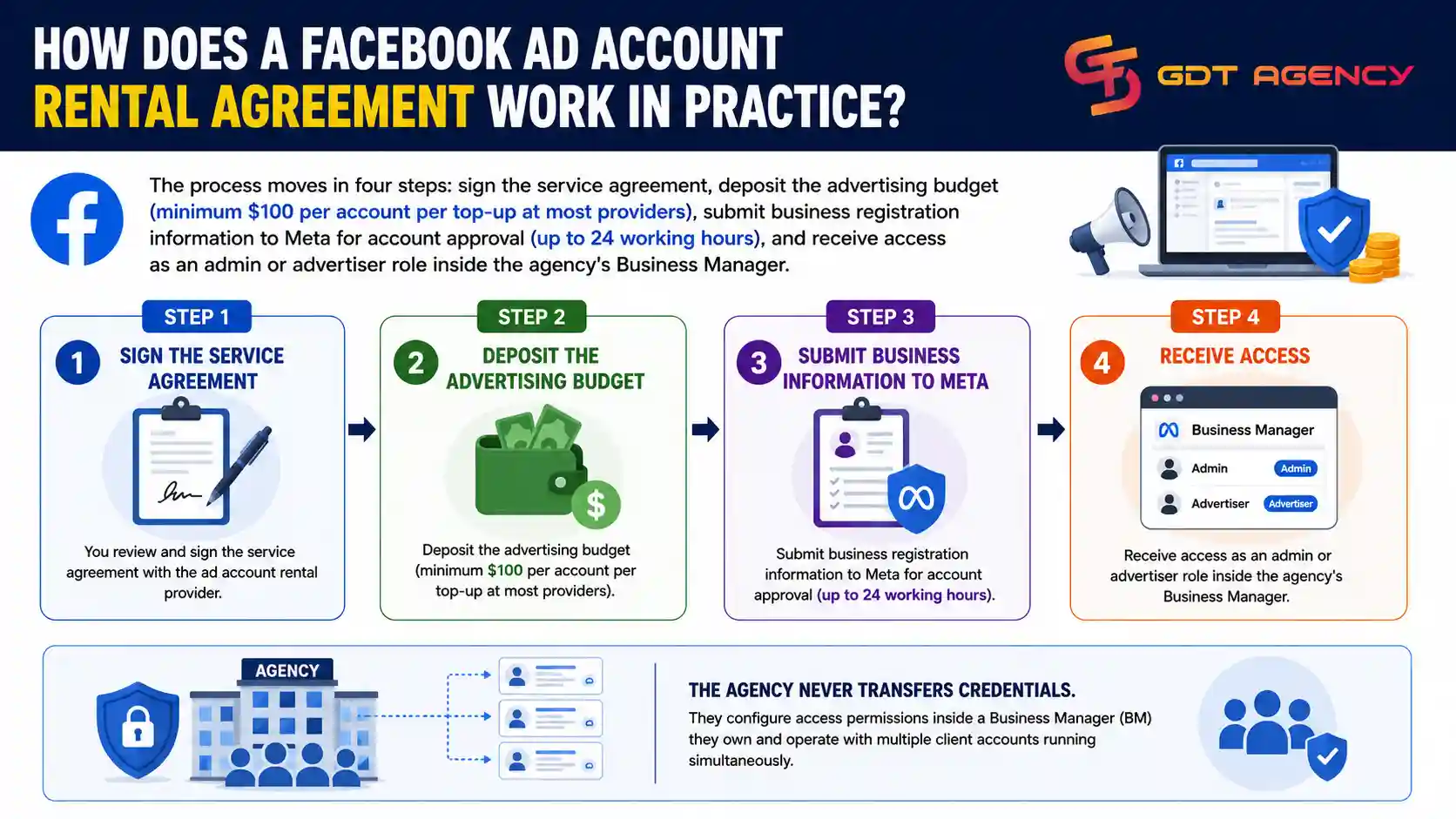
The agency never transfers credentials – they configure access permissions inside a BM they own and operate with multiple client accounts running simultaneously.
Is Renting a Facebook Ad Account Legal Under Meta’s Terms of Service?
Many critics argue that renting a Facebook ad account is not permitted under Meta’s ecosystem because Meta does not publicly offer an official ad account rental program, and many providers operate through practices that violate platform policies, including credential sharing, account transfers, and the use of personal profiles for commercial advertising. These arrangements can expose advertisers to account restrictions, disabled campaigns, and loss of access to advertising assets.
After more than 6 years working with Facebook Ads and Facebook agency ad accounts at GDT Agency, I believe the issue is more nuanced than either side suggests. The question is not whether an advertiser pays for access to an account. The question is how that access is structured.
If an agency owns a Business Manager and grants an advertiser user-level permissions within that Business Manager, the arrangement resembles a standard agency-client relationship that Meta’s infrastructure was designed to support. The advertiser operates campaigns through assigned roles while the agency retains ownership of the advertising assets.
However, advertisers should not assume that every account rental arrangement is automatically compliant simply because the agency keeps ownership. Meta evaluates the broader operating environment, including business transparency, identity verification, payment activity, policy compliance, and account behavior.
In my view, the term “Facebook ad account rental” often creates confusion because it describes very different business models under the same label. A provider that shares login credentials or transfers account control presents a very different risk profile from an agency that grants access through Business Manager permissions. The determining factor is not the rental fee itself but whether the ownership structure, access permissions, and advertiser identity align with the way Meta designed its Business Manager ecosystem.
What Are the Key Terms Every Facebook Ad Account Rental Agreement Must Include?
Six clauses make a rental agreement enforceable and protective: fee structure and billing method, access rights and restrictions, refund and replacement policy, policy compliance responsibilities, data ownership terms, and termination conditions – a provider who cannot deliver a PDF contract covering all six is operating without the infrastructure to support a professional rental relationship.
Each clause protects a different dimension of the advertiser’s operation. A missing fee clause creates billing disputes. A missing replacement SLA leaves advertisers with no recourse during account downtime. A missing data ownership clause means custom audiences and Pixel history belong to whoever’s BM they sit in – which is the agency’s, not yours.
What Does a Standard Fee Structure Look Like in a Facebook Ad Account Rental Contract?
Three fee models exist in the agency account rental market, and the contract must name which one applies before any budget changes hands:
| Fee Model | How It Works | Typical Range | Risk to Advertiser |
| Fixed monthly retainer | Flat fee regardless of spend volume | $300 – $1,500/month | Fee continues during account downtime |
| Percentage of ad spend | Agency takes a cut of monthly budget consumed | 5% – 10% of spend | Costs scale directly with campaign investment |
| Margin on deposit | Agency applies markup before funds become spendable | Varies by provider | Reduces effective budget without transparent disclosure |
Beyond the core model, five additional financial terms require explicit definition in the contract: minimum deposit per top-up (most providers set $100 per account), prepay versus credit line structure, setup fee, early termination penalty, and currency conversion margin for non-USD deposits. Providers charging below 3% of ad spend typically operate shared accounts with reduced support capacity, per ecomparkour.com’s 2024 analysis of the rental market.
What Refund and Replacement Terms Should the Agreement Clearly Define?
The replacement SLA is the single clause with the most direct financial impact when an account goes down – and it must state a specific timeframe (industry standard: 24-48 hours), at no additional charge, in writing. Refund policies across providers split into three categories: full cash refund within a defined claim window, free account replacement with no cash return, or no refund under any circumstances. All three are common, all three are legitimate if disclosed pre-signature, and none of them are negotiable after the account suspension has already occurred.
The clause must also define four specific conditions: what qualifies as a suspension event triggering replacement eligibility, who assesses fault when the suspension reason is disputed, how many days after suspension the advertiser can file a claim, and whether temporary account restrictions – where the account is under review but not permanently disabled – trigger the same replacement terms as a permanent ban.
What Access Rights and Restrictions Does the Rental Agreement Grant the Advertiser?
Admin role access inside the agency’s Business Manager allows campaign creation, budget management, ad set configuration, and performance reporting – but excludes payment method changes, Business Manager ownership modifications, new user additions at the BM level, and budget movement across accounts outside the rental agreement. Advertiser role access is more limited, removing user management capabilities while retaining full campaign operation.
Most providers also require pre-approval before the advertiser expands into new campaign types, new targeting categories, or audience segments outside the original registration. The contract must specify the approval request process, the maximum turnaround time for approvals, and the consequence of launching unapproved campaigns – which in most agreements triggers the same penalty mechanism as running off-registered products.
How Does the Agreement Define Data Ownership and Asset Separation?
The Pixel, Facebook Page, custom audiences, and creative library must sit inside the advertiser’s own Business Manager – not the agency’s – and the contract must state this explicitly, because assets stored inside the agency’s BM revert to agency control when the relationship ends. The correct structure has the agency’s BM hosting only the ad account itself, with all advertiser-owned assets linked from a separate advertiser-controlled BM.
The data ownership clause must define three things: which BM hosts the Pixel and who holds legal ownership of conversion event data accumulated during the rental, whether custom audiences built during the campaign period belong to the advertiser or the agency after termination, and the data handover timeline (standard: 7-14 days post-termination) including what format the export takes. Advertisers who skip this clause and store everything inside the agency’s BM exit the rental relationship with no historical audience data, no conversion history, and no ability to resume optimized campaigns with a different provider.
→ Understanding the agreement is only the first step. Next, see How to Access a Rented Facebook Agency Ad Account to learn how the access process works from start to finish.
What Policy Compliance Clauses Should Every Advertiser Verify Before Signing?
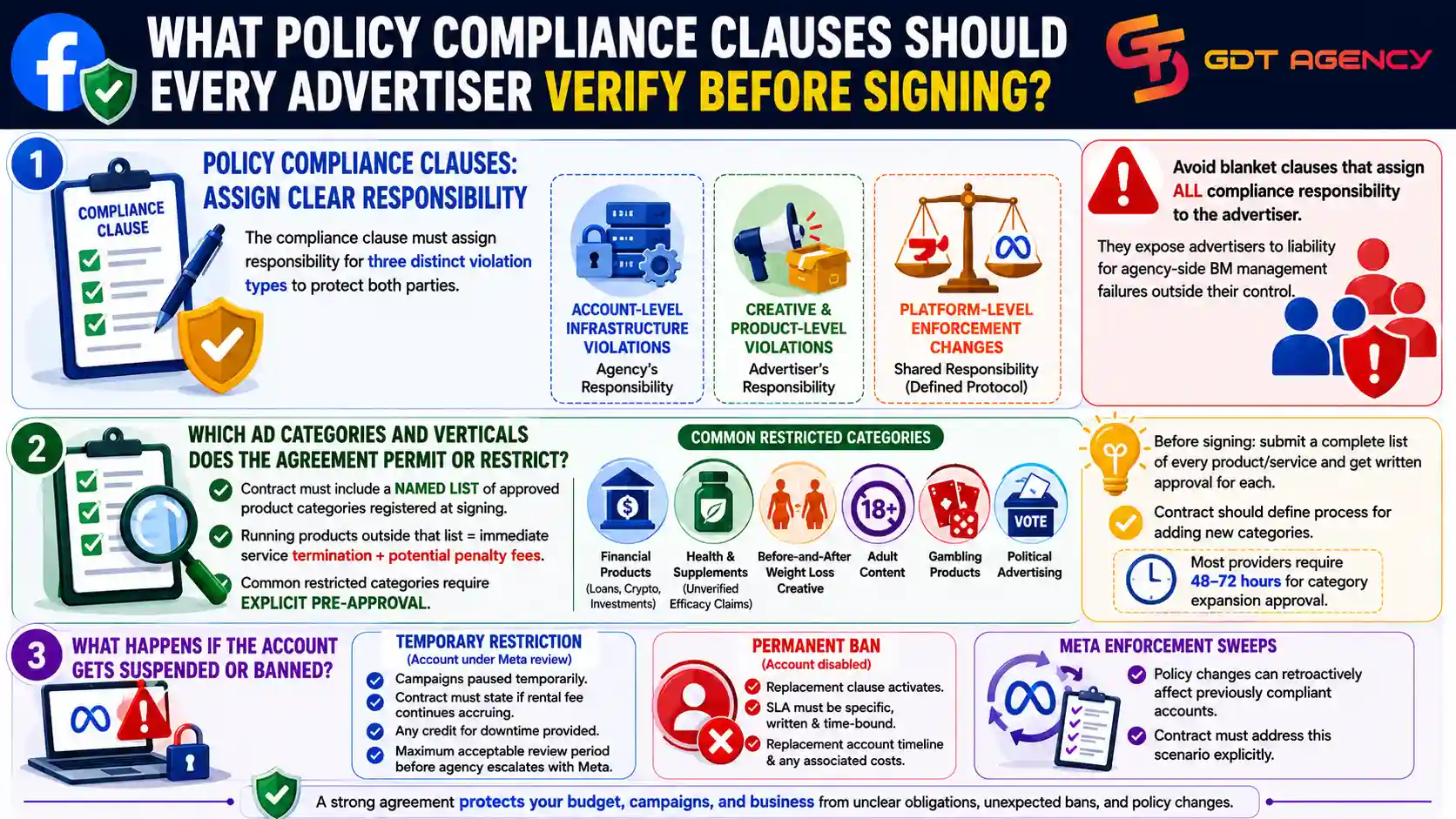
The compliance clause must assign responsibility for three distinct violation types: account-level infrastructure violations (agency’s responsibility), creative and product-level violations (advertiser’s responsibility), and platform-level enforcement changes where Meta updates policies that affect previously compliant campaigns (shared responsibility with a defined response protocol). Agreements that assign all compliance responsibility to the advertiser in a blanket clause expose advertisers to liability for agency-side BM management failures outside their control.
Which Ad Categories and Verticals Does the Agreement Permit or Restrict?
The contract must include a named list of approved product categories registered at signing – any campaign running products or services outside that list triggers immediate service termination and potential penalty fees at most providers. Common restricted categories requiring explicit pre-approval include financial products (loans, crypto, investment services), health and supplement claims with unverified efficacy language, before-and-after weight loss creative, adult content, gambling products, and political advertising.
Before signing, submit a complete list of every product and service you plan to advertise and get written confirmation that each item is approved. The contract should also define the process for adding new categories after the agreement starts – most providers require 48-72 hours for category expansion approval, and launching without it carries the same consequences as running a prohibited product from day one.
What Happens to the Agreement If the Account Gets Suspended or Banned?
The contract must distinguish between temporary restriction (account under Meta review, campaigns paused) and permanent ban (account disabled), because these two outcomes trigger different financial and operational obligations. During a temporary restriction, the contract must state whether the rental fee continues accruing, whether the agency provides any credit for downtime, and what the maximum acceptable review period is before the agency escalates with Meta on the advertiser’s behalf.
For permanent bans, the replacement clause activates, which returns the discussion to whether the SLA is specific, written, and time-bound. The compliance section must also address Meta’s periodic enforcement sweeps, where policy changes retroactively affect accounts that were fully compliant at signing. A contract that ignores this scenario leaves advertisers with no recourse when Meta’s own rule changes – not the advertiser’s campaigns – trigger the suspension.
What Is the Verification Checklist Before Signing a Facebook Ad Account Rental Agreement?
Verifying a rental agreement before signing requires checking six areas in sequence: provider legitimacy, account history, contract completeness, fee transparency, data ownership terms, and replacement SLA – a process that takes approximately one hour and establishes the contractual foundation for every decision made after campaigns launch.
How Do You Verify the Account History and Legitimacy of the Provider?
Three questions establish account health before any other evaluation: how long has this specific ad account been active (a new account carries the same restrictive daily limits as a personal account), what is the lifetime spend on this account (higher spend signals higher Meta trust and more stable budget capacity), and how many policy strikes has this account recorded in the last 90 days (one active strike accelerates the path to suspension). The provider must answer all three with documented evidence, not verbal assurances.
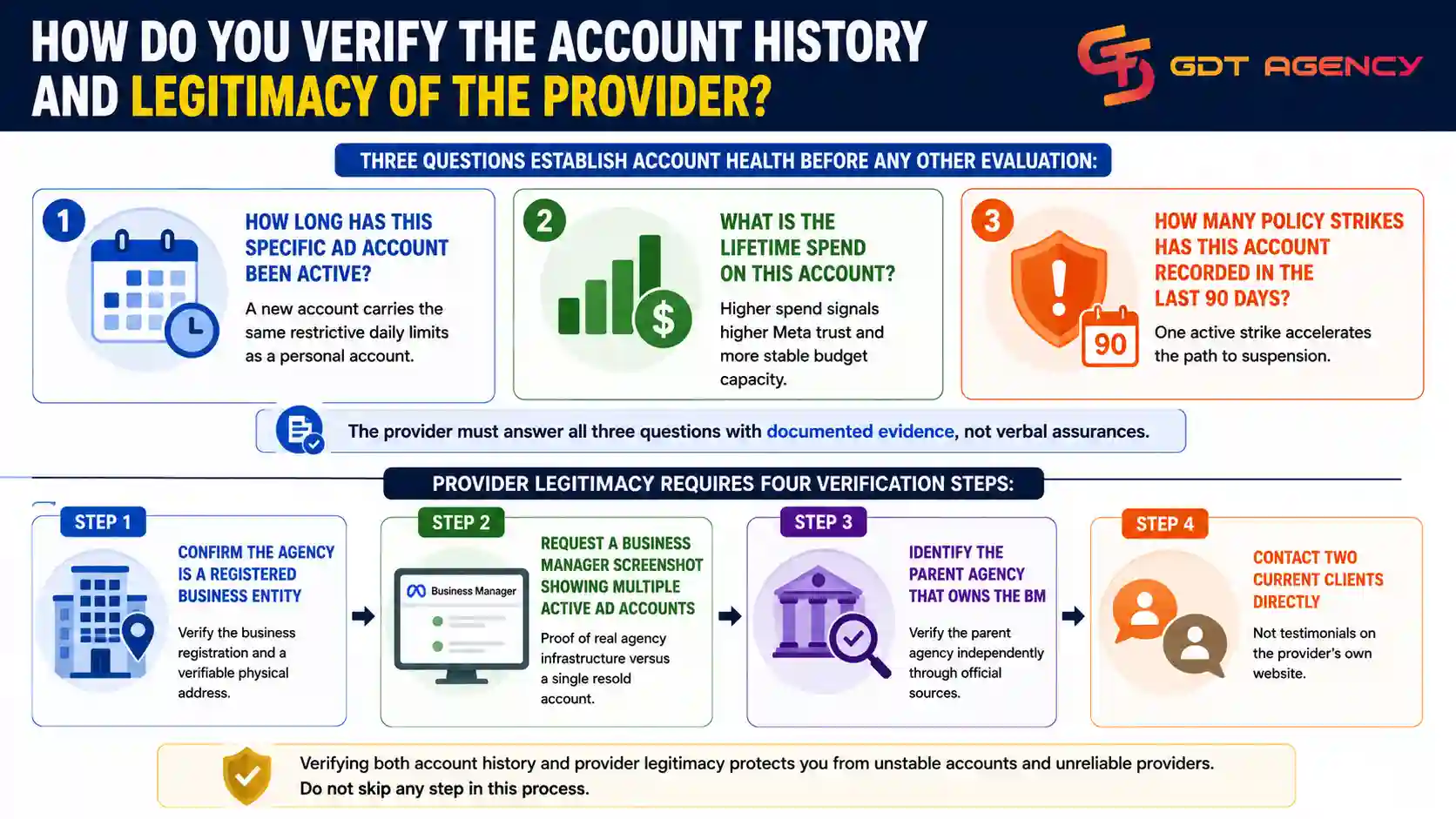
Provider legitimacy requires four verification steps: confirm the agency is a registered business entity with a verifiable physical address, request a Business Manager screenshot showing multiple active ad accounts (proof of real agency infrastructure versus a single resold account), identify the parent agency that owns the BM and verify it independently, and contact two current clients directly – not testimonials on the provider’s own website.
What Documents Should a Legitimate Agency Provide Before You Sign?
A legitimate provider delivers six documents without delay or negotiation:
| Document | Minimum Requirement |
| Service agreement PDF | All 6 core clauses covered with specific terms, not placeholder language |
| Sample invoice | Line-item breakdown with no hidden fees, billing currency specified |
| Business Manager screenshot | Multiple ad accounts visible, BM name consistent with agency branding |
| Account history report | Lifetime spend figure and policy strike count for the last 90 days |
| Pricing breakdown | Fee model named explicitly, deposit minimums, and all additional charges listed |
| Client references | Two active clients contactable directly via Messenger or email |
The service agreement and the replacement SLA are non-negotiable. A provider who delays either document, claims they are unnecessary, or offers a verbal arrangement in place of written terms is operating without the accountability infrastructure that a rental relationship requires.
How Does a Facebook Ad Account Rental Agreement Differ From Buying or Self-Managing an Ad Account?
Renting an agency account delivers faster access to higher spend limits and established account trust history, buying a transferred account violates Meta’s Commercial Terms and creates immediate ban exposure for the buyer, and self-managing a standard account is the most policy-compliant path, but starts with restrictive daily limits that require months of consistent spend to increase. The three models serve different risk tolerances and budget timelines.
What Are the Risks of a Rental Agreement That Standard Ad Account Users Never Face?
Two structural risks are exclusive to the rental model. Dependency risk means the advertiser’s entire campaign operation relies on the agency remaining solvent, compliant, and responsive – if the agency loses its Meta partnership status or stops operating, every account inside their BM goes dark simultaneously with no advertiser-controlled recovery option. Shared BM exposure means that a severe policy violation by another advertiser inside the same Business Manager can trigger Meta enforcement that affects every account in that BM, including campaigns that are fully compliant – a risk that personal account holders and Business Manager owners never face.
How Do Penalty Clauses in Facebook Ad Account Rental Agreements Work?
Penalty clauses activate when an advertiser runs products or services outside the approved category list, triggering immediate service termination and a penalty fee calculated either as a fixed amount or as actual damages to the agency’s account health score and lost business from other clients sharing the same BM. The contract must define “off-registered products” by naming specific prohibited categories rather than using vague language like “policy-violating content” – a specific clause gives the agency clear enforcement grounds and gives the advertiser clear advance notice of what triggers liability.
What Should the Termination Clause in a Facebook Ad Account Rental Agreement Cover?
The termination clause must specify four conditions: notice period (standard range: 7-30 days, applicable to both parties), data handover timeline after termination (standard: 7-14 days with a defined export format), early termination penalty conditions if either party exits before a minimum contract term, and advertiser protection terms if the agency initiates termination without proper notice or stops servicing the account without returning prepaid budget. Without an agency-initiated termination clause, advertisers have no contractual basis to recover budget sitting in the account when the provider goes dark.
→ Choosing the right access model is just as important as reviewing the rental agreement. Learn more in our Buy Agency BM Access guide before making your decision.
Final Thoughts
A Facebook ad account rental agreement is not a formality – it is the only document that defines what you own, what you owe, and what happens when something goes wrong. Every advertiser who has lost campaigns, budget, or audience data in a rental arrangement can point to one missing clause: no replacement SLA, no data ownership definition, no fee transparency, or no termination protection.
The verification process takes one hour before signing. Recovering from a bad agreement – rebuilding audiences, disputing unauthorized charges, or finding a replacement provider mid-campaign – takes months. The six-clause framework and the document checklist in this guide give you a systematic way to evaluate any provider and any contract before a dollar of budget changes hands.
One principle applies to every clause discussed here: if it is not in writing, it does not exist. Verbal commitments from agency sales representatives carry no weight when an account is suspended, a penalty is charged, or a termination happens without notice. Get every term in a PDF, signed by both parties, before you top up your first deposit.
Frequently Asked Questions
1. What is the minimum information a Facebook ad account rental agreement must contain?
A rental agreement must contain six elements to be enforceable: the fee structure and billing model (fixed retainer, percentage of spend, or deposit margin), access rights defining what role the advertiser receives inside the agency’s Business Manager, refund and replacement terms with a specific SLA timeframe, compliance responsibility assignment distinguishing agency-level versus advertiser-level obligations, data ownership terms specifying who controls the Pixel and custom audiences, and termination conditions including notice period and prepaid budget return policy. Any agreement missing one of these six elements creates a gap the advertiser absorbs financially when a dispute arises.
2. Can a Facebook ad account rental agreement protect the advertiser if the account gets banned?
Yes – but only if the replacement clause names a specific timeframe (24-48 hours is standard), states the replacement is provided at no additional charge, and defines what evidence determines whether the ban was caused by the advertiser’s campaign content or by agency-side BM management failures. An agreement that assigns all suspension liability to the advertiser by default, regardless of fault, provides no real protection. Request a clause that distinguishes between advertiser-caused violations and agency infrastructure failures before signing.
3. What fee model in a Facebook ad account rental agreement costs the least over time?
The fixed monthly retainer costs the least when ad spend is high, because a flat fee does not scale with budget. The percentage-of-spend model becomes more expensive as campaigns scale – a 7% fee on $20,000 monthly spend costs $1,400 per month versus a $500-$800 flat retainer at the same spend level. The margin-on-deposit model is the least transparent because the markup reduces effective budget without appearing as a separate line item on the invoice. Request an itemized cost breakdown for each model at your projected monthly spend before selecting a provider.
4. Does a Facebook ad account rental agreement override Meta’s own Terms of Service?
No – Meta’s Commercial Terms and advertising policies take precedence over any bilateral agreement between an advertiser and an agency. A rental contract cannot legally authorize campaign types Meta prohibits, override Meta’s account suspension decisions, or transfer account ownership in ways Meta’s Terms forbid. The contract governs the relationship between the two parties; it cannot create rights against Meta that neither party possesses independently. Any clause claiming the agency can override Meta enforcement or guarantee account survival regardless of policy changes is legally unenforceable and factually false.
5. What happens to custom audiences and Pixel data when a Facebook ad account rental agreement ends?
Custom audiences and Pixel data stored inside the agency’s Business Manager revert to agency control when the contract ends – the advertiser loses access with no recovery option if the data ownership clause did not specify otherwise at signing. The correct structure keeps the advertiser’s Pixel and custom audiences inside the advertiser’s own Business Manager, with the agency’s BM hosting only the ad account. If the current agreement has assets stored in the agency’s BM, negotiate a data handover clause before renewal that defines the export format, the transfer timeline (standard: 7-14 days post-termination), and the agency’s obligation to delete advertiser data from their systems after handover is confirmed.