How to Run Facebook Ads for Moving Companies and Book More Jobs

Facebook Ads work for moving companies when the campaign targets a real service area and speaks to a person who needs to move within weeks. A moving company that sets up Business Manager correctly, defines a tight geo-radius, and builds a funnel from awareness to booking sees a return that outperforms most other paid channels available to local service businesses.
Facebook Ads succeed for movers because moving is a decision driven by a specific trigger. A lease ends. A job starts in a new city. A family outgrows a home. These triggers create urgency, and Facebook finds people who show that urgency through life-event data, local group activity, and search behavior tied to relocation.
Targeting and budget decide most of the outcome. A moving company that sets its radius too wide burns budget on leads outside its service zone. A narrow radius combined with a starting budget of $1,500 to $3,000 per month keeps cost per lead controlled during the first 60 days of testing.
The funnel matters as much as the targeting. Ads that jump straight from cold audience to a quote form miss buyers who need a second touch. Below, this article covers account setup, targeting, funnel structure, lead conversion, and a case from GDT Agency that shows these steps in action.
- Facebook Ads for Moving Companies: Does It Really Work?
- What Do You Need Before Running Facebook Ads for a Moving Company?
- What Ad Account Setup Do You Need?
- How Much Budget Should You Start With?
- How Do You Target the Right Audience for Moving Company Ads?
- How Do You Set Up Local and Geo-Radius Targeting?
- How Do You Build a Lookalike Audience from Past Customers?
- How Do You Build a Facebook Ads Funnel for a Moving Company?
- What Ad Creative Works Best for Moving Companies?
- How Do You Use Retargeting to Recover Lost Leads?
- How Do You Turn Facebook Leads into Booked Jobs?
- What Should Your Lead Form Include?
- How Fast Should You Follow Up with Leads?
- How GDT Agency Delivered 310% ROI for American Van Lines in 90 Days
- The Challenge: American Van Lines Before GDT Agency
- What American Van Lines Really Wants?
- How GDT Agency Helped American Van Lines Deliver 310% ROI in Just 90 Days
- Result After 90 Days
- Final Thoughts
- FAQs
- Do Facebook Ads work better than Google Ads for moving companies?
- How much does it cost to run Facebook Ads for a moving company?
- Why do moving company Facebook ad accounts get restricted?
- How long does it take to see results from Facebook Ads for a moving company?
- What is the best ad creative for a moving company on Facebook?
Facebook Ads for Moving Companies: Does It Really Work?
Yes, Facebook Ads work for moving companies under three conditions: a defined local service area, a lead capture system that responds within minutes, and a budget that survives the first month of testing.
Moving is a high-intent, low-frequency purchase. The ad account depends on catching demand at the right moment rather than building brand awareness over time. A company that ignores this timing sees higher costs and lower booking rates than one that aligns ad spend with peak moving windows.
The first condition, a defined service area, keeps the budget from spreading across zip codes the company cannot service profitably. The second condition, fast lead response, matters because movers compare three to five quotes within 24 hours. A slow follow-up loses the job regardless of ad performance. The third condition, budget durability, gives the algorithm enough data to optimize. An account that pauses after two weeks never reaches a stable cost per lead.
Moving companies that meet these three conditions see a lower cost per lead than competitors relying only on referrals or Google Ads during off-peak months, since Facebook keeps the pipeline full even when organic search demand drops.
What Do You Need Before Running Facebook Ads for a Moving Company?
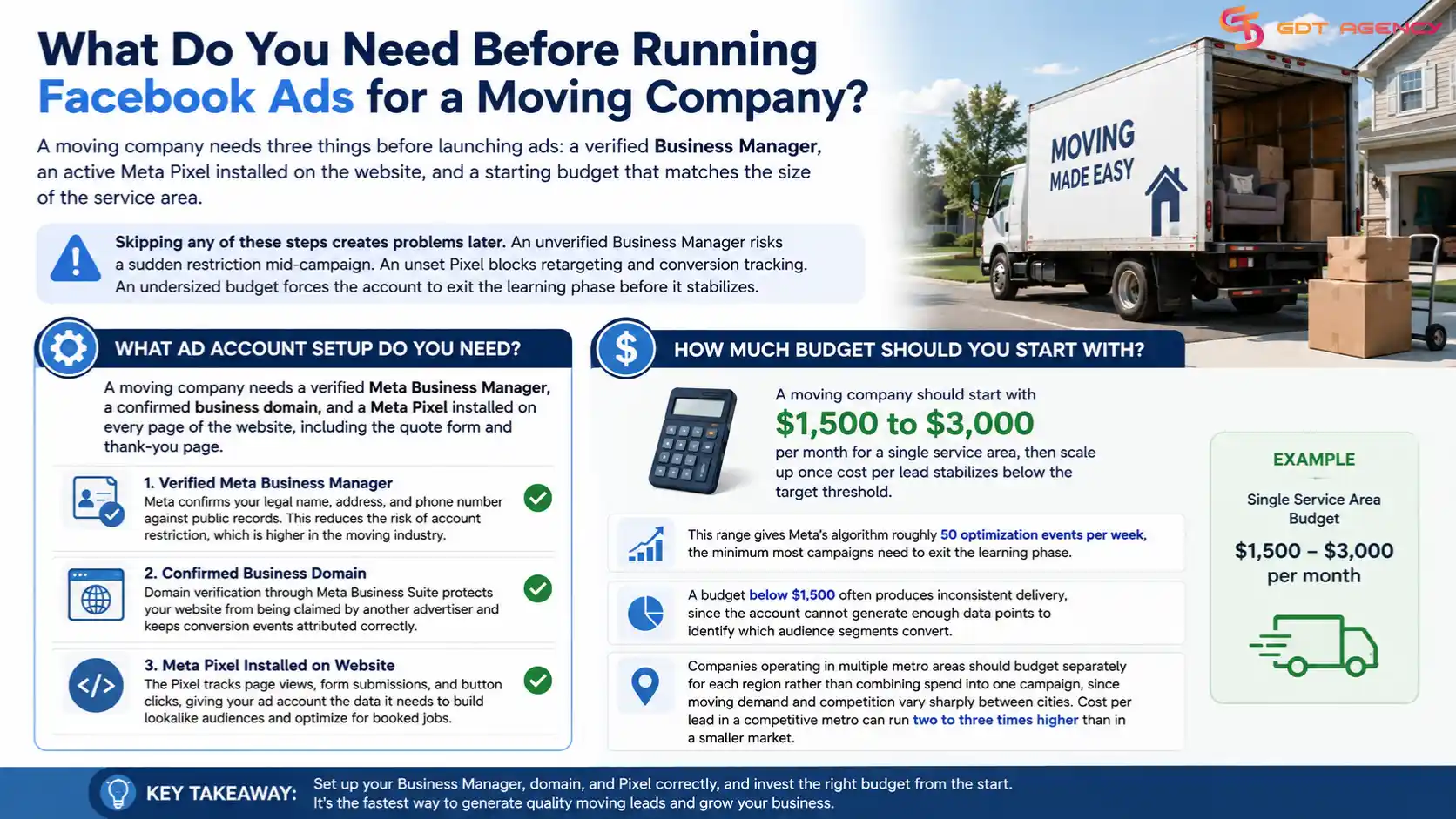
A moving company needs three things before launching ads: a verified Business Manager, an active Meta Pixel installed on the website, and a starting budget that matches the size of the service area.
Skipping any of these steps creates problems later. An unverified Business Manager risks a sudden restriction mid-campaign. An unset Pixel blocks retargeting and conversion tracking. An undersized budget forces the account to exit the learning phase before it stabilizes.
What Ad Account Setup Do You Need?
A moving company needs a verified Meta Business Manager, a confirmed business domain, and a Meta Pixel installed on every page of the website, including the quote form and thank-you page.
Business verification asks Meta to confirm the company’s legal name, address, and phone number against public records. This step reduces the risk of account restriction, which happens more often to moving companies than to most local service categories because the industry carries a history of ad policy violations tied to misleading pricing claims. Since advertising requirements vary across industries, choosing the right account structure also matters. Businesses operating in different verticals often face different approval standards, spending limits, and compliance requirements. Learn more in our guide to Facebook Ad Account by Business Type: Use Cases and Verticals.
Domain verification through Meta Business Suite protects the company’s website from being claimed by another advertiser and keeps conversion events attributed correctly. The Pixel tracks page views, form submissions, and button clicks, giving the ad account the data it needs to build lookalike audiences and optimize for booked jobs rather than clicks.
How Much Budget Should You Start With?
A moving company should start with $1,500 to $3,000 per month for a single service area, then scale up once cost per lead stabilizes below the target threshold.
This range gives Meta’s algorithm roughly 50 optimization events per week, the minimum most campaigns need to exit the learning phase. A budget below $1,500 often produces inconsistent delivery, since the account cannot generate enough data points to identify which audience segments convert.
Companies operating in multiple metro areas should budget separately for each region rather than combining spend into one campaign, since moving demand and competition vary sharply between cities. Cost per lead in a competitive metro can run two to three times higher than in a smaller market.
How Do You Target the Right Audience for Moving Company Ads?
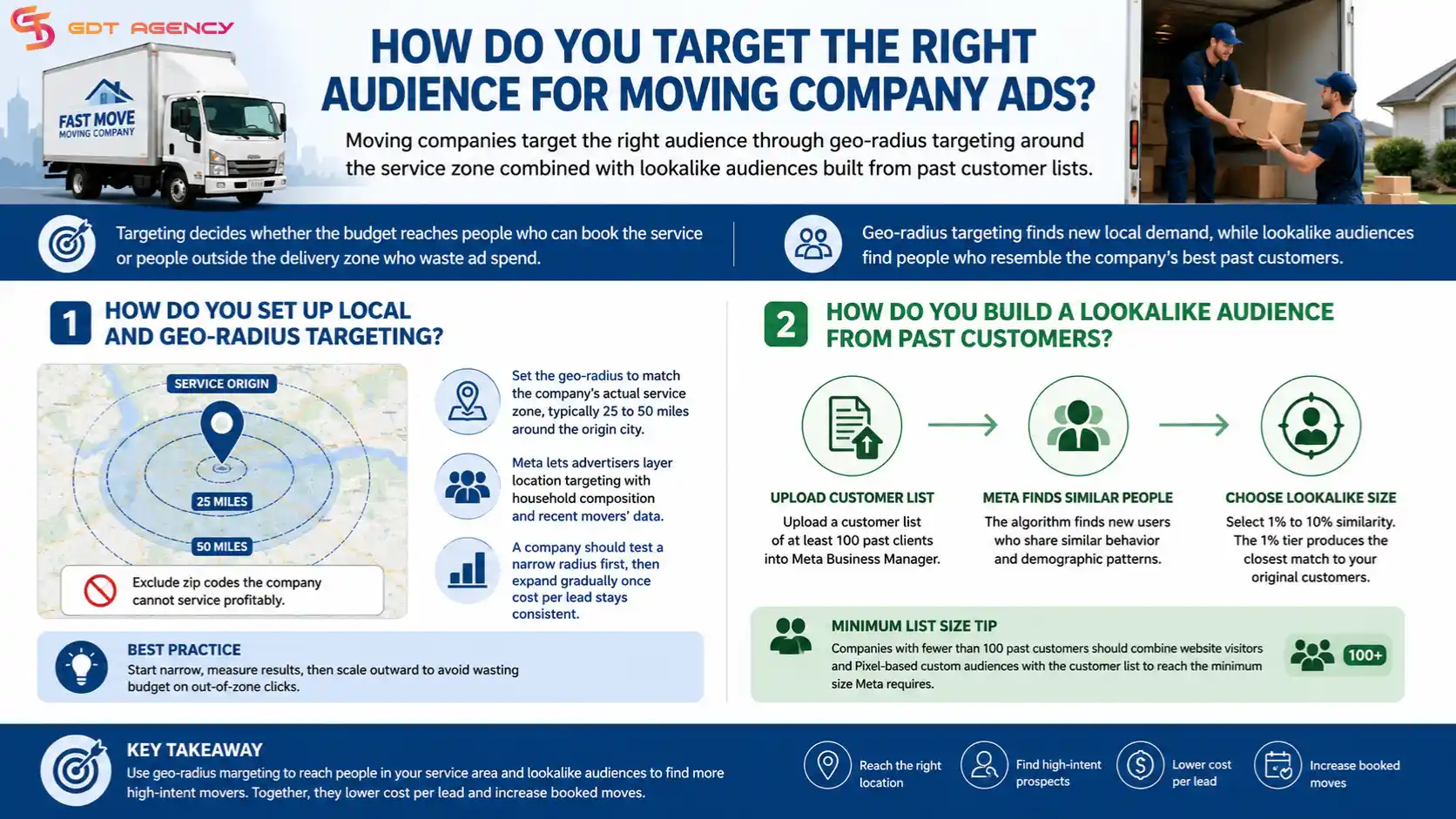
Moving companies target the right audience through geo-radius targeting around the service zone combined with lookalike audiences built from past customer lists.
Targeting decides whether the budget reaches people who can book the service or people outside the delivery zone who waste ad spend. The two methods below work together. Geo-radius targeting finds new local demand, while lookalike audiences find people who resemble the company’s best past customers, regardless of where they currently live if they plan a move into the area.
How Do You Set Up Local and Geo-Radius Targeting?
Set the geo-radius to match the company’s actual service zone, typically 25 to 50 miles around the origin city, and exclude zip codes the company cannot service profitably.
Meta lets advertisers layer location targeting with household composition and recent movers’ data, narrowing the audience to people showing signals tied to relocation. A company should test a narrow radius first, then expand gradually once cost per lead stays consistent, rather than starting wide and pulling back after wasting budget on out-of-zone clicks.
How Do You Build a Lookalike Audience from Past Customers?
Build a lookalike audience by uploading a customer list of at least 100 past clients into Meta Business Manager, then let the algorithm find new users who share similar behavior and demographic patterns.
A moving company’s customer list contains the strongest signal available: people who completed a booking. Meta compares this list against its broader user base and generates an audience of 1 to 10 percent similarity, with the 1 percent tier producing the closest match to the original customer profile. Companies with fewer than 100 past customers should combine website visitors and Pixel-based custom audiences with the customer list to reach the minimum size Meta requires.
How Do You Build a Facebook Ads Funnel for a Moving Company?
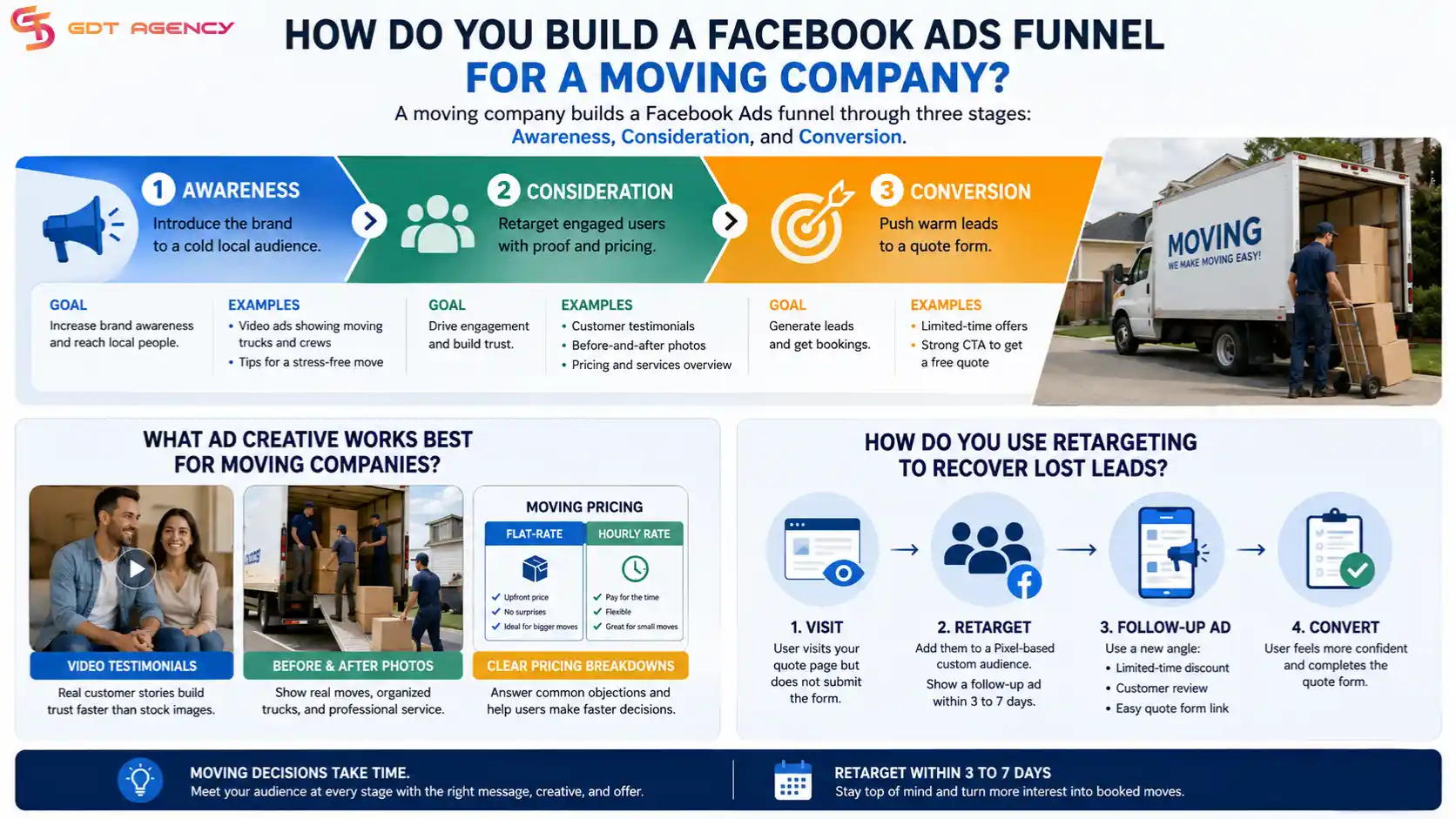
A moving company builds a Facebook Ads funnel through three stages: an awareness stage that introduces the brand to a cold local audience, a consideration stage that retargets engaged users with proof and pricing, and a conversion stage that pushes warm leads to a quote form.
Moving decisions rarely close on the first ad impression. A person scrolling past an ad while planning a move three months out behaves differently from someone comparing quotes this week, so the funnel needs creative and messaging suited to each stage rather than one generic ad running to everyone.
What Ad Creative Works Best for Moving Companies?
Video testimonials, before-and-after photos of completed moves, and clear pricing breakdowns work best for moving company ad creative.
Video content showing real trucks, real crews, and real customer reactions builds trust faster than stock imagery, since moving involves handing personal belongings to strangers and buyers want proof of reliability before they commit. Photos showing packed trucks or organized storage units give a concrete sense of the company’s professionalism, while a graphic breaking down flat-rate versus hourly pricing answers a common objection before the user clicks.
How Do You Use Retargeting to Recover Lost Leads?
Retarget users who visited the quote page but did not submit a form, using a Pixel-based custom audience to show a follow-up ad within 3 to 7 days of their first visit.
Most moving leads compare multiple companies before deciding, so a user who left the site without booking has not necessarily chosen a competitor. Retargeting ads work best when they add new information rather than repeat the first ad, such as a limited-time discount, a customer review, or a direct link to a shortened quote form that reduces friction from the first visit.
How Do You Turn Facebook Leads into Booked Jobs?
Moving companies turn Facebook leads into booked jobs by responding within five minutes of form submission, using a short form that captures only essential details, and following up with a phone call rather than relying on email.
Speed decides most outcomes at this stage. A lead who fills out a form on Facebook compares options in real time, and the company that calls first usually books the job, regardless of price differences between competitors.
What Should Your Lead Form Include?
A moving company’s lead form should include name, phone number, moving date, origin and destination ZIP codes, and approximate home size, and nothing beyond these five fields.
Every additional field on a lead form reduces completion rate. A short form gets more submissions, and the company gathers remaining details during the follow-up call, when the lead already shows engagement and willingness to share information.
How Fast Should You Follow Up with Leads?
A moving company should call a new lead within five minutes of form submission, since a response time above 30 minutes drops the chance of reaching that lead by more than half.
Movers submit multiple quote requests at once, so the company that reaches out first often secures the booking before competitors respond. An instant notification through the CRM connected to the Facebook lead form removes the delay between submission and outreach.
How GDT Agency Delivered 310% ROI for American Van Lines in 90 Days
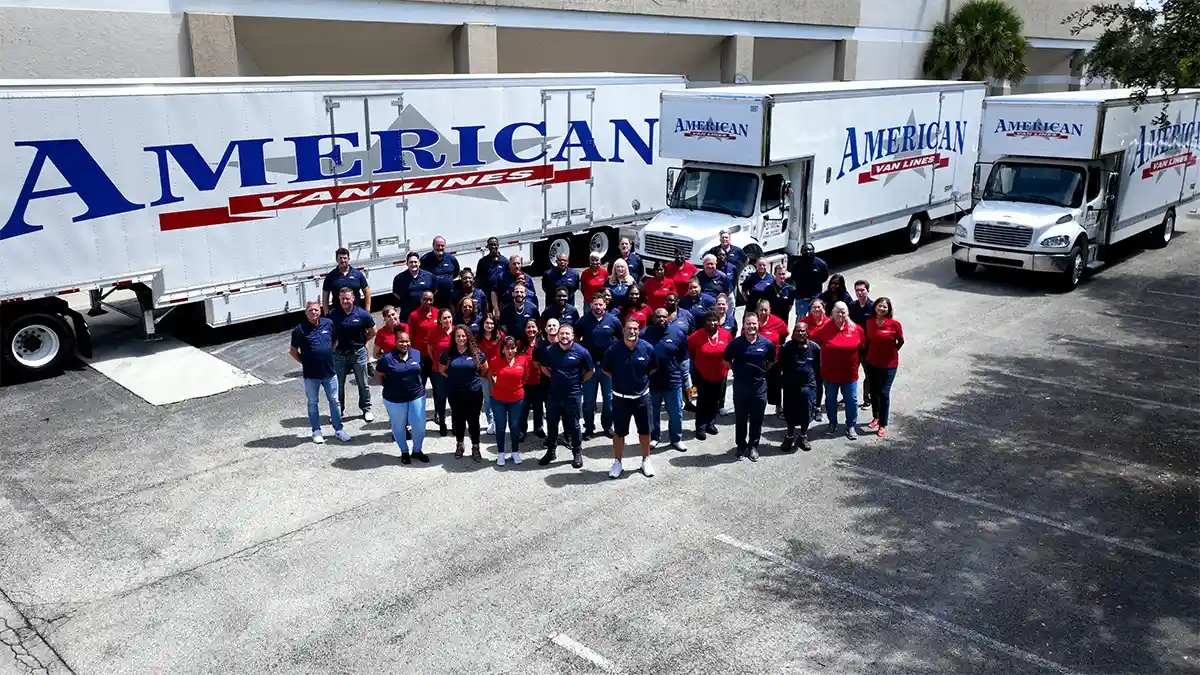
In an era where the “Paid Search Death Spiral” has driven moving industry keywords to over $65/click, traditional lead generation is no longer sustainable for national carriers. American Van Lines (AVL), a family-owned nationwide moving company established in 1995, faced the challenge of unsustainable customer acquisition costs through traditional paid search channels. By implementing a high-trust Facebook Agency Account, GDT Agency engineered a digital transformation in just 90 days to help AVL deliver a 310% increase in ROI while reducing cost-per-lead by 58% compared to their previous search-based campaigns.
The Challenge: American Van Lines Before GDT Agency
By late 2024, AVL was facing a profit crisis despite being a long-established, family-owned company. In Q4 2024, they spent $67,400 on marketing but generated only $48,170 in net profit, a 4.6% margin. Customer acquisition costs were nearly equal to their profits.
1. Google Ads Became Unsustainable
AVL had been running Google Search campaigns and spent nearly 80% of their marketing budget on Google Ads ($54.200), with the average CPC for “long distance movers” and “moving company near me” climbing to $45 – $72.
The cost per booked move reached $447, leaving little to no profit after operating costs. Pausing ads only made things worse, as re-entering auctions drove costs even higher.
2. Failed DIY Facebook Ads
In Q3 2024, they tried to solve the problem itself by running Facebook Ads. However, with poor targeting, generic creatives, and no funnel or tracking, they only get 6 bookings after spending $8,200 over 8 weeks.
Cost per booking hit $1,366, and lead quality was so low that the sales team stopped taking Facebook leads seriously.
Their marketing manager shares with us that “ We thought Facebook would be the ‘cheap’ alternative to Google. We were wrong. We spent money, got terrible leads, and our sales team started ignoring the Facebook leads entirely because they were of such low quality.”
What American Van Lines Really Wants?
When AVL realized that they needed expert help, their CEO met GDT Agency’s founder, who presented a case study of another moving company that had reduced CPL from $71 to $29, scaled from 400 to 1,200 leads per quarter, and achieved 340% ROI using Facebook Agency Accounts at the industry conference in January 2025.
He shared with us the goals that he wants for AVL:
- Reduce Cost Per Lead below $35 (48% reduction from the current $68)
- Generate a minimum of 600 qualified leads in 90 days (2X previous Facebook attempt)
- Achieve 15%+ lead-to-booking rate (maintain quality while lowering cost)
- Deliver a minimum 200% ROI (2:1 return on ad spend)
- Establish diversified lead source (reduce Google dependency from 80% to <50%)
The stage was set. The challenge was clear. Now it was time for GDT Agency to deliver.
How GDT Agency Helped American Van Lines Deliver 310% ROI in Just 90 Days
After gathering clear information about American Van Lines, we discussed and designed a funnel that intercepts prospects months before they actively search for movers.
1. Overcoming Ad Budget Constraints
- The Problem: AVL’s internal team faced a strict Meta Daily Spending Limit (DSL) capped at $250/day due to a low trust score, making it impossible to scale nationally in competitive markets.
- The Solution: GDT migrated AVL to a rented Facebook agency account. This bypassed the account “warm-up” phase, allowed an $800+ daily spend, trained the pixel 3x faster, and ultimately drove a 58% reduction in cost-per-lead (CPL).
2. Implementing a Three-Stage Funnel
- Stage 1 – Awareness (Cold Traffic): Target prospects 3-6 months before they actively look for movers by focusing on major life transitions (e.g., newlyweds, new jobs) and using authentic, real-crew video assets. When early data showed a lagging booking rate in California, GDT added an “Estimated Move Size” question to the lead form, boosting the booking rate by 40%.
- Stage 2 – Consideration (Warm Traffic): Retargeted recent page visitors and video viewers. Ads focused on building trust, utilizing carousel formats to break down the moving process and highlighting industry credentials (USDOT, AMSA ProMover) alongside 5-star social proof.
- Stage 3 – Decision (Hot Traffic): Deployed a hybrid approach combining Facebook Lead Ads (Volume Play for mobile users with a short 4-field form) and Optimized Landing Pages (Quality Play for desktop users using interactive calculators and live chat). This combined method delivered 34% more bookings than either format could alone.
Result After 90 Days
At the end of the 90-day period, AVL achieved:
- Total Ad Spend: $24,120 (California market: $8,400 (35%), Texas Corridor: $6,030 (25%), Florida Markets: $4,824 (20%), Northeast Corridor: $4,866 (20%))
- Total Leads: 847 (Facebook Lead Ads: 521 leads, Landing Page Conversions: 326 leads)
- Total Bookings: 156
- Total Revenue: $1,199,952
ROI Calculation:
| Revenue Generated: $1,199,952 AVL Net Margin: 11% (industry best-in-class) → Gross Profit: $131,995 | Ad Spend: $24,120 Sales Team Cost (allocated): $7,800 → Total Marketing Cost: $31,920 |
| Net Profit: $100,075 | |
| ROI: ($100,075 / $31,920) × 100 = 313.5% | |
Final Thoughts
Facebook Ads work for moving companies that treat the platform as a system, not a single ad. A company that sets up the account correctly, targets a real service radius, builds a three-stage funnel, and responds to leads within minutes turns Facebook into a source of booked jobs rather than a budget drain.
The GDT Agency case with American Van Lines shows what happens when these pieces come together inside a 90-day window. The same framework applies to any moving company willing to fix account structure and targeting before increasing spend.
>>> Maybe you are also interested in: How to Run High-Converting Facebook Ads for SaaS Companies: A Step-by-Step Guide
FAQs
Do Facebook Ads work better than Google Ads for moving companies?
Facebook Ads and Google Ads serve different stages of the buyer journey, so neither replaces the other for a moving company. Google Ads capture people searching for a mover right now, while Facebook Ads reach people before they start that search, often through life-event targeting and lookalike audiences built from past customers. A moving company that runs both channels together sees a lower blended cost per lead than a company relying on one channel.
How much does it cost to run Facebook Ads for a moving company?
Most moving companies should start with $1,500 to $3,000 per month for a single service area, giving the algorithm enough data to leave the learning phase within two to three weeks. Companies operating in multiple metro areas need separate budgets for each region, since cost per lead varies between competitive coastal metros and smaller inland markets.
Why do moving company Facebook ad accounts get restricted?
Moving company ad accounts get restricted more often than other local service categories because Meta flags the industry for past violations tied to misleading pricing claims and unverified business information. Completing business verification, confirming domain ownership, and avoiding vague pricing language in ad copy reduce this risk.
How long does it take to see results from Facebook Ads for a moving company?
Most moving companies see stable cost per lead within 30 to 60 days, once the account exits the learning phase and the retargeting audience builds enough size to perform. Full-funnel results, including a drop in cost per booking, show up within 60 to 90 days, matching the timeline GDT Agency achieved with American Van Lines.
What is the best ad creative for a moving company on Facebook?
Video testimonials from real customers, before-and-after photos of completed moves, and graphics breaking down flat-rate versus hourly pricing perform best for moving company ads. These formats build trust faster than in most other local service categories, since customers hand personal belongings to a crew they have never met.