
How to Run Facebook Ads for Moving Companies and Book More Jobs
Facebook Ads work for moving companies when the campaign targets a real service area and speaks to a person who needs to move within weeks.…
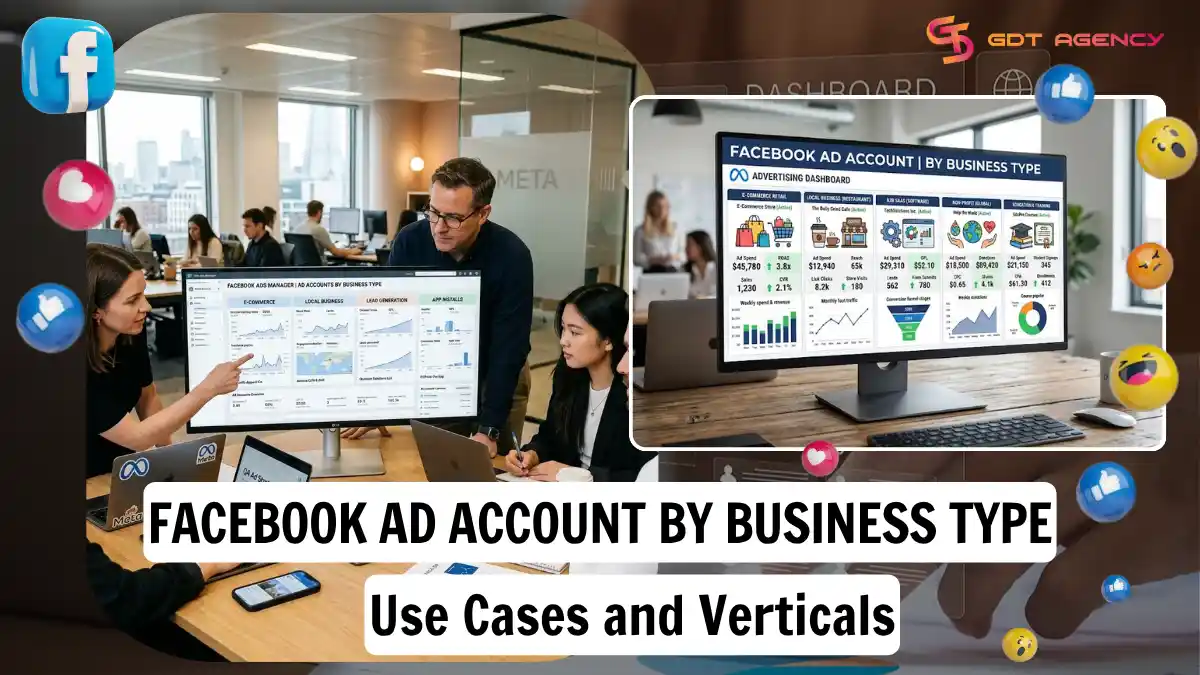
A Facebook ad account by business type refers to an ad account structure that matches the rules, spending pattern, and creative approach of a specific industry. Every business runs ads through Facebook, but not every business runs ads the same way. A local bakery sets up an account differently from a crypto exchange, and a finance company faces a different review process than a clothing brand.
Business type shapes three things directly: verification level, spending capacity, and content restriction. A low-risk vertical like retail passes standard verification and rarely triggers a policy flag. A high-risk vertical like gambling or supplements goes through extra scrutiny and often needs a different account structure altogether.
Some verticals also carry a compliance burden that standard accounts cannot absorb. Finance, crypto, dating, and health supplements sit in this group. These businesses often rely on agency ad accounts or rented accounts to keep campaigns running without constant bans.
This article breaks down business types, use cases, and account requirements by vertical. Below, you will find the difference between low-risk and high-risk businesses, how setup requirements shift by industry, and whether a restricted vertical can still run legal Facebook ads.
A Facebook ad account by business type is an account configured to match the policy tier, verification requirement, and creative style of one industry. Facebook does not treat every account the same. It sorts accounts by the risk level of the business behind them.
As an expert at GDT Agency who has spent more than 6 years working with Facebook ad accounts, from personal to Facebook agency ad accounts, I understand that the classification starts the moment a business picks its industry category during setup. From there, Facebook applies rules that follow that category through every campaign the account runs.
The business type acts as the anchor for everything else in this article. It determines:
A skincare brand and a payday loan company both advertise products, but Facebook treats them as different risk categories. The skincare brand faces normal ad review. The loan company faces added scrutiny under Facebook's financial services policy.
→ If you're new to Meta advertising, start by learning what a Facebook ad account is and how it works before choosing the right account type for your business.
Businesses fall into two main groups on Facebook: low-risk verticals and high-risk verticals. This split decides how strict the platform gets with an account from day one.
Every business type sits somewhere on this risk scale, and the position affects account stability. Below, we cover what puts a business in each group.
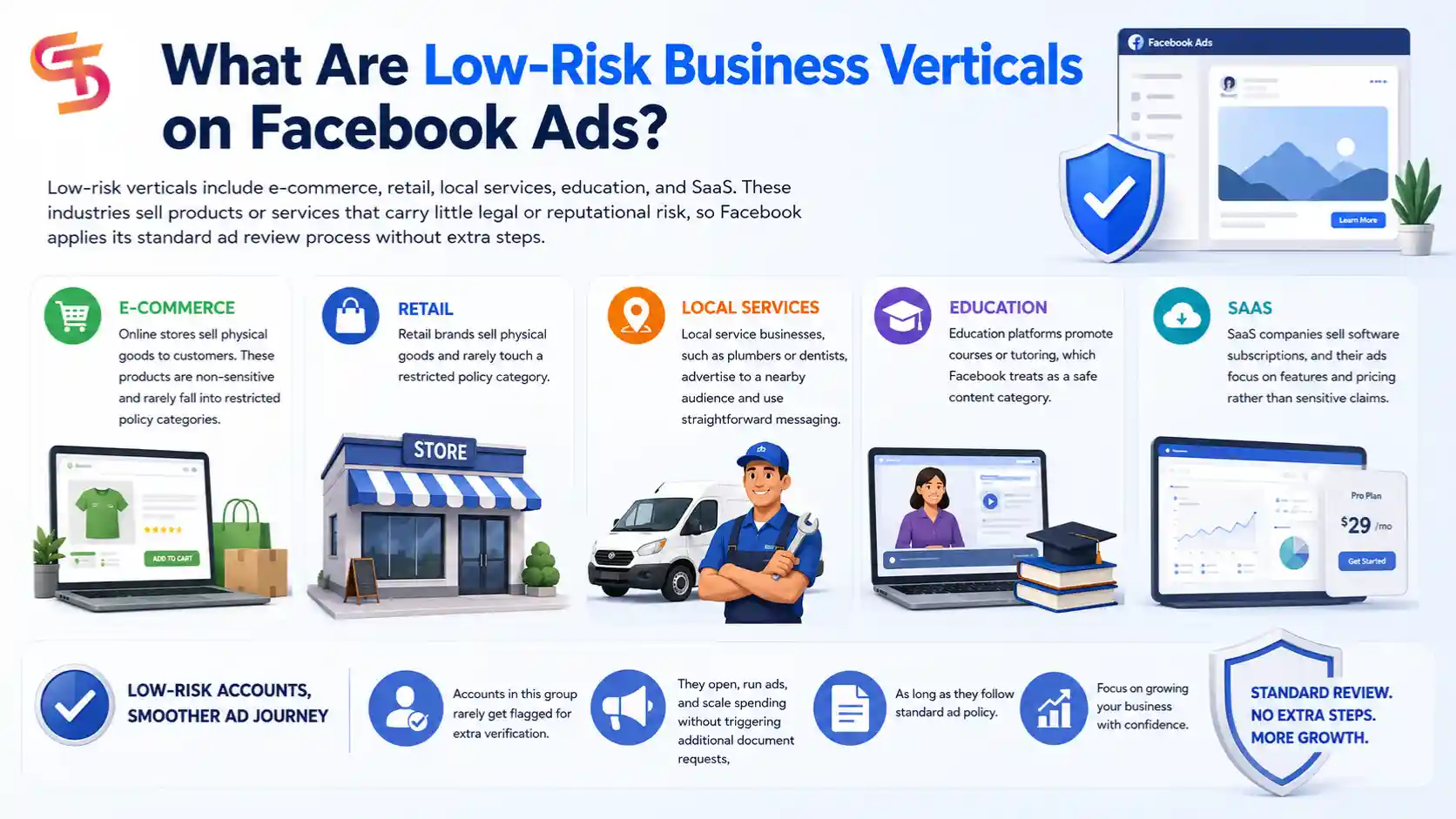
Low-risk verticals include e-commerce, retail, fulfillment, local services, education, photographers and SaaS. These industries sell products or services that carry little legal or reputational risk, so Facebook applies its standard ad review process without extra steps.
Retail brands sell physical goods and rarely touch a restricted policy category. Local service businesses, such as plumbers or dentists, advertise to a nearby audience and use straightforward messaging. Education platforms promote courses or tutoring, which Facebook treats as a safe content category. SaaS companies sell software subscriptions, and their ads focus on features and pricing rather than sensitive claims.
Accounts in this group rarely get flagged for extra verification. They open, run ads, and scale spending without triggering additional document requests, as long as they follow standard ad policy.
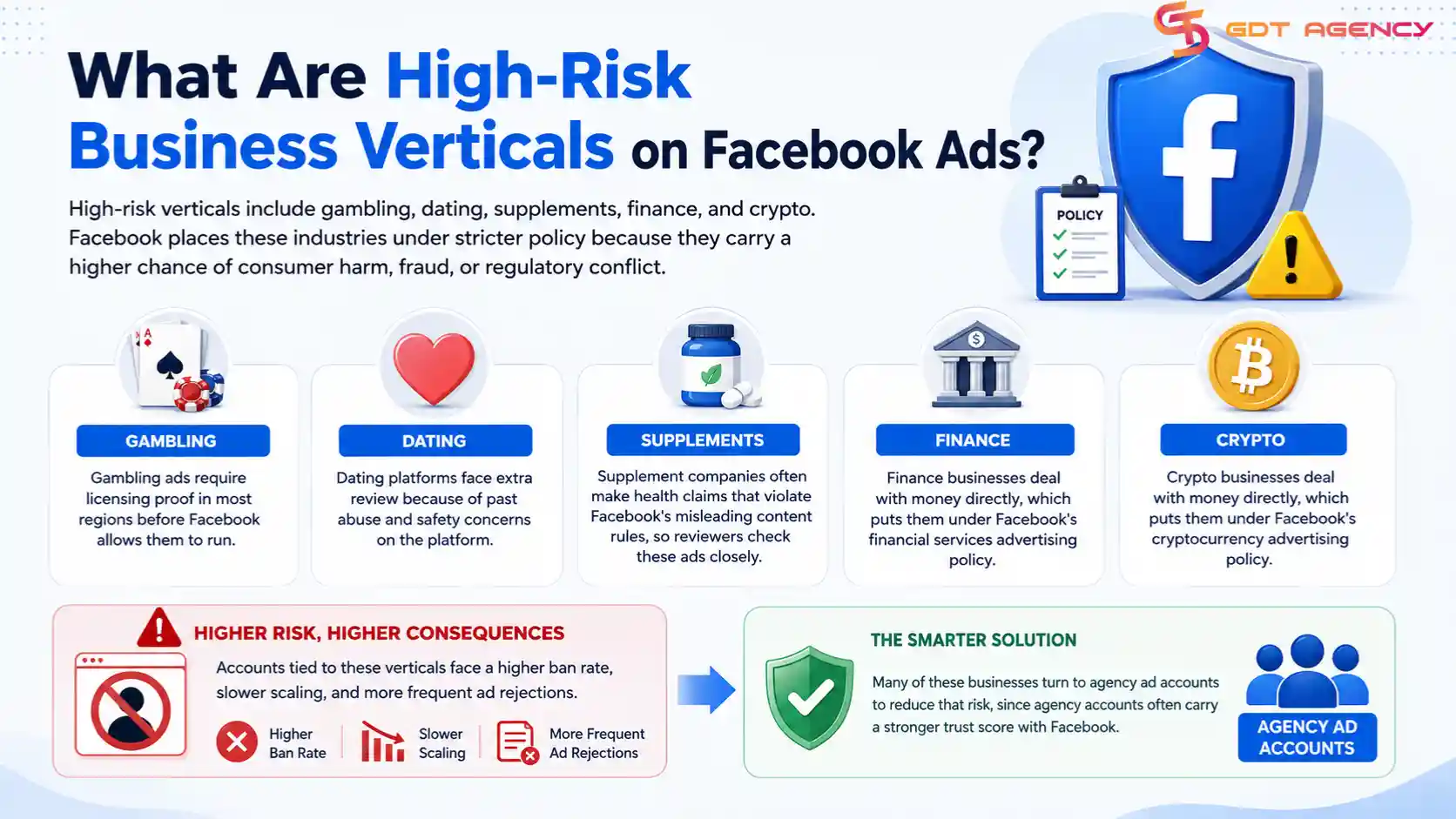
High-risk verticals include gambling, dating, supplements, finance, and crypto. Facebook places these industries under stricter policy because they carry a higher chance of consumer harm, fraud, or regulatory conflict.
Gambling ads require licensing proof in most regions before Facebook allows them to run. Dating platforms face extra review because of past abuse and safety concerns on the platform. Supplement companies often make health claims that violate Facebook's misleading content rules, so reviewers check these ads closely. Finance and crypto businesses deal with money directly, which puts them under Facebook's financial services and cryptocurrency advertising policy.
Accounts tied to these verticals face a higher ban rate, slower scaling, and more frequent ad rejections. Many of these businesses turn to agency ad accounts to reduce that risk, since agency accounts often carry a stronger trust score with Facebook.
Facebook ad account requirements shift based on business type, mainly through verification depth, spending limits, and content review. A low-risk business clears setup fast. A high-risk business goes through several extra checks before it can spend at scale.
The gap between these two experiences comes down to how much liability the vertical carries. Below, we compare e-commerce and finance/crypto to show how different the process gets.
An e-commerce business needs catalog integration, pixel setup, and standard verification to run Facebook ads. This setup lets the account track purchases, retarget visitors, and sync product data directly into ad campaigns.
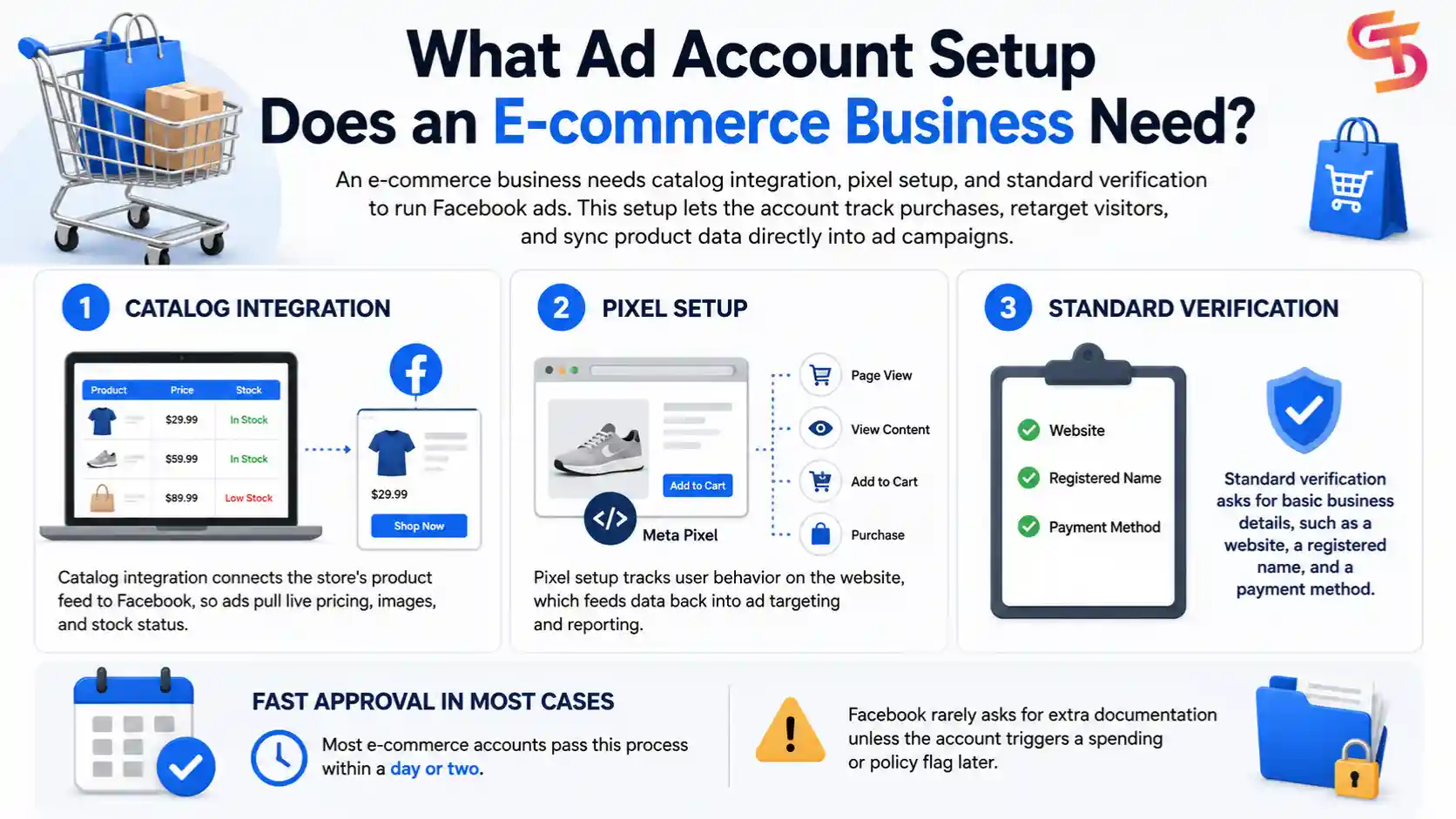
Catalog integration connects the store's product feed to Facebook, so ads pull live pricing, images, and stock status. Pixel setup tracks user behavior on the website, which feeds data back into ad targeting and reporting. Standard verification asks for basic business details, such as a website, a registered name, and a payment method.
Most e-commerce accounts pass this process within a day or two, and Facebook rarely asks for extra documentation unless the account triggers a spending or policy flag later.
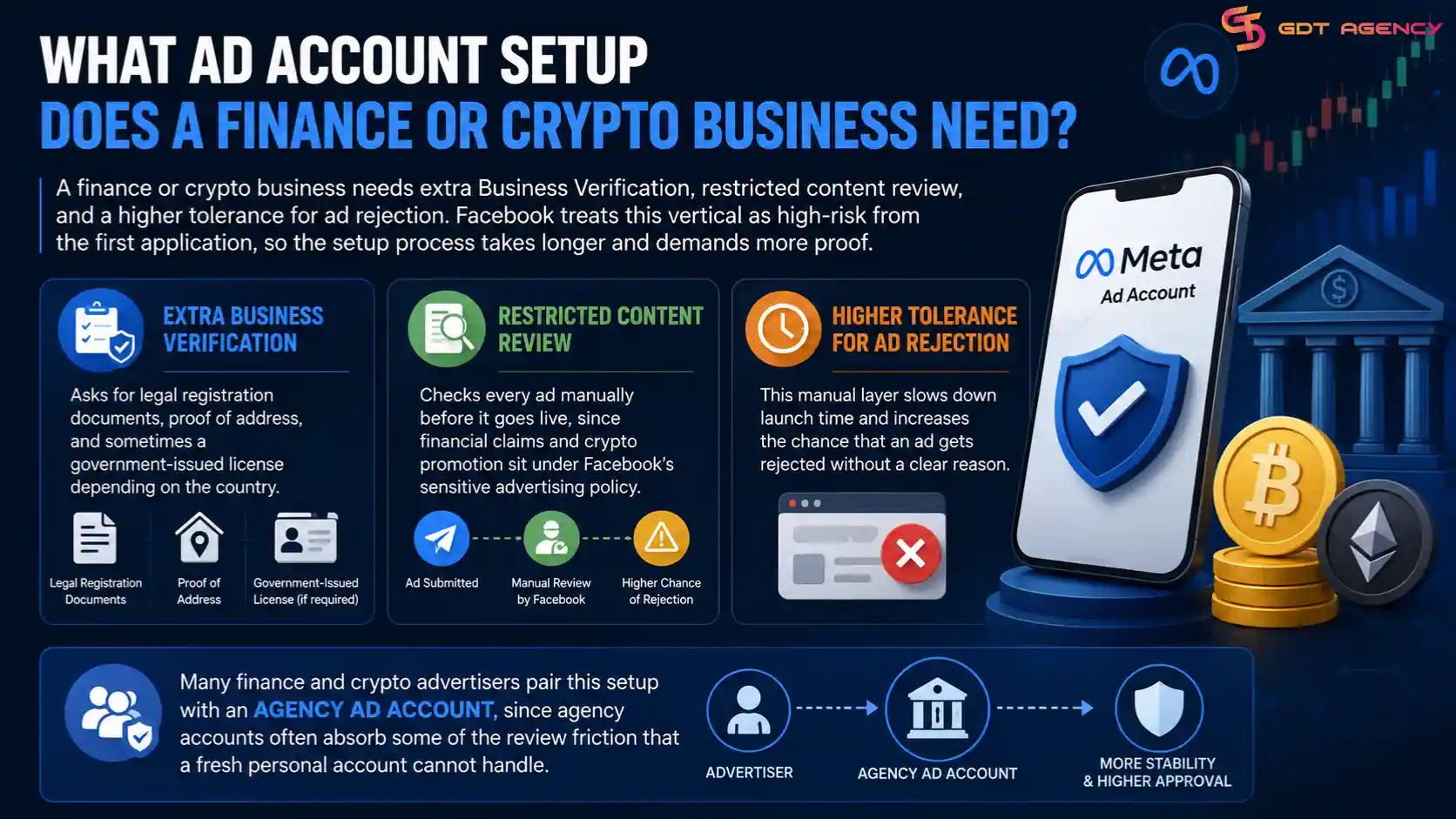
A finance or crypto business needs extra Business Verification, restricted content review, and a higher tolerance for ad rejection. Facebook treats this vertical as high-risk from the first application, so the setup process takes longer and demands more proof.
Extra Business Verification asks for legal registration documents, proof of address, and sometimes a government-issued license depending on the country. Restricted content review checks every ad manually before it goes live, since financial claims and crypto promotion sit under Facebook's sensitive advertising policy. This manual layer slows down launch time and increases the chance that an ad gets rejected without a clear reason.
Many finance and crypto advertisers pair this setup with an agency ad account, since agency accounts often absorb some of the review friction that a fresh personal account cannot handle.
No, not every business type qualifies for a standard Facebook ad account. Some verticals hit policy limits that a standard account cannot clear, which pushes them toward agency or rented account structures instead.
Facebook's policy sets hard boundaries for certain industries. A payday loan company, for example, cannot advertise in most regions regardless of how clean its documentation looks. A dating app might qualify for a standard account in one country and get denied in another, based on local regulation.
When a business hits this wall, three paths remain open:
This is where many high-risk businesses shift their strategy. Instead of fighting rejection after rejection on a personal account, they move to an agency structure that already understands the vertical's restrictions.
Each vertical uses Facebook ads for a different primary goal, shaped by how customers buy within that industry. E-commerce chases direct sales, while service-based businesses chase leads and bookings.
Understanding this difference helps a business pick the right campaign objective instead of copying a generic template. Below, we break down the two most common use case groups.
Common use cases for e-commerce ad accounts include retargeting, catalog sales, and seasonal promotions. These three goals cover most of the spending inside a typical online store's ad account.
Retargeting shows ads to people who already visited the store or added a product to cart, which usually converts at a higher rate than cold traffic. Catalog sales run dynamic ads that pull directly from the product feed, so the ad updates automatically as stock and pricing change. Seasonal promotions push short-term campaigns around holidays or sale events, and these campaigns often carry the highest daily budget of the year.
A store running all three use cases at once needs an account that can handle frequent budget changes without triggering a spending review.
Common use cases for service-based business ad accounts include lead generation, local awareness, and appointment booking. Unlike e-commerce, these businesses sell a service rather than a shippable product, so the campaign goal centers on getting a person to reach out.
Lead generation campaigns collect contact details through a form directly inside Facebook, which skips the extra step of sending someone to a website. Local awareness campaigns target people within a set radius of the business address, which fits industries like home repair or dining. Appointment booking campaigns link directly to a scheduling tool, so a potential customer can pick a time slot without leaving the ad.
Service businesses typically run smaller daily budgets than e-commerce, but they depend heavily on account stability since a paused account cuts off their lead flow immediately.
Yes, restricted verticals can still run Facebook ads legally through compliant agency account structures and adjusted creative. Restriction does not mean a total ban. It means the business must work within a narrower set of rules.
A gambling company can advertise in regions where it holds a license, as long as it submits proof and follows Facebook's gambling ad policy for that country. A supplement brand can advertise if it removes exaggerated health claims and sticks to approved language. A finance company can advertise if it discloses required terms and avoids promising guaranteed returns.
Agency ad accounts help here because they often come with a policy track record already built for the vertical. This reduces the trial-and-error period that a brand-new account usually goes through before it finds language and targeting that Facebook approves.
The difference between restricted and prohibited verticals on Facebook comes down to whether ads can run at all. Restricted verticals can advertise under specific conditions. Prohibited verticals cannot advertise under any condition.
A restricted vertical, such as alcohol or gambling, needs licensing, age targeting, or regional approval before an ad goes live. Once a business meets those conditions, Facebook allows the campaign to run. A prohibited vertical, such as illegal drugs or counterfeit goods, has no path to approval. Facebook removes these ads regardless of documentation or targeting adjustments.
This distinction matters because businesses in the restricted category still have room to operate, while businesses in the prohibited category need to rethink their entire ad strategy or platform choice.
Rare verticals that require agency ad account rental include online gambling in specific regions, adult wellness products, and CBD. These niches sit in a gray zone where standard accounts struggle to survive more than a few campaigns.
Online gambling faces different rules by country, so an agency account with a proven history in a specific region often clears review faster than a fresh account. Adult wellness products, including certain intimate health items, trigger Facebook's sensitive content filters even when the product itself is legal to sell. CBD sits in a similar spot, since Facebook's policy on it shifts based on ingredient sourcing and regional law.
Businesses in these niches often treat agency account rental as a standard cost of doing business rather than a workaround, since personal accounts rarely survive long-term in these categories.
Vertical classification affects Business Manager structure by changing how many ad accounts, pixels, and pages Facebook allows under one Business Manager. High-risk verticals often face tighter limits than low-risk ones.
A low-risk Business Manager might hold several ad accounts and pixels without issue, since Facebook trusts the overall risk profile. A high-risk Business Manager often gets capped at fewer ad accounts, and Facebook watches pixel activity more closely for policy violations. This forces high-risk businesses to spread their advertising across multiple Business Managers instead of consolidating everything in one place.
This structural difference is one reason agencies build separate Business Managers dedicated to specific verticals rather than mixing risk levels together.
The difference between a personal ad account and an agency ad account for high-risk verticals comes down to ownership, spending limit, and ban risk. A personal account ties directly to one individual's identity and history. An agency account operates under a business entity with its own track record.
Personal accounts for high-risk verticals often hit spending caps fast and face bans with little warning, since Facebook has no prior trust signal tied to that identity. Agency accounts usually carry a longer operating history, which gives Facebook more data to judge the account fairly. This history often translates into higher spending limits and fewer sudden bans, even when running the same type of ad content.
Businesses that lose a personal account in a high-risk vertical often switch to an agency structure specifically to avoid repeating the cycle of setup, ban, and reapplication.
Cross-border verticals affect ad account policy enforcement by triggering different rules depending on the country an ad targets. The same product can be fully legal in one market and fully restricted in another.
Gambling ads illustrate this clearly. A gambling operator licensed in Malta can run ads freely inside the European Union, but the same ad gets blocked automatically when targeted at a country where online gambling is illegal. Supplement companies face a similar split, since ingredient regulations differ by country, and an approved claim in one market becomes a policy violation in another.
Businesses that advertise across multiple countries need to map their vertical against each target country's specific rules, rather than assuming one approval covers every market.
Business type decides how a Facebook ad account behaves from the first day it runs. A retail store and a crypto exchange both open an account the same way on the surface, but Facebook treats them on completely different terms underneath. The vertical sets the verification depth, the spending ceiling, and the tolerance for creative risk.
High-risk businesses do not need to accept constant bans as the cost of advertising on Facebook. An agency ad account, paired with content that stays inside policy limits, gives these businesses a stable path forward instead of a cycle of setup and rejection. The businesses that scale fastest in restricted verticals are usually the ones that plan their account structure around their industry from the start, rather than fixing it after the first ban.
Yes. Low-risk businesses like retail or education usually clear setup within a day or two. High-risk businesses like finance or crypto go through manual content review and extra document checks, which can take much longer.
It can happen if the ad content uses language tied to a restricted category, even if the product itself is low-risk. A skincare brand that makes strong medical claims, for example, can get flagged the same way a supplement company does.
Not exactly. An agency ad account operates under an agency's Business Manager and often comes with an established policy history. A rented account is typically an existing account handed over for a business to use, which may or may not sit inside an agency structure.
Facebook does not charge restricted verticals a higher ad rate directly. The added cost usually comes from agency fees, account rental fees, or the extra time spent adjusting creative to pass review.
No. Ad history, pixel data, and past performance stay tied to the original account. A switch to an agency account starts a new performance history, even though the agency's own track record can still help the account gain trust faster.
Yes. Facebook applies local law and regional policy on top of its own global rules. A gambling ad approved for one country can get rejected instantly when the same campaign targets a country where online gambling is illegal.
Facebook Ads work for moving companies when the campaign targets a real service area and speaks to a person who needs to move within weeks.…
Running high-converting Facebook ads for SaaS company requires seven core steps: campaign setup, audience targeting, ad creative, funnel building, budget planning, mistake avoidance, and performance…
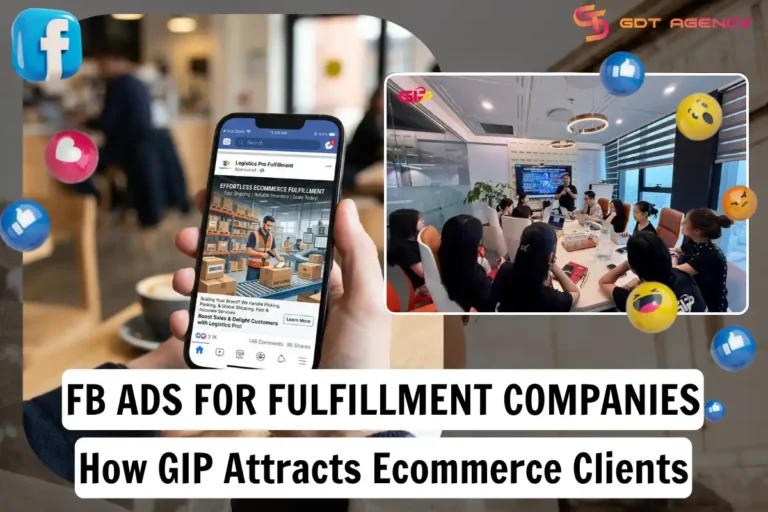
Facebook Ads work for fulfillment companies when the campaign targets the right buyer and shows real operational proof. GIP Fulfillment, a fulfillment provider serving ecommerce…

Photographers can run Facebook Ads successfully when they combine clear targeting, strong creative, and a tested follow-up process. This method works because Facebook still holds…

Facebook Ads for e-commerce is a paid advertising system on Meta’s platform that helps online stores find buyers, drive product sales, and grow revenue through…