Facebook Ads for Fulfillment Companies: How GIP Attracts Ecommerce Clients

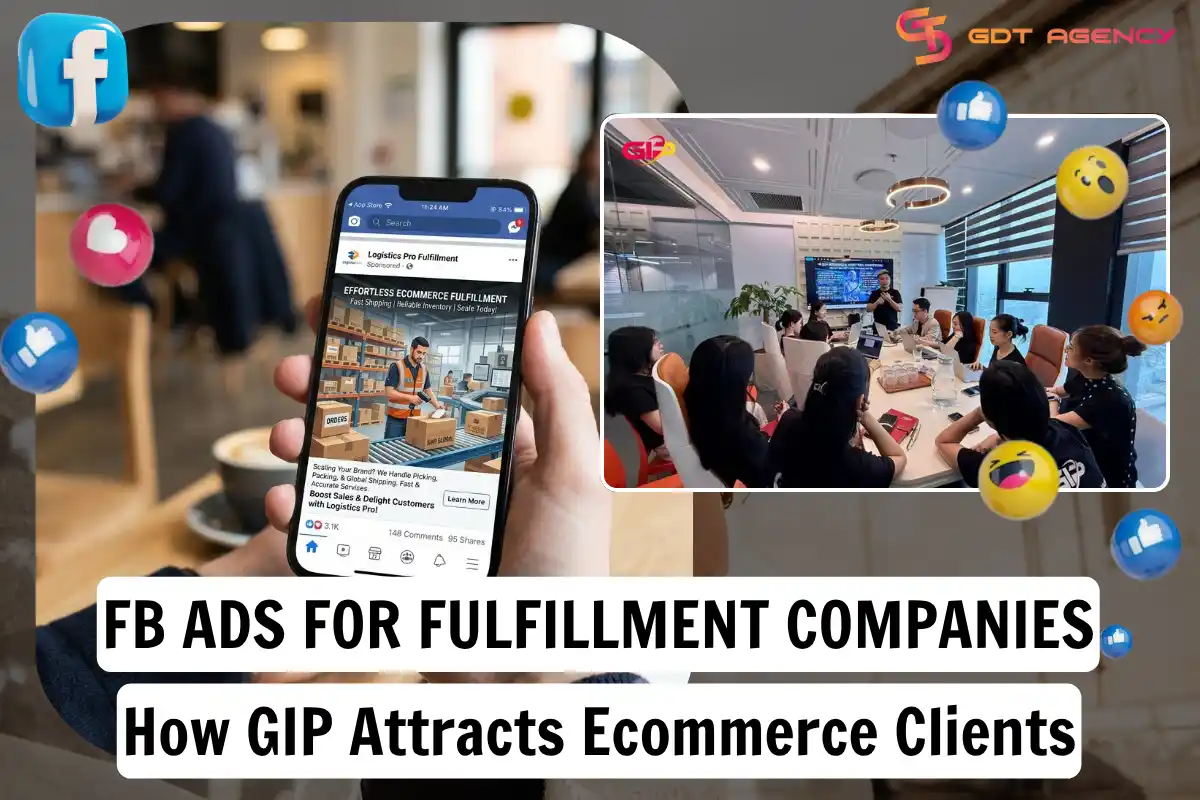
Facebook Ads work for fulfillment companies when the campaign targets the right buyer and shows real operational proof. GIP Fulfillment, a fulfillment provider serving ecommerce sellers across Southeast Asia, uses this channel to reach store owners who need warehousing, pick and pack, and shipping support. The result is a steady stream of qualified leads that convert into long-term fulfillment contracts.
A fulfillment company sells a service, not a product, so the ad strategy differs from typical ecommerce advertising. GIP builds campaigns around trust signals such as warehouse footage, delivery speed, and coverage across multiple countries. This approach answers the buyer’s first question directly: can this provider actually handle my orders at scale?
The ad formats matter as much as the targeting. Video content that shows a real warehouse floor performs better than static graphics for this industry, because the buyer wants proof before they hand over their inventory. Lead form ads then capture the request without forcing the visitor to leave Facebook, which shortens the path from click to conversation.
Below, this article breaks down whether Facebook Ads work for fulfillment companies, what the term means in this context, which ad formats perform best, and how GIP Fulfillment runs its own campaigns to attract ecommerce clients.
- Facebook Ads for Fulfillment Companies: Does It Work?
- What Is Facebook Ads for Fulfillment Companies?
- How Is This Different from White Label Facebook Ads Fulfillment?
- Who Is the Target Audience for These Ads?
- What Facebook Ad Formats Work Best for Fulfillment Companies?
- Video Ads Showing Warehouse and Fulfillment Operations
- Lead Form Ads for Quote Requests
- How Does GIP Fulfillment Use Facebook Ads to Attract Ecommerce Clients?
- Facebook Ads vs LinkedIn Ads: Which Works Better for Fulfillment Companies?
- When Facebook Ads Perform Better
- When LinkedIn Ads Perform Better
- How Should Facebook Pixel and Conversions API Be Set Up for B2B Fulfillment Leads?
- What Types of Fulfillment Companies Benefit Most from Facebook Ads?
- Paid vs Organic Social: Which Should Fulfillment Companies Prioritize First?
- How Do Cross-Border Ecommerce Fulfillment Companies Target International Clients on Facebook?
- Final Thoughts
- Frequently Asked Questions
- Is Facebook Ads a good channel for a B2B fulfillment company?
- Why do fulfillment companies face frequent ad account bans on Facebook?
- How much should a fulfillment company budget for Facebook Ads?
- What is a good ROI benchmark for Facebook Ads in the fulfillment industry?
- Should a fulfillment company hire an agency or manage Facebook Ads in-house?
Facebook Ads for Fulfillment Companies: Does It Work?
Yes, Facebook Ads work for fulfillment companies, for 3 main reasons: precise audience targeting, low entry cost compared to trade shows or referral networks, and a format built for showing operational proof through video and images.
As the CEO and Founder of GDT Agency with years of experience working with Facebook ads in multiple industries using Facebook agency ad accounts, I know that fulfillment is a B2B service with a long sales cycle, so the channel needs to do more than generate a click.
Facebook’s targeting options let a fulfillment provider narrow its audience to ecommerce store owners, Shopify sellers, and small business founders based on interests, page behavior, and lookalike audiences built from past client profiles. This precision reduces wasted spend compared to broader channels like display advertising.
Cost also favors fulfillment companies that are still building their client base. A fulfillment provider can start testing campaigns with a modest daily budget and scale spend once a specific ad set proves it generates qualified leads. Compare this to LinkedIn Ads, where cost per click for B2B audiences runs consistently higher.
Facebook also rewards the exact content type that builds trust for this industry. Warehouse walkthroughs, packing process videos, and client testimonials all perform well in feed and Stories placements, giving the fulfillment company a way to demonstrate capability rather than just describe it in text.
What Is Facebook Ads for Fulfillment Companies?
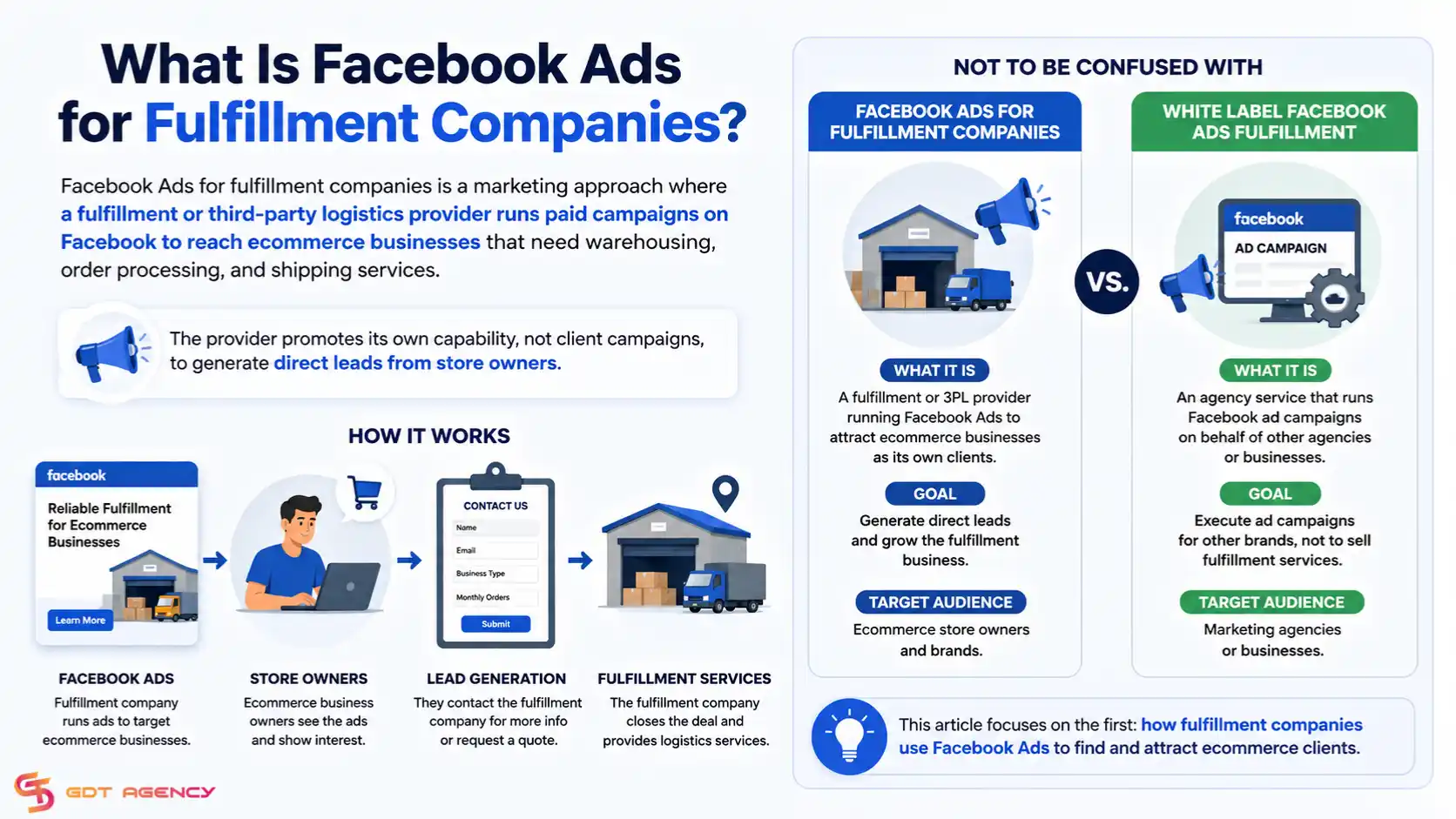
Facebook Ads for fulfillment companies is a marketing approach where a fulfillment or third-party logistics provider runs paid campaigns on Facebook to reach ecommerce businesses that need warehousing, order processing, and shipping services. The provider promotes its own capability, not client campaigns, to generate direct leads from store owners.
This definition sits apart from a common source of confusion in this space. Many search results under similar keywords point to a completely different service: agencies that offer white label. Facebook Ads fulfillment, meaning they run ad campaigns on behalf of other agencies. That is an advertising execution service. Facebook Ads for fulfillment companies, as covered in this article, refers to the opposite direction: a logistics or fulfillment provider using Facebook as its own client acquisition channel.
How Is This Different from White Label Facebook Ads Fulfillment?
White label Facebook Ads fulfillment describes a marketing agency that manages Meta ad campaigns for another agency’s clients, under that agency’s brand. The word “fulfillment” in that context refers to executing an ad campaign.
In contrast, Facebook Ads for a fulfillment company like GIP has nothing to do with ad execution services. GIP is a logistics provider that stores inventory, picks and packs orders, and ships products for ecommerce sellers. The ads promote warehousing and shipping capability, not marketing services. Readers who search for one term sometimes land on content built for the other, so this distinction matters before any strategy discussion begins.
Who Is the Target Audience for These Ads?
The target audience for Facebook Ads run by a fulfillment company includes ecommerce store owners, direct-to-consumer brand founders, and operations managers who handle order processing for a growing online business.
These buyers typically show specific signals on Facebook: they follow ecommerce tools like Shopify or WooCommerce, engage with content about scaling an online store, or belong to groups focused on cross-border ecommerce. A fulfillment company can also build a custom audience from website visitors who viewed a pricing or service page, then create a lookalike audience from that group to find new prospects with similar characteristics.
→ Facebook Ads for fulfillment companies is a marketing approach where a fulfillment or third-party logistics provider runs paid campaigns on Facebook to reach ecommerce businesses that need warehousing, order processing, and shipping services. Fulfillment and third-party logistics are just one of many industries that rely on Facebook advertising, and each business vertical requires different targeting, creative, and campaign objectives. If you want to see how Facebook advertising differs across industries, read our guide on Facebook Ad Account by Business Type: Use Cases and Verticals.
What Facebook Ad Formats Work Best for Fulfillment Companies?
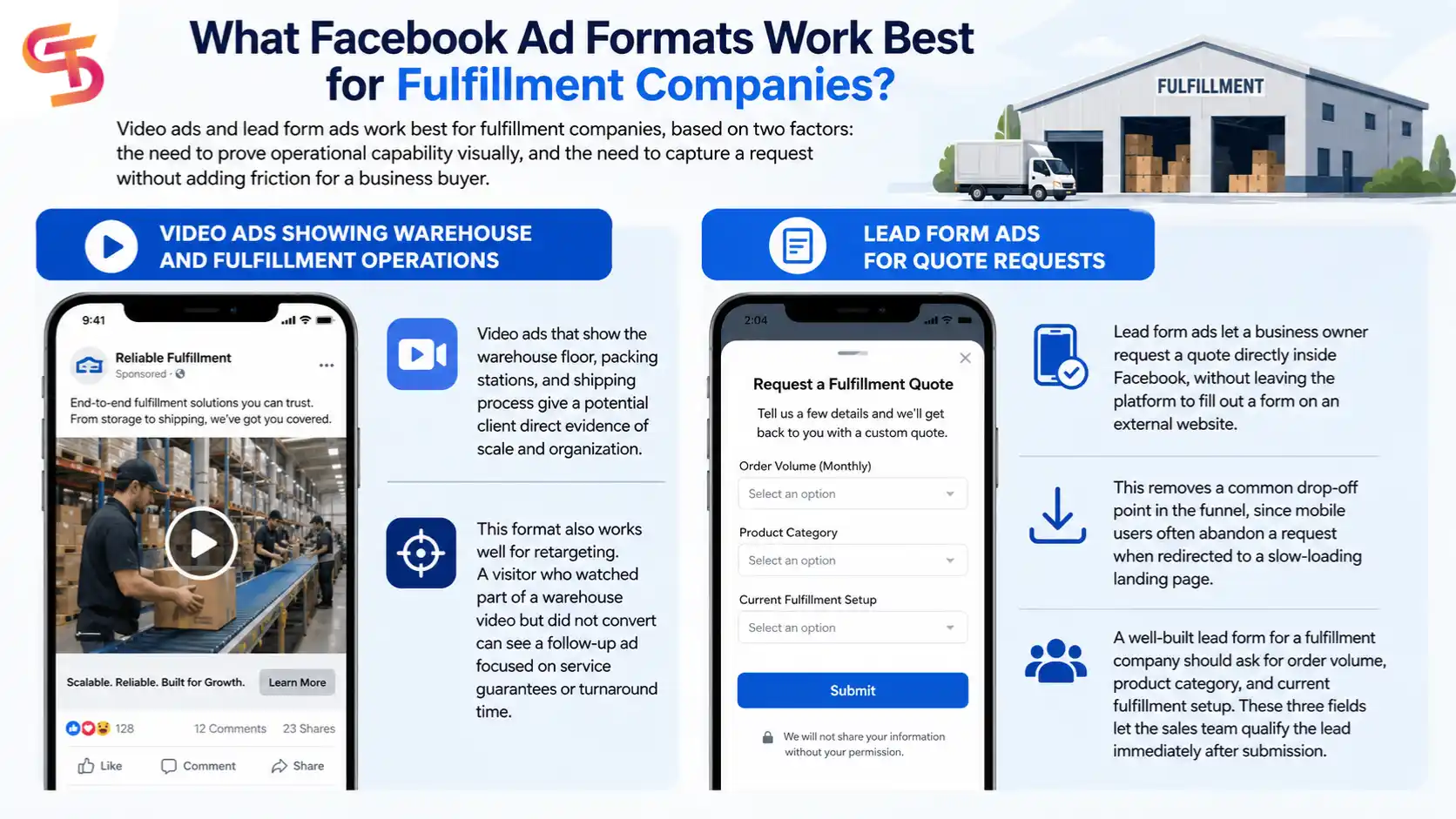
Video ads and lead form ads work best for fulfillment companies, based on two factors: the need to prove operational capability visually, and the need to capture a request without adding friction for a business buyer.
A fulfillment service is intangible until a buyer sees the actual operation. Formats that combine visual proof with a low-friction next step consistently outperform generic text-based ads for this industry, because they answer the buyer’s core doubt: can this provider really do what they claim.
Video Ads Showing Warehouse and Fulfillment Operations
Video ads that show the warehouse floor, packing stations, and shipping process give a potential client direct evidence of scale and organization. A short clip of staff picking and packing an order, followed by a shipment leaving the dock, communicates operational readiness faster than any written description.
This format also works well for retargeting. A visitor who watched part of a warehouse video but did not convert can see a follow-up ad focused on service guarantees or turnaround time, which keeps the fulfillment company visible during a longer B2B decision process.
Lead Form Ads for Quote Requests
Lead form ads let a business owner request a quote directly inside Facebook, without leaving the platform to fill out a form on an external website. This removes a common drop-off point in the funnel, since mobile users often abandon a request when redirected to a slow-loading landing page.
A well-built lead form for a fulfillment company should ask for order volume, product category, and current fulfillment setup. These three fields let the sales team qualify the lead immediately after submission, instead of scheduling a call just to gather basic information.
How Does GIP Fulfillment Use Facebook Ads to Attract Ecommerce Clients?
GIP Fulfillment runs Facebook Ads to attract ecommerce clients by fixing an infrastructure problem first: unstable ad accounts. GIP moved to a rented, high-trust ad account setup through GDT Agency, and that single change turned an unusable campaign into a stable client acquisition channel.
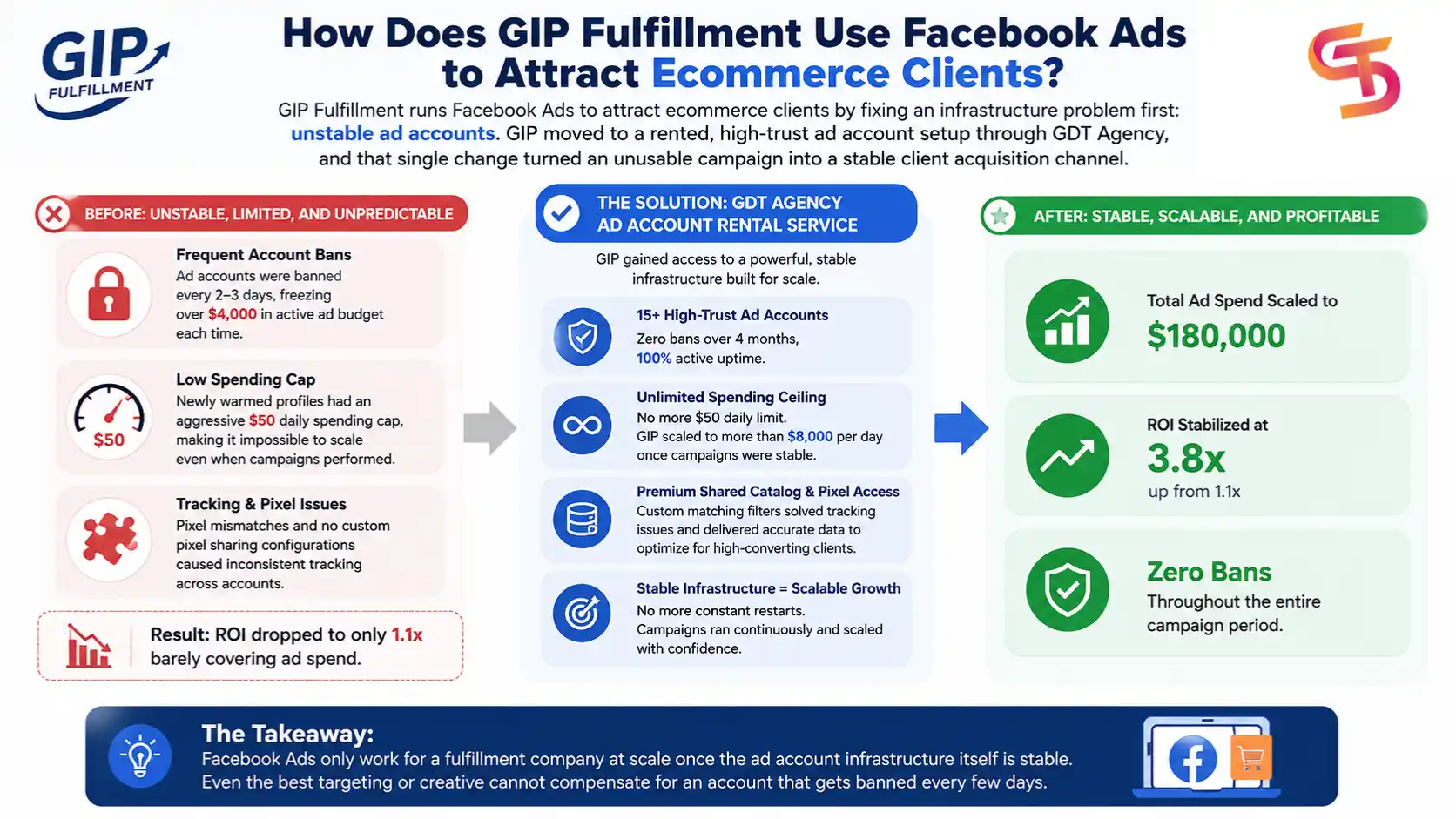
Before this change, GIP’s ad accounts faced repeated bans every two to three days, which froze more than $4,000 in active ad budget each time an account went down. Newly warmed profiles carried an aggressive $50 daily spending cap, so GIP could not scale a campaign even when it started performing. Pixel mismatches and the lack of custom pixel sharing configurations added another layer of friction, since GIP could not track conversions consistently across accounts. These three problems combined pushed ROI down to 1.1, a level that barely covers ad spend, let alone funds growth.
The turnaround came from switching to GDT Agency’s ad account rental service. GIP gained access to 15 or more high-trust ad accounts and recorded zero bans over four months, a 100 percent active uptime rate that let campaigns run without the constant restart cycle that had blocked growth before. The spend ceiling moved from a fixed $50 daily cap to an unlimited ceiling, and GIP began spending more than $8,000 per day once campaigns proved stable enough to scale. Premium shared catalog and pixel access, paired with custom matching filters, solved the tracking problem and gave GIP accurate data to optimize toward ecommerce clients who convert.
The result shows in three numbers: GIP scaled total ad spend to $180,000, stabilized ROI at 3.8x, up from the earlier 1.1x, and faced zero bans throughout the campaign period. This case demonstrates that Facebook Ads only work for a fulfillment company at scale once the ad account infrastructure itself is stable, since even the best targeting or creative cannot compensate for an account that gets banned every few days.
Facebook Ads vs LinkedIn Ads: Which Works Better for Fulfillment Companies?
Facebook Ads work better for reaching small and mid-size ecommerce sellers early in their search for a fulfillment partner, while LinkedIn Ads work better for reaching enterprise shippers and supply chain decision-makers who require a longer, account-based sales process.
The two platforms serve different stages of the buyer journey for a fulfillment company. Facebook reaches a wider pool of ecommerce founders at lower cost, which suits companies still building volume. LinkedIn reaches a smaller, more senior audience with higher intent but at a higher cost per lead, which suits companies targeting large retail or enterprise accounts.
When Facebook Ads Perform Better
Facebook Ads perform better during the awareness stage, when a fulfillment company wants to reach small to mid-size ecommerce sellers who are actively growing their order volume. These buyers respond well to visual proof and often make decisions faster than enterprise accounts, since a single founder or small operations team usually controls the choice.
When LinkedIn Ads Perform Better
LinkedIn Ads perform better for account-based marketing aimed at enterprise shippers, where the buyer is a supply chain director or procurement manager working through a formal evaluation process. These campaigns work best paired with thought leadership content, since enterprise buyers research a provider’s expertise before requesting a proposal.
How Should Facebook Pixel and Conversions API Be Set Up for B2B Fulfillment Leads?
Facebook Pixel and Conversions API should track lead form submissions, quote requests, and pricing page visits as the core conversion events for a B2B fulfillment company, since these actions signal genuine buying intent rather than casual browsing.
Server-side tracking through the Conversions API matters more for this industry than for typical ecommerce advertising, because B2B buyers often visit a site from a work device with stricter privacy settings, which can block standard browser-based Pixel tracking. Setting up both Pixel and Conversions API together gives Meta’s algorithm more accurate signals to optimize campaigns toward genuine leads instead of low-value clicks.
What Types of Fulfillment Companies Benefit Most from Facebook Ads?
Fulfillment companies that serve direct-to-consumer brands, cross-border ecommerce sellers, and small to mid-size online retailers benefit most from Facebook Ads, since these buyer segments are active on the platform and make decisions faster than enterprise shippers.
A fulfillment provider focused on cold chain logistics or large-scale industrial clients may find LinkedIn or direct outreach more effective, since those buyers rarely make sourcing decisions through social media. The fit depends heavily on how the target client actually searches for and evaluates a provider.
Paid vs Organic Social: Which Should Fulfillment Companies Prioritize First?
Paid social should come first for a fulfillment company that needs leads quickly, while organic social builds trust and credibility over time but takes longer to generate direct inquiries.
A new fulfillment provider with limited brand recognition typically needs paid campaigns to reach potential clients who have never heard of the company. Once a steady client base exists, organic content such as client success stories and behind-the-scenes warehouse posts can support paid campaigns by reinforcing credibility for prospects who research the company before submitting a lead form.
How Do Cross-Border Ecommerce Fulfillment Companies Target International Clients on Facebook?
Cross-border ecommerce fulfillment companies target international clients on Facebook by layering location targeting across multiple countries with interest signals tied to specific marketplace platforms and shipping challenges relevant to each region.
A provider operating across several countries, such as GIP’s presence in Vietnam, the Philippines, Thailand, Malaysia, and Indonesia, can run separate ad sets for each market with localized messaging about delivery speed and customs handling in that specific country. This regional approach performs better than a single broad campaign, since fulfillment needs and shipping regulations vary significantly across Southeast Asian markets.
>>> Related Article: Facebook Ads for E-Commerce: Setup, Strategy, and Scaling in 2026
Final Thoughts
Facebook Ads work for fulfillment companies, but the channel only delivers results once two conditions are met: the ad account infrastructure stays stable, and the campaign shows real operational proof instead of generic claims. GIP’s case makes this point clearly. Targeting and creative could not fix a 1.1 ROI, because the real bottleneck was an ad account that kept getting banned. Once GIP moved to a high-trust, rented account setup, the same market and the same service scaled to $180,000 in spend and a 3.8x ROI.
A fulfillment company that wants similar results should treat ad account stability as the foundation, not an afterthought. Video content that shows the warehouse and packing process builds trust with ecommerce buyers, lead form ads reduce friction at the point of conversion, and accurate pixel tracking through the Conversions API keeps the data clean enough to optimize toward real leads. For companies operating across multiple countries, splitting campaigns by market instead of running one broad ad set gives each region the localized proof it needs to convert.
Facebook Ads and LinkedIn Ads serve different stages of this journey rather than competing for the same budget. A fulfillment company can use Facebook to reach smaller ecommerce sellers who decide quickly, then layer in LinkedIn once it starts targeting enterprise shippers with a longer evaluation process. The combination, built on a stable ad account foundation, gives a fulfillment company a repeatable path from cold audience to signed client.
Frequently Asked Questions
Is Facebook Ads a good channel for a B2B fulfillment company?
Yes, Facebook Ads work well for a B2B fulfillment company, especially when targeting small to mid-size ecommerce sellers who make decisions faster than enterprise buyers. The channel works best when paired with video proof of warehouse operations and a stable ad account setup that avoids frequent bans.
Why do fulfillment companies face frequent ad account bans on Facebook?
Fulfillment companies often face frequent ad account bans due to newly warmed profiles, inconsistent pixel setups, and aggressive spending patterns that trigger Meta’s automated risk detection. Renting established, high-trust ad accounts through an agency reduces this risk significantly, as GIP’s case shows with zero bans over four months after the switch.
How much should a fulfillment company budget for Facebook Ads?
A fulfillment company should start with a modest daily budget while testing which audience and creative combination generates qualified leads, then scale spend once ROI stabilizes. GIP scaled from a $50 daily cap on a struggling account to more than $8,000 in daily spend once its ad account infrastructure became stable and ROI reached 3.8x.
What is a good ROI benchmark for Facebook Ads in the fulfillment industry?
A ROI of 3x or higher generally signals a healthy Facebook Ads campaign for a fulfillment company, since the service involves a longer sales cycle and higher client lifetime value than typical ecommerce products. GIP’s stabilized ROI of 3.8x after fixing its ad account issues falls within this healthy range.
Should a fulfillment company hire an agency or manage Facebook Ads in-house?
A fulfillment company should consider working with an agency when it lacks stable ad account access or in-house expertise in B2B targeting and pixel configuration, since these two factors caused GIP’s early campaign failures. Once ad account infrastructure is solid, the choice between agency and in-house management depends on team size and available marketing expertise.