Facebook Ad Account Policies: What Gets Approved and Banned


Facebook ad account policies define 3 categories of content: what gets approved without conditions, what gets restricted with conditions, and what gets banned permanently. These rules apply to every advertiser running ads through Meta's platform, from solo marketers to agency-managed accounts. Understanding the full policy system is the difference between ads that run smoothly and an account that faces repeated rejections or permanent disabling.
Knowing the rules is only part of the challenge. Facebook's review process uses a combination of automated systems and human reviewers, and the enforcement is not always consistent or predictable. Advertisers who understand how the review process works can structure their campaigns to reduce friction and avoid triggering unnecessary flags.
Beyond approval and rejection, Facebook policies affect the long-term health of your ad account. A single policy violation can result in a rejected ad. A pattern of violations can escalate to account restriction or full disablement. For agencies managing multiple client accounts, the stakes are even higher because one flagged account can affect the entire Business Manager structure.
After understanding the policy framework, advertisers need practical compliance steps they can apply before submitting any campaign. This article walks through the complete system - from what Facebook allows, to what it bans, to how the review process works, and finally what a compliant account setup looks like in practice.
- What Are Facebook Ad Account Policies and Why Do They Matter?
- What Types of Content Does Facebook Allow in Ads?
- What Are the Standard Requirements for a Facebook Ad to Get Approved?
- What Is Restricted Content on Facebook Ads and How Does It Differ from Prohibited Content?
- What Content Is Banned from Facebook Ads?
- Does Facebook Ban Ads That Use Before-and-After Images?
- Does Facebook Prohibit Ads That Target Users Based on Sensitive Personal Attributes?
- How Do You Keep Your Facebook Ad Account Compliant?
- How Does Facebook's Ad Review Process Work?
- What Happens to Your Facebook Ad Account If an Ad Violates Policy?
- Does Having an Agency Ad Account Affect How Facebook Policies Apply to Your Ads?
- Final Thoughts
What Are Facebook Ad Account Policies and Why Do They Matter?
Facebook Ad Account Policies are a set of rules and standards that govern what advertisers can and cannot promote on Meta's platforms, including Facebook, Instagram, Messenger, and the Audience Network. These policies sit within a three-tier framework: Meta's Advertising Standards, Meta's Terms of Service, and Meta's Community Standards. All three apply simultaneously to every ad an account runs.
Specifically, these policies exist to serve 3 groups at the same time.
- For users, the policies protect them from misleading offers, harmful products, and privacy violations.
- For legitimate advertisers, the policies create a level playing field where bad actors cannot undercut honest campaigns with false claims.
- For Meta itself, the policies protect ad revenue and platform integrity.
To understand why the policies are enforced so strictly, it helps to understand that Meta processes billions of ad impressions daily and relies on automated systems to catch violations at scale before they reach users.
The practical implication for advertisers is that ignorance of the rules is not an accepted defense. Meta's Advertising Standards state explicitly that it is the advertiser's responsibility to understand and comply with all applicable policies. This responsibility extends to the content of the ad itself, the landing page the ad links to, and the product or service being promoted. All three must comply with policy, not just the ad creative.
According to Meta's Advertising Standards documentation, advertisers must also comply with applicable laws in their target regions. This means a campaign that is legally permitted in one country may still violate Facebook policy if it conflicts with laws in another country where the ad is being served.
→ If you're new to Facebook advertising, start by learning what a Facebook ad account is and how it works before diving into the platform's policies.
What Types of Content Does Facebook Allow in Ads?
Facebook allows ads that promote lawful products and services, use accurate and honest representations, link to functional and policy-compliant landing pages, and target audiences in ways that do not discriminate based on protected characteristics. These four conditions form the baseline for approved content across all industries.
To understand what "allowed" looks like in practice, it helps to break the criteria into concrete categories. Below is a summary of the main content types Facebook approves without additional conditions:
| Permitted Content Category | Key Requirements |
| E-commerce products (clothing, electronics, home goods) | Accurate product description, functional checkout page |
| Software and apps | No deceptive functionality claims, functional app store link |
| Education and online courses | Honest outcome claims, real institution or creator |
| Financial services (standard) | No misleading fee information, compliant landing page |
| Local businesses and services | No false reviews, accurate business representation |
| Events and entertainment | Accurate event details, compliant ticket page |
This table outlines the baseline permitted categories. Each category carries its own sub-rules, but these are the industries where advertisers generally experience smooth approval if the ad creative and landing page meet standard requirements.
What Are the Standard Requirements for a Facebook Ad to Get Approved?
A Facebook ad gets approved when it meets five baseline requirements:
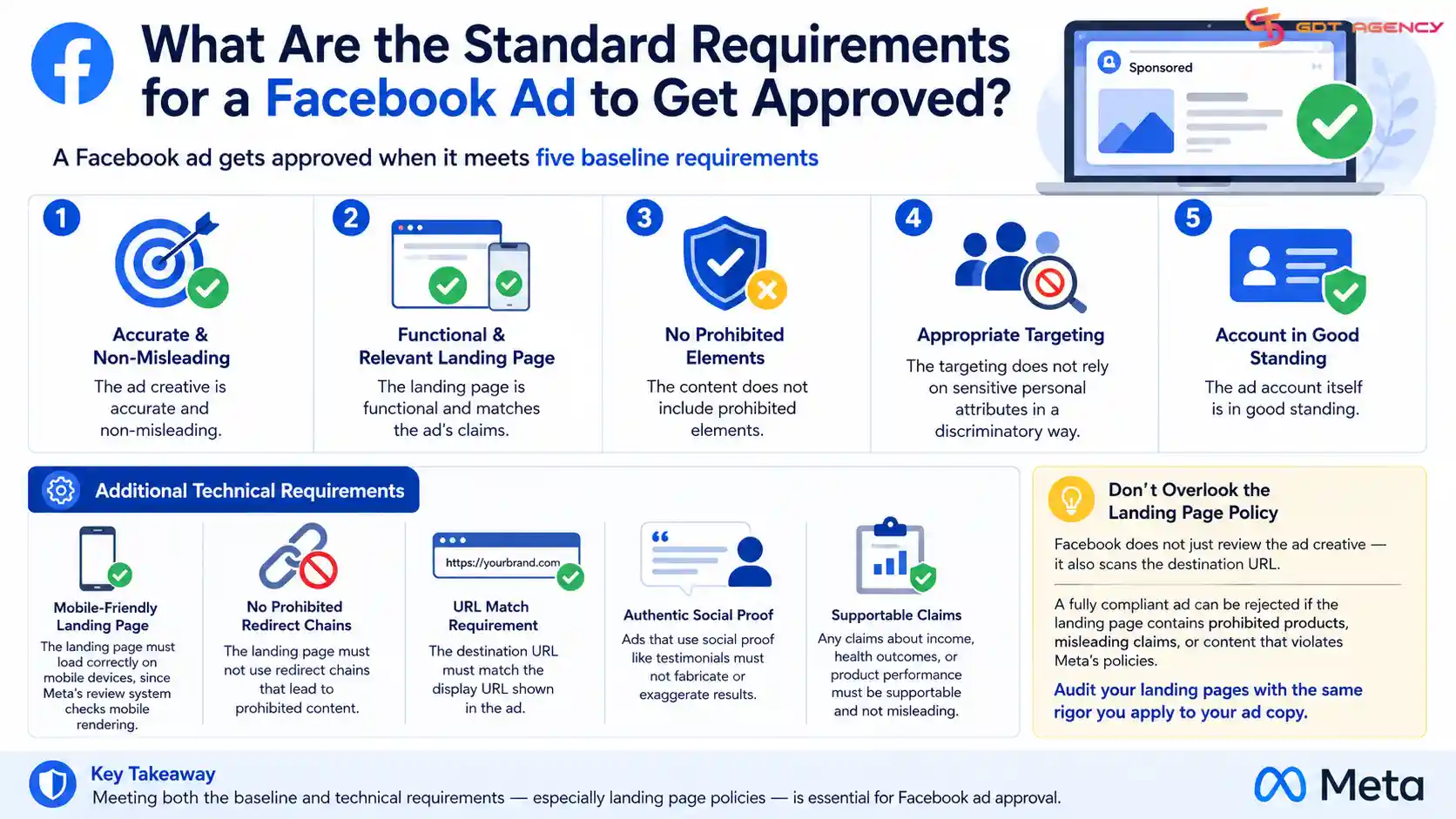
- The ad creative is accurate and non-misleading.
- The landing page is functional and matches the ad's claims.
- The content does not include prohibited elements.
- The targeting does not rely on sensitive personal attributes in a discriminatory way.
- The ad account itself is in good standing.
Beyond these five, Facebook applies additional technical requirements. The landing page must load correctly on mobile devices, since Meta's review system checks mobile rendering. The landing page must not use redirect chains that lead to prohibited content. The destination URL must match the display URL shown in the ad. Ads that use social proof like testimonials must not fabricate or exaggerate results. Any claims about income, health outcomes, or product performance must be supportable and not misleading.
One requirement that surprises many new advertisers is the landing page policy. Facebook does not just review the ad creative - it also scans the destination URL. A fully compliant ad can be rejected if the landing page contains prohibited products, misleading claims, or content that violates Meta's policies. This means advertisers need to audit their landing pages with the same rigor they apply to their ad copy.
What Is Restricted Content on Facebook Ads and How Does It Differ from Prohibited Content?
Restricted content is allowed on Facebook with prior written permission from Meta, additional certifications, or targeting restrictions applied to the campaign. Prohibited content is never allowed under any circumstances, regardless of permissions or certifications.
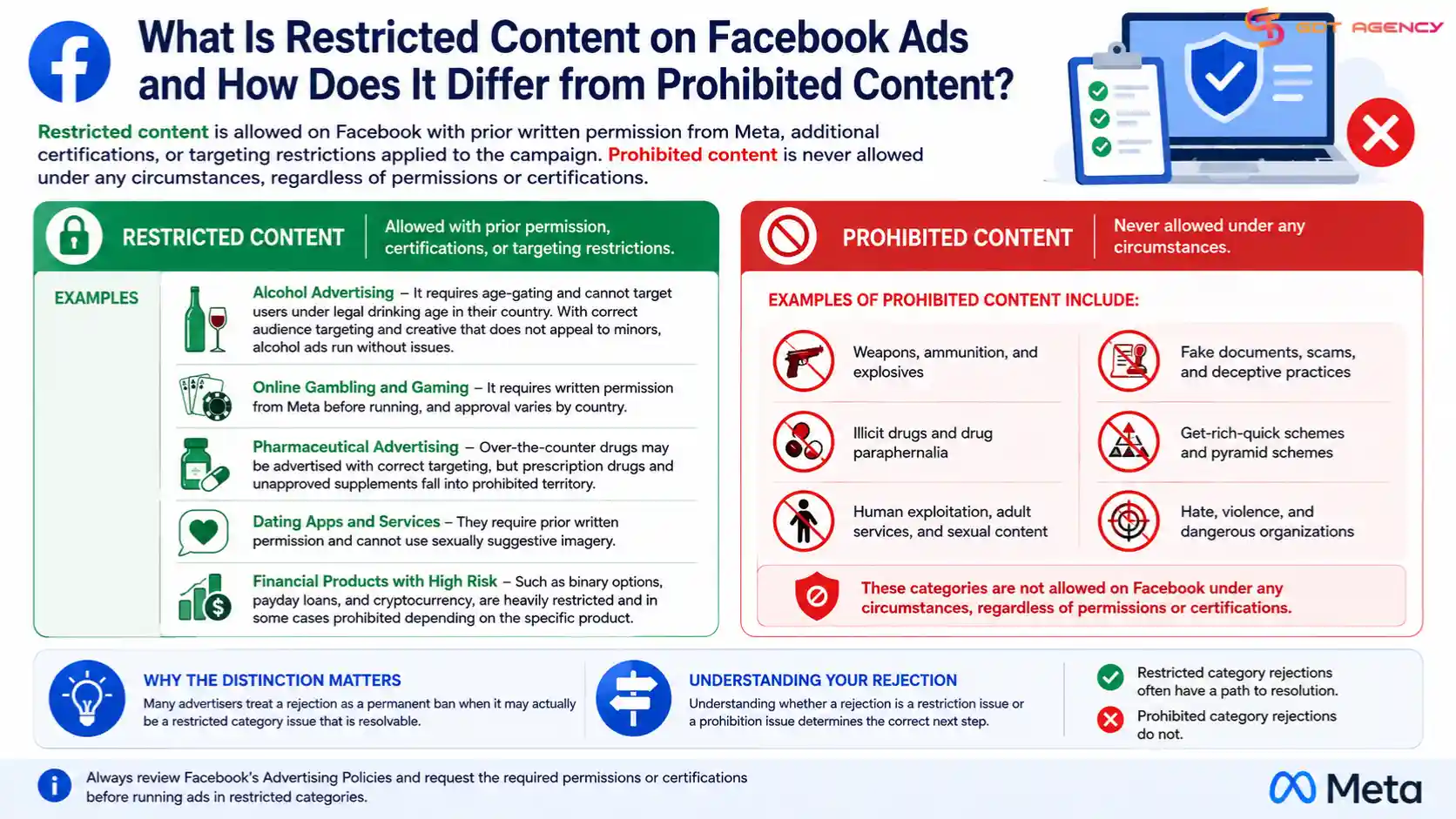
The distinction matters because many advertisers treat a rejection as a permanent ban when it may actually be a restricted category issue that is resolvable. For example:
- Alcohol advertising is restricted - it requires age-gating and cannot target users under the legal drinking age in their country. With correct audience targeting and creative that does not appeal to minors, alcohol ads run without issues.
- Online gambling and gaming are restricted - it requires written permission from Meta before running, and approval varies by country.
- Pharmaceutical advertising is restricted - over-the-counter drugs may be advertised with correct targeting, but prescription drugs and unapproved supplements fall into prohibited territory.
- Dating apps and services are restricted - they require prior written permission and cannot use sexually suggestive imagery.
- Financial products with high risk, such as binary options, payday loans, and cryptocurrency, are heavily restricted and in some cases prohibited depending on the specific product.
Understanding whether a rejection is a restriction issue or a prohibition issue determines the correct next step. Restricted category rejections often have a path to resolution. Prohibited category rejections do not.
What Content Is Banned from Facebook Ads?
Facebook bans 6 main categories of content permanently across all ad types and placements: illegal products and services, discriminatory practices, deceptive and misleading content, adult and sexually explicit content, dangerous products and substances, and health and wellness misinformation. No certification or permission overrides these prohibitions.
Specific prohibited categories include:
| Prohibited Category | Examples |
| Illegal products and services | Counterfeit goods, drug paraphernalia, illegal weapons, and modifications |
| Discriminatory practices | Ads that deny housing, employment, or credit based on race, gender, religion, national origin, sexual orientation, or disability |
| Deceptive content | False claims, fabricated testimonials, misleading before/after imagery |
| Adult content | Nudity, sexually explicit material, and content implying sexual acts |
| Dangerous goods | Sale of firearms without proper licensing, explosives, and tobacco to minors |
| Health misinformation | Unproven medical treatments, anti-vaccine content, miracle cure claims |
This table covers the main prohibited categories. Each one has subcategories and nuances, but these represent the areas where Facebook enforces zero-tolerance policies consistently.
Does Facebook Ban Ads That Use Before-and-After Images?
Yes, Facebook bans ads that use before-and-after images in most health, fitness, and weight loss contexts. The policy targets imagery that implies dramatic physical transformation because these images typically involve misleading claims about outcomes. An ad showing a person's body significantly thinner or more muscular after using a product violates Facebook's personal attributes policy and its policy against misleading health claims.
The personal attributes policy extends beyond body image. Facebook prohibits ads that imply knowledge of a user's personal attributes, including health conditions, financial situation, or mental health status. A weight loss ad that opens with "Struggling with your weight?" is flagged because it implies knowledge of the user's body. The correct approach is to describe the product's features without implying assumptions about the viewer.
Does Facebook Prohibit Ads That Target Users Based on Sensitive Personal Attributes?
Yes, Facebook prohibits ads that use targeting or messaging to discriminate against users based on sensitive personal attributes, including race, ethnicity, color, national origin, religion, age, sex, sexual orientation, gender identity, family status, disability, medical condition, and genetic information. This applies to the housing, employment, and credit sectors specifically through Meta's Special Ad Categories framework.
Beyond explicit targeting, the prohibition also covers ad copy and creative that imply discrimination. An ad for a job opening that uses imagery showing only one demographic, or copy that implies preference for candidates of a specific background, can be flagged under this policy even if the targeting settings appear neutral. The full creative must comply, not just the audience setup.
How Do You Keep Your Facebook Ad Account Compliant?
Keeping a Facebook ad account compliant requires five ongoing practices: running a pre-submission creative review against Meta's Advertising Standards, maintaining accurate and functional landing pages, setting up Business Manager with correct roles and access controls, enabling two-factor authentication on all admin accounts, and auditing account access regularly to remove unauthorized users.
These 5 practices form the baseline compliance infrastructure. Below is a practical breakdown of each:
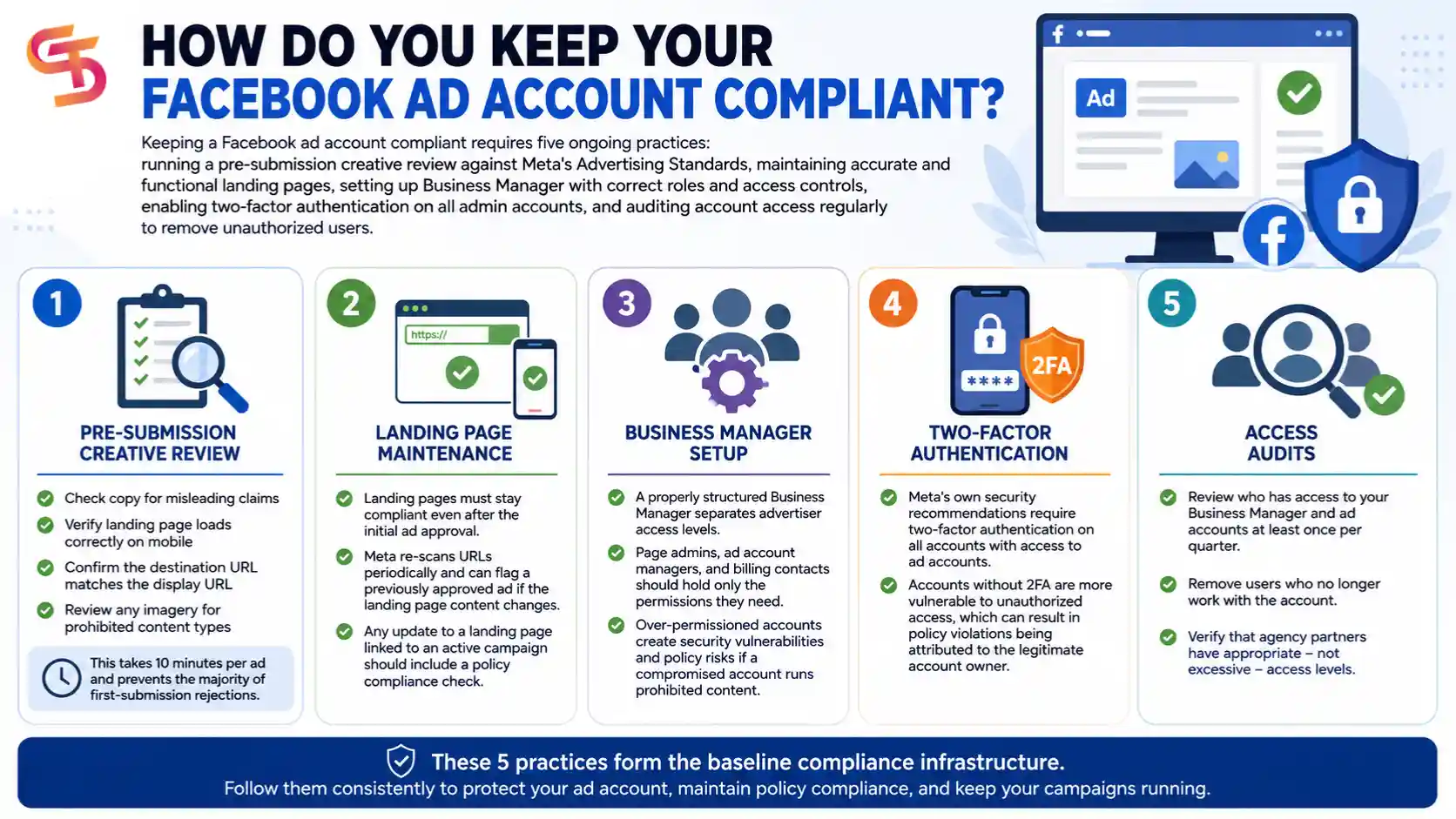
1. Pre-submission creative review: Before submitting any ad, check the copy for misleading claims, verify the landing page loads correctly on mobile, confirm the destination URL matches the display URL, and review any imagery for prohibited content types. This takes 10 minutes per ad and prevents the majority of first-submission rejections.
2. Landing page maintenance: Landing pages must stay compliant even after the initial ad approval. Meta re-scans URLs periodically and can flag a previously approved ad if the landing page content changes. Any update to a landing page linked to an active campaign should include a policy compliance check.
3. Business Manager setup: A properly structured Business Manager separates advertiser access levels. Page admins, ad account managers, and billing contacts should hold only the permissions they need. Over-permissioned accounts create security vulnerabilities and policy risks if a compromised account runs prohibited content.
4. Two-factor authentication: Meta's own security recommendations require two-factor authentication on all accounts with access to ad accounts. Accounts without 2FA are more vulnerable to unauthorized access, which can result in policy violations being attributed to the legitimate account owner.
5. Access audits: Review who has access to your Business Manager and ad accounts at least once per quarter. Remove users who no longer work with the account and verify that agency partners have appropriate - not excessive - access levels.
How Does Facebook's Ad Review Process Work?
Facebook's ad review process works in two stages: an initial automated review that checks ads against policy rules using machine learning, followed by a human review that handles edge cases, appeals, and ads flagged by the automated system as requiring closer inspection. Most ads complete the automated review within 24 hours, though Meta's current policy states review can take longer during high-volume periods.
The automated system checks the ad creative, the destination URL, and the advertiser's account history simultaneously. It uses image recognition to identify prohibited imagery, natural language processing to flag prohibited claims in ad copy, and URL scanning to check landing page content. An ad account with a clean policy history moves through this process faster than an account with previous violations on record.
Human review activates when the automated system flags an ad as uncertain, when an advertiser submits an appeal after rejection, or when the ad falls into a category that Meta has designated as requiring manual review. Human reviewers apply the same policies as the automated system, but can apply more contextual judgment to edge cases. However, human review timelines are less predictable and can extend to several business days.
What Happens to Your Facebook Ad Account If an Ad Violates Policy?
A Facebook ad policy violation triggers a four-stage escalation: the individual ad is rejected, a warning is issued to the ad account, repeated violations lead to account-level advertising restrictions, and severe or persistent violations result in full account disablement.
Each stage has distinct implications:
- Ad rejection (Stage 1): The specific ad is disapproved and cannot run. The advertiser receives a notification with the policy violation cited. The ad account remains fully functional for other campaigns.
- Account warning (Stage 2): After multiple rejections for the same type of violation, Meta issues a formal warning to the account. The account can still run ads, but the warning is recorded in the account's policy history.
- Advertising restriction (Stage 3): Meta limits the account's ability to run certain types of ads or restricts spending capacity. Some features, like creating new ad accounts or adding new payment methods, may be blocked.
- Account disablement (Stage 4): The ad account and its associated ads are fully disabled. The Business Manager may also be affected if the violations are severe enough. At this stage, recovery requires a formal appeal with supporting documentation.
The critical point is that the escalation is cumulative and account-specific. An ad account that reaches Stage 3 or 4 carries that history even after individual violations are resolved.
Does Having an Agency Ad Account Affect How Facebook Policies Apply to Your Ads?
No, Facebook policies apply identically to agency ad accounts and self-managed ad accounts. The same Advertising Standards, prohibited content rules, and review processes govern both. However, agency-level Business Manager structures add a second layer of access control that affects how violations are handled and who bears responsibility.
In an agency BM setup, the agency holds the ad account and grants access to the client. If a client runs ads through an agency account that violate policy, the violation is recorded against the agency's account, not just the client. This makes advertiser vetting a compliance requirement for agencies, not just a business preference. Agencies managing accounts for multiple clients need clear internal policies for what campaigns they accept and how they review client creative before it goes to Meta's review system. For advertisers using rented agency accounts, understanding this structure matters because account health is a shared responsibility between the agency and the advertiser.
Final Thoughts
Facebook ad account policies operate as a layered system where platform-level rules, category-specific restrictions, and account-level history all interact to determine what runs and what gets flagged. Advertisers who treat compliance as a one-time checklist rather than an ongoing practice are the ones who end up facing unexpected account restrictions at the worst possible moment.
The practical path forward is straightforward: understand the difference between prohibited content and restricted content, build a pre-submission review process, keep Business Manager access clean, and know the appeal process before you need it. For agencies managing accounts on behalf of clients, add advertiser vetting and client creative review to that list.
Policy enforcement on Facebook will continue to evolve. Meta updates its Advertising Standards regularly, and new product categories - particularly in cryptocurrency, AI tools, and health technology - are subject to policy changes as the regulatory environment shifts. Checking Meta's Advertising Standards directly before launching campaigns in new categories is the most reliable way to stay ahead of enforcement changes.
Articles in the category Policies Compliance
No articles found in this category yet.