
Facebook Ads Stuck in Learning Phase in 2026: How To Get Out Quickly
Facebook ads stay stuck in the learning phase in 2026 when the account cannot generate enough signal density. Fix it by consolidating small ad sets…
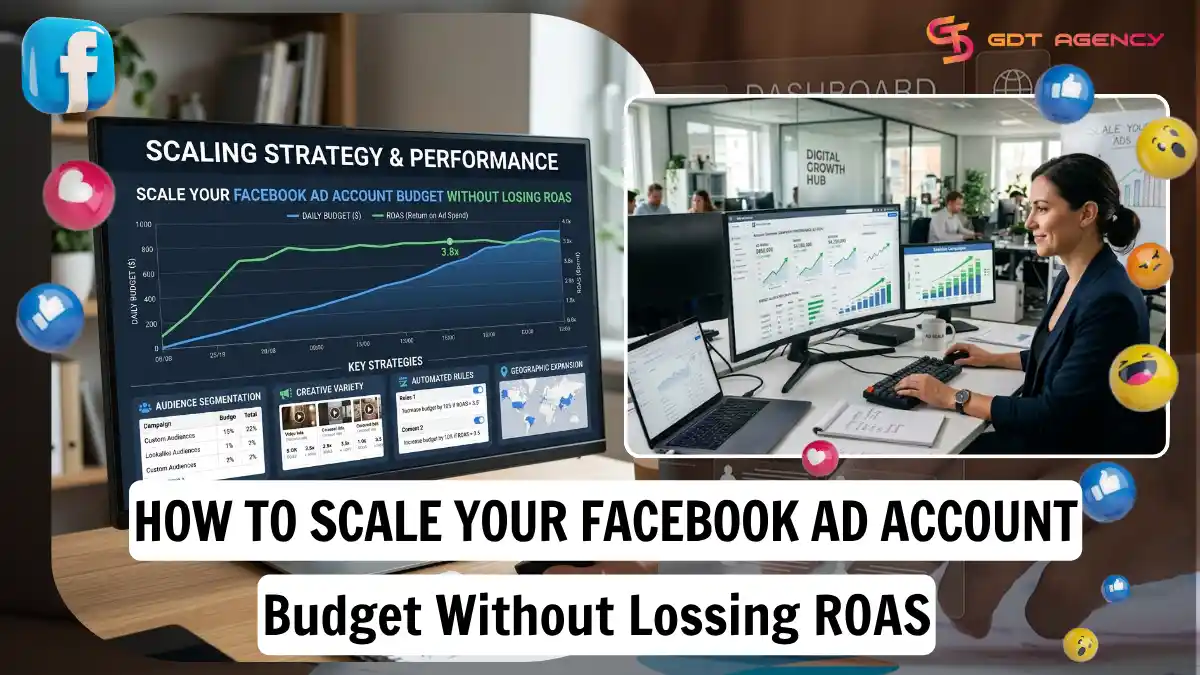
Scaling a Facebook ad account budget without losing ROAS means increasing your daily ad spend in planned, data-driven increments - not random jumps - while keeping your cost per acquisition stable and your return on ad spend positive. Most advertisers damage their ROAS not because they scale, but because they scale too fast, too early, or without the right campaign structure underneath.
Before you touch your budget, your campaign needs to pass specific performance thresholds. A stable CPA within 20% of your target, at least 30 to 50 weekly conversions, and 3 to 7 consecutive days of consistent delivery are the minimum signals that tell you a campaign is ready. Scale before these conditions are met, and you are spending money to collect noise, not results.
Once you confirm those signals, the method you use to increase spend determines whether your ROAS holds. The 20% rule - never increasing a campaign budget by more than 20% every 48 hours - gives Meta's algorithm time to recalibrate delivery without forcing a re-entry into the learning phase. Pair that with the right choice between ABO and CBO at each stage, and your scaling becomes repeatable instead of reactive.
Knowing when to stop or pull back is just as important as knowing when to push. A CPA spike of 40% or more after a budget increase is a clear signal to roll back, wait 48 hours, and try a smaller increment. The sections below walk you through every part of this process in order.
Scaling a Facebook ad account budget means increasing your ad spend in a controlled, systematic way while maintaining or improving ROAS - it is not simply adding more money to a campaign and waiting for better results.
The difference between these two approaches is significant. When advertisers treat scaling as a spending exercise, they dump budget into campaigns that have not yet proven stable, and Meta's algorithm responds by broadening delivery to burn the new budget fast, often to lower-quality audiences. The result is a higher CPA and a lower ROAS within days.
Real scaling treats budget increases as a signal to the algorithm. You are telling Meta: "These are my best-performing ad sets, give them more fuel." To do that effectively, you need a clean campaign structure, validated ad sets, and a clear understanding of two core methods - vertical scaling and horizontal scaling.
→ If you're new to Meta advertising, start by learning what a Facebook ad account is and how it works before applying any budget scaling strategy.
Vertical scaling and horizontal scaling are the two main approaches to growing your Facebook ad spend. Vertical scaling wins for speed, horizontal scaling wins for stability, and the most effective accounts use both together, depending on which growth stage they are in.
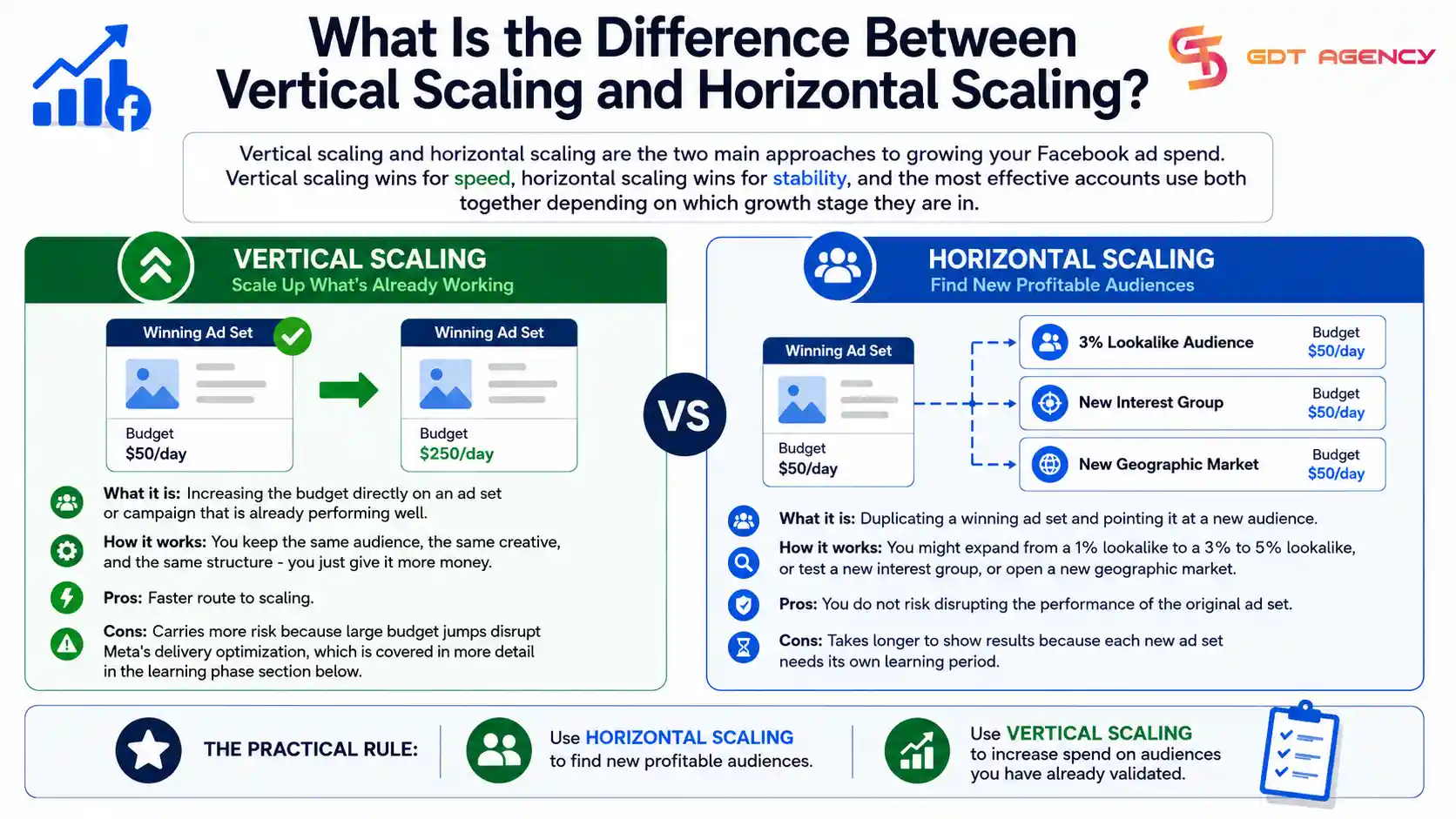
The practical rule: use horizontal scaling to find new profitable audiences, and use vertical scaling to increase spend on audiences you have already validated.
One of the most common beliefs among advertisers is: “Never increase your Facebook ad budget by more than 20%, or Meta will reset learning and destroy performance.”
This rule has spread widely across media buying communities because many advertisers have experienced performance swings after scaling. Over time, the 20% threshold became treated as a universal rule instead of a guideline.
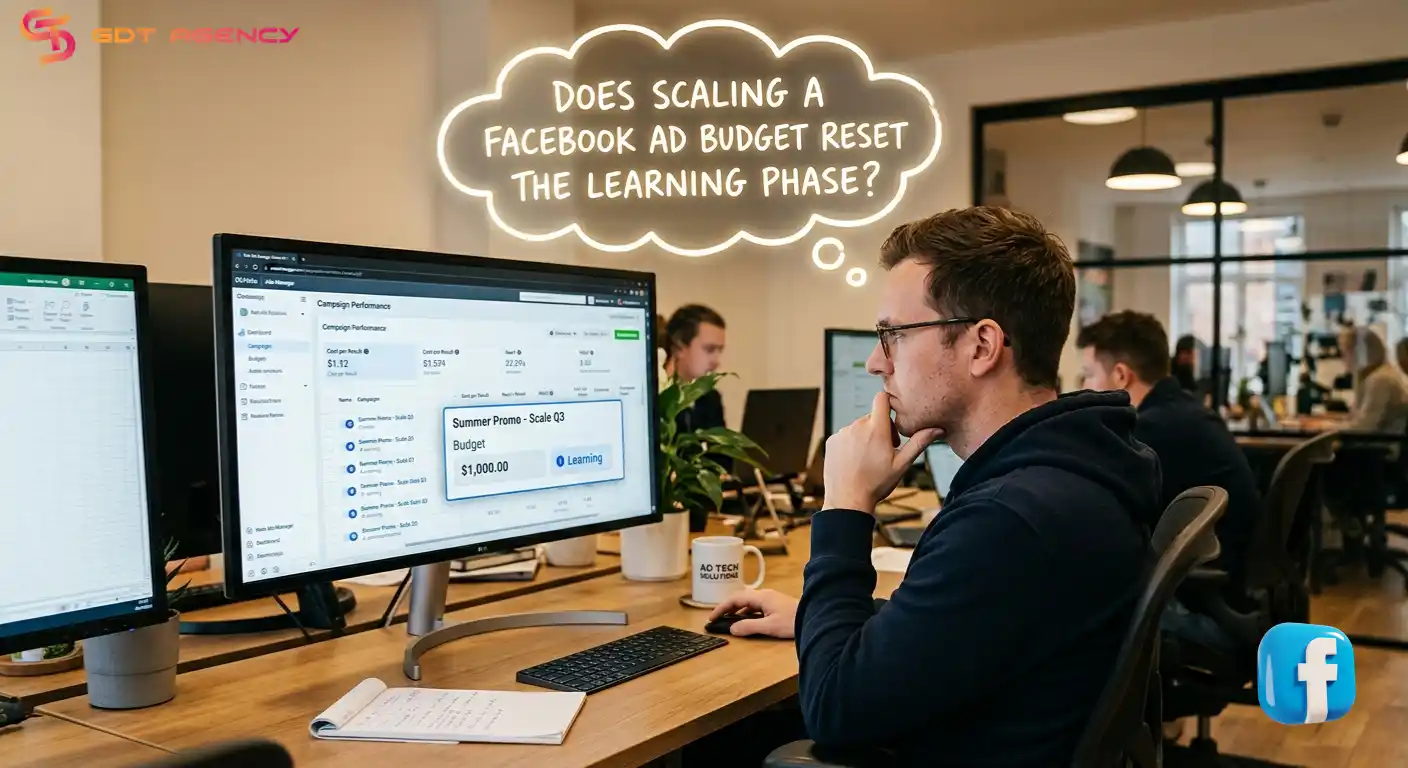
There is a reason this belief exists. Meta’s learning phase is designed to adjust delivery when campaign conditions change, and larger budget edits can increase the chance of re-entering learning. During that period, CPA and ROAS may fluctuate while the system recalibrates.
But after spending more than 6 years working with Facebook ads, Facebook agency ad accounts, and advertisers, as an expert at GDT Agency, my view is that the industry often oversimplifies this idea. “I do not think budget increases are the real reason most campaigns fail after scaling. In many cases, the campaign already had weak fundamentals before the increase happened. The budget change simply exposed them.”
I have seen advertisers increase budgets well beyond 20% and maintain performance. I have also seen campaigns lose efficiency after much smaller adjustments. From my experience, the more important question is not whether the learning phase resets. It is whether the campaign has earned the right to scale.
“If conversion volume is stable, creative fatigue is under control, and the audience still has room to expand, scaling becomes much safer. But if those signals are weak, even a cautious increase can create instability.”
The learning phase matters, but I rarely treat it as the main decision factor. I pay more attention to conversion consistency, audience depth, and whether the account is showing signs that it can absorb additional spend before I raise budgets.
A Facebook ad campaign is ready to scale when it shows three conditions together: a CPA within 20% of your target, at least 30 to 50 weekly conversions, and 3 to 7 days of stable, consistent delivery - not just one good day.
This is the part most advertisers skip. They see a strong ROAS on day two and increase the budget immediately. Then performance collapses by day four, and they blame Meta's algorithm. The real problem is that one or two good performance days are often noise - they do not confirm that your campaign structure and audience fit are genuinely solid.
The sections below show you exactly which numbers to check before you scale, and which signals tell you the campaign is not ready yet.
A campaign signals readiness to scale when your CPA sits within 20% of your target CPA, your ROAS has held steady for at least 3 to 7 days, and your campaign is generating a minimum of 30 to 50 conversions per week.
The table below shows how these three thresholds map to green-light and red-light status for scaling decisions:
| Signal | Green Light (Ready to Scale) | Red Light (Not Ready) |
| CPA stability | Within 20% of target CPA | Fluctuating more than 40% day over day |
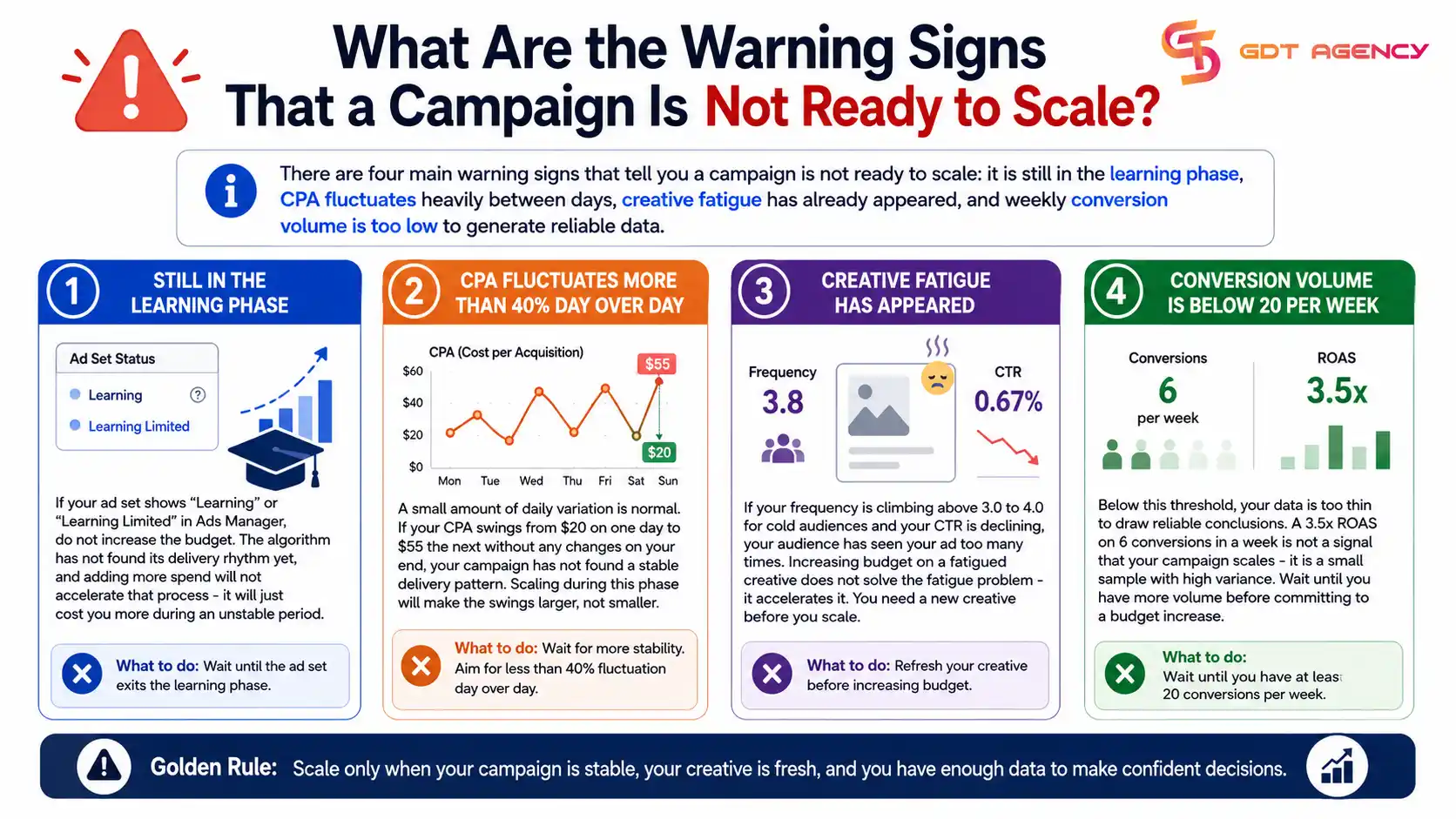
| Conversion volume | 30-50+ conversions per week | Below 20 conversions per week |
| Days of stable delivery | 3-7 consecutive days | Less than 3 days or inconsistent |
| Learning phase status | Exited (active delivery) | Still in learning or limited |
| Frequency | Under 3.0 for cold audiences | Above 4.0 - potential saturation |
The CPA threshold matters because it tells you whether your unit economics are intact. If your target CPA is $30 and your actual CPA has been $34 for five consecutive days, that is within 20% and acceptable for scaling. If your CPA was $28 on Monday, $48 on Tuesday, and $22 on Wednesday, you do not have a working campaign - you have an unstable one. Scaling that will amplify the instability, not fix it.
The conversion volume threshold matters because Meta's algorithm uses conversion data to optimize delivery. According to Meta's advertising documentation, ad sets need approximately 50 conversion events per week to fully exit the learning phase. Below that volume, the algorithm is still making delivery decisions with incomplete data, which makes performance less predictable as spend increases.
There are four main warning signs that tell you a campaign is not ready to scale: it is still in the learning phase, CPA fluctuates heavily between days, creative fatigue has already appeared, and weekly conversion volume is too low to generate reliable data.
You increase a Facebook ad budget without losing ROAS by combining the 20% budget increase rule, the right CBO and ABO structure for each campaign phase, and horizontal expansion through audience duplication - each step tied to performance data, not guesses.
This is the core of what most advertisers get wrong. They treat the budget as a lever they can pull whenever they feel ready, and they get inconsistent results because they are not following a system. The three subsections below give you that system.
The 20% budget increase rule means you never increase a campaign or ad set budget by more than 20% in any single edit, and you wait at least 48 hours between increases to give Meta's algorithm time to recalibrate.
The reason this rule works is mechanical. Meta's delivery system uses a continuous feedback loop to decide who sees your ads, when, and at what cost. When you make a significant budget change, you alter the inputs to that system. A jump of 20% or less is small enough that the algorithm can absorb it without re-entering the learning phase. A jump of 50%, 100%, or more forces it to reset.
Here is what safe vertical scaling looks like in practice over two weeks, starting from a $50 daily budget:
| Day | Budget | Change |
| Day 1 | $50/day | Baseline |
| Day 3 | $60/day | +20% |
| Day 5 | $72/day | +20% |
| Day 7 | $86/day | +20% |
| Day 9 | $103/day | +20% |
| Day 11 | $124/day | +20% |
| Day 13 | $149/day | +20% |
Starting from $50 and applying the 20% rule every 48 hours, you reach nearly $150 per day within two weeks. Starting from a higher base - say, $200 per day on an agency ad account - you can reach $600 per day within the same timeframe using the same method.
The key discipline is waiting between increases. If you increase on Day 3 and then again on Day 4 because results look good, you are effectively making a 44% combined increase in 48 hours. That is enough to trigger the learning phase.
According to a scaling analysis published by AdMetrics, controlled budget increases tied to strict performance rules are significantly more likely to maintain stable CPA than unstructured budget changes, particularly for campaigns spending above $100 per day.
ABO wins for testing and isolating variables, CBO wins for scaling validated ad sets, and the most effective approach transitions from ABO in the testing phase to CBO once you have confirmed winners.
This comparison comes up in almost every scaling conversation because both options approach budget management differently. The table below breaks down when each one makes sense:
| Factor | ABO (Ad Set Budget Optimization) | CBO (Campaign Budget Optimization) |
| Budget control | You set a fixed budget per ad set | Meta distributes the budget across ad sets automatically |
| Best used for | Testing new creatives and audiences | Scaling proven, validated ad sets |
| Algorithm behavior | Guarantees each ad set gets equal spend | Focuses spend on the best-performing ad sets |
| Risk level | Lower - prevents one ad set from taking all the budget | Higher if you have unproven ad sets in the same campaign |
| Scaling phase | Phase 1: Testing | Phases 2 and 3: Scaling and growth |
The practical transition works like this. In your testing phase, you run ABO with equal budgets across 3 to 5 ad sets, typically $10 to $17 per ad set at a $50/day account limit. You test one variable per ad set - audience, creative angle, or placement. After 5 to 7 days, you identify 2 to 3 winners based on CPA and ROAS. Those winners move into a CBO campaign. You set the CBO campaign budget at roughly 2 times the combined daily spend of the winning ad sets - so if two winners each ran at $20 per day, start the CBO at $80 per day.
From there, you apply the 20% rule to the CBO campaign budget, not to individual ad sets. This lets Meta's algorithm decide which validated ad set gets the incremental spend based on real-time performance data.
One important constraint: never mix unproven and proven ad sets inside the same CBO campaign. When you do this, Meta's algorithm tends to dump most of the budget into one ad set and starve the others, which was exactly the problem ABO was designed to solve in the testing phase.
You scale Facebook ads horizontally by duplicating winning ad sets and pointing each copy at a distinct audience segment - expanding lookalike percentages, testing new interest groups, or opening new geographic markets - while checking for audience overlap before publishing.
Audience overlap is the specific risk with horizontal scaling that most guides overlook. If you run three ad sets targeting overlapping audiences within the same campaign, those ad sets compete against each other in the same auctions. This drives up your CPM across all three because you are essentially bidding against yourself. The result is higher costs and lower delivery efficiency.
Here is a practical horizontal scaling sequence that avoids this problem:
Step 1 - Expand your lookalike audience size. If your winning ad set targets a 1% lookalike of your purchasers, duplicate it and change the lookalike to 2% to 3%. Then duplicate again for 3% to 5%. Each percentage range targets a distinct tier of audience similarity, so overlap is minimal.
Step 2 - Test new interest groups. Create a new ad set using broad interest targeting related to your offer, but different from any interest group you are already running. Use Meta's Audience Overlap tool in Ads Manager to check that the new audience does not overlap significantly with your existing ad sets before activating it.
Step 3 - Open new geographic markets. If you have strong Pixel data from your primary market, you can use that data to build lookalike audiences in new countries. This approach often delivers lower CPMs in markets outside the United States, which can improve your blended ROAS even if individual market ROAS looks different from your domestic baseline.
Each new ad set from horizontal scaling starts in ABO during its own testing period. Only move it into your CBO scaling campaign after it has validated its own performance data independently.
You know scaling is hurting your Facebook ad performance when your CPA climbs more than 40% above your Phase 1 baseline after a budget increase and holds there for more than 3 days - that is the clearest signal that something has broken in delivery.
The problem with scaling damage is that it often looks like a normal performance dip at first. CPA goes up a little, ROAS drops slightly - these fluctuations happen even in healthy campaigns. The difference is duration and magnitude. A 10% to 15% CPA increase that self-corrects within 48 hours is normal. A 40% or 50% CPA increase that holds or worsens over 3 to 5 days means your scaling action triggered the learning phase or pushed your audience into saturation.
After increasing a Facebook ad budget, you should monitor five core metrics in this priority order: CPA, ROAS, CPM, CTR, and frequency - checking them at 3-day and 7-day intervals after each budget change.
The table below shows what healthy post-scaling numbers look like versus warning-level numbers, based on industry benchmarks across common verticals:
| Metric | Healthy Range (Post-Scaling) | Warning Level | Action Required |
| CPA | Within 20% of Phase 1 CPA | 40%+ above Phase 1 CPA | Roll back the budget immediately |
| ROAS | Within 15% of Phase 1 ROAS | More than 30% below Phase 1 ROAS | Roll back and assess the creative |
| CPM | Gradual increase of 10-20% | Sudden spike of 40%+ | Check audience overlap and frequency |
| CTR | Stable or above 1.71% average | Below 1.0% after 1,000 impressions | Creative problem - not a budget problem |
| Frequency | Below 3.0 for cold audiences | Above 4.0 and rising | Audience saturation - add new creatives |
The 3-day checkpoint is your first decision point. If CPA is within 20% of your Phase 1 CPA at 3 days, continue scaling. If CPA has jumped 40% or more, roll back the budget to its previous level, wait 48 hours, and try a smaller increase next time.
The 7-day checkpoint is your green light for Phase 3 scaling. If ROAS is within 15% of Phase 1 ROAS at day 7, your campaign has absorbed the budget increase and is ready for the next increment.
According to WordStream's Facebook Ads benchmarks, the average CTR across all Facebook ad verticals is 1.71%. If your CTR drops below 1.0% after 1,000 impressions on a scaled ad set, the problem is almost always creative - more budget will not fix a creative that is not resonating.
When ROAS drops after a budget increase, your first action is to roll back the budget to its previous level within 24 to 48 hours - then identify whether the drop came from a scaling shock or from creative fatigue, because each problem requires a different fix.
This distinction is critical, and most advertisers miss it. A scaling shock happens when the budget increase itself disrupts the learning phase. In this case, rolling back the budget and waiting 48 hours often allows the algorithm to restabilize, and you can try a smaller increase afterward. The ROAS drop is temporary and mechanical.
Creative fatigue happens when your audience has seen your ad enough times that they stop engaging with it. In this case, rolling back the budget will slow the damage but will not fix the root cause. You need new creative. A fatigued creative shows specific signals alongside the ROAS drop: rising frequency above 4.0, declining CTR, and increasing CPA even before you made the budget change.
Here is how to distinguish the two and respond:
One additional note on how you measure ROAS: platform-reported ROAS in Ads Manager only captures last-click attributed conversions. It systematically undercounts the actual revenue influence of your Facebook campaigns, especially for brands with longer purchase consideration cycles. Before you make a rollback decision based on ROAS alone, also check your blended ROAS - total revenue divided by total ad spend across all channels. This metric, sometimes called Marketing Efficiency Ratio (MER), gives a more accurate picture of whether your Facebook spend is contributing to business growth even when Ads Manager numbers look weaker.
Scaling a Facebook ad account through an agency account is meaningfully different from scaling a personal advertiser account because agency accounts start with higher spend limits, carry existing trust signals with Meta's algorithm, and eliminate the new account warm-up constraint that limits how fast standard accounts can grow.
This distinction matters practically for any advertiser who has hit a ceiling on their personal account and is considering using a rented or agency-managed ad account to scale faster.
A higher spend limit on an agency account directly removes the most common bottleneck for scaling - the $50 per day cap that Meta places on new ad accounts, which takes weeks of consistent spending to raise regardless of how well your campaigns perform.
New Facebook ad accounts start with a $50 per day spend limit. This limit increases only through consistent ad spend over several weeks - no amount of account warm-up activity, page engagement, or profile completion speeds up this process. For an advertiser who needs to test 5 ad sets at $10 per day each in ABO, that $50 cap already consumes the entire daily budget, leaving no room to scale into a CBO campaign at all.
Agency ad accounts typically start with spend limits of $250 to $1,000 per day or higher, depending on the account's history and the agency's standing with Meta. This means an advertiser using an agency account can skip the ramp-up phase entirely and begin testing at meaningful spend levels from day one.
The scaling speed difference is significant. Starting from $250 per day and applying the 20% rule every 48 hours, an advertiser can reach approximately $750 per day within two weeks without triggering any learning phase resets. Starting from $50 per day, reaching the same level takes over a month using the same method.
Yes, Pixel data from your primary market can help you build lookalike audiences in new countries - and this is one of the most cost-effective horizontal scaling strategies available, because CPMs in markets outside the United States are consistently lower, which means you reach more people per dollar spent.
The mechanism works through Meta's Lookalike Audience tool. Once your Meta Pixel has collected enough conversion data from your primary market - typically at least 1,000 purchase events is a reliable baseline - you can use that data as a source audience to build 1% lookalike audiences in other countries. Meta's algorithm identifies users in those new markets who share behavioral and demographic characteristics with your existing purchasers.
The practical benefit is that you are not starting from zero in a new market. You are entering with a targeting signal already shaped by your best customers. Combined with lower CPMs in markets like Southeast Asia, Latin America, or parts of Europe compared to the United States, this approach often produces a lower cost per acquisition in the expansion market than in the domestic one.
One important implementation note: when you target audiences outside your primary market, align both your ad creative and your landing page language with the target market's primary language. Running English-language ads to a Vietnamese or Spanish-speaking audience will reduce relevance scores and increase your effective CPM, which erodes the cost advantage you were trying to capture.
Yes, for many accounts, creative volume is a bigger scaling bottleneck than budget - because an account running 3 to 5 creatives across all campaigns will hit audience saturation faster as spend increases, and no budget strategy can fix a creative supply problem.
This is a counterintuitive point, but it shows up consistently in agency-level scaling data. When you increase your budget, Meta shows your ads to more people more frequently. If your creative library is small, frequency rises faster, saturation hits sooner, and CPA climbs. The solution is not to slow down the budget increase - it is to maintain a steady flow of new creative variations.
Agencies that scale successfully at $500 to $5,000 per day typically run 10 to 20 active creatives per ad set and rotate new ones into their testing campaign weekly. This creative velocity keeps frequency manageable even as total spend rises, and it builds a validated asset library that makes future scaling decisions data-driven rather than guesswork.
For advertisers working with tighter creative resources, the minimum viable approach is to have at least 3 to 5 new creative variations ready to test before each significant budget increase. If your current winning creative has been running for more than 4 to 6 weeks at consistent volume, treat it as close to fatigue and start testing replacements before you need them.
The Marketing Efficiency Ratio (MER) is a blended performance metric calculated by dividing total business revenue by total ad spend across all channels - it matters during scaling because it captures the full revenue contribution of your Facebook campaigns, including the purchases that Ads Manager's attribution does not credit.
Facebook's platform-reported ROAS measures only the conversions that Meta's attribution system directly links to your ads within its attribution window. This undercounts the actual impact in two common scenarios. First, customers who see your Facebook ad, leave, and purchase later through a Google search or direct visit are typically credited to Google - even though your Facebook ad was part of their decision path. Second, view-through conversions and assisted conversions often fall outside the default reporting window.
MER solves this by removing the attribution debate entirely. If your business generated $50,000 in revenue last month and you spent $10,000 on ads across all channels, your MER is 5.0. That number does not depend on which platform takes credit for which sale.
The practical use of MER during scaling: before rolling back a Facebook budget based on a declining Ads Manager ROAS, check whether your total business revenue has also declined or whether it has held steady. If your MER is stable or improving while Ads Manager ROAS appears weaker, you may be looking at an attribution shift rather than an actual performance problem - and pulling back your Facebook budget could reduce revenue that Ads Manager was not measuring correctly.
Scaling a Facebook ad budget is not complicated, but it requires patience. The advertisers who maintain ROAS as they grow are not the ones with the biggest budgets - they are the ones who follow a system and resist the urge to react to every good or bad day.
Start with the basics. Make sure your campaign has exited the learning phase, your CPA is stable, and you have enough weekly conversions to trust the data. Then increase your budget in 20% increments every 48 hours, watch your CPA and ROAS checkpoints at 3 days and 7 days, and roll back immediately if numbers break past your threshold.
The goal is not to spend more. The goal is to spend more on what already works.
You should increase your Facebook ad budget by no more than 20% per edit, and wait at least 48 hours before making another increase. Larger jumps - anything above 25% to 30% in a single change - raise a high chance of pushing your ad set back into the learning phase, which spikes your CPA for 7 to 14 days while the algorithm recalibrates.
Starting from $50 per day and applying the 20% rule every 48 hours, you can reach approximately $150 per day in two weeks and $1,000 per day in roughly 5 to 6 weeks - assuming your performance holds and you do not need to roll back at any checkpoint. Starting from a higher base, like $250 per day on an agency account, you can reach $1,000 per day in about 3 to 4 weeks using the same method.
Use ABO during the testing phase so every ad set gets equal budget and you can isolate which audience or creative is actually winning. Once you have 2 to 3 confirmed winners with stable CPA and consistent conversion volume, move them into a CBO campaign and let Meta's algorithm distribute spend across those proven ad sets. Never mix untested and tested ad sets inside the same CBO campaign.
A ROAS drop after a budget increase usually means one of two things. Either the increase was too large and pushed your ad set back into the learning phase - in which case rolling back and waiting 48 hours typically helps - or your creative has hit fatigue and the audience is tuning it out. Check your frequency first. If it is above 4.0, the problem is creative fatigue, not budget size. Adding new creative variations will do more than any budget adjustment.
There is no universal answer because a good ROAS depends entirely on your margins. As a practical baseline, your ROAS should be high enough that your CPA sits at least 20% below your break-even CPA - meaning you have a buffer to absorb the short-term performance dips that come with scaling. If your campaign is barely profitable at its current spend level, scaling will make it unprofitable faster.
Vertical scaling means increasing the budget on an existing ad set that is already performing well. Horizontal scaling means duplicating that ad set into a new audience - a broader lookalike, a new interest group, or a new country. Vertical scaling grows spend faster but carries more risk of disrupting performance. Horizontal scaling is slower but more stable because you are not touching your existing winning ad set.
Yes, you can scale with a personal advertiser account, but you will move more slowly at the start because new accounts begin with a $50 per day spend limit. That limit only increases through consistent spend over several weeks - no shortcut raises it faster. If you need to scale quickly or run large test volumes from the start, an agency ad account removes that ceiling and gives you a head start on the budget phases that matter most.
Facebook ads stay stuck in the learning phase in 2026 when the account cannot generate enough signal density. Fix it by consolidating small ad sets…
Advertisers boost Facebook return on ad spend for new ad accounts in 2026 by consolidating campaigns into a single CBO structure and running broad targeting…

Creative fatigue kills Facebook ad scaling by triggering a chain reaction inside Meta’s algorithm – engagement drops, CPMs rise, and the budget you added to…