
Facebook BM2500: What It Is & How To Stay Safe 2026
Facebook BM2500 is a Business Manager account that can hold up to 2,500 ad accounts under one login, built for agencies and advertisers who run…
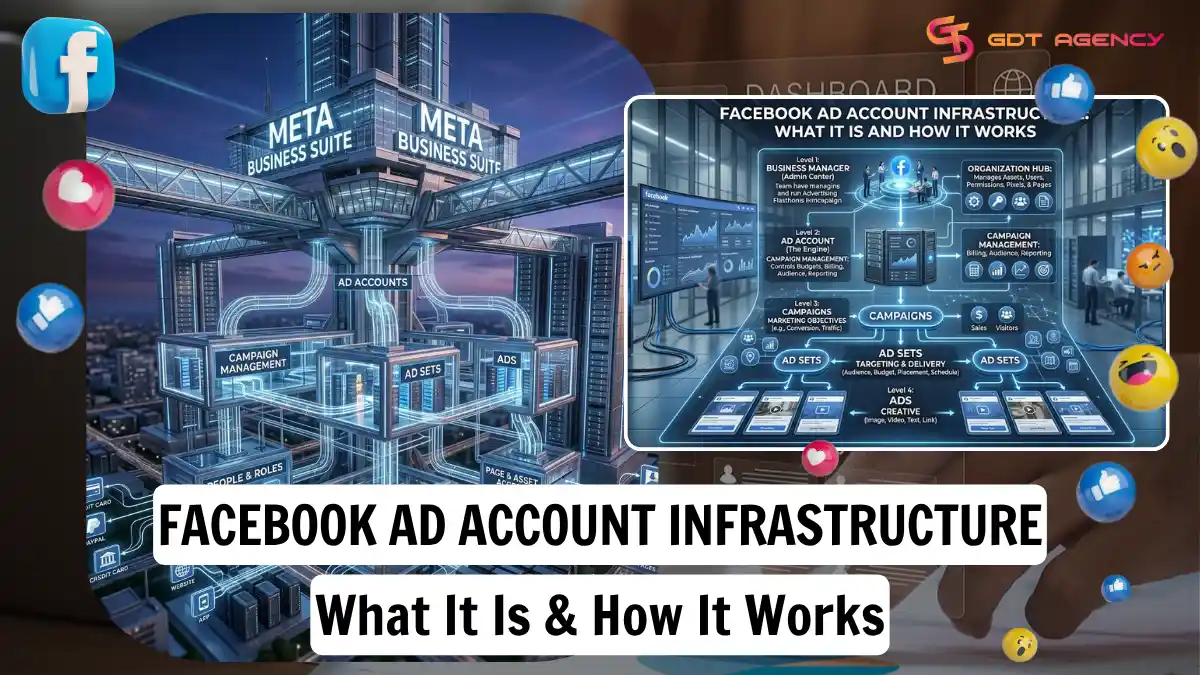
Facebook ad account infrastructure is the connected system that links a Business Manager, ad accounts, payment methods, pixels, and permission roles into one operating structure for running ads. Specifically, this system determines how stable your campaigns stay when you scale spend, add team members, or run multiple accounts at once. Beyond that, infrastructure works by passing signals between each component, so Meta can evaluate account trust based on the whole structure rather than a single ad account in isolation. Below, this article breaks down what Facebook ad account infrastructure is, how it works behind the scenes, the components that build it, and why each component matters, giving you the clearest path to running campaigns that stay stable at scale.
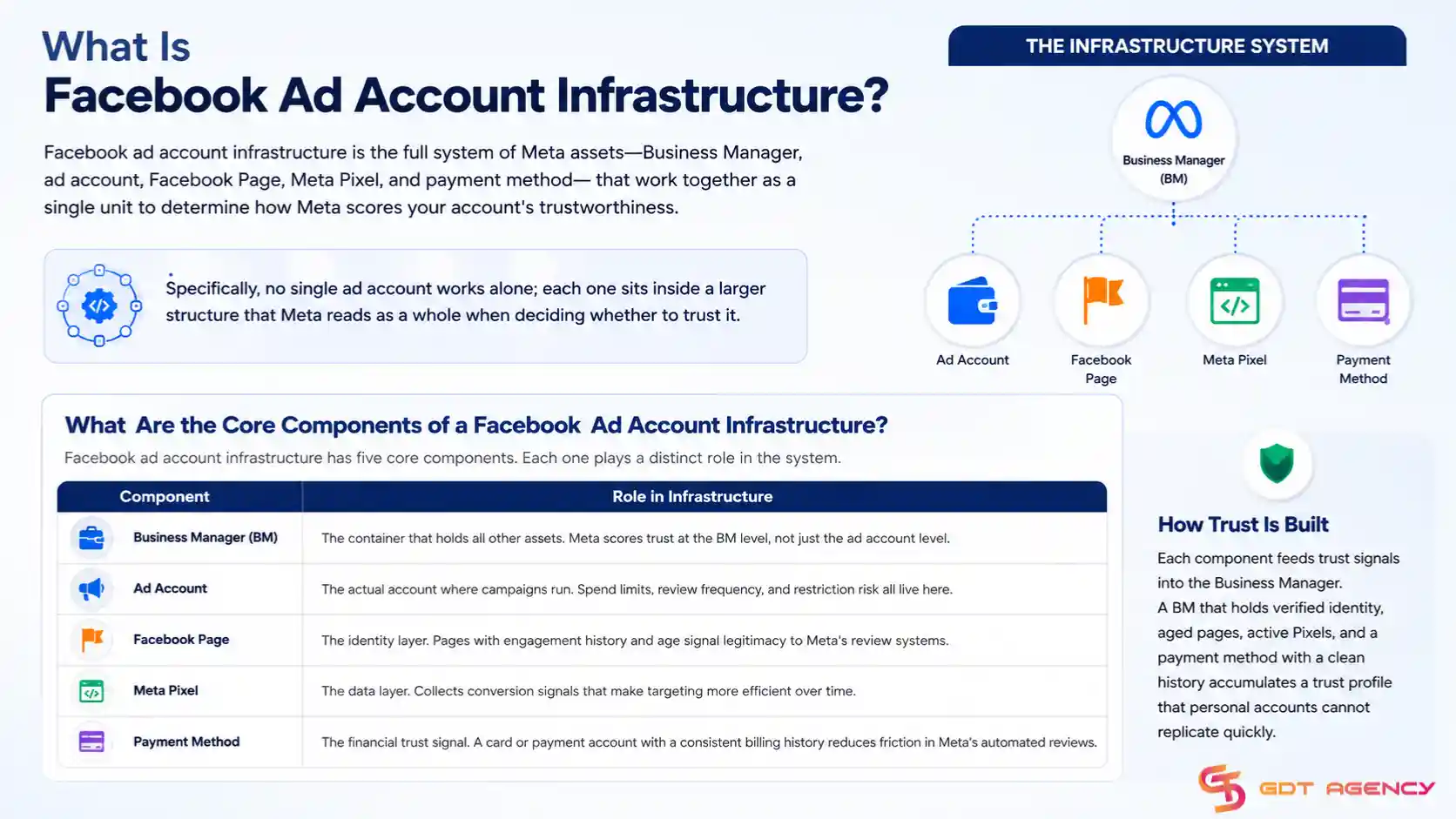
Facebook ad account infrastructure is the full system of Meta assets - Business Manager, ad account, Facebook Page, Meta Pixel, and payment method - that work together as a single unit to determine how Meta scores your account's trustworthiness. Specifically, no single ad account works alone; each one sits inside a larger structure that Meta reads as a whole when deciding whether to trust it.
As an expert at GDT Agency that have nearly 10 years in this Facebook ads game, working with multiple accounts from standard to high-quality Facebook agency account, I usually talk with my team that they can think of infrastructure as the plumbing behind a house. The ad account is the faucet you interact with directly, but the pipes, valves, and pressure system behind the wall determine whether that faucet keeps running or shuts off without warning.
→ Before diving deeper into infrastructure, it's important to understand what a Facebook ad account is and how it works, since every infrastructure setup is built around the ad account itself.
Facebook ad account infrastructure has five core components: Business Manager, Ad Account, Facebook Page, Meta Pixel, and Payment Method. Each one plays a distinct role in the system.
The table below defines each component and its function inside the infrastructure:
| Component | Role in Infrastructure |
| Business Manager (BM) | The container that holds all other assets. Meta scores trust at the BM level, not just the ad account level. |
| Ad Account | The actual account where campaigns run. Spend limits, review frequency, and restriction risk all live here. |
| Facebook Page | The identity layer. Pages with engagement history and age signal legitimacy to Meta's review systems. |
| Meta Pixel | The data layer. Collects conversion signals that make targeting more efficient over time. |
| Payment Method | The financial trust signal. A card or payment account with a consistent billing history reduces friction in Meta's automated reviews. |
Each component feeds trust signals into the Business Manager. A BM that holds verified identity, aged pages, active Pixels, and a payment method with a clean history accumulates a trust profile that personal accounts cannot replicate quickly.
A weak ad account infrastructure relies on a single Business Manager, one payment method, and no backup accounts, while a strong ad account infrastructure spreads risk across multiple Business Managers, diversified payment methods, and pre-verified backup ad accounts.
In practice, a weak setup looks like this: one advertiser, one ad account, one credit card, and one person holding admin access. If that card gets flagged for suspicious activity or that admin loses access, the entire operation stops.
On the other hand, a strong setup keeps a secondary payment method active before it's ever needed, maintains at least one backup ad account already warmed up and ready to receive budget, and spreads admin access across more than one trusted person so a single point of failure doesn't take down the whole account.
The difference becomes most visible at scale. A weak infrastructure might hold up fine at $50 a day, but the same setup often breaks down once daily spend crosses into the thousands, because higher spend draws more automated review from Meta's systems. A strong infrastructure is built to absorb that scrutiny without losing delivery.
>>> Before looking at how this infrastructure works, it is important to understand how an ad account is created and configured in the first place. If you are new to Facebook advertising, see our guide on How to Set Up a Facebook Ad Account for a complete walkthrough of the setup process.
Facebook ad account infrastructure works by connecting each component into a single structure that Meta evaluates as one unit rather than as separate, unrelated parts. Specifically, every action taken inside one component sends a signal that affects how Meta treats the rest of the structure.
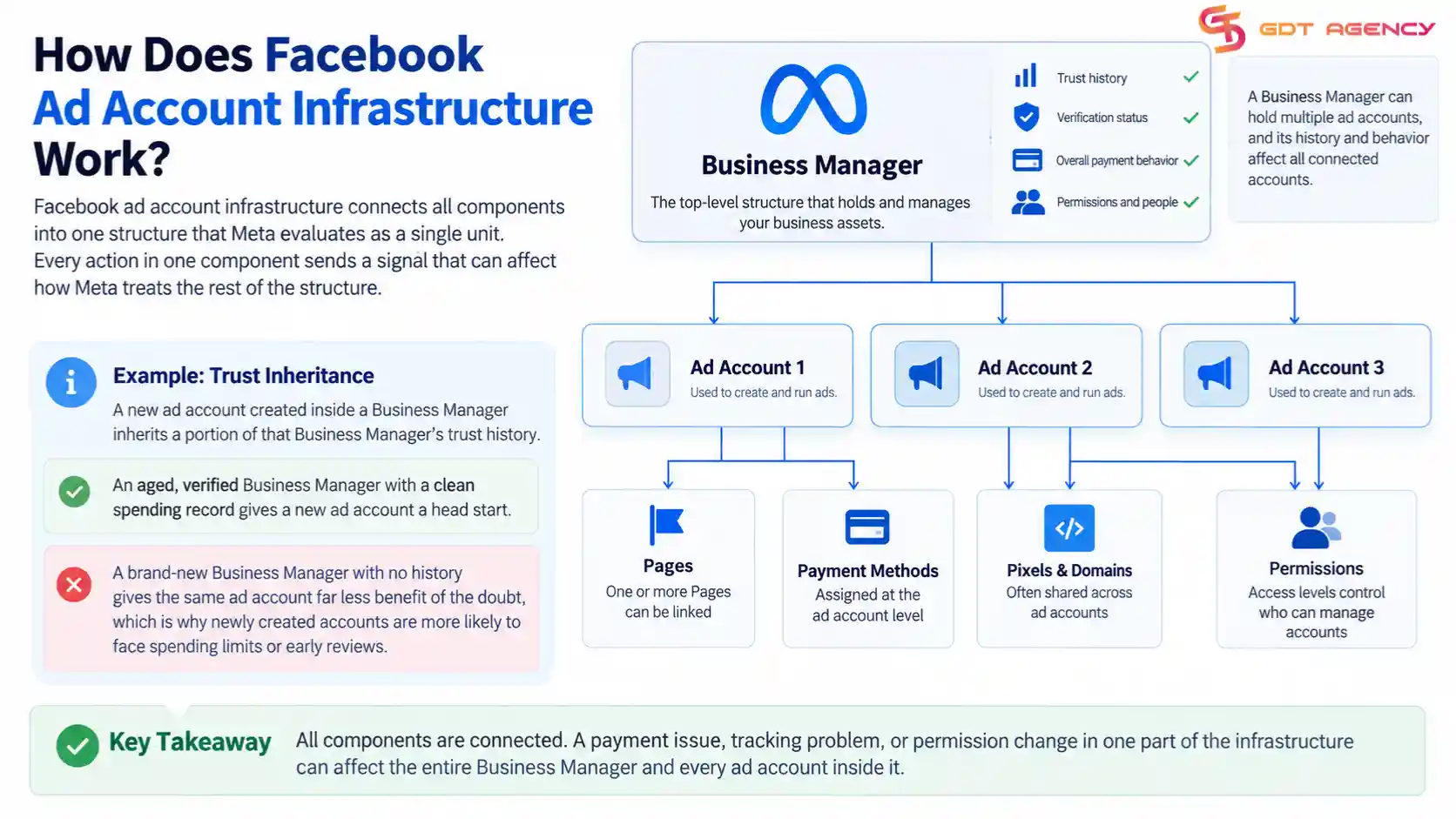
To illustrate, when a new ad account is created inside a Business Manager, it inherits a portion of that Business Manager's trust history. An aged, verified Business Manager with a clean spending record gives a new ad account a head start. A brand-new Business Manager with no history gives that same ad account far less benefit of the doubt, which is why newly created accounts are more likely to face spending limits or early reviews.
The components of Facebook ad account infrastructure connect through a layered hierarchy: the Business Manager sits at the top, ad accounts and Pages sit underneath it, and payment methods, pixels, and permission roles attach directly to the ad accounts inside that structure.
Specifically, a Business Manager can hold multiple ad accounts, and each ad account can be linked to one or more Pages for running ads. Payment methods are assigned at the ad account level, but Meta also tracks payment behavior at the Business Manager level, which is why a payment issue on one ad account can still affect the reputation of the entire Business Manager. Pixels and domains are typically shared across ad accounts within the same Business Manager, which means tracking problems or domain verification issues can ripple across every account using that pixel.
Permissions add another connection point. A person with Admin access on the Business Manager can affect every ad account underneath it, while someone with Advertiser access on a single ad account has a much narrower blast radius. This is why infrastructure planning has to account for how permissions cascade, not just who has access to what.
Meta evaluates ad account infrastructure behind the scenes by scoring account age, spending consistency, payment reliability, and policy history across the entire Business Manager, then applying that combined score to decisions about spending limits, review frequency, and account trust.
To put it plainly, Meta's automated systems don't just look at whether an individual ad has a policy violation. They look at patterns: how often payments fail, how quickly spend increases, how many ad accounts share a payment method, and whether previous ad accounts under the same Business Manager were disabled. Because of this, an advertiser who has never violated a policy can still face restrictions if their infrastructure shows patterns that resemble higher-risk accounts, such as rapid account creation or shared payment details across unrelated Business Managers.
This evaluation happens continuously, not just at account creation. That means infrastructure isn't something you set up once and forget; it's something that gets re-scored every time you add an account, change a payment method, or adjust spend.
Infrastructure determines your campaign stability because Meta uses the trust signals accumulated inside your Business Manager to decide your spend limit tier, your review frequency, and how aggressively its automated systems flag your account when a policy question arises.
This is not a theory. It is how Meta's advertiser scoring system operates at a structural level. The quality of your infrastructure sets the ceiling on what your campaigns can do - and the floor for how much disruption you absorb when something triggers a review.
Think of it this way: two advertisers run identical campaigns with identical budgets and identical creatives. One runs from a two-year-old verified Business Manager with Pixel history and a clean payment record. The other runs from a new personal ad account. The first advertiser gets fewer ad disapprovals, higher spend limits, and faster recovery if something gets flagged. The second advertiser hits the same friction that kills most campaigns before they reach meaningful scale.
Account warm-up history means the accumulated record of progressive, consistent spending behavior - starting from low budgets and increasing gradually over weeks - that signals to Meta's system that the account belongs to a legitimate advertiser rather than a fraud actor or policy violator.
Meta's automated systems watch spending patterns closely. An account that starts at $5/day and increases spend by 20-30% every few days over several weeks builds a behavioral profile that looks like a normal advertiser scaling a legitimate campaign. An account that starts at $500/day on day one looks like a potential fraud or abuse vector - and gets treated accordingly with higher review frequency and lower trust scores.
Warm-up history is cumulative and persistent. Every week of consistent spending adds to the account's behavioral profile. A well-warmed account from 12 months ago still carries that signal even if the account goes dormant for a few months. This is part of why agency accounts with years of history are so valuable - the warm-up work is already done and cannot be faked or accelerated.
You build stable Facebook ad account infrastructure either by constructing a layered BM system from scratch over 6-12 months, or by renting access to an existing agency-level infrastructure where the trust score, BM verification, Pixel history, and account recovery systems are already in place.
Both options are real. The right one depends on your timeline and tolerance for risk during the buildup phase.
Building from scratch means starting a fresh BM, getting it verified, connecting aged Pages, warming up ad accounts gradually, building Pixel history, and maintaining a clean payment record - all without triggering any policy flags during the process. Done correctly, this produces a solid infrastructure. Done with one mistake in month three, it can reset you to zero.
Renting agency account access means getting an active slot inside an existing infrastructure that already has verified BM status, pre-built trust score, Pixel history, and partner support access. You get immediate access to the spend limits and stability that would take a year to build yourself. This approach is standard practice for media buyers running high-volume or international campaigns where downtime is not an option.
Facebook ad account infrastructure is the connected system, not the single ad account, that determines whether campaigns keep running or fall apart under pressure. Throughout this article, the same pattern shows up again and again: Meta evaluates trust at the level of the whole structure, so a weak point in one component- a shared pixel, an unverified domain, a single payment method- tends to affect everything connected to it.
As a result, the advertisers who scale without repeated disruptions are rarely the ones with the biggest budgets. They're the ones who treat infrastructure as something to build deliberately: separating risk across Business Managers, keeping backup accounts ready before they're needed, and giving payments and permissions the same attention as the ads themselves. Whether that infrastructure is built in-house or accessed through an agency-level account, the underlying principle stays the same: stability comes from the structure behind the account, not from the account alone.
Facebook ad account infrastructure is the system of business assets and settings that supports an ad account. It can include the Business Portfolio, payment method, Facebook Page, Instagram account, domain, Pixel, Conversions API, and user permissions. A well-managed infrastructure helps advertisers maintain better control over access, payments, tracking, and business assets.
The main components include the Business Portfolio, ad account, payment method, Facebook Page, Instagram account, domain, tracking assets such as Meta Pixel and Conversions API, and user permissions. Each component plays a different role in supporting the ad account and its advertising activities.
Yes. Payment issues can interrupt ad delivery when Meta cannot collect advertising costs successfully. Advertisers should maintain a valid payment method, monitor failed payments and outstanding balances, and resolve billing issues quickly to reduce unnecessary interruptions.
Permissions control what each person or business can do with an ad account and its connected assets. Advertisers should give users only the access they need for their roles. Proper permission management reduces the risk of unauthorized changes and helps protect important business assets.
You can build a safer infrastructure by keeping business ownership clear, using reliable payment methods, managing user permissions carefully, protecting administrator accounts, connecting the correct Pages and tracking assets, and keeping domains and landing pages compliant with Meta's advertising policies. A strong infrastructure can reduce operational risks, but it cannot guarantee that an ad account will never face restrictions.
Facebook BM2500 is a Business Manager account that can hold up to 2,500 ad accounts under one login, built for agencies and advertisers who run…

You create a Facebook prepaid ad account by setting up a Business Account first, then choosing Available Funds as your payment method, and finally confirming…
A Facebook postpaid ad account is a billing model that lets advertisers run campaigns first and pay later, instead of preloading a balance before ads…

You create a Facebook Business ad account through Meta Business Suite, then set up payment, assign user roles, and connect it to your Business Portfolio.…

You should create a separate ad account instead of running ads from your personal Facebook account. A separate Facebook personal ad account keeps your billing,…