How Creative Fatigue Kills Your Facebook Ad Scaling – And How to Stop It

Creative fatigue kills Facebook ad scaling by triggering a chain reaction inside Meta’s algorithm – engagement drops, CPMs rise, and the budget you added to grow your results starts working against you instead. The same ad that ran profitably at $50 per day can burn out in 10 days at $500 per day, because higher spend pushes the same creative to the same people far faster. This is not a creative quality problem. It is a scaling mechanics problem, and it follows a predictable pattern every time.
Spotting creative fatigue before it damages your campaigns requires watching 3 specific signals inside Meta Ads Manager: frequency climbing above 2.5 to 3.0, CTR dropping more than 15% week over week, and CPM rising without any change to targeting or budget. When these three signals appear together, the algorithm has already started penalizing your delivery. The good news is that data shows these signals before performance fully collapses, which gives you a window to act.
Stopping creative fatigue from killing your scale requires a creative refresh pipeline – not a single winning ad. The refresh pipeline keeps tested replacements ready before fatigue sets in, so you can swap assets without rebuilding campaigns from scratch or losing delivery momentum. A targeted refresh that swaps only the hook or visual format takes a fraction of the time a full rebuild requires and produces cleaner performance data.
- What Is Creative Fatigue in Facebook Ads?
- How Does Facebook’s Algorithm React to Creative Fatigue?
- Why Does Creative Fatigue Get Worse as You Scale Budget?
- What Are the Warning Signs That Creative Fatigue Is Killing Your Scaling?
- How Does Creative Fatigue Directly Block Facebook Ad Scaling?
- Does Creative Fatigue Cause the Learning Phase to Reset When Scaling?
- How Much Can Creative Fatigue Increase Your CPA During a Scale?
- How Do You Stop Creative Fatigue from Killing Your Facebook Ad Scaling?
- How Often Should You Refresh Ad Creatives When Scaling Facebook Campaigns?
- What Should a Creative Refresh Pipeline Look Like for Scaled Campaigns?
- Which Creative Rotation Strategies Prevent Fatigue at Higher Budgets?
- How Is Creative Fatigue Different from Ad Fatigue and Audience Fatigue in Facebook Campaigns?
- What Is the Difference Between Creative Fatigue and Ad Fatigue?
- What Is the Difference Between Creative Fatigue and Audience Fatigue?
- How Does Creative Fatigue at Agency Scale Differ from Single-Account Campaigns?
- Final Thoughts
- Frequently Asked Questions
- 1. What is creative fatigue in Facebook ads?
- 2. How do I know if my Facebook ads have creative fatigue?
- 3. How often should I refresh Facebook ad creatives?
- 4. What is the difference between creative fatigue and audience fatigue?
- 5. How many creatives do I need when scaling Facebook ads?
- 6. Does creative fatigue trigger the Facebook learning phase to reset?
- 7. What is a creative refresh pipeline and why does it matter for scaling?
What Is Creative Fatigue in Facebook Ads?
Creative fatigue is the performance decay that happens when an audience sees the same ad concept enough times that it stops triggering a response – click-through rates fall, cost per acquisition climbs, and Meta’s algorithm begins restricting delivery because engagement signals have weakened.
Specifically, this is not the same as an ad performing poorly from the start. Creative fatigue affects ads that were working well. The concept was strong, the targeting was right, and the results were solid – until repeated exposure caused the audience to mentally tune it out. Psychologists call this process habituation: after enough exposures to the same stimulus, the brain stops registering it as novel. In advertising, habituation shows up directly in your Ads Manager metrics as a steady downward curve in CTR and a steady upward curve in CPM.
How Does Facebook’s Algorithm React to Creative Fatigue?
Facebook’s algorithm reacts to creative fatigue by reducing delivery frequency, increasing CPM, and pushing the ad toward less responsive audience segments – because the system interprets falling engagement as a signal that the ad is no longer relevant to users.
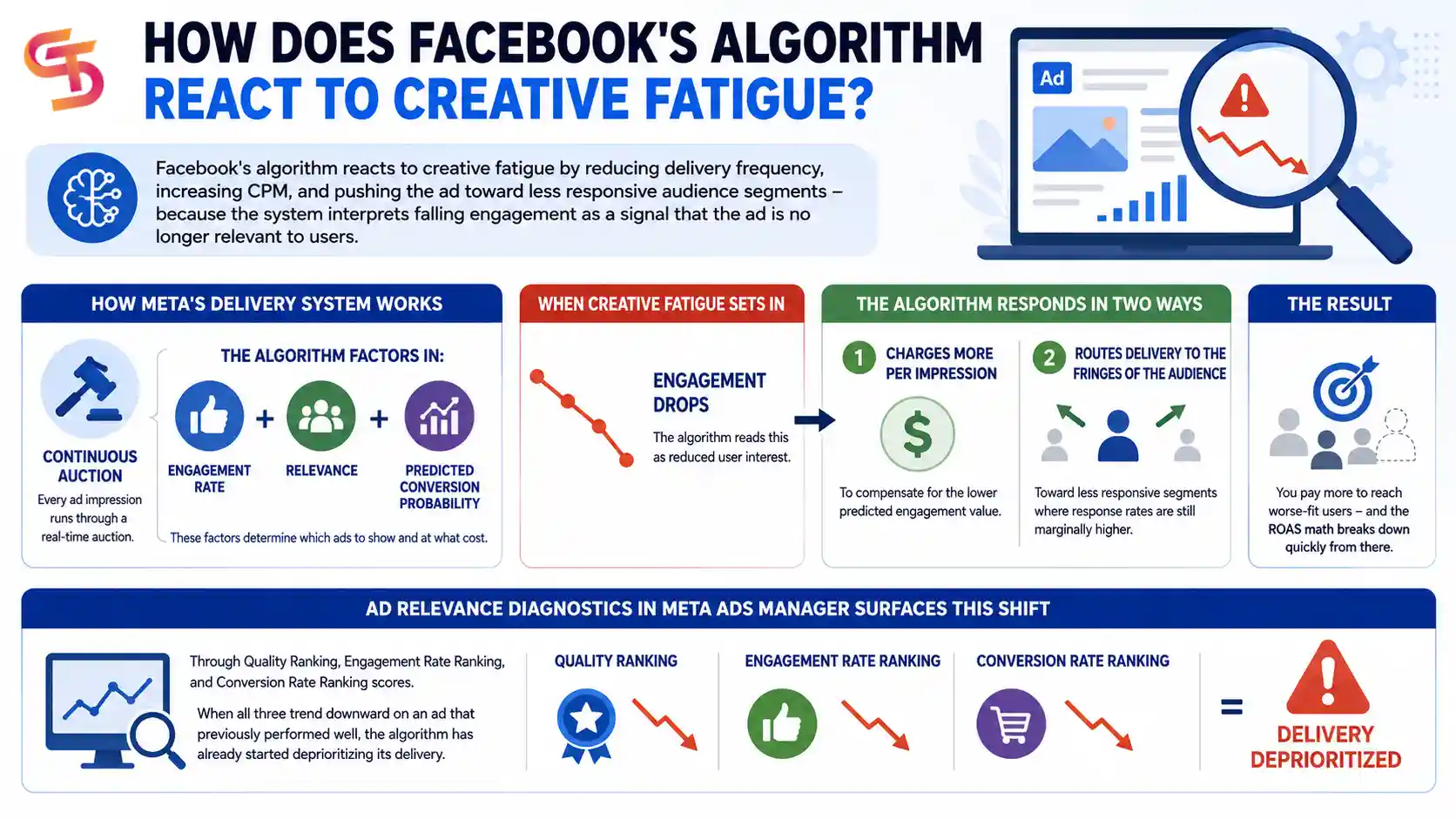
Meta’s delivery system runs a continuous auction for every ad impression. The algorithm factors in engagement rate, relevance, and predicted conversion probability when deciding which ads to show and at what cost. When an ad starts fatiguing, engagement drops. The algorithm reads this as reduced user interest and responds in two ways:
- It charges more per impression to compensate for the lower predicted engagement value.
- It routes delivery toward the fringes of the target audience, where response rates are still marginally higher.
The result is that the advertiser pays more to reach worse-fit users – and the ROAS math breaks down quickly from there.
Ad Relevance Diagnostics in Meta Ads Manager surfaces this shift through Quality Ranking, Engagement Rate Ranking, and Conversion Rate Ranking scores. As the CEO and Founder of GDT Agency, with years of experience working with Facebook ads, I can affirm that when all 3 trends downward on an ad that previously performed well, the algorithm has already started deprioritizing its delivery.
Why Does Creative Fatigue Get Worse as You Scale Budget?
Creative fatigue accelerates directly with budget – an ad running at $500 per day reaches the same target audience 10 times faster than the same ad at $50 per day, which means the fatigue timeline compresses from weeks into days.
The math here is straightforward. Higher daily spend means more daily impressions. More impressions against a fixed audience size means each person in that audience sees the ad more often, more quickly. An ad that stays fresh for six weeks at $50 per day might burn out in 10 days at $500 per day – not because the creative got worse, but because the exposure rate increased tenfold. This is the core mechanical reason why scaling strategies that work at low spend often fail at high spend, even when targeting, offer, and creative quality stay identical.
The implication for scaling is that creative refresh requirements grow proportionally with budget. A campaign spending $5,000 per day needs a creative pipeline that can produce and test new variations every few days, not every few weeks. Many advertisers scale the budget without scaling the creative production system, and this gap is where scaling attempts break down.
What Are the Warning Signs That Creative Fatigue Is Killing Your Scaling?
There are four measurable warning signs that creative fatigue is killing your scaling: frequency climbing above 2.5, CTR dropping more than 15% week over week, CPM rising without targeting changes, and Ad Relevance Diagnostics scores declining across all three rankings.
These signals appear in Ads Manager before performance fully collapses. Most advertisers catch creative fatigue too late – after CPA has already doubled or ROAS has dropped below breakeven – because they check results rather than leading indicators. Watching these four metrics as a weekly habit gives you a window to refresh before damage accumulates.
Which Metrics in Meta Ads Manager Signal Creative Fatigue?
The five metrics that signal creative fatigue most reliably in Meta Ads Manager are frequency, CTR (link clicks), CPM, CPA, and Ad Relevance Diagnostics – and frequency is the earliest warning of all. Here is how each metric behaves as creative fatigue sets in:
| Metric | Healthy Range | Fatigue Signal | What It Means |
| Frequency | Below 2.5 | Above 2.5-3.0 | Audience is seeing the ad too often |
| CTR (Link Click) | Above 1% | Drop of 15%+ week over week | Audience is tuning out the creative |
| CPM | Stable or declining | Rising without targeting changes | Algorithm is penalizing low engagement |
| CPA | Stable | Rising 20%+ from baseline | Delivery is reaching lower-quality segments |
| Ad Relevance Diagnostics | Average or Above Average | Below Average on 2+ rankings | Full algorithm deprioritization underway |
The table above shows the progression from early warning to confirmed fatigue. Frequency crossing 2.5 is the trigger to start preparing a creative refresh. CTR dropping 15% week over week confirms the fatigue is active. CPM and CPA rising together mean the algorithm has already started restricting delivery.
Meta Ads Manager now also surfaces a Frequency-to-CTR ratio directly in reporting columns. When frequency climbs above 2.5 and CTR drops 15% from the previous week simultaneously, the ad is fatigued and a refresh should already be queued.
How Fast Does Creative Fatigue Set In at Different Budget Levels?
Creative fatigue sets in faster at higher budgets – at $50 per day, a strong creative typically runs 4 to 6 weeks before fatiguing, while the same creative at $500 per day may fatigue within 7 to 14 days, and at $5,000 per day fatigue can appear in 3 to 5 days.
This timeline compression is the reason campaigns that scaled successfully to mid-range budgets often collapse at high budgets with no obvious explanation. The creative did not change. The audience did not change. The budget changed, and with it, the exposure rate.
The practical implication is that creative refresh cadence must be calibrated to the spend level, not to a fixed calendar schedule. A rule like “refresh every 4 weeks” works at $50 per day and fails catastrophically at $5,000 per day. Industry benchmarks from Meta business reports and Socialbakers indicate that many Facebook ads experience noticeable performance decay within three to four weeks at standard spend levels – but this window shrinks significantly at high-budget scale.
How Does Creative Fatigue Directly Block Facebook Ad Scaling?
Yes, creative fatigue directly blocks Facebook ad scaling because it triggers a self-reinforcing negative cycle: engagement drops, CPMs rise, delivery degrades, and ROAS collapses – and all four of these outcomes get worse as budget increases, not better.
This is the mechanism that confuses many advertisers when their scaling attempts fail. They increase the budget expecting proportional returns, instead see CPA double within 48 hours, and assume targeting is wrong or the offer has weakened. In most cases, the underlying cause is creative fatigue accelerating faster than the advertiser anticipated. The budget increase amplified the exposure rate, fatigue set in earlier than it would have at lower spend, and the algorithm’s negative feedback loop took over before any optimization could compensate.
Does Creative Fatigue Cause the Learning Phase to Reset When Scaling?
Yes, creative fatigue can indirectly trigger a learning phase reset when scaling, because the engagement drop it causes disrupts campaign stability – and Meta resets the learning phase whenever a campaign experiences a significant performance change or a meaningful edit is made in response to declining results.
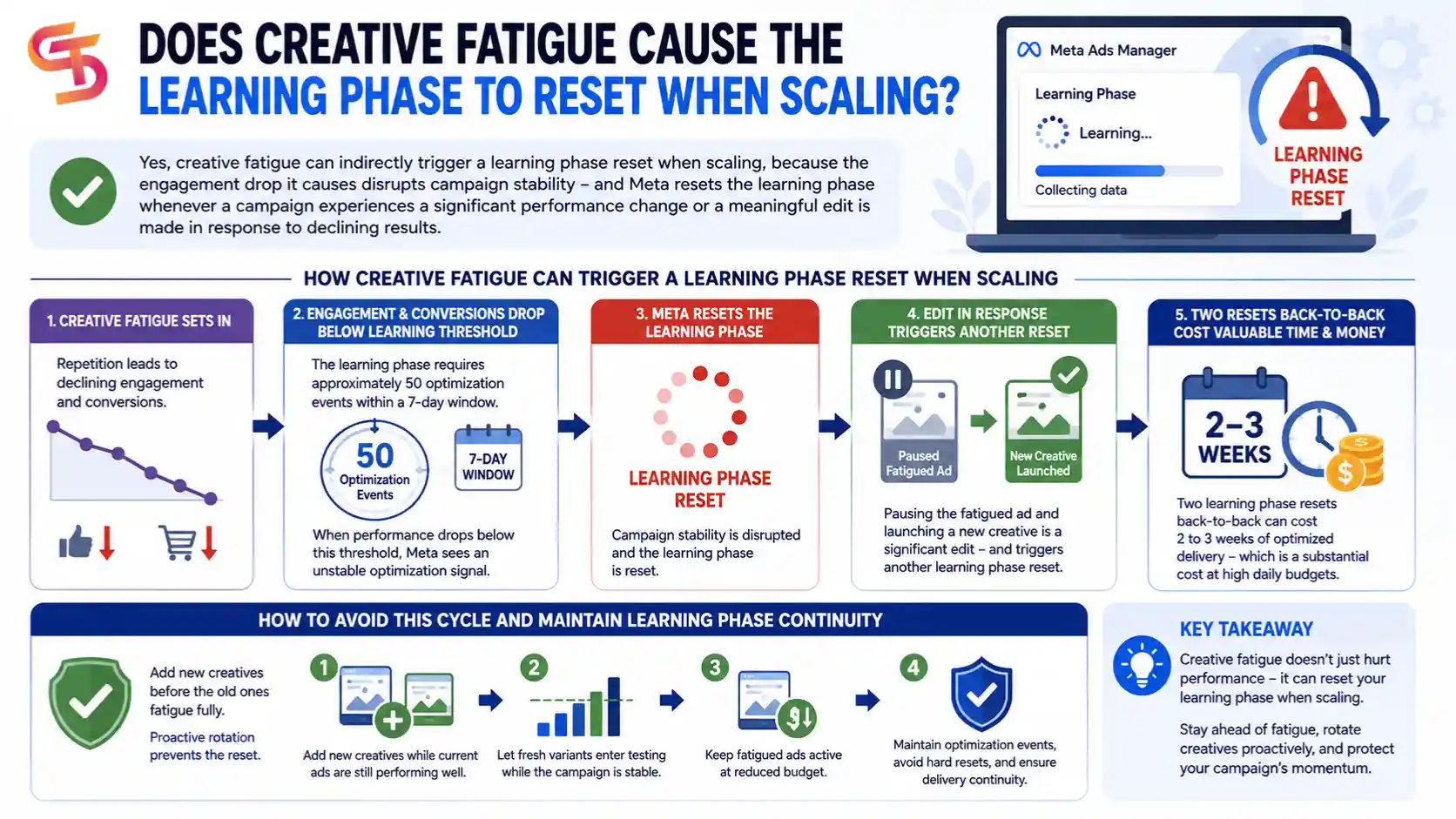
The learning phase requires approximately 50 optimization events within a 7-day window. When creative fatigue causes engagement and conversions to drop sharply, the campaign often falls below this threshold. Meta treats this as an unstable optimization signal and resets the learning phase. If the advertiser then pauses the fatigued ad and launches a new creative in response, this counts as a significant edit and triggers another reset. Two learning phase resets back-to-back can cost 2 to 3 weeks of optimized delivery, which is a substantial cost at high daily budgets.
The way to avoid this cycle is to add new creatives before the old ones fatigue fully, rather than pausing and replacing after the fact. Keeping fatigued ads active at reduced budget while fresh variants enter testing prevents the hard reset and maintains delivery continuity.
How Much Can Creative Fatigue Increase Your CPA During a Scale?
Creative fatigue can increase CPA by 40 to 100% or more during a scaling push, with research indicating that conversions can decrease by approximately 45 percent after an audience reaches around 4 exposures to the same creative.
Industry data cited by Facebook advertising practitioners puts the conversion decay curve at roughly 45% after 4 exposures. In practical terms, this means an advertiser scaling from $1,000 to $2,000 per day who does not refresh creative may see CPA climb from $35 to $68 within 48 hours – not because targeting broke, but because the audience hit the saturation threshold faster at double the spend. Reports from agencies managing multi-client campaigns document CTR and conversion efficiency declines of 20 to 40% within a 3 to 4 week window when creatives are not refreshed, with sharper drops at higher budget levels.
How Do You Stop Creative Fatigue from Killing Your Facebook Ad Scaling?
You stop creative fatigue from killing your Facebook ad scaling by building a continuous creative refresh pipeline – not by finding a single winning ad, but by maintaining a system that introduces tested replacements before existing creatives wear out.
The fundamental shift this requires is moving from a reactive mindset (refresh when performance drops) to a proactive one (introduce new variants before fatigue shows). Advertisers who never get blindsided by creative fatigue treat creative testing as an ongoing operation, not a one-time setup task. The mechanics of this system cover three areas: refresh cadence, pipeline structure, and rotation strategy.
How Often Should You Refresh Ad Creatives When Scaling Facebook Campaigns?
You should refresh top-of-funnel prospecting creatives every 5 to 7 days at high spend levels, mid-funnel retargeting creatives every 10 to 14 days, and base all refresh timing on frequency data rather than a fixed calendar.
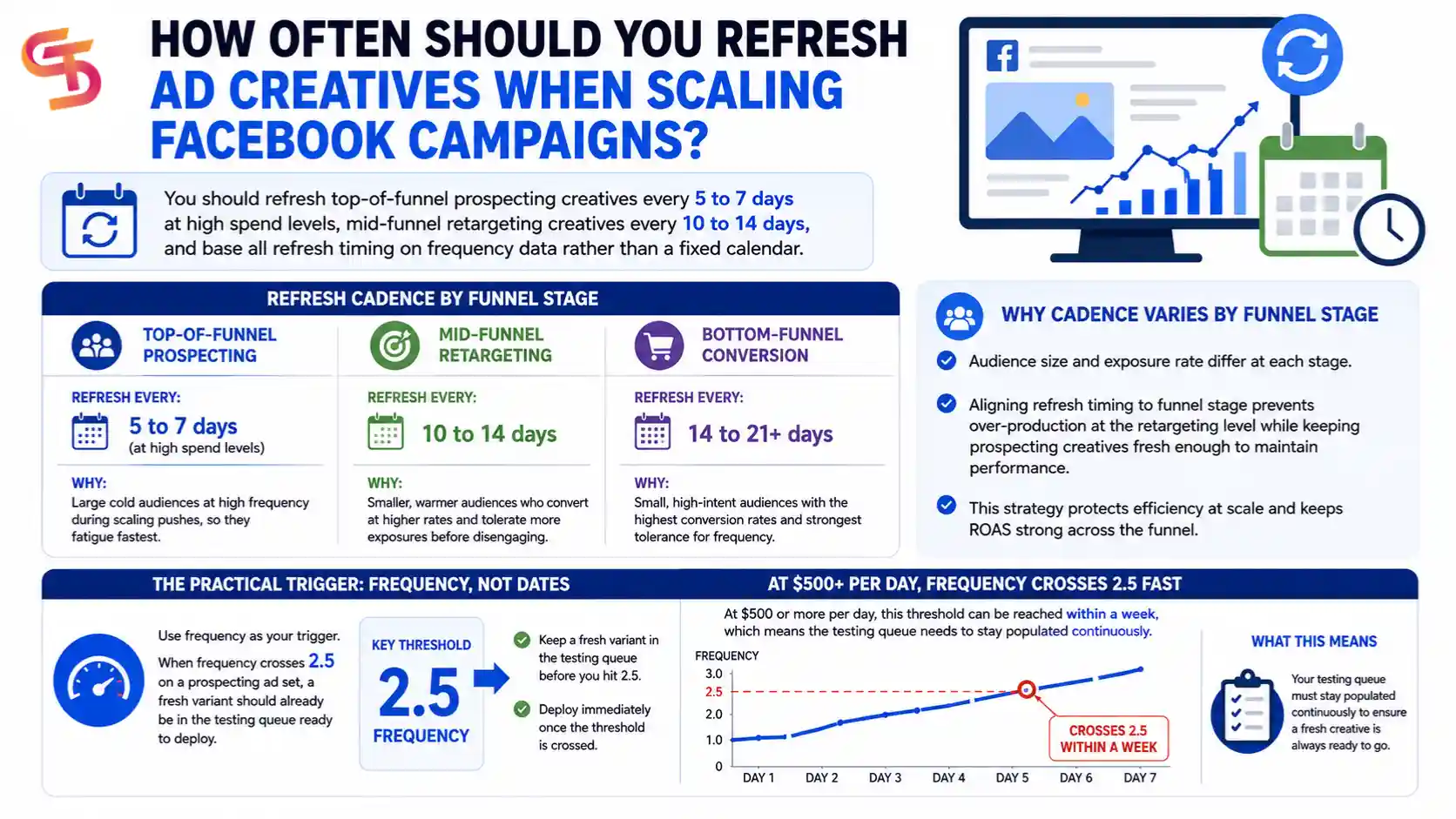
Refresh cadence varies by funnel stage because audience size and exposure rate differ at each stage. Top-of-funnel campaigns run against large cold audiences at high frequency during scaling pushes, so they fatigue fastest. Mid-funnel retargeting reaches smaller, warmer audiences who convert at higher rates and tolerate more exposures before disengaging. Aligning refresh timing to the funnel stage prevents over-production at the retargeting level while keeping prospecting creatives fresh enough to maintain performance.
The practical trigger to use is frequency, not dates. When frequency crosses 2.5 on a prospecting ad set, a fresh variant should already be in the testing queue, ready to deploy. At $500 or more per day, this threshold can be reached within a week, which means the testing queue needs to stay populated continuously.
What Should a Creative Refresh Pipeline Look Like for Scaled Campaigns?
A creative refresh pipeline for scaled campaigns should maintain 3 to 5 active concepts in rotation, introduce at least 1 to 2 new concepts into testing every week, and use a dedicated testing campaign to evaluate new variants before they are needed as replacements.
The structure works like this: a separate low-budget testing campaign runs new creative concepts continuously against a cold audience segment. This campaign evaluates hook performance, format response, and conversion rate for each new concept. When a current winner in the main scaling campaign shows early signs of fatigue – frequency above 2.5, CTR trending down – a tested replacement is already available to deploy. This eliminates the gap period where performance is declining and a replacement has not yet been identified.
Key elements of a functional pipeline include:
- A dedicated testing campaign with a budget of 10 to 15 percent of the main campaign spend
- A naming convention that tracks creative versions and launch dates
- A documentation system that records which hooks, formats, and angles performed well
- A retirement process for fatigued assets – archive rather than delete, so performance data is preserved for future reference
- A weekly review cycle to identify which concepts are entering the fatigue curve and which replacements are ready to scale
The testing campaign creates a predictable cadence rather than a reactive scramble. When the main campaign needs a new creative, one is ready. This is the operational difference between advertisers who scale successfully and those who plateau repeatedly.
Which Creative Rotation Strategies Prevent Fatigue at Higher Budgets?
There are four creative rotation strategies that prevent fatigue at higher budgets: targeted component refresh, format diversification, dynamic creative deployment, and audience segmentation by creative type. Each strategy addresses a different dimension of the fatigue problem:
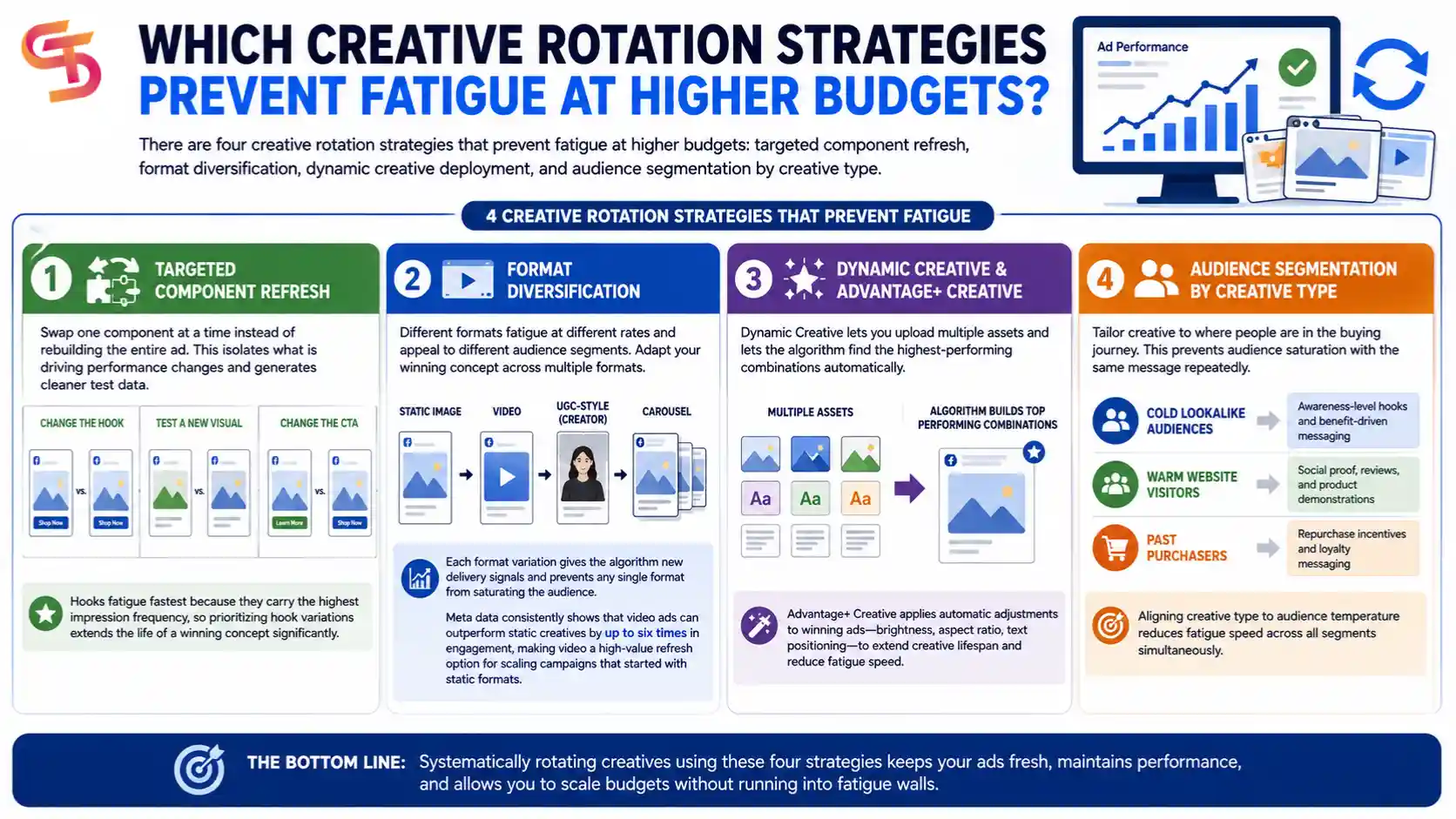
- Targeted component refresh – Instead of rebuilding an entire ad when fatigue appears, swap one component at a time. Change the hook while keeping the format and CTA identical. Test a new visual while keeping the copy unchanged. Change the CTA while leaving everything else intact. This approach isolates what is driving performance changes and generates cleaner test data. Hooks fatigue fastest because they carry the highest impression frequency, so prioritizing hook variations extends the life of a winning concept significantly.
- Format diversification – Different formats fatigue at different rates and appeal to different audience segments. A winning static image concept should be adapted into a video version, then into a UGC-style creator format, then into a carousel. Each format variation gives the algorithm new delivery signals to work with and prevents any single format from saturating the audience. Meta data consistently shows that video ads can outperform static creatives by up to six times in engagement, making video a high-value refresh option for scaling campaigns that started with static formats.
- Dynamic creative and Advantage+ Creative – Meta’s Dynamic Creative tool allows advertisers to upload multiple images, headlines, and descriptions simultaneously and lets the algorithm assemble the highest-performing combinations automatically. This gives the algorithm more variation to work with without requiring manual production of every permutation. Advantage+ Creative applies automatic adjustments to winning ads – brightness, aspect ratio, text positioning – to extend creative lifespan and reduce fatigue speed.
- Audience segmentation by creative type – Segmenting targeting into separate ad sets for cold lookalike audiences, warm website visitors, and past purchasers, each with creative tailored to where those people sit in the buying journey, prevents any single audience segment from receiving the same message repeatedly. Cold audiences respond to awareness-level hooks and benefit-driven messaging. Warm audiences respond to social proof, reviews, and product demonstrations. Past purchasers respond to repurchase incentives and loyalty messaging. Aligning creative type to audience temperature reduces fatigue speed across all segments simultaneously.
→ Once you have refreshed your creatives, the next step is increasing spend without hurting performance. Read How to Scale Your Facebook Ad Account Budget Without Losing ROAS for proven budget scaling strategies.
How Is Creative Fatigue Different from Ad Fatigue and Audience Fatigue in Facebook Campaigns?
Creative fatigue, ad fatigue, and audience fatigue are three distinct problems with three different root causes – creative fatigue means the idea itself has worn out, ad fatigue is driven by delivery structure and pacing, and audience fatigue happens when the same people see an ad too often, regardless of the creative quality.
Understanding this distinction prevents misdiagnosis. An advertiser who treats audience fatigue as a creative problem spends production resources rebuilding ads when the fix is broadening the target audience. An advertiser who treats creative fatigue as an audience problem spends budget testing new targeting when the concept itself is the issue. The fix for each type is different, and applying the wrong fix wastes both time and budget.
What Is the Difference Between Creative Fatigue and Ad Fatigue?
Creative fatigue means the core concept has lost novelty, and the audience no longer finds it interesting, while ad fatigue is driven by structural delivery problems – pacing, frequency capping, placement mix – rather than the quality of the creative idea itself.
An ad suffering from creative fatigue will perform poorly regardless of how the delivery is structured because the concept itself has been exhausted. Changing the audience or adjusting frequency caps will not fix a fatigued concept – the idea needs to be replaced or substantially reworked. Ad fatigue, by contrast, can often be resolved by adjusting delivery parameters without changing the creative. Reducing frequency, broadening placement selection across Reels, Stories, and In-Stream formats, or restructuring the campaign budget can restore performance for an ad that is structurally sound but over-delivered. The diagnostic test is straightforward: if moving the same creative to a fresh audience with adjusted delivery settings restores performance, the problem is ad fatigue. If performance stays weak regardless of delivery changes, the problem is creative fatigue.
What Is the Difference Between Creative Fatigue and Audience Fatigue?
Creative fatigue means the idea has worn out for all audiences, while audience fatigue means a specific audience segment has seen any ad from a campaign too many times – the creative may still be strong, but that particular group has reached saturation.
Audience fatigue is most common in retargeting campaigns and small audience segments where the pool of eligible users is limited. When a campaign targets a highly specific audience of 50,000 people with a $500 daily budget, the math forces high frequency even with strong engagement. The creative is not the problem – the audience size is. The fix is widening the audience, adding exclusion lists to suppress users who have already converted or taken the desired action, and letting lookalike audiences bring fresh users into the funnel. Creative fatigue and audience fatigue can appear simultaneously in a campaign, but they require separate fixes. Broadening the audience while also refreshing the creative addresses both simultaneously.
How Does Creative Fatigue at Agency Scale Differ from Single-Account Campaigns?
At agency scale, creative fatigue becomes an operational crisis rather than a single-campaign problem – multiple clients experiencing fatigue simultaneously creates compounding pressure on creative production, account management, and client reporting that individual advertisers never face.
A single advertiser managing one account can respond to fatigue manually: monitor frequency, produce a few new variants, swap the creative, and move on. An agency managing 20 to 50 client accounts simultaneously faces a different problem entirely. When three or four clients hit fatigue thresholds in the same week, the team must produce fresh creatives across multiple industries, audiences, and brand guidelines simultaneously. Performance data is fragmented across accounts. Insights from one client’s successful refresh do not automatically inform another client’s campaign. The result is that teams spend their time reacting to declines rather than preventing them, creative production gets rushed, and testing becomes shallow.
Agencies that manage creative fatigue successfully at scale do two things differently. First, they build predictive refresh schedules aligned to expected fatigue windows for each account, rather than waiting for performance to drop. Second, they standardize the refresh process into a repeatable production workflow – intake brief, component swap options, approval process, and launch protocol – so that every account gets a consistent response to fatigue signals regardless of team capacity on any given week. Some agencies use white-label Facebook agency ad accounts to handle creative production volume during high-fatigue periods, which maintains output quality without requiring internal team expansion.
Final Thoughts
Creative fatigue does not announce itself loudly. It shows up quietly in your Ads Manager as a frequency number that climbs past 2.5, a CTR that drops a few percentage points week over week, and a CPM that creeps upward without any obvious cause. By the time most advertisers notice the pattern, the damage is already done – budgets have been spent delivering an exhausted creative to a saturated audience, and ROAS has collapsed in a way that feels sudden but was actually building for days.
Frequently Asked Questions
1. What is creative fatigue in Facebook ads?
Creative fatigue in Facebook ads is the performance decline that happens when an audience sees the same ad concept too many times. After repeated exposures, users stop responding – CTR falls, CPM rises, and Meta’s algorithm reduces delivery because engagement signals have weakened. It is not a sign that the ad was poorly made. It is a natural result of finite audience size meeting consistent impression delivery.
2. How do I know if my Facebook ads have creative fatigue?
Watch four metrics in Meta Ads Manager: frequency above 2.5 to 3.0, CTR dropping more than 15% week over week, CPM rising without targeting changes, and Ad Relevance Diagnostics scores declining. When frequency and CTR move in opposite directions at the same time, creative fatigue is the most likely cause.
3. How often should I refresh Facebook ad creatives?
At standard spend levels, refresh top-of-funnel prospecting creatives every one to two weeks and mid-funnel retargeting creatives every two to three weeks. At high spend levels ($500 per day or more), prospecting creatives may need refreshing every 5 to 7 days. Use frequency data as your trigger – not a fixed calendar schedule.
4. What is the difference between creative fatigue and audience fatigue?
Creative fatigue means the concept itself has lost novelty – the idea is worn out regardless of who sees it. Audience fatigue means a specific group of people has seen the ad too many times, but the creative may still perform well with fresh audiences. The fix for creative fatigue is a new concept. The fix for audience fatigue is broadening targeting or adding exclusion lists.
5. How many creatives do I need when scaling Facebook ads?
A scaling campaign should maintain 3 to 5 active concepts in rotation at any time, with 1 to 2 new concepts entering testing every week through a dedicated testing campaign. The exact number scales with daily spend – higher budgets require faster concept turnover because impression volume is higher and fatigue timelines are shorter.
6. Does creative fatigue trigger the Facebook learning phase to reset?
It can. When creative fatigue causes engagement and conversions to drop sharply, the campaign may fall below the 50-optimization-event threshold Meta requires for stable learning. If the advertiser then pauses the fatigued ad and launches a replacement, this counts as a significant edit and triggers another learning phase reset. The better approach is to add new creatives alongside existing ones before fatigue fully sets in, which avoids the hard reset and maintains delivery continuity.
7. What is a creative refresh pipeline and why does it matter for scaling?
A creative refresh pipeline is a continuous system for producing, testing, and rotating ad creatives so that a replacement is always ready before the current winner wears out. It includes a dedicated low-budget testing campaign, a naming convention to track versions and dates, documentation of winning hooks and formats, and a weekly review process. Without this system, scaling campaigns stall repeatedly each time a winning ad fatigues, because the team is always reacting to decline rather than preventing it.