To learn how to use anti-detect browser to stop Facebook account bans, you must configure isolated virtual profiles with unique hardware fingerprints, integrate high-quality mobile or residential proxies to mask your IP address, and scale your operations using premium whitelisted Facebook agency accounts.
Imagine waking up on the morning of a major promotional launch, opening your Ads Manager, and being greeted by a sea of red warnings. Your personal profile is restricted, your Business Managers are disabled, and your active campaigns are frozen. Desperate to keep your ads running, you quickly log into a backup Facebook profile on your laptop. Within ten minutes, that account is banned as well. This is the frustrating reality of “associated bans” or “account chaining.”
In this comprehensive guide, we will show you exactly how to use anti-detect browser to stop Facebook account bans, spoof your digital fingerprints, and build a resilient advertising setup that scales.
Key Takeaways:
  • Spoof browser fingerprinting: Facebook tracks Canvas, WebGL, AudioContext, and system fonts. Spoofing these parameters isolates each profile and prevents associated bans.
  • Avoid cheap datacenter proxies: Only use mobile or residential proxies to match your IP location with the geographic location of your Facebook account.
  • Sandbox session data: Keep cookies, local storage, and history completely isolated between profiles to prevent cross-contamination.
  • Collect cookies before logging in: Use the cookie robot feature to build browsing history and mimic a natural human user before opening Facebook.
  • Stabilize with premium accounts: While anti-detect browsers protect your hardware fingerprint, you must combine them with a premium rent Facebook ads account service to safely scale high budgets without trigger-happy bot restrictions.
Table of Contents

How to Use Anti-detect Browser to Stop Facebook Account Bans in 2026

Many advertisers believe that Facebook only tracks cookies and IP addresses. According to this common assumption, using a VPN, changing an IP address, or clearing browser cookies should be enough to start fresh after an account restriction.
As an expert at GDT Agency who has spent more than 5 years working with Facebook ads, ad accounts, and Facebook agency accounts, I believe that Facebook’s security systems do not just track cookies and IP addresses.
How-to-Use-Anti-detect-Browser-to-Stop-Facebook-Account-Bans
Facebook security
They analyze your device’s unique digital signature, and when one account gets banned, Meta will flag your entire hardware profile to ensure that any other account logged in from the same machine is instantly flagged and shut down.
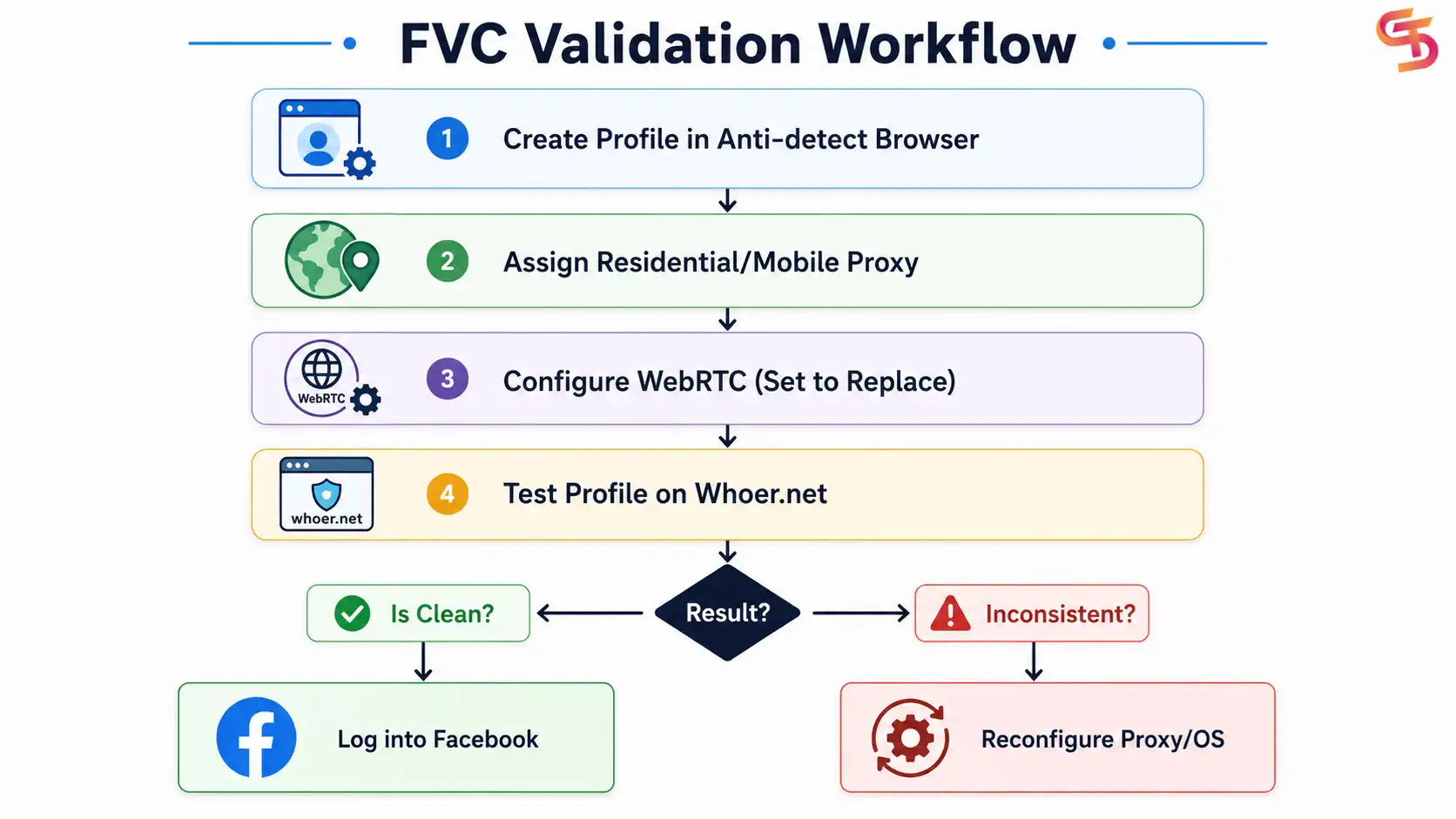
To prevent errors that lead to fingerprint leaks and account bans, here is the exact step-by-step framework to configure your anti-detect browser profiles safely:
How-to-Use-Anti-detect-Browser-to-Stop-Facebook-Account-Bans
Valiadation Workflow

Step 1: Create a Profile and Match the User-Agent

Download a trusted anti-detect browser like MoreLogin or PhoneGrid. Click “Create Profile.” Ensure that your profile’s User-Agent matches the operating system of your physical machine.

How-to-Use-Anti-detect-Browser-to-Stop-Facebook-Account-Bans
Create a Profile

If you are running Windows, configure your virtual profiles to use Windows User-Agents. Mixing a macOS User-Agent with Windows hardware APIs can trigger browser inconsistency flags in Facebook’s AI.

Step 2: Assign a Dedicated Proxy

Under the proxy settings, input your proxy credentials. We recommend using high-quality residential or mobile proxies. Do not use cheap datacenter proxies. Check that the proxy’s location matches the country of the Facebook profile you intend to use.

How-to-Use-Anti-detect-Browser-to-Stop-Facebook-Account-Bans
Assign a Dedicated Proxy
For example, if you are logging into a US-based Facebook account, your proxy IP must be from the United States.

Step 3: Configure WebRTC and Geo-location

Ensure your WebRTC setting is set to Replace or Altered, not disabled. If WebRTC is disabled, it flags your profile as a bot. The replacement setting forces WebRTC to leak the IP address of your proxy, not your actual home IP. Additionally, enable the “Fill Geo-location based on IP” setting to align your browser’s GPS coordinates with your proxy’s location.

Step 4: Validate Your Fingerprint Setup

Before opening Facebook, navigate to a fingerprint testing website like Whoer.net or Pixelscan.net. Verify that:
  • Your IP and DNS locations match perfectly.
  • Your WebRTC leak reveals your proxy IP, not your local IP.
  • The fingerprint test displays a green “Clean” or “Consistent” status.
Never log into a Facebook account until the profile scores 100% on Whoer.net and shows zero configuration inconsistencies on Pixelscan. Skipping this step is the fastest way to get your backup profiles blacklisted.

How Anti-detect Browsers Work to Stop Facebook Account Bans
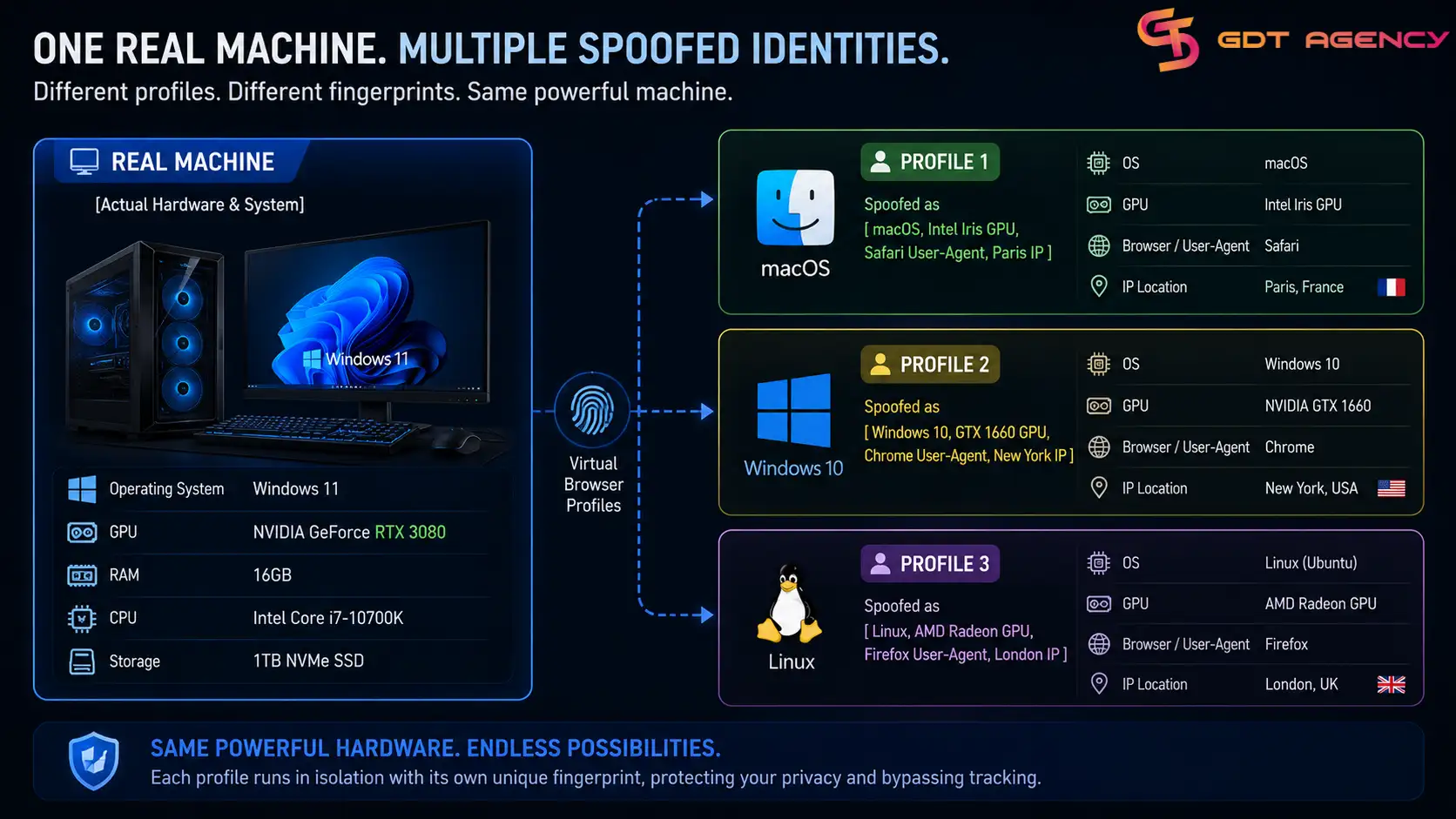
Anti-detect browsers do not block tracking scripts (which would trigger immediate red flags); instead, they feed Facebook a customized, highly realistic, and completely isolated digital fingerprint for every browser profile you run.
An anti-detect browser functions by running on a modified Chromium engine. Instead of sharing your computer’s real hardware specifications, the browser lets you create virtual profiles. For each profile, the browser generates a distinct set of system specifications:
How-to-Use-Anti-detect-Browser-to-Stop-Facebook-Account-Bans
How Anti-detect Browsers Work

To Facebook, these 3 profiles look like 3 entirely different computers operating in different cities. The cookies, local storage, and cache for each profile are kept in completely isolated sandboxes. There is zero data leakage between profiles, meaning an issue on one profile will never contaminate the others.

Many advertisers mistakenly believe that blocking Canvas or WebGL rendering entirely is the key to privacy. In reality, blocking these elements makes your browser look extremely suspicious to Meta’s security bots, as genuine users never block standard hardware rendering.
The secret to how to use anti-detect browser to stop Facebook account bans lies in spoofing (replacing your real data with realistic noise) rather than blocking the data collection entirely.

Top 5 Reliable Anti-detect Browsers You Should Try

Not all anti-detect browsers offer the same level of protection. Choosing the wrong browser can expose your accounts to unnecessary risks. Choosing the right one can make account management significantly safer and more scalable.

1. MoreLogin

MoreLogin is a strong choice for Facebook advertisers who need both anti-detect browser profiles and mobile environments in one platform.
Its anti-detect browser helps users create isolated profiles with separate fingerprints, proxies, cookies, time zones, WebRTC settings, and device parameters, which is useful for managing multiple Facebook ad accounts, Business Managers, and team members without mixing account data.
How-to-Use-Anti-detect-Browser-to-Stop-Facebook-Account-Bans
Morelogin
MoreLogin also supports team permissions, profile sharing, batch operations, and automation tools, making it suitable for agencies and advertisers running accounts at scale.

What makes MoreLogin stand out is its built-in Cloud Phone feature. Besides browser-based account management, users can run cloud-based Android environments for mobile logins, app workflows, account warm-up, testing, and mobile-side operations. This gives MoreLogin an advantage over many traditional anti-detect browsers that only focus on desktop profiles.

Pros:Cons:
  • Combines an anti-detect browser and Cloud Phone in one platform.
  • Creates isolated browser profiles with separate fingerprints, proxies, cookies, time zones, WebRTC settings, and device parameters.
  • Helps manage multiple Facebook ad accounts, Business Managers, and team members without mixing account data.
  • Supports team permissions, profile sharing, batch operations, and automation tools. Includes Cloud Phone for mobile logins, app workflows, account warm-up, testing, and mobile-side operations.
  • More complete than many traditional anti-detect browsers that only focus on desktop profiles.
  • May take some time to learn because it combines browser fingerprints, proxies, Cloud Phone, team management, and automation in one system.
  • Performance still depends on proxy quality, account behavior, and consistent environment management.
  • May be more powerful than necessary for users who only manage one or two Facebook accounts.

Best for: Agencies, affiliate marketers, and businesses managing multiple accounts.

2. Phonegrid

PhoneGrid is a cloud phone platform for teams that need scalable Android environments without buying or maintaining physical devices. For Facebook advertisers, it can be useful when workflows involve mobile-side account checks, app logins, ad testing, verification tasks, or Android-based operations.

Instead of running local emulators on a computer, PhoneGrid lets users access cloud-based Android phones from one dashboard, keep sessions available remotely, and manage mobile workflows in a cleaner way.
How-to-Use-Anti-detect-Browser-to-Stop-Facebook-Account-Bans
phonegrid

Its main advantage is that it focuses directly on cloud phone infrastructure. This makes PhoneGrid suitable for teams that need mobile environments at scale, especially when they want to reduce hardware costs, avoid maintaining multiple physical phones, and manage Android workflows remotely.

Pros:Cons:
  • Focuses specifically on cloud phone infrastructure.
  • Helps teams run scalable Android environments without physical devices.
  • Useful for mobile-side Facebook account checks, app logins, ad testing, verification tasks, and Android-based operations.
  • Provides remote access to cloud-based Android phones from one dashboard. Reduces dependence on local emulators and computer hardware.
  • Suitable for teams that need persistent mobile environments for daily workflows.
  • Not an anti-detect browser.
  • Does not focus on browser fingerprint management.
  • Less suitable for users who mainly need desktop browser profile isolation.
  • Users who need both browser fingerprints and cloud phones may need to combine it with a dedicated anti-detect browser.
Best for: Mobile marketers, app testers, and social media account managers.

3. Adspower

AdsPower has become a leading solution for large-scale account management. It combines browser fingerprint protection with powerful automation and team management tools.
How-to-Use-Anti-detect-Browser-to-Stop-Facebook-Account-Bans
ads power

It offers advanced browser fingerprint customization, proxy management, team permission controls, and automation tools. Its extensive feature set makes it a popular choice for businesses operating at scale.

Pros:Cons:
  • Extensive browser fingerprint settings
  • Built-in automation features
  • Strong team collaboration and permission controls
  • Suitable for managing hundreds or thousands of profiles
  • Large user base and active ecosystem
  • The interface can feel overwhelming for beginners
  • Resource usage may increase with large profile volumes
Best for: Large account operations, e-commerce sellers, and advertising agencies.

4. Dolphin Anty

Dolphin Anty is widely recognized in the affiliate marketing industry. The platform offers a balance of usability, performance, and automation capabilities.
How-to-Use-Anti-detect-Browser-to-Stop-Facebook-Account-Bans
Dolphin Anty

The browser enables users to create separate browser environments, integrate proxies, and automate repetitive tasks. Its balance of usability and performance makes it suitable for both beginners and experienced users.

Pros:Cons:
  • Clean and intuitive interface
  • Popular among affiliate marketers
  • Supports automation and proxy integration
  • Fast profile creation and management
  • Good performance for medium-sized operations
  • Some advanced features are locked behind premium plans
  • Less suitable for enterprise-scale teams than certain competitors
Best for: Affiliate marketers, traffic arbitrage teams, and performance marketers.

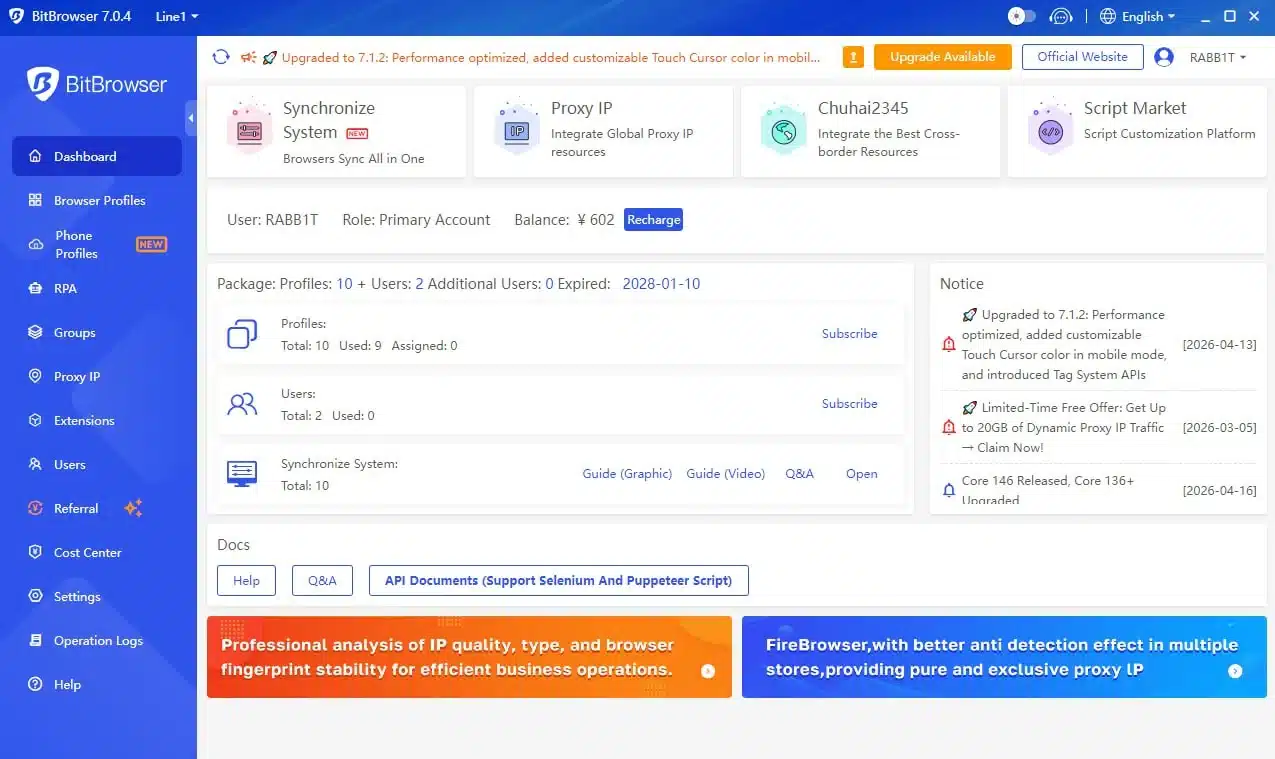
5. Bitbrowser

BitBrowser provides a budget-friendly option for users who need browser fingerprint protection and multi-account management without a high monthly cost.
How-to-Use-Anti-detect-Browser-to-Stop-Facebook-Account-Bans
BitBrowser
It supports fingerprint isolation, proxy integration, team collaboration, and bulk profile management. The platform is often chosen by users looking for a budget-friendly alternative without sacrificing essential anti-detection features.
Pros:Cons:
  • Competitive pricing
  • Supports a large number of browser profiles
  • Team collaboration features available
  • Proxy integration and fingerprint customization
  • Suitable for startups and small businesses
  • User experience is not as polished as some premium alternatives
  • Documentation and support resources can be limited in some regions
Best for: Small businesses, freelancers, and budget-conscious account managers.

Best Practices: Proxies, Cookies, and Account Warming
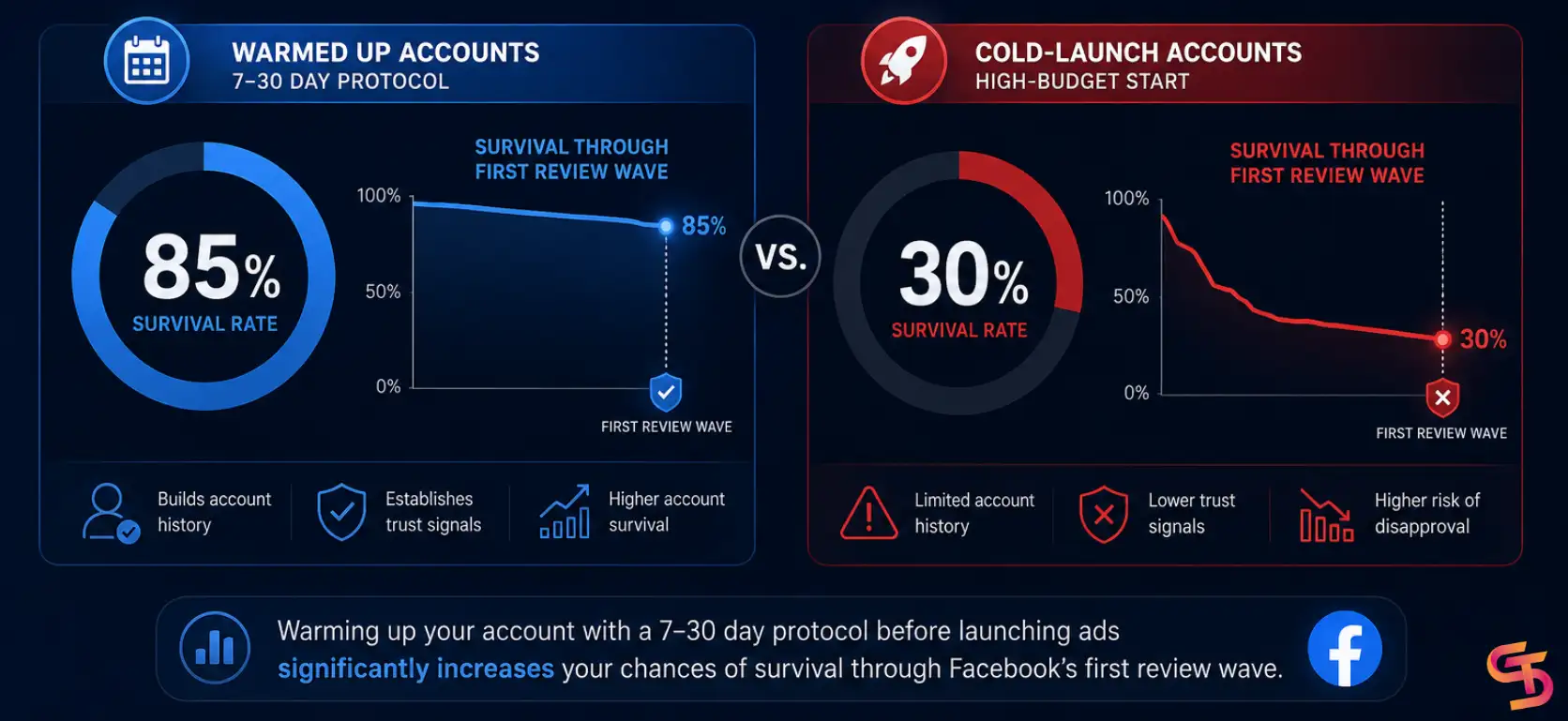
Spoofing your hardware fingerprint is only half the battle; to stop Facebook account bans, you must also maintain high IP trust scores and practice proper account warming.
Data from specialized Facebook media buying research shows that accounts warmed up using a 7–30 day protocol before their first ad campaign have an 85% survival rate through the first review wave, compared to a roughly 30% survival rate for cold-launch accounts that start with high-budget campaigns immediately.
How-to-Use-Anti-detect-Browser-to-Stop-Facebook-Account-Bans
Best practices

The Importance of Residential and Mobile Proxies

A proxy is the internet connection for your virtual profile. Facebook tracks the reputation of your IP address.
If you use cheap datacenter proxies, Meta’s firewall recognizes that the IP originates from a hosting facility (like Amazon Web Services or DigitalOcean) rather than a home internet provider. Real people do not browse Facebook from datacenters, so these IPs are flagged immediately.
  • Residential Proxies: These route your traffic through residential home internet connections, making them highly trusted.
  • Mobile Proxies (4G/5G): These are the gold standard. Because hundreds of real mobile users share the same cellular IP pool daily, Facebook cannot easily ban a mobile IP range without affecting legitimate users.
When a real human browses the web, they accumulate cookies and history from sites like Google, Amazon, and news outlets. If you log into Facebook on a brand-new browser profile with zero cookies, Facebook’s security bots mark it as a suspicious, automated login.
To prevent this, utilize the Cookie Robot feature found in most anti-detect browsers. Set the robot to run for 3-5 days before logging into Facebook. The robot will automatically visit a list of popular websites, loading cookies into your profile and building a natural-looking browsing history.

The Ultimate Upgrade: Premium Facebook Agency Accounts

While anti-detect browsers protect your hardware and connection identity, they cannot bypass the strict spending limits and compliance checks imposed on standard personal profiles or self-created Business Managers.
To scale without bottlenecks, you must combine your anti-detect setup with premium whitelisted agency accounts. Whitelisted accounts provided by verified partners maintain stable CPMs and experience near-zero automated shutdowns when running campaigns via isolated profiles.

The Limits of Self-Managed Accounts

Even with a flawless anti-detect browser configuration, you will eventually face obstacles when you try to scale your spend. Standard, self-managed ad accounts are subject to:
  • Strict daily spending limits (often starting at $50/day).
  • Aggressive automated compliance sweeps that trigger bans for minor issues.
  • Days or weeks of waiting for automated Meta support responses when a ban occurs.
If you are running a business, you cannot afford to have your marketing halt for weeks. When your campaign performance is strong, you need the ability to scale your budget immediately. If you run into issues, you need to understand how to handle them.

Why Combine Anti-detect Browsers with GDT Agency Accounts?

By importing a premium Facebook agency account from GDT Agency into your anti-detect browser profile, you secure the ultimate advertising infrastructure. These whitelisted agency accounts provide:
  • Unlimited Daily Spend: Scale your winning campaigns from $100/day to $10,000/day instantly without triggering automated compliance flags.
  • High-Trust Meta Status: Agency accounts are pre-vetted and whitelisted by Meta partners, meaning your ads skip the harshest automated filters and benefit from stable CPMs.
  • Direct Agency Support: If a compliance issue arises, GDT Agency handles the appeal directly with Meta representatives, resolving restrictions in hours rather than weeks.

Effectiveness of This Combination in Real Conditions

In early 2026, a B2B SaaS client was spending $1,500/day on Facebook Ads. Because they were running their campaigns from standard Chrome profiles, Facebook’s AI linked their personal profiles and executed a sweep.
Their Business Manager was disabled, and their backup profiles were banned within 48 hours due to device fingerprint correlation. They were losing $5,000 in daily pipeline revenue.
We intervened and migrated their operation. We guided them to set up MoreLogin with dedicated 4G mobile proxies, run a cookie-warming cycle for 3 days, and assign their pixel to a premium GDT Agency whitelisted account.
By isolating their physical devices and utilizing a high-trust agency account, the client scaled their daily spend to $4,500/day with zero restrictions. Their CPM dropped by 18% due to the whitelisted account’s high-trust rating.

Conclusion

Mastering how to use an anti-detect browser to stop Facebook account bans is essential for any advertiser looking to scale campaigns in 2026. By isolating your browser profiles, spoofing your hardware fingerprint, and routing your traffic through high-quality mobile or residential proxies, you eliminate the risk of linked account bans.
However, spoofing your device is only the first step. To scale your advertising budget without the constant headache of automated restrictions, you need high-trust infrastructure. Pair your isolated setup with a premium, whitelisted ad account. If you are ready to scale your paid promotion, contact GDT Agency today to learn about our premium agency account solutions.

Frequently Asked Questions (FAQ)

1. Can I use a VPN instead of residential proxies in an anti-detect browser?

No. Standard VPN services use public server IPs that are shared by thousands of users. Facebook maintains a database of known VPN IP ranges and flags accounts using them immediately. To stop Facebook account bans, you must use clean, dedicated residential or mobile proxies that mimic residential home connections.

2. How do I warm up a new Facebook profile in an anti-detect browser?

Start by running the browser’s cookie robot for 3 days to visit random sites. Once you log into Facebook, spend the first 3-4 days performing low-risk actions: scroll the news feed, watch videos, join groups, and search for pages. Avoid opening the Ads Manager or creating campaigns during this initial warming period.

3. What should I do if my Facebook ad account is already restricted?

If your account has been restricted, do not attempt to log into a new backup account on the same browser profile. First, review our guide on how to fix Facebook ad account disabled errors. Then, set up a brand-new virtual profile in your anti-detect browser with a new proxy before accessing another Facebook account.

4. Why are my Facebook ads not spending after migrating profiles?

If your ads are not spending on a new profile, it is typically due to a mismatch between your proxy location and the account billing address, or an unverified payment method. Check out our troubleshooting guide for Facebook ads not spending to identify and resolve the issue.