
TikTok Ads for E-commerce: A Complete Guide to Formats, Cost, and Setup

TikTok Ads for e-commerce works as a paid promotion system that helps online stores reach buyers through short-form video on one of the fastest-growing platforms today. The system runs on an auction model, and it rewards stores that pair the right ad format with the right creative. Small and mid-size brands use it to drive traffic, generate leads, and push direct sales through TikTok Shop.
Store owners usually start with a narrow set of questions before they commit any budget. They want to know which ad types fit an online store, how much a real campaign costs, and how to get an account running without hitting a wall on day one. Each of these questions has a direct answer, and this guide answers them in order.
Targeting and creative decide most of the outcome once the account is live. A store that skips proper Pixel setup or ignores TikTok’s product policies often burns budget without seeing sales. This guide walks through setup, targeting, and video creative so a store avoids that outcome.
Beyond the basics, a real case study shows what a working TikTok Ads campaign looks like for an actual e-commerce brand. From here, the guide moves through ad formats, cost, account setup, targeting, and video creative, in that order, before closing with a real client result.
- What is TikTok Ads for E-commerce?
- How Do TikTok Ads Work for Online Stores?
- Is TikTok Ads Worth It for E-commerce Businesses?
- What Types of TikTok Ads Work Best for E-commerce?
- What is the Difference Between In-Feed Ads and Spark Ads?
- What Are TikTok Shopping Ads?
- How Much Do TikTok Ads Cost for E-commerce?
- What is the Minimum Budget to Start TikTok Ads?
- How Does TikTok Ads Pricing Compare to Facebook Ads for E-commerce?
- How Do You Set Up a TikTok Ads Account for E-commerce?
- Do You Need a TikTok Business Account to Run Ads?
- How Do You Connect TikTok Pixel to Your Online Store?
- How Do You Create Video Ads That Convert for E-commerce?
- How Long Should a TikTok Ad Video Be for E-commerce?
- Case Study: How a GDT Agency Client Scaled E-commerce Sales with TikTok Ads
- What Are Common TikTok Ads Restrictions for E-commerce Products?
- Can Dropshipping Stores Run TikTok Ads?
- Why Does TikTok Disable E-commerce Ad Accounts?
- What is a TikTok Agency Ad Account and Why Do E-commerce Brands Use It?
- What is the TikTok Creator Marketplace and How Does It Help E-commerce Brands?
- Final Thoughts
- Frequently Asked Questions
- Do I need TikTok Shop to run TikTok Ads for my store?
- Can I run TikTok Ads without making my own videos?
- How long does it take to see results from TikTok Ads?
- What is a good ROAS for TikTok Ads in e-commerce?
- Can I use the same video ad on TikTok and Facebook?
- What happens if my TikTok ad account gets disabled?
What is TikTok Ads for E-commerce?
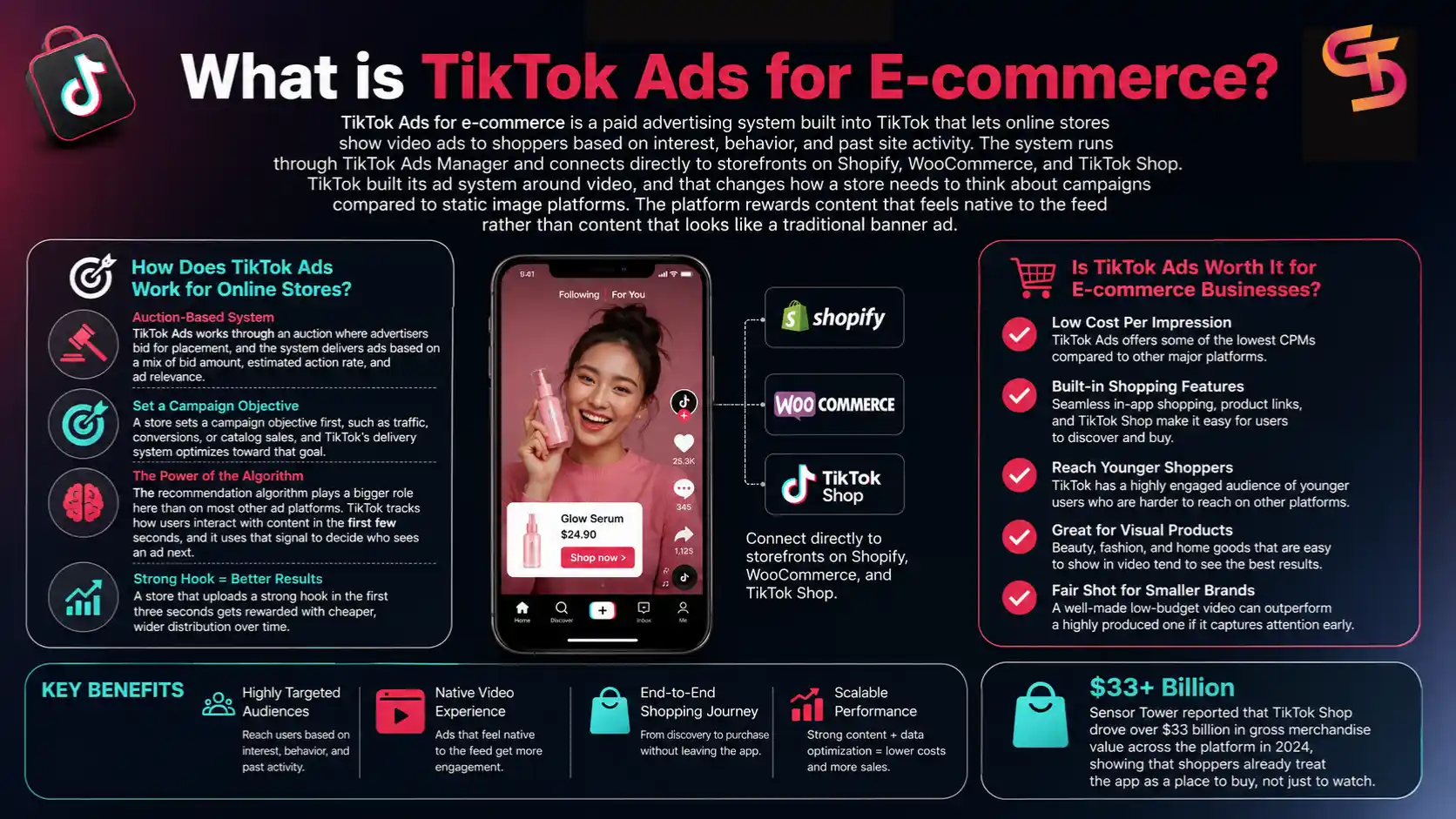
TikTok Ads for e-commerce is a paid advertising system built into TikTok that lets online stores show video ads to shoppers based on interest, behavior, and past site activity. The system runs through TikTok Ads Manager and connects directly to storefronts on Shopify, WooCommerce, and TikTok Shop.
TikTok built its ad system around video, and that changes how a store needs to think about campaigns compared to static image platforms. The platform rewards content that feels native to the feed rather than content that looks like a traditional banner ad.
How Do TikTok Ads Work for Online Stores?
TikTok Ads works through an auction where advertisers bid for placement, and the system delivers ads based on a mix of bid amount, estimated action rate, and ad relevance. A store sets a campaign objective first, such as traffic, conversions, or catalog sales, and TikTok’s delivery system optimizes toward that goal.
The recommendation algorithm plays a bigger role here than on most other ad platforms. TikTok tracks how users interact with content in the first few seconds, and it uses that signal to decide who sees an ad next. A store that uploads a strong hook in the first three seconds gets rewarded with cheaper, wider distribution over time.
Is TikTok Ads Worth It for E-commerce Businesses?
Yes, TikTok Ads is worth it for most e-commerce businesses, mainly because of its low cost per impression, its built-in shopping features, and its reach among younger buyers who are harder to reach elsewhere. Stores selling visually demonstrable products, such as beauty, fashion, and home goods, tend to see the strongest results.
The platform also gives smaller brands a fair shot at scale, since a well-made low-budget video can outperform a highly produced one if it captures attention early. Sensor Tower reported that TikTok Shop drove over $33 billion in gross merchandise value across the platform in 2024, showing that shoppers already treat the app as a place to buy, not just to watch.
What Types of TikTok Ads Work Best for E-commerce?
Five ad types work best for e-commerce: In-Feed Ads, Spark Ads, Collection Ads, Shopping Ads, and TopView Ads, each suited to a different stage of the shopper’s decision. Most stores build their core strategy around In-Feed Ads and Spark Ads, then add the others once the account has stable data.
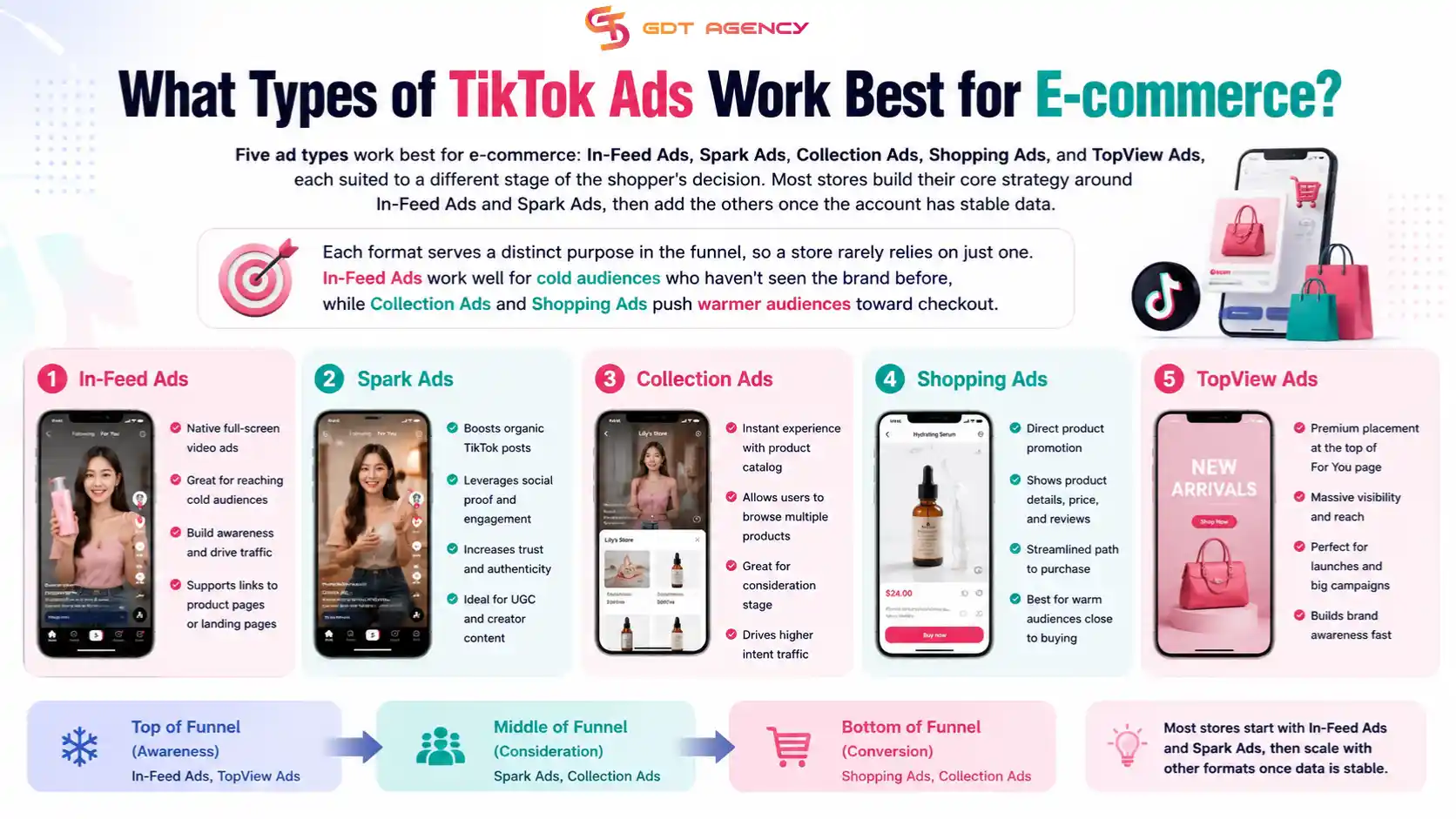
Each format serves a distinct purpose in the funnel, so a store rarely relies on just one. In-Feed Ads work well for cold audiences who haven’t seen the brand before, while Collection Ads and Shopping Ads push warmer audiences toward checkout.
What is the Difference Between In-Feed Ads and Spark Ads?
In-Feed Ads use brand-uploaded creative built specifically for the campaign, while Spark Ads boost an existing organic post from the brand’s own account or a creator’s account. Spark Ads keep the likes, comments, and shares from the original post, so the ad carries social proof that a fresh In-Feed Ad doesn’t have.
In practice, stores that already post organic content get more mileage from Spark Ads, since the format lets them scale a video that already proved it resonates with real viewers. In-Feed Ads work better for stores just starting out, since there’s no organic post history to draw from yet.
What Are TikTok Shopping Ads?
TikTok Shopping Ads are ad formats that link directly to a store’s product catalog inside TikTok Shop, letting shoppers browse, add to cart, and check out without leaving the app. The format pulls product images, prices, and availability straight from the connected catalog, so listings stay current without manual updates.
Shopping Ads work best for stores with an active TikTok Shop storefront and a clean product feed. A store with mismatched pricing or out-of-stock items in its feed risks running ads for products shoppers can’t actually buy, which hurts both sales and account trust with the platform.
How Much Do TikTok Ads Cost for E-commerce?
TikTok Ads for e-commerce typically cost a minimum of $50 per day at the ad group level, with CPM ranging from about $6 to $10 depending on industry and audience competition. Actual spend varies widely based on product category, target audience size, and the season a store is advertising in.
Several factors push cost up or down beyond the platform’s base rate. Competitive categories like beauty and fashion tend to carry higher CPMs, while niche or seasonal products can see costs spike sharply around major shopping periods like Black Friday.
What is the Minimum Budget to Start TikTok Ads?
The minimum budget to start TikTok Ads is $50 per day at the ad group level and $500 for the full campaign lifetime budget, though most e-commerce stores need a larger test budget to gather enough data for the algorithm to optimize properly. TikTok’s own delivery system needs roughly 50 conversions per week per ad group before it can optimize reliably.
Stores that launch with the bare minimum often see slow or inconsistent results in the first week, since the algorithm hasn’t gathered enough signal yet. A more realistic starting budget for a new e-commerce account sits between $20 and $50 per day per campaign, run for at least a week before judging performance.
How Does TikTok Ads Pricing Compare to Facebook Ads for E-commerce?
TikTok Ads generally costs less per impression than Facebook Ads, but Facebook Ads often delivers a lower cost per acquisition for stores with an established pixel and years of conversion data.
The gap comes down to audience maturity: Facebook’s ad system has more historical data on most users, while TikTok’s targeting still leans more on content signals than long-term user profiles.
Stores with strong short-form video creative tend to close that gap quickly on TikTok, since the platform rewards engaging content with cheaper delivery regardless of account age.
How Do You Set Up a TikTok Ads Account for E-commerce?
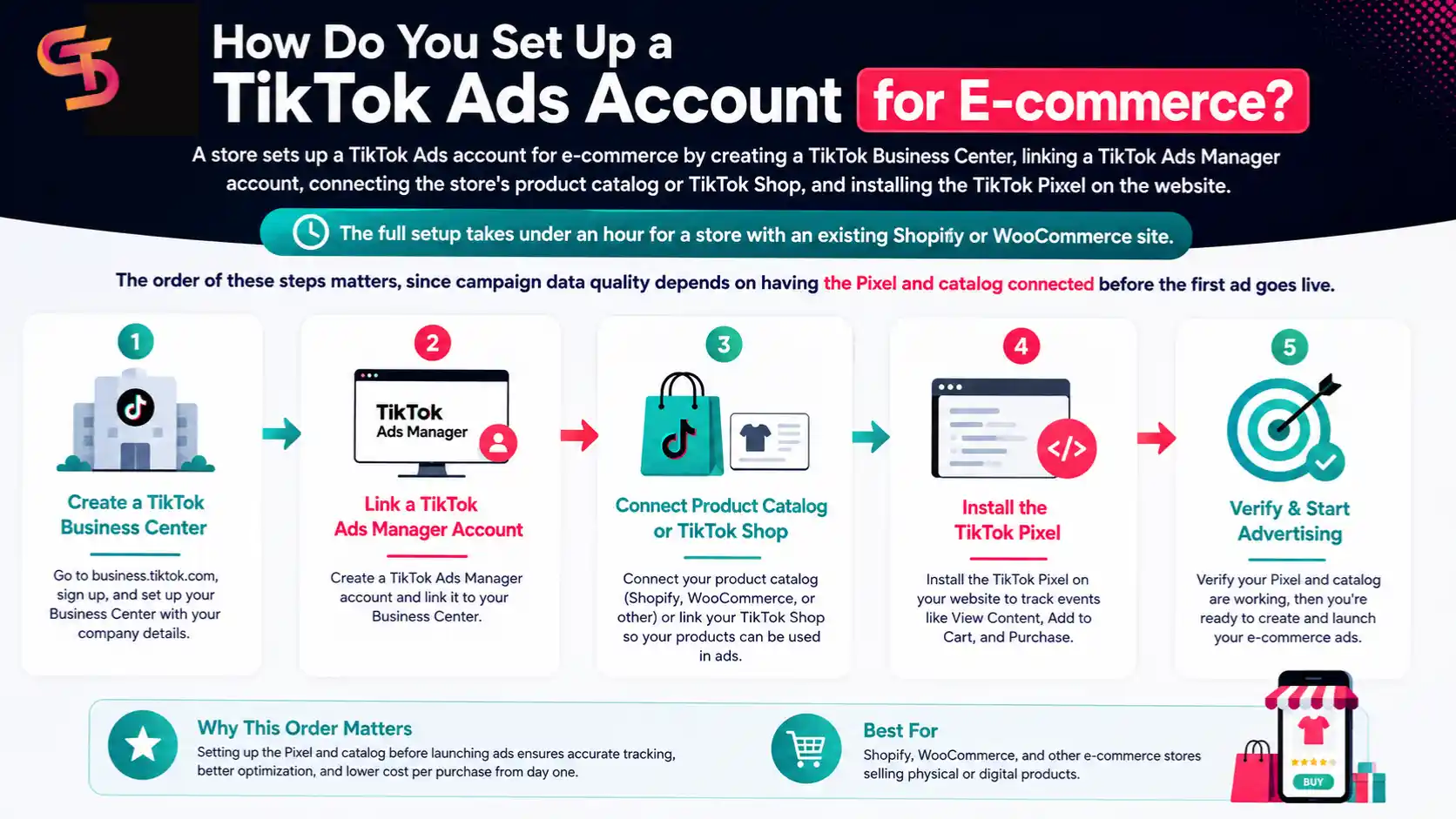
A store sets up a TikTok Ads account for e-commerce by creating a TikTok Business Center, linking a TikTok Ads Manager account, connecting the store’s product catalog or TikTok Shop, and installing the TikTok Pixel on the website. The full setup takes under an hour for a store with an existing Shopify or WooCommerce site.
The order of these steps matters, since campaign data quality depends on having the Pixel and catalog connected before the first ad goes live.
Do You Need a TikTok Business Account to Run Ads?
Yes, a store needs a TikTok Business Account to run ads, since TikTok’s advertising tools, analytics, and catalog features are only available through Business Center, not through a personal profile. A personal account can post organic content, but it can’t access Ads Manager or run any paid campaign.
Switching from personal to business takes a few minutes inside the TikTok app settings, and it doesn’t remove any existing followers or content from the account.
How Do You Connect TikTok Pixel to Your Online Store?
A store connects the TikTok Pixel by generating the Pixel code inside TikTok Events Manager, then installing it through a native integration on Shopify or WooCommerce, or by pasting the code manually into the site’s header. Shopify stores can connect the Pixel in a few clicks through the TikTok channel app, while WooCommerce stores typically need a plugin or manual code placement.
Once installed, the Pixel tracks key events like page views, add-to-cart actions, and completed purchases, feeding that data back into TikTok’s ad system for optimization. A store should test the Pixel with TikTok’s Events Manager diagnostic tool right after setup to confirm events are firing correctly before spending any ad budget.
How Do You Create Video Ads That Convert for E-commerce?
A store creates video ads that convert by opening with a strong hook in the first three seconds, using UGC-style filming instead of polished studio production, and showing the product in real use rather than in a static shot. TikTok users scroll fast, and an ad that looks like organic content earns more watch time than one that looks like a traditional advertisement.
The strongest e-commerce ads on the platform tend to follow a simple structure: hook, problem, product demonstration, and a clear call to action.
How Long Should a TikTok Ad Video Be for E-commerce?
A TikTok ad video for e-commerce should run between 9 and 15 seconds for conversion-focused campaigns, though TopView and brand awareness formats can extend to 60 seconds without hurting performance. Shorter videos tend to hold attention better for direct-response goals like purchases, since viewers decide whether to keep watching within the first couple of seconds anyway.
Stores running catalog or retargeting ads often see the best results with videos under 10 seconds, since the goal is a quick reminder rather than a full product story.
Case Study: How a GDT Agency Client Scaled E-commerce Sales with TikTok Ads
Senere Shop, an e-commerce store selling electric nail trimmers, laser hair removers, and hair extensions to Gen Z and Millennial buyers across Europe and the US, turned a break-even TikTok ad account into a 4X ROAS operation after partnering with GDT Agency. Before the partnership, the store’s campaigns brought in traffic and occasional sales, but ROAS sat around or below 2.0x, and cost per acquisition stayed high enough to block real profit.
GDT Agency took on the account in Q1 2023 and found four core problems behind the weak performance:
- Ad creative that looked repurposed from Facebook instead of built for TikTok.
- Broad targeting with no audience testing.
- A reactive budget process with no regular optimization schedule.
- A standard ad account that limited spend and slowed ad review.
Each problem got a direct fix. GDT rebuilt Senere Shop’s creative around UGC-style video, trending sounds, and benefit-focused text overlays, replacing studio-shot product demos with phone-shot footage that matched how real TikTok content looks. The team then restructured targeting around interest segments, retargeting, and lookalike audiences, splitting ad groups by audience and ad variant so winners were easy to spot. On the budget side, GDT tracked performance every two hours and reallocated spend from weak ads to strong ones on that same schedule. Finally, GDT moved the account onto one of its premium TikTok agency ad accounts, removing the spending limits and review delays that come with a standard account.
Over the following 90 days, Senere Shop’s numbers moved in a clear direction. CPA dropped 40%, from $35 to $21. Click-through rate rose from 0.8% to 1.5%, and the website conversion rate from TikTok traffic climbed from 1.5% to 2.5%. Monthly ad spend scaled 5X, from $5,000 to $25,000, and monthly revenue from TikTok Ads grew from $7,500 to a range of $100,000 to $112,500, a jump of more than 300%. Average ROAS rose from roughly 1.5x to between 4.0x and 4.5x, an increase of about 250%.
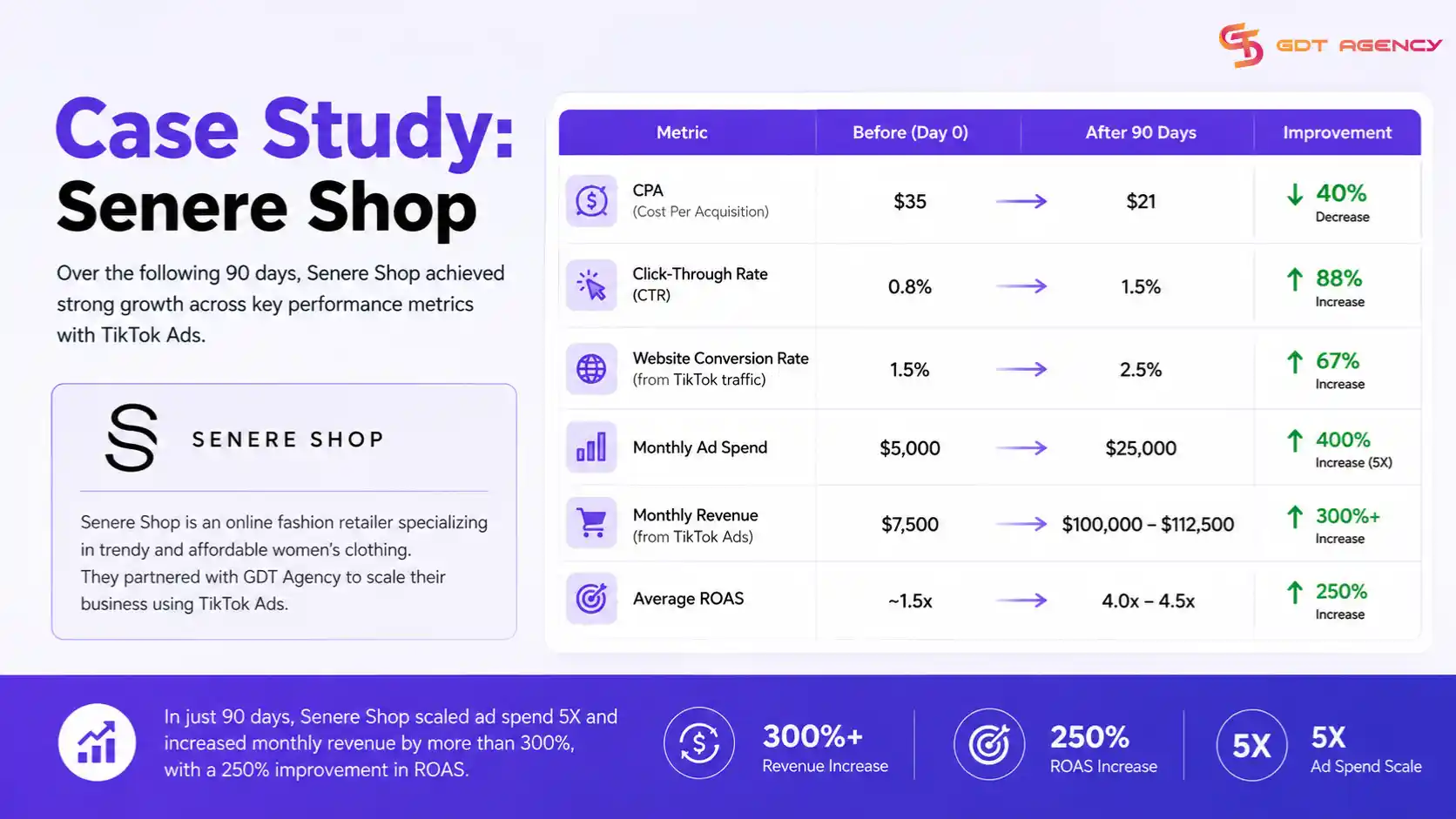
Senere Shop now runs a large monthly TikTok ad budget on an ongoing basis, and the account continues to return a profitable ROAS at that higher spend level. The result shows what proper creative, targeting, budget management, and account infrastructure can do together, not any single fix on its own.
What Are Common TikTok Ads Restrictions for E-commerce Products?
TikTok restricts several categories of e-commerce products, including certain supplements, weight-loss products, counterfeit goods, and items that make unverified health claims. Stores in these categories often see ads rejected or accounts flagged even when the product itself is legal to sell.
Beauty and wellness brands run into these restrictions more than most other categories, since TikTok applies extra scrutiny to any health or appearance-related claim in ad copy or video.
Can Dropshipping Stores Run TikTok Ads?
Yes, dropshipping stores can run TikTok Ads, but they face closer review than stores with their own inventory, and TikTok often flags accounts that show inconsistent shipping times or vague product sourcing. A dropshipping store improves its approval odds by keeping shipping timelines accurate in ad copy and avoiding exaggerated product claims.
Stores that pair dropshipping with a rented agency ad account often see fewer disruptions, since agency accounts typically carry a stronger trust history with TikTok than a brand-new personal account.
Why Does TikTok Disable E-commerce Ad Accounts?
TikTok disables e-commerce ad accounts mainly for policy violations, payment issues, or patterns that resemble past banned accounts, such as shared billing details or device fingerprints linked to previously restricted stores. A single disapproved ad rarely causes a full account ban, but repeated violations or a sudden spike in spend without matching account history often does.
Stores that scale spend gradually, rather than jumping from $20 a day to $500 a day overnight, tend to avoid triggering TikTok’s automated risk flags.
What is a TikTok Agency Ad Account and Why Do E-commerce Brands Use It?
A TikTok Agency Ad Account is an advertising account managed under an agency’s Business Center, offering an e-commerce brand a more stable spending environment, faster support access, and often a higher trust level with TikTok than a personal account. Brands use agency accounts mainly to reduce the risk of sudden disapproval or account disable, especially when running products in stricter categories.
Agencies like GDT Agency provide access to these accounts for clients who need more reliable ad delivery across TikTok, Meta, and Google Ads, particularly for stores that have already hit friction on their own accounts.
What is the TikTok Creator Marketplace and How Does It Help E-commerce Brands?
The TikTok Creator Marketplace is a platform inside TikTok that connects brands with creators for paid collaborations, letting an e-commerce store commission content from creators whose audience matches its target buyer. Brands can then run that creator content as a Spark Ad, combining the creator’s built-in audience trust with paid distribution.
This approach works well for stores that don’t yet have a strong in-house content pipeline, since it shortcuts the need to build organic credibility from zero.
Final Thoughts
TikTok Ads gives e-commerce stores a direct path to buyers through video, and the platform rewards stores that treat creative as the main lever, not an afterthought. A store that sets up the Pixel correctly, picks the right ad format for each stage of the funnel, and scales budget gradually avoids most of the account issues that trip up newer advertisers.
The stores that see the strongest results usually share three habits: they test creative often instead of running one video for months, they layer retargeting on top of cold prospecting instead of relying on one or the other, and they keep their product feed and shipping claims accurate to stay clear of policy flags. None of this requires a huge budget. It requires consistent testing and a clear read on which video hooks actually hold attention.
For stores that keep hitting account restrictions or want more stability while scaling spend, an agency ad account through a provider like GDT Agency removes a lot of the friction that comes with running ads on a brand-new personal account.
>>> Maybe you are also interested in: TikTok Ads for MMO Academy: Setup, Restrictions, and Recovery Guide
Frequently Asked Questions
Do I need TikTok Shop to run TikTok Ads for my store?
No, a store doesn’t need TikTok Shop to run TikTok Ads. A store can run standard In-Feed Ads or Spark Ads that link to its own website checkout. TikTok Shop is only required for Shopping Ads, which sell directly inside the app.
Can I run TikTok Ads without making my own videos?
Yes, a store can run TikTok Ads without producing its own videos by using Spark Ads on creator content sourced through the TikTok Creator Marketplace. This lets a brand advertise with content that already carries an established audience and tone.
How long does it take to see results from TikTok Ads?
Most e-commerce stores need one to two weeks of consistent spend before TikTok’s algorithm gathers enough data to optimize delivery. Judging a campaign after only two or three days usually leads to a wrong read on real performance.
What is a good ROAS for TikTok Ads in e-commerce?
A ROAS of 2x or higher is generally considered solid for TikTok Ads in e-commerce, though the target varies by margin and product price point. Lower-margin categories often need a higher ROAS to stay profitable, while higher-margin products can work with a lower one.
Can I use the same video ad on TikTok and Facebook?
A store can reuse footage across both platforms, but a direct copy-paste rarely performs well. TikTok favors a rawer, UGC-style edit with on-screen text and fast pacing, while Facebook tolerates a more polished, slower-paced cut.
What happens if my TikTok ad account gets disabled?
A disabled TikTok ad account can be appealed through TikTok’s support channel, but approval isn’t guaranteed and the process can take days or weeks. This is one of the main reasons e-commerce brands move to an agency ad account, since it offers a more stable base to run ads from while the appeal is pending.