Google Ads for Weight Loss Surgery Clinics: How to Attract High-Value Patients

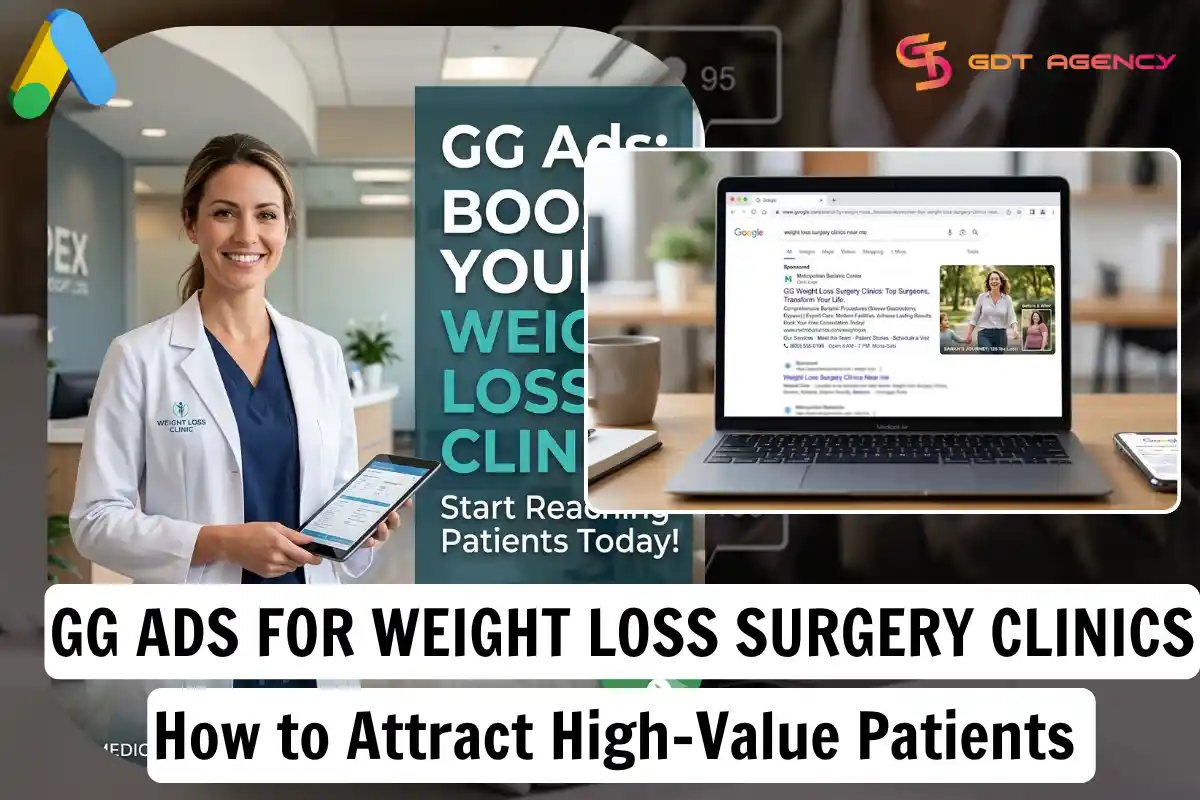
Google Ads gives weight loss surgery clinics a direct way to reach patients who already search for bariatric procedures, consultation costs, and nearby surgeons. A clinic that sets up the right campaign type, targets the correct audience, and builds a landing page that answers real patient questions will convert clicks into booked consultations instead of wasted spend.
Search campaigns, Performance Max, and Local Services Ads each play a different role in this process. Search campaigns catch patients who type specific procedure names into Google, while Performance Max spreads the message across YouTube, Display, and Gmail to build awareness earlier in the decision. Local Services Ads work best for clinics that want to appear at the very top of results with a verified badge that builds trust before the click even happens.
Targeting the right patient matters more in this industry than in most others. A clinic that spends its budget on people who cannot afford surgery or do not meet medical criteria for the procedure loses money on every click. The clinic needs to filter for income level, insurance status, BMI range, and genuine intent to book a consultation, not just curiosity about the topic.
Cost and compliance shape everything else in this space. Bariatric surgery keywords carry some of the highest CPCs in healthcare marketing, and Google enforces strict certification rules before it allows a clinic to run these ads at all. Below, this guide walks through campaign selection, targeting, keyword strategy, budget expectations, ad copy, and the compliance rules a clinic must meet before it spends a single dollar.
- What Is Google Ads for Weight Loss Surgery Clinics?
- Which Google Ads Campaign Types Work Best for Weight Loss Surgery Clinics?
- Are Search Ads Effective for Bariatric Surgery Marketing?
- Should Clinics Use Performance Max or Local Services Ads?
- How Do You Target the Right Patients on Google Ads?
- What Targeting Criteria Identify High-Value Patients?
- How Does Patient Qualification Filter Out Low-Intent Traffic?
- What Keywords Should Weight Loss Surgery Clinics Target?
- How Much Does Google Ads Cost for Weight Loss Surgery Clinics?
- Is Google Ads Worth the Investment for Bariatric Clinics?
- What Compliance Requirements Apply to Google Ads for Medical Services?
- Do Weight Loss Surgery Clinics Need LegitScript Certification?
- GDT Agency Case Study: Scaling Patient Acquisition for a ReVita Surgery Client
- Final Thoughts
- FAQ
- How long does it take to see results from Google Ads for a bariatric surgery clinic?
- Can a new bariatric surgery clinic run Google Ads without an established reputation?
- Does Google allow before-and-after photos in bariatric surgery ads?
What Is Google Ads for Weight Loss Surgery Clinics?
Google Ads for weight loss surgery clinics is a paid advertising system that places a clinic’s offer in front of people actively searching for bariatric procedures, consultation pricing, or surgeon reviews. The system works on an auction model, where the clinic bids on keywords and pays only when someone clicks the ad.
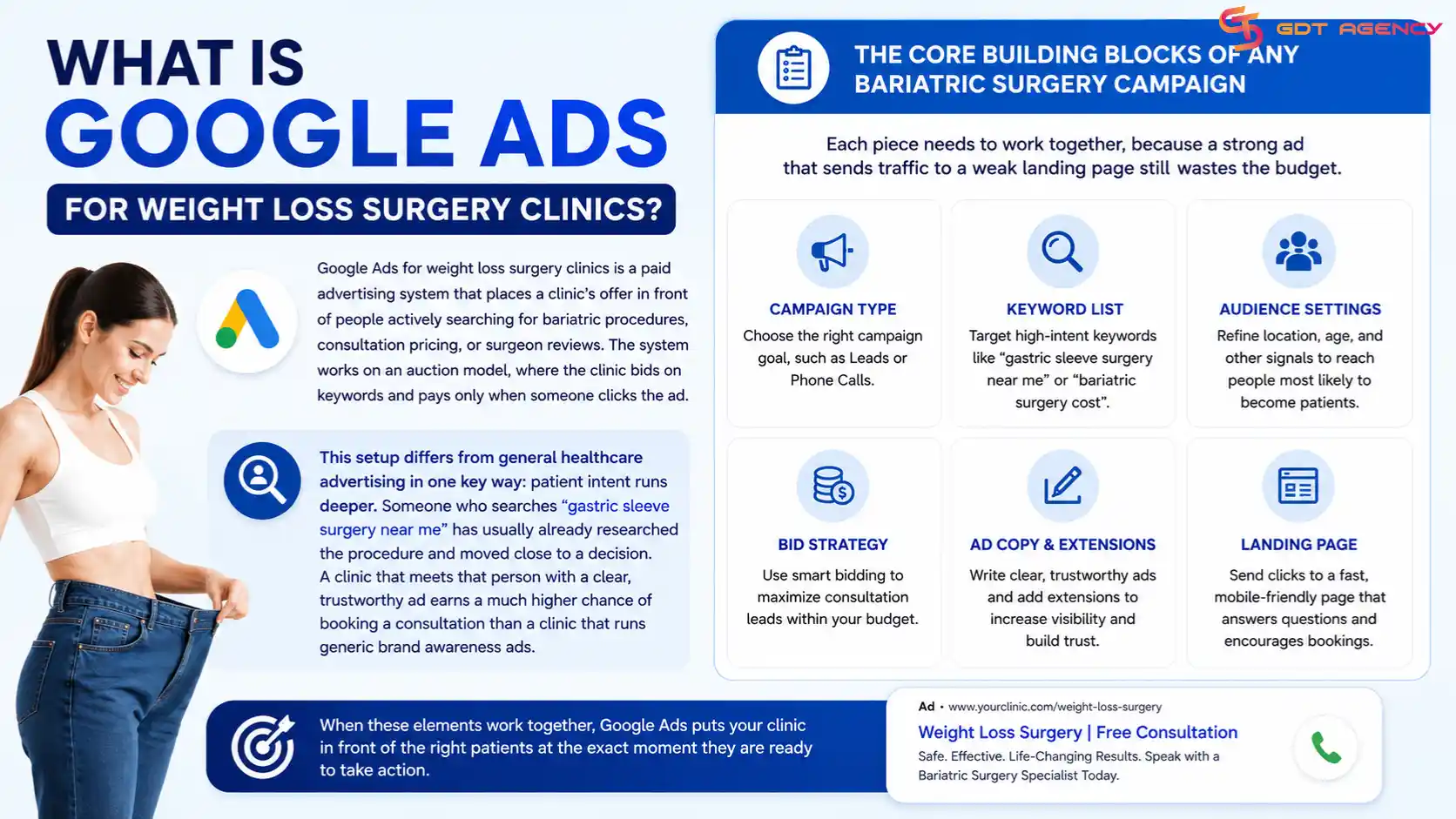
This setup differs from general healthcare advertising in one key way: patient intent runs deeper. Someone who searches “gastric sleeve surgery near me” has usually already researched the procedure and moved close to a decision. A clinic that meets that person with a clear, trustworthy ad earns a much higher chance of booking a consultation than a clinic that runs generic brand awareness ads.
The core building blocks of any bariatric surgery campaign include the campaign type, the keyword list, the audience settings, the bid strategy, the ad copy with its extensions, and the landing page that receives the click. Each piece needs to work together, because a strong ad that sends traffic to a weak landing page still wastes the budget.
Which Google Ads Campaign Types Work Best for Weight Loss Surgery Clinics?
Search campaigns win for patients close to a decision, Performance Max wins for reaching a wider pool of potential patients across multiple channels, and Local Services Ads wins for clinics that want top placement and a verified trust badge. Each type serves a different stage of the patient’s journey.
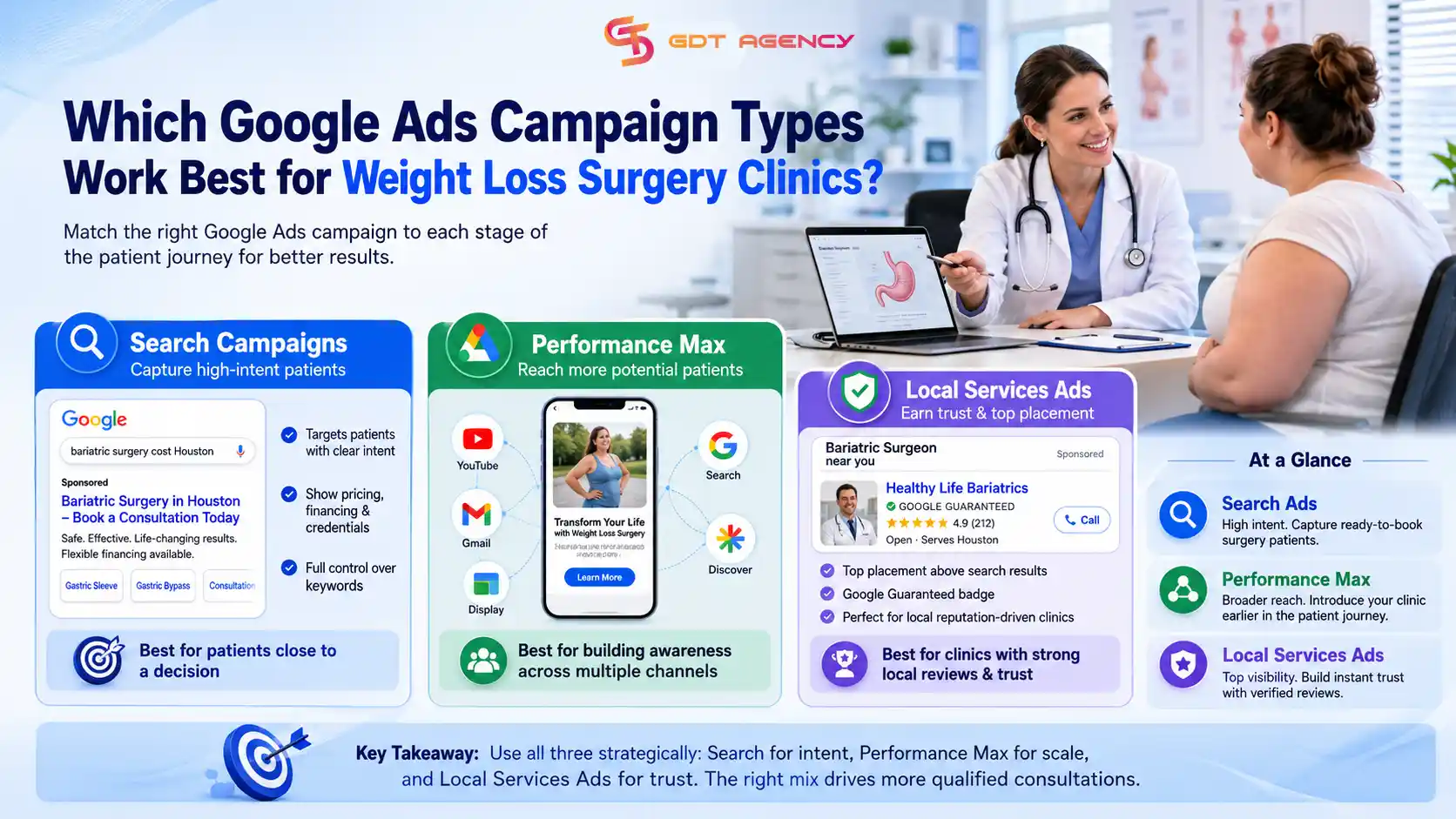
To understand where each campaign fits, a clinic should look at how a patient searches at each stage. Someone typing “bariatric surgery cost Houston” already knows what they want and searches with clear intent, which makes Search the right tool. Someone scrolling YouTube or Gmail has not started that search yet, so Performance Max introduces the clinic earlier. A patient comparing three local surgeons through a map search benefits from a Local Services Ads listing that shows reviews and a Google Guarantee badge right away.
Are Search Ads Effective for Bariatric Surgery Marketing?
Yes, Search Ads work well for bariatric surgery marketing because they capture patients at the exact moment they type a procedure name or a “near me” query into Google. This direct match between the search term and the ad gives Search campaigns a natural advantage over other formats.
Three reasons explain why Search performs so strongly in this niche.
- First, the searcher already knows what procedure they want, so the clinic does not need to educate them from scratch.
- Second, Search ads let the clinic show pricing, financing options, and surgeon credentials directly in the ad copy, which pre-qualifies the click before it happens.
- Third, Search campaigns give the clinic full control over which keywords trigger the ad, so the team can exclude low-intent searches like “what is bariatric surgery,” and focus spend on “schedule bariatric surgery consultation.”
Should Clinics Use Performance Max or Local Services Ads?
Clinics should use Performance Max when they want to reach patients earlier in their research and build broader awareness, while they should use Local Services Ads when they want top-of-page placement built on trust signals and verified reviews. Local Services Ads suits smaller clinics with a strong local reputation, and Performance Max suits clinics that already have solid brand assets and want wider reach.
Performance Max pulls from a single campaign to serve ads across Search, Display, YouTube, Gmail, and Discover, which means the clinic reaches a patient who has not typed a direct search query yet. Local Services Ads instead sits above regular Search results and only shows clinics that pass a background check and license verification, which builds instant credibility with a nervous first-time patient. A clinic with a strong online reputation and licensed surgeons on staff usually sees faster returns from Local Services Ads, since the badge alone increases the click-through rate compared to a standard text ad.
How Do You Target the Right Patients on Google Ads?
Clinics target the right patients on Google Ads by combining demographic filters, income signals, geographic radius, and search behavior that points to genuine surgical intent. A campaign built only on broad keywords without these layers ends up paying for clicks from people who will never book a consultation.
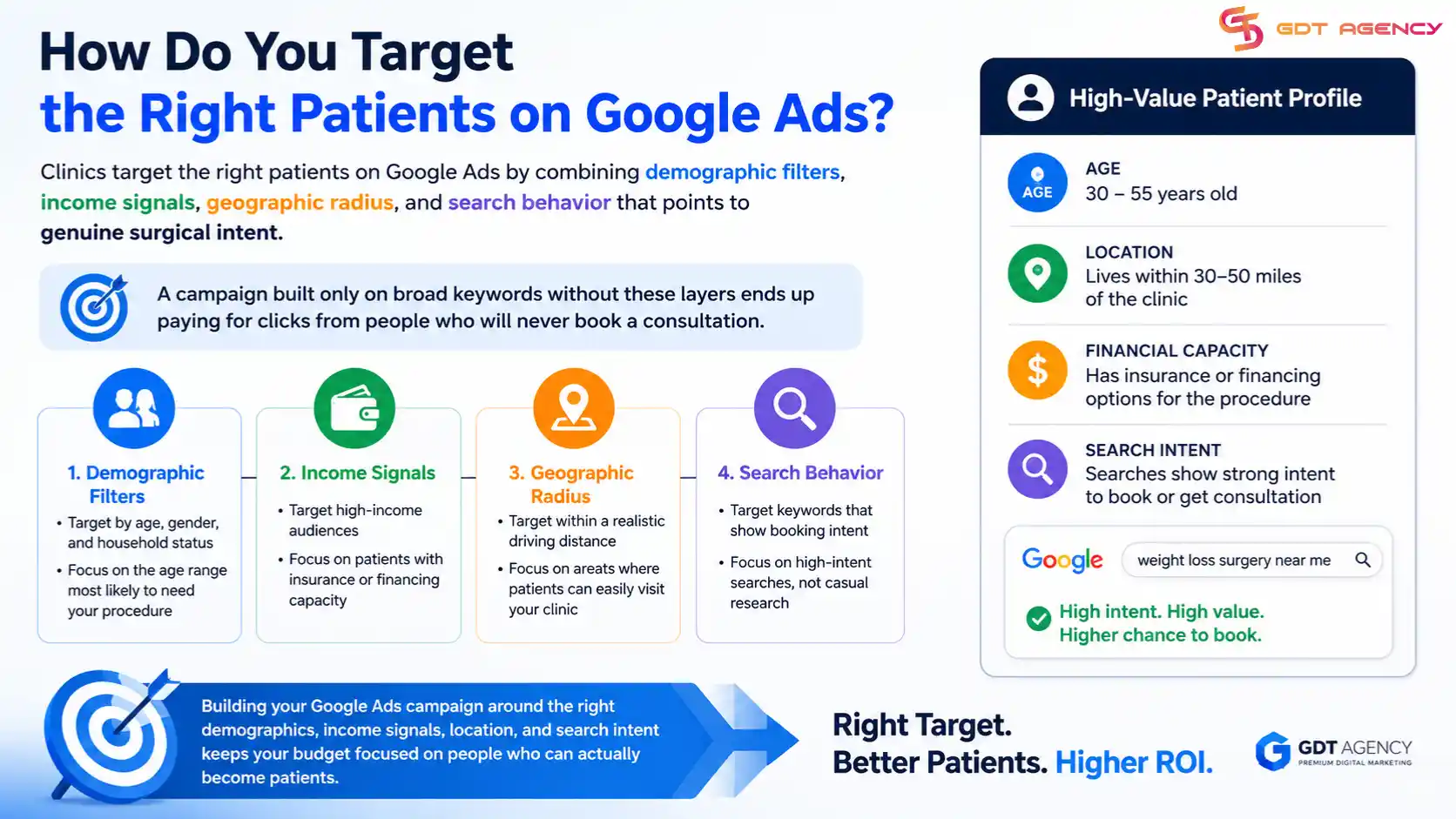
A high-value patient for a weight loss surgery clinic usually falls within a specific age range, lives within a reasonable driving distance of the clinic, carries insurance or financing capacity that covers the procedure, and shows search behavior tied to booking rather than casual research. Building a campaign around this definition keeps the budget focused on people who can actually become patients.
What Targeting Criteria Identify High-Value Patients?
High-value patients for bariatric surgery clinics typically fall between ages 30 and 60, live within a 25 to 50-mile radius of the clinic, hold insurance coverage or the financial means to pay out of pocket, and search using terms tied to consultation booking rather than general curiosity.
These four criteria work together rather than alone:
- Age range: Most bariatric surgery candidates fall between 30 and 60, since this group meets medical eligibility more often and holds stronger financial stability than younger searchers.
- Geographic radius: Patients rarely travel more than an hour for a procedure that requires multiple follow-up visits, so a tight radius keeps spend relevant to people who can actually attend appointments.
- Financial capacity: Household income signals and insurance coverage data help a clinic avoid spending on clicks from people who cannot afford the procedure even with financing.
- Search behavior: Terms like “book bariatric consultation” or “gastric bypass surgeon accepting new patients” show far higher intent than “how does weight loss surgery work.”
How Does Patient Qualification Filter Out Low-Intent Traffic?
Patient qualification filters out low-intent traffic by adding a short screening step, such as a form question or a call script, that checks BMI range, insurance status, and readiness to schedule before the lead reaches the sales team.
This filter usually sits right after the click, either on the landing page or during the first phone call. A landing page might ask a visitor to select their current BMI range and insurance provider before it shows the “Book a Consultation” button, which naturally removes people who do not meet the basic surgical criteria. A clinic that skips this step often finds its sales team spending hours on calls with people who were never eligible for surgery in the first place, which drains both ad budget and staff time.
What Keywords Should Weight Loss Surgery Clinics Target?
Weight loss surgery clinics should target three keyword groups: awareness terms for people still researching, consideration terms for people comparing procedures or surgeons, and decision terms for people ready to book. Splitting the keyword list this way lets the clinic match ad copy and bids to each stage of intent.
Awareness terms include phrases like “types of bariatric surgery” or “gastric sleeve vs bypass,” and these searches usually come from people who have not chosen a procedure yet. Consideration terms include “best bariatric surgeon in [city]” or “bariatric surgery cost with insurance,” which show a patient narrowing down options. Decision terms include “schedule gastric sleeve consultation” or “bariatric surgery clinic accepting new patients now,” and these carry the highest intent along with the highest cost per click.
A clinic with a limited budget should weigh spend toward decision and consideration keywords first, since these terms convert at a much higher rate than broad awareness searches. Awareness keywords still hold value for retargeting later, but they rarely justify a high bid on their own in a Search campaign built for direct response.
How Much Does Google Ads Cost for Weight Loss Surgery Clinics?
Google Ads costs for weight loss surgery clinics typically run between $8 and $25 per click on Search campaigns, with cost per acquisition often landing between $300 and $1,200 depending on the market and competition level. These figures sit well above the average across most industries because bariatric surgery keywords carry high commercial value and limited daily search volume.
Several factors push this cost higher than a typical healthcare campaign. Competition for bariatric keywords stays intense in most major metro areas, since a limited number of certified surgeons compete for the same search terms. Google also applies stricter quality requirements to medical ads, and a clinic with a lower quality score pays more per click even for the same keyword. Add to this the long consideration window most patients need, often 30 to 90 days between the first search and the booked consultation, and the clinic needs a budget large enough to stay visible across that entire window.
Is Google Ads Worth the Investment for Bariatric Clinics?
Yes, Google Ads is worth the investment for bariatric clinics because a single booked surgery typically generates far more revenue than the cost to acquire that patient through paid search. A gastric sleeve or bypass procedure often brings in tens of thousands of dollars, which makes even a $1,000 cost per acquisition a strong return.
The math becomes clearer when a clinic looks at lifetime patient value rather than the cost of a single click. A patient who books surgery also returns for follow-up visits, nutrition counseling, and sometimes a second procedure years later, which adds recurring revenue beyond the initial surgery fee. A clinic that tracks return on ad spend across this full patient relationship, rather than just the first booked appointment, usually finds that Google Ads pays for itself many times over within the first year.
What Compliance Requirements Apply to Google Ads for Medical Services?
Google Ads applies strict compliance requirements to medical service ads, including healthcare-related certifications, restrictions on before-and-after imagery, and limits on specific medical claims that cannot be verified. A clinic that skips these requirements risks having its ads disapproved or its account suspended entirely.
Google reviews healthcare advertisers more closely than most other industries, since medical claims carry real risk if they mislead a patient. This means a bariatric surgery clinic needs to prepare documentation ahead of time, including proof of medical licensing, business verification, and in many cases a third-party certification that confirms the clinic operates a legitimate, safe practice.
Do Weight Loss Surgery Clinics Need LegitScript Certification?
Yes, weight loss surgery clinics generally need LegitScript certification to run Google Ads for surgical procedures, since Google requires this certification for a range of healthcare services tied to prescription treatments, surgery, and other regulated medical care.
LegitScript reviews a clinic’s licensing, ownership, and compliance history before it issues certification, and Google will not approve certain healthcare campaigns without proof of this review. The certification process can take several weeks, so a clinic should start this application well before the planned campaign launch date. Skipping this step often means a clinic builds a full campaign only to find Google rejects it at the final approval stage, which wastes both time and the internal resources spent on campaign setup.
GDT Agency Case Study: Scaling Patient Acquisition for a ReVita Surgery Client
GDT Agency helped ReVita, a weight loss surgery clinic based in Mexico, cut its cost per lead by 53.9% while scaling ad spend and lead volume at the same time. ReVita served patients from the US and Canada with lower-cost gastric sleeve and gastric bypass procedures, but its Google Ads campaigns sent all traffic to one generic homepage and produced a cost per lead of $76.
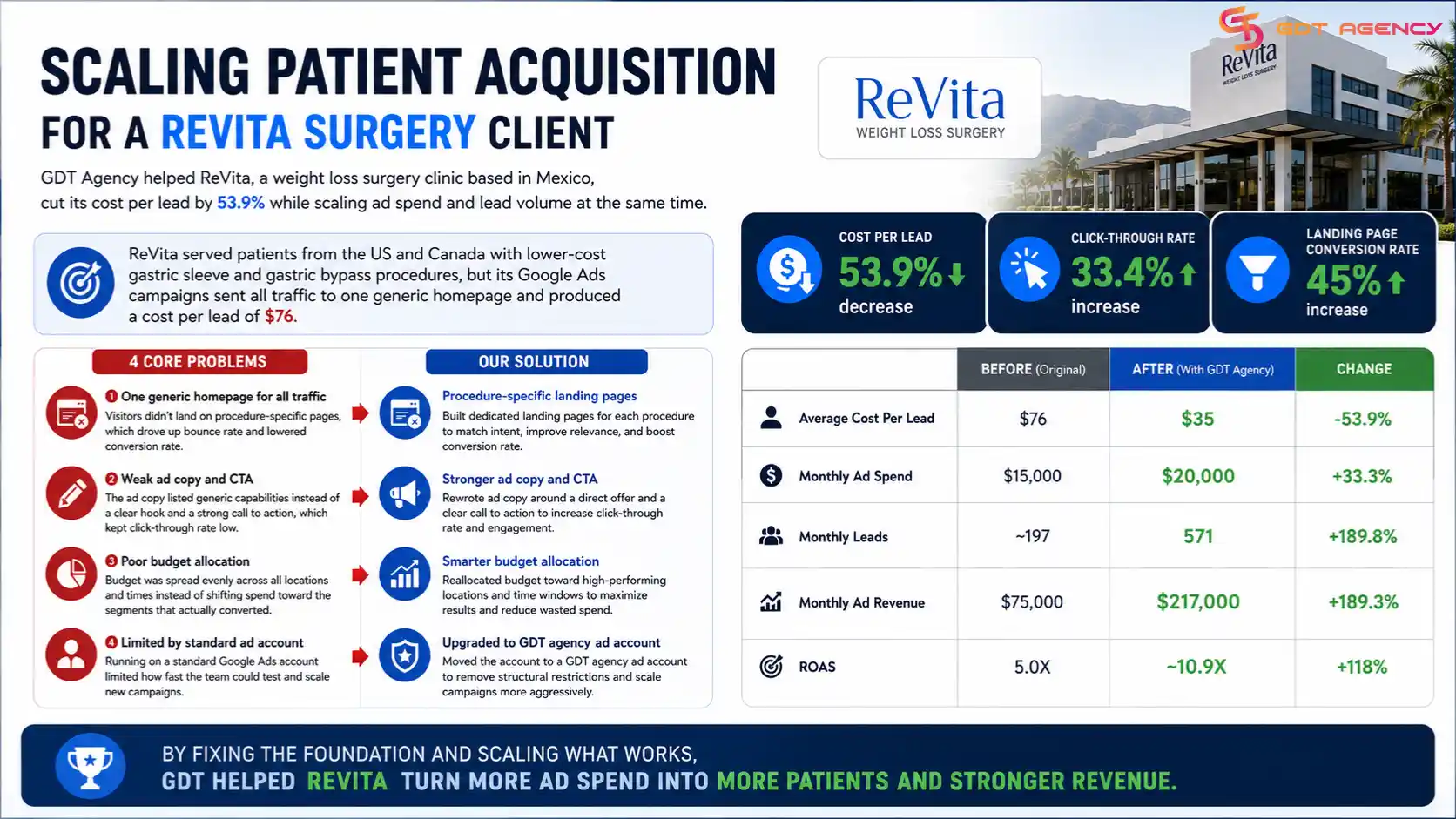
The GDT team found 4 core problems behind this underperformance.
- First, the clinic sent every visitor to the same homepage instead of a page built around the specific procedure they searched for, which drove up bounce rate and pushed down conversion rate.
- Second, the ad copy listed generic capabilities instead of a clear hook and a strong call to action, which kept click-through rate low.
- Third, the clinic spread its budget evenly across all locations and times instead of shifting spend toward the segments that actually converted.
- Fourth, the clinic ran on a standard Google Ads account, which limited how fast the team could test and scale new campaigns.
GDT built separate landing pages for each procedure, rewrote the ad copy around a direct offer and a clear CTA, reallocated budget toward high-performing locations and time windows, and moved the account onto a Google agency ad account to remove structural restrictions. Within months, average cost per lead dropped from $76 to $35, a 53.9% decrease, while click-through rate rose 33.4% and landing page conversion rate rose 45%. Monthly ad spend grew from $15,000 to $20,000, monthly leads grew from about 197 to 571, and monthly ad revenue grew from $75,000 to $217,000, which pushed ROAS from 5.0X to roughly 10.9X.
Final Thoughts
Google Ads gives weight loss surgery clinics a strong channel to reach patients ready to book, but only when the clinic matches campaign type to patient intent, filters for genuine qualification, and clears Google’s compliance bar before launch. A clinic that treats these steps as one connected system, rather than isolated tasks, builds a campaign that keeps cost per acquisition in check while filling the consultation calendar with patients who actually convert to surgery.
>>> Maybe you are also interested in: Google Ads for IaaS Companies: Campaign Types, Targeting, and Budget Strategy
FAQ
How long does it take to see results from Google Ads for a bariatric surgery clinic?
Most clinics see initial consultation bookings within the first 30 to 60 days, though the full patient decision cycle often stretches to 90 days given the size of the financial and medical commitment.
Can a new bariatric surgery clinic run Google Ads without an established reputation?
Yes, a new clinic can run Google Ads, but it should expect a higher cost per click until it builds enough reviews and a verified profile to compete with established local providers.
Does Google allow before-and-after photos in bariatric surgery ads?
Google restricts certain before-and-after imagery in healthcare ads, so a clinic should review current ad policy requirements before including these photos in a campaign.