Google Ads for Roofing Companies: Setup, Cost and Campaign Strategy

Google Ads works well for roofing companies because it puts your business in front of homeowners at the exact moment they search for a roofer. A homeowner with a leak doesn’t browse Facebook for help. They type “roof repair near me” into Google and call the first company that answers their question. That behavior makes Google Ads one of the fastest paths to qualified roofing leads.
The cost of running Google Ads for a roofing company depends on your market, your competition, and the campaign type you choose. Most roofers spend between $1,500 and $5,000 a month, with cost-per-click ranging from $8 to $25 depending on the city. Small budgets can still generate leads, but they limit how many clicks you get each day.
Campaign type matters just as much as budget. Search campaigns, Local Services Ads, and Performance Max each serve a different role in a roofing company’s lead funnel. Search campaigns capture people who type a specific query. Local Services Ads put your business at the very top of results with a pay-per-lead model. Performance Max extends your reach across Google’s full ad network.
Setup determines whether any of this pays off. A roofing company that skips proper keyword research, ad group structure, or landing page alignment will waste budget on clicks that never convert. The sections below walk through each piece: how the platform works, what it costs, which campaign types fit a roofing business, and how to set one up correctly.
- What Is Google Ads for Roofing Companies?
- Does Google Ads Work for Roofing Companies?
- How Much Does Google Ads Cost for a Roofing Company?
- What Are the Best Google Ads Campaign Types for Roofing Companies?
- What Is Google Local Services Ads for Roofers?
- How Does Performance Max Work for Roofing Companies?
- How Do You Set Up a Google Ads Campaign for a Roofing Company?
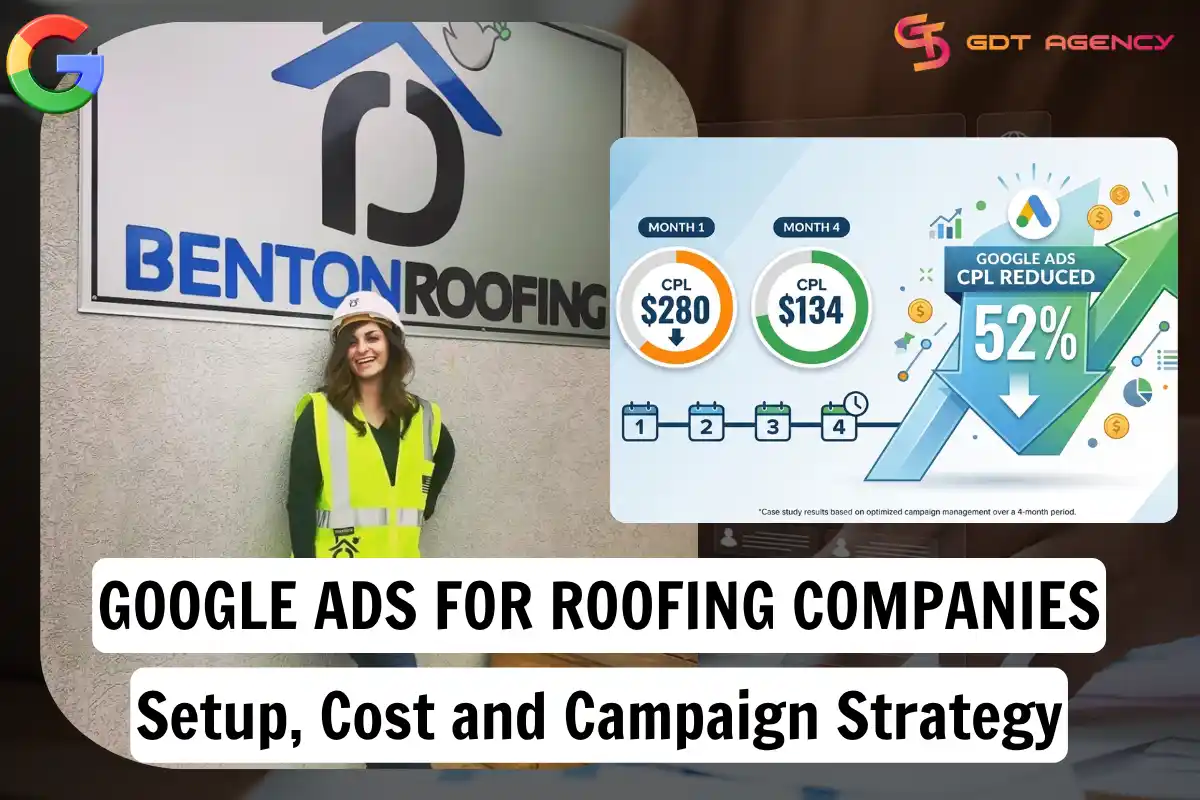
- Case Study: 4 Months Improved Benton Roofing’s Google Ads CPL by 52%
- Challenges with Benton Roofing Before Working with GDT Agency
- Challenges When Changing To Google Ads
- What GDT Agency Do To Help Benton Roofing?
- Result of Benton After 120 Days
- Final Thoughts
- FAQs
- How long does it take to see results from Google Ads for a roofing company?
- Can a small roofing company compete with larger companies on Google Ads?
- Do roofing companies need a website to run Google Ads?
- What is a good click-through rate for roofing ads?
What Is Google Ads for Roofing Companies?
Google Ads is a paid advertising platform that lets a roofing company show up at the top of search results when a homeowner searches for roofing services. The platform runs on an auction system, where advertisers bid on keywords and Google ranks ads by bid amount and ad quality.
For a roofing company, this auction system means you compete with other local roofers for the same searches. The word “roofing” carries most of the intent in this space, so search volume around repair, replacement, and installation queries drives most of the platform’s value for this industry.
Roofers use Google Ads because the platform connects them to people actively searching for help, not people scrolling for entertainment. A homeowner who searches “emergency roof leak repair” has already decided they need a roofer. Google Ads puts your business in front of that person before they call a competitor.
Does Google Ads Work for Roofing Companies?
Yes, Google Ads works for roofing companies, and it works for three main reasons: high purchase intent, local targeting precision, and measurable return on ad spend. Roofing is a service people search for only when they need it, which makes paid search a strong match for the industry.
To explain further, high purchase intent means the person searching is often ready to hire someone within days, not months. Local targeting lets a roofing company show ads only within its actual service radius, so budget doesn’t go toward clicks from people outside the coverage area. Measurable return on ad spend means a roofer can track exactly how many leads and jobs come from each dollar spent.
These three factors work together to make Google Ads a strong channel for lead generation. A roofer running a well-structured campaign can expect a lower cost per lead than most offline advertising methods, because Google Ads targets people already searching rather than people who might notice a billboard or a mailer. The tradeoff is that Google Ads requires ongoing management. Bids shift, competitors enter the market, and seasonal demand changes how much you need to spend to stay competitive.
Roofing companies that succeed with Google Ads treat the platform as an active channel, not a set-it-and-forget-it tool. They review search terms weekly, adjust bids based on performance, and update ad copy when click-through rates drop.
How Much Does Google Ads Cost for a Roofing Company?
Google Ads costs a roofing company between $1,500 and $5,000 a month for most local markets, with cost-per-click averaging $8 to $25 depending on competition and location. Roofing sits among the higher-cost home service categories because the value of a single job can run into the thousands of dollars.
Specifically, this cost range covers search campaigns targeting keywords like “roof replacement cost” or “roofing contractor near me.” Larger metro markets with more roofing companies bidding on the same terms push cost-per-click toward the higher end. Smaller markets with fewer competitors often see lower costs per click but also lower search volume.
Budget planning starts with understanding your average job value and close rate. A roofing company that closes 20% of its leads and earns $8,000 per job can afford a higher cost per lead than a company with a lower close rate. This math determines how much room you have to bid competitively.
What Are the Best Google Ads Campaign Types for Roofing Companies?
The best Google Ads campaign types for roofing companies are Search campaigns, Local Services Ads, and Performance Max, grouped by how directly each one targets ready-to-buy searches. Search campaigns work best for specific keyword targeting, Local Services Ads work best for pay-per-lead simplicity, and Performance Max works best for broad reach across Google’s network.
For example, a roofing company running all three at once often sees Search campaigns drive the highest-intent leads, Local Services Ads fill in gaps with lower management overhead, and Performance Max pick up additional visibility on Display, YouTube, and Discover placements.
Choosing the right mix depends on how much time your team has to manage campaigns. Local Services Ads require less day-to-day optimization than Search campaigns, which makes them a good starting point for roofing companies without dedicated marketing staff.
What Is Google Local Services Ads for Roofers?
Google Local Services Ads is a pay-per-lead advertising format that displays roofing companies at the very top of search results with a “Google Guaranteed” badge. This badge signals to homeowners that Google has verified the business’s licensing and insurance.
Roofers pay only when a homeowner contacts them through the ad, not per click. This model reduces wasted spend from people who click but never call. The Google Guaranteed badge also builds trust faster than a standard text ad, since homeowners see it as a form of vetting before they even visit the roofer’s website.
How Does Performance Max Work for Roofing Companies?
Performance Max works for roofing companies by using Google’s automated bidding and placement system to show ads across Search, Display, YouTube, Gmail, and Discover from a single campaign. The system uses machine learning to find the combination of placements that drives the most conversions for the budget given.
Roofing companies use Performance Max to extend reach beyond search results, particularly for reaching homeowners who haven’t started actively searching yet but show behavior patterns similar to past customers. This campaign type works best when paired with strong conversion tracking, since the automated system relies on conversion data to optimize placements.
How Do You Set Up a Google Ads Campaign for a Roofing Company?
You set up a Google Ads campaign for a roofing company by building a clear account structure: separate campaigns by service type, group keywords into tightly themed ad groups, and write ad copy that matches each ad group’s specific intent. This structure keeps your quality score high and your cost per click lower over time.
Step by step, the setup process starts with campaign structure. A roofing company should split campaigns by service line, such as roof repair, roof replacement, and roof inspection, rather than lumping all keywords into one campaign. Each campaign then breaks into ad groups organized around a single theme, like “flat roof repair” or “shingle roof replacement,” with 10 to 20 closely related keywords per group.
Ad copy needs to speak directly to the keyword theme in each group. An ad group targeting “emergency roof repair” should use headlines that mention fast response time, not generic roofing language. Landing pages should mirror this same specificity, sending emergency repair traffic to a page built around emergency service rather than a general homepage.
Conversion tracking closes the loop on setup. Every roofing campaign needs call tracking and form tracking connected to Google Ads, so the platform’s bidding algorithm learns which keywords and ads produce actual jobs, not just clicks.
Case Study: 4 Months Improved Benton Roofing’s Google Ads CPL by 52%
Benton Roofing is an experienced, full-service commercial and industrial roofing company serving clients that was founded in 1978 and quickly developed a reputation for excellence and expansion from Florida to the mountains of North Carolina in 1993.

With over 40 years of experience, Benton Roofing has established a reputation for providing high-quality commercial and industrial roofing solutions.
Challenges with Benton Roofing Before Working with GDT Agency
Before working with GDT Agency, Benton Roofing used to run Local Service Ads (LSAs), which are designed to give local businesses priority placement in Google search results.
When a homeowner searches for “roofing service near me”, they might see an LSA at the very top of the page, even above traditional ads and organic results. Though it sounds very promising, it doesn’t work for Benton Roofing.
As the ad format isn’t perfect for them, they even encounter issues that leave them feeling like there’s a hole in their digital strategy:
Uncontrollable Leads:
LSAs don’t give Benton the freedom to target specific keywords like Google Ads. As Google determines when an ad appears based on its algorithm, it doesn’t always align with the expertise.
Benton focuses on commercial leads, but Google sends them residential roofing. At the end, they pay for those irrelevant leads, which increase their high costs, but they do not get the result they expect.
No Control Over Search Terms
Like other roofing companies, Benton also gets into trouble when using LSAs. Benton often gets frustrated with the inability to refine the terms triggering their ads.
Mr. Caleb – the CEO of Benton Roofing shared with us that “with Google Ads, you can hand-pick the right terms to connect with your ideal customers, but LSAs are not so much”. That is also one of the main reasons they switch from LSAs to Google Ads.
Challenges When Changing To Google Ads
Initially, they thought that everything would be fine when they changed, and the result that they expected would appear. However, they could not turn their dream into reality, because they actually continually faced a lot of problems:
1. High Cost Per Lead with Inconsistent Results
Benton Roofing was running Google Ads from a standard account with limited campaign optimization. While the ads generated clicks, the cost per lead continued to rise, making it difficult to maintain profitable campaigns.
Some weeks produced leads, while other weeks generated mostly clicks without conversions. This inconsistency made it hard for the company to forecast marketing costs or plan job scheduling.
2. Limited Access to Advanced Optimization Tools
Running Google ads from a standard account limited access to advanced agency-level tools and optimization features available through a Google agency account.
Therefore, it is difficult for Benton to properly manage bidding strategies, analyze search intent, or identify which keywords were actually driving qualified roofing inquiries.
3. Poor Keyword Targeting and Irrelevant Clicks
Another serious problem they have to face is that a large portion of the ad spend was going toward low-intent or irrelevant searches, like general roofing information or DIY-related queries.
Because the campaigns lacked a structured keyword strategy and negative keyword filtering, the ads often appeared for searches that did not lead to real roofing service requests. This wasted budget and drove up the overall CPL.
→ To solve these issues, Benton Roofing decided to contact GDT Agency to seek the help of an expert with seasoned experience in Google advertising.
What GDT Agency Do To Help Benton Roofing?
After gathering all the necessary information about Benton Roofing, together, we have analyzed and built a structured 120-day optimization plan to solve the issues of rising costs, inconsistent leads, and inefficient targeting.
Instead of making all changes at once, the team improved the account step by step through 4 phases, with each phase focused on a specific part of the Google Ads system. Here’s exactly what we do:
Phase 1 (Days 1-30): Foundation and Account Transition
The first step that we took was moving Benton Roofing from a standard Google Ads account to a Google ads agency account rented from GDT to run under a professionally managed infrastructure with better control, tracking, and optimization capabilities.
1. Audit and Cleanup
After switching the account to the agency account, we guided Benton’s team to perform a deep-dive audit of their historical data.
We found that nearly 40% of their previous spending was being wasted on inefficient keyword targeting and missing negative keywords. Immediately, we excluded over 500 negative keywords, specifically targeting DIY roofing and residential repair keywords.
2. Campaign Rebuild Structure:
After the audit, the team rebuilt the account structure and implemented a cleaner campaign framework to focus exclusively on high-intent commercial and industrial search terms like “industrial TPO roofing” and “commercial roof replacement NC.”
3. Conversion Tracking Rebuild:
Conversion tracking was also fully configured to capture both phone calls and form submissions from the website.
We moved beyond simple “click” tracking and implemented dynamic call tracking and lead form integration to ensure Google’s algorithm could see exactly which keywords resulted in commercial roofing inquiries.
Result After 30 Days:
By the end of the first month, we successfully stabilized the account and established a clean data baseline. Here is the performance after the first 30 days:
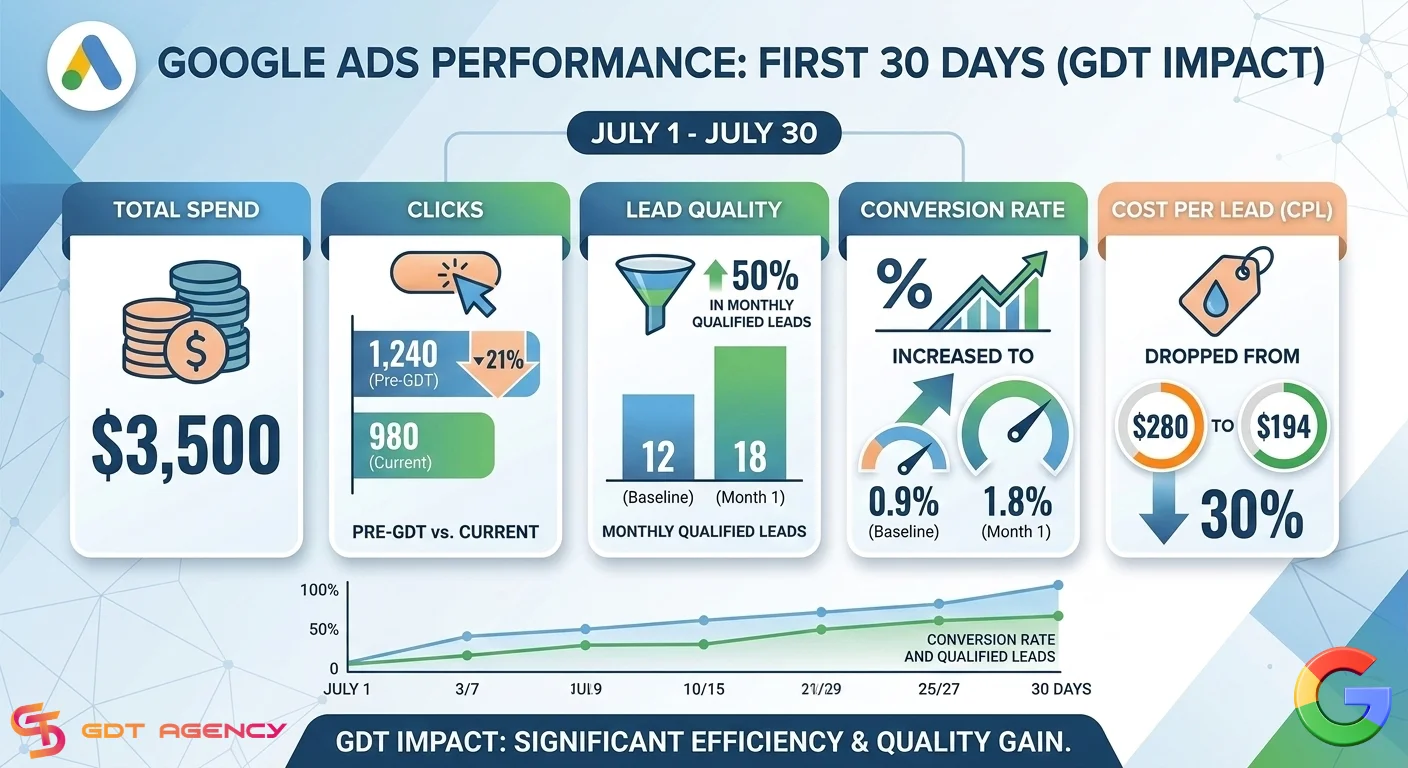
- Total Spend: $3,500
- Clicks: Decreased from 1,240 (pre-GDT) to 980.
- Lead Quality: Monthly qualified leads rose from 12 to 18.
- Conversion Rate: Increased from 0.9% (Baseline) to 1.8%.
- Cost Per Lead (CPL): Dropped from $280 to $194.
- Wasted Spend: We cut $1,150 in monthly spend that was previously going toward “DIY” or “residential-only” searches.
Though the total number of clicks decreased from 1240 to 980 (a 21% reduction in low-intent traffic), we saw a slight increase in lead quality (from 12 to 18 per month). By doubling the conversion rate through negative keyword filtering, we cut nearly $90 off the cost of every lead in the first month.
Most importantly, the initial wasted spend was cut by 15%, saving Benton approximately $1,150 in the first 30 days alone.
Phase 2 (Days 31-60): Intent-Based Targeting and Alpha/Beta Structure
Once the foundation was solid, we shifted our focus to intent. We moved to an “Alpha/Beta” campaign structure, which involves separating proven, high-performing keywords (Alphas) from experimental, discovery-based terms (Betas).
1. Commercial Intent Focus:
We guided them to build specific ad groups for Benton’s core services, such as metal roofing and commercial repairs, following the Single Keyword Ad Group (SKAG) approach.
This method allowed them to write hyper-relevant ad copy for every specific search, which matched the user’s search query exactly, and improved the Quality Score.
2. Geo-Targeting Refinement:
We analyzed the performance of Benton across Florida and North Carolina and then decided to implement advanced geo-fencing, ensuring ads only appeared in high-density commercial hubs where the potential for large-scale industrial contracts was higher.
3. Landing Page Optimization:
We provided recommendations to align the website’s landing pages with the new ad messaging, focusing on their 40-year reputation and commercial expertise to boost the conversion rate.
Result After Phase 2:
By the end of month two, the flow of irrelevant residential leads had slowed to a trickle, and qualified commercial inquiries began to rise.
With a clean data set, we transitioned to high-intent “Alpha” campaigns. We moved the budget toward terms that specifically signaled a need for commercial or industrial repairs. Here is the performance at the end of phase 2:
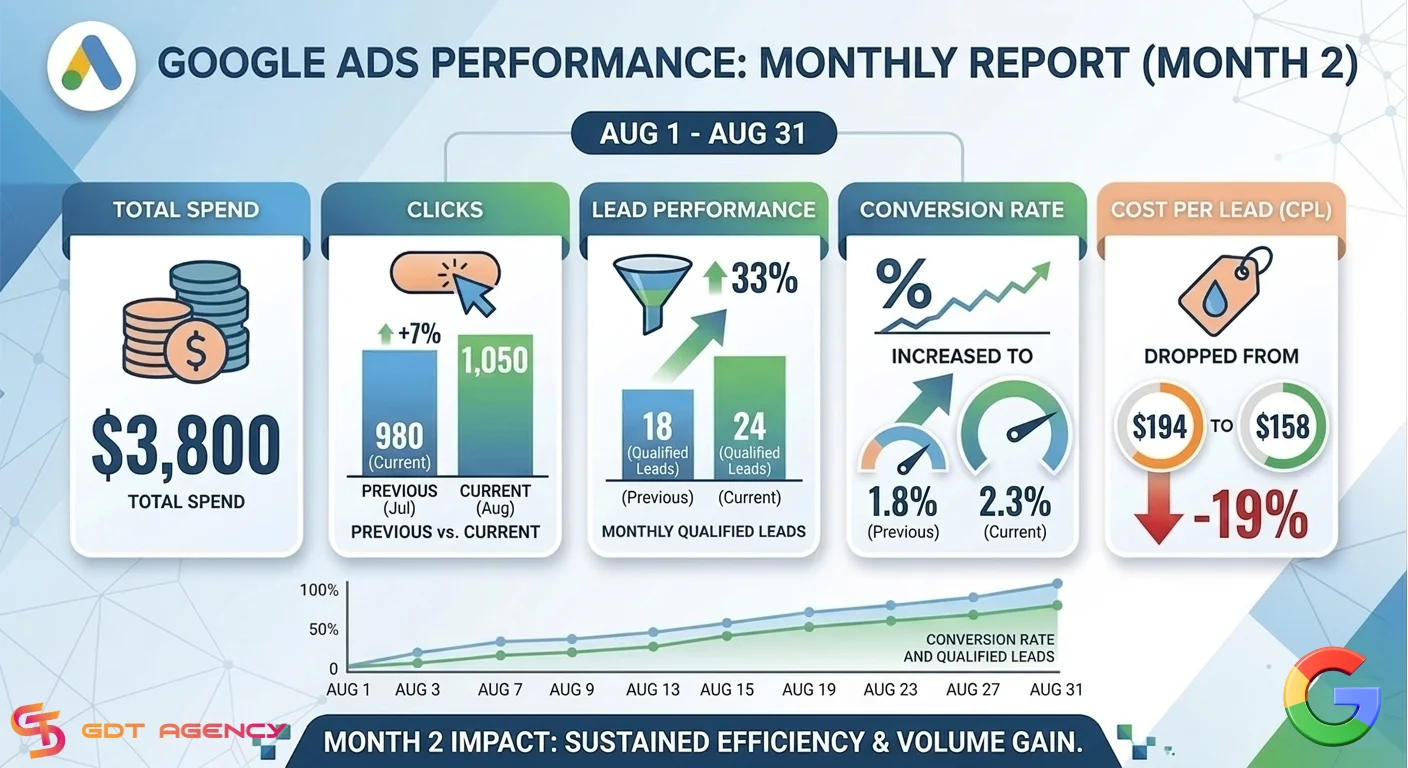
- Spend: $3,800
- Clicks: 1,050
- CPL Performance: Dropped from $194 down to $158.
- Lead Volume: Increased to 24 qualified leads.
- Conversion Rate: Improved to 2.3%.
The Click-Through Rate (CTR) improved as our ads became more relevant to the searchers and the ad copy began speaking directly to commercial needs.
By focusing on Florida and North Carolina’s commercial hubs and showing more relevant ads to the right people, we achieved a 18% reduction in Cost Per Lead while simultaneously increasing the volume of incoming inquiries.
Phase 3 (Days 61-90): Scaling and Smart Bidding Integration
Once we had 60 days of clean conversion data, we felt confident enough to let Google’s machine learning take a larger role. Based on my experience, a great ad is useless if the landing page doesn’t convert.
We realized Benston’s existing website was too general, so we supported Benton to develop dedicated, high-speed landing pages tailored specifically to commercial clients with:
- Clear calls-to-action (CTAs) for commercial quotes
- Trust signals highlighting their 40-year history.
- Mobile-optimized forms to capture leads instantly.
Then we transitioned the account from manual bidding to “Target CPA” (Cost Per Acquisition).
1. Smart Bidding Activation:
We guided Benton on how to use the Agency Account’s advanced features and set a target CPL that was 30% lower than their historical average.
By doing this, the system began automatically adjusting bids in real-time based on the likelihood of a conversion. This allowed Google’s machine learning to find more users likely to convert within our target price range.
2. Remarketing for Commercial Leads:
Mr.Celab told us that “commercial roofing is a high-ticket service with a long decision cycle”. Therefore, we advise Benton to implement a remarketing campaign to keep their brand at the top of the mind for users who have visited the site but haven’t yet requested a quote.
Result After Phase 3:
By aligning the ad message perfectly with the landing page content, we saw an immediate jump in the conversion rate, which naturally began to pull the CPL down. Besides, the scaling and smart bidding integration strategy also brought good results.
Here is the performance at the end of phase 3:
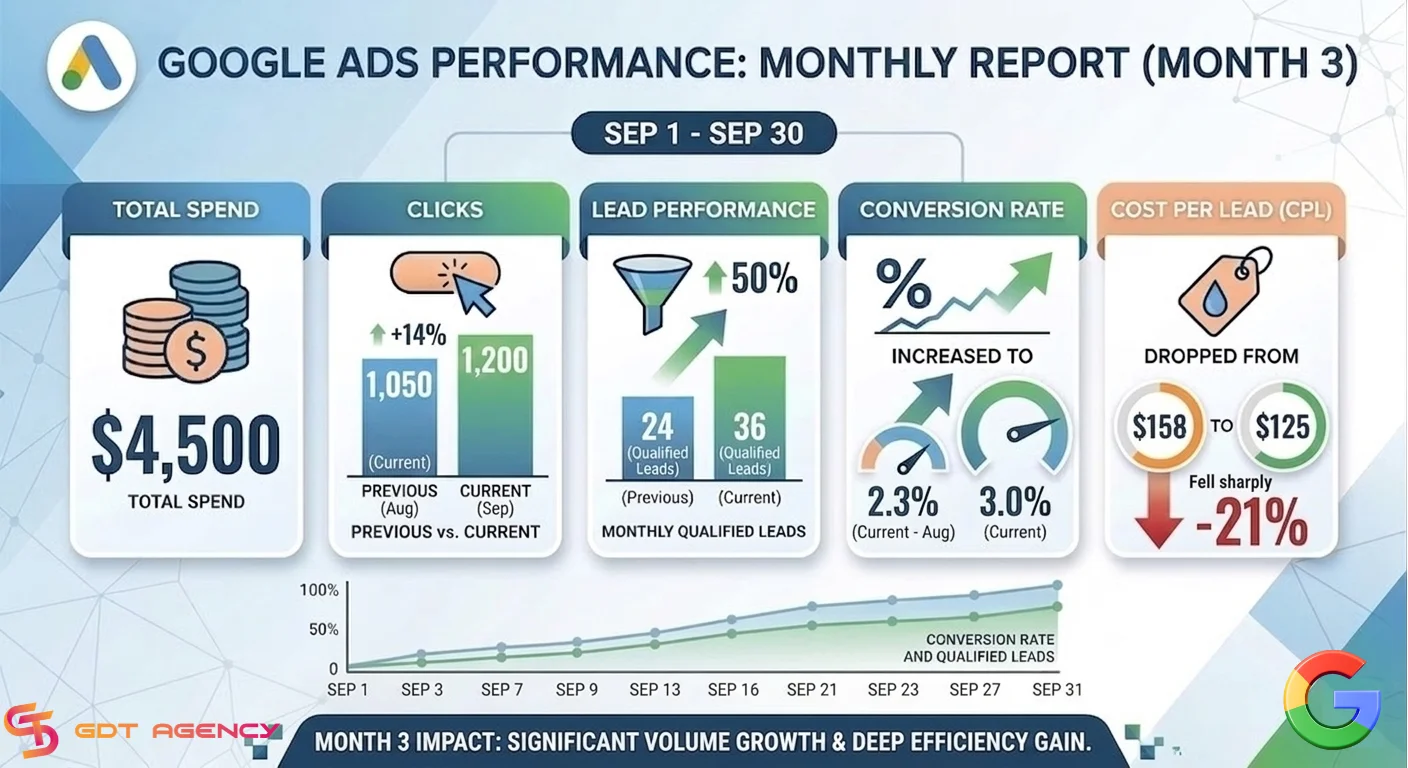
- Spend: $4,500
- Clicks: 1,200
- CPL Performance: Fell sharply to $125.
- Lead Volume: Qualified leads doubled, jumping from 18 (in Phase 1) to 36 monthly leads.
- Conversion Rate: Climbed to 3.0%.
For us, this was the most efficient phase. Even as we increased the spend, the conversion rate stayed high because the machine learning was now fully optimized.
Phase 4 (Days 91-120): Optimization and Efficiency Max
In the final 30 days, we have tried to ensure the 52% CPL reduction was sustainable for the long term. We analyzed time-of-day and device-level performance to ensure Benton Roofing was only appearing when conversion probability was at its peak.
- Advanced Negative Keyword Sculpting: We reviewed the “Search Terms Report” daily to catch any remaining residential or irrelevant traffic to ensure every dollar spent was a “commercial dollar.”
- Ad Copy A/B Testing: We tested various calls-to-action (CTAs). We found that emphasizing “Free Commercial Roof Inspections” performed 40% better than “Contact Us Today.”
Result After Phase 4:
At the end of phase 4, while the CPL rose slightly due to more aggressive scaling into competitive auctions, the sheer volume of leads (42/month) made this the most profitable stage for the client’s bottom line.
Here is the performance at the end of phase 4:
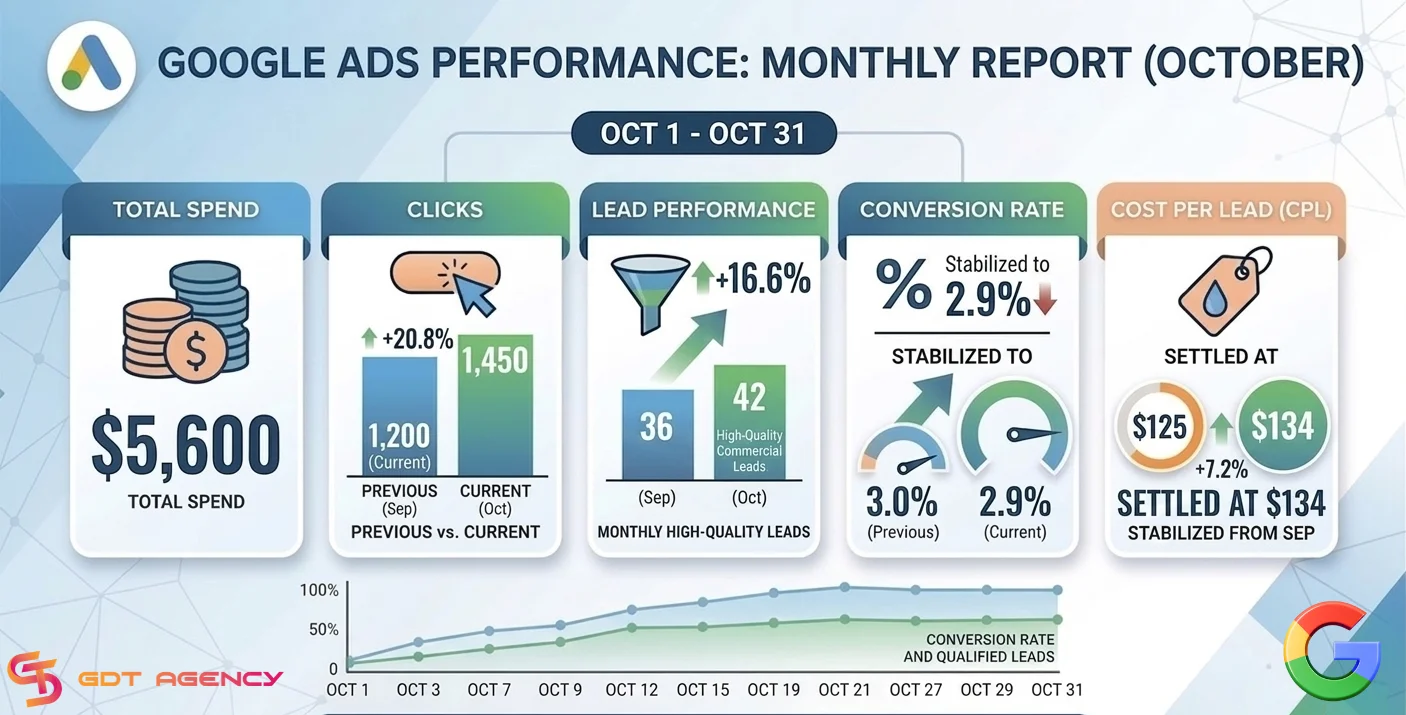
- Spend: $5,600
- Clicks: 1,450
- CPL Performance: Settled at $134.
- Lead Volume: Stabilized at 42 high-quality commercial leads per month.
- Conversion Rate: Stabilized at 2.9% (on a much higher lead volume).
By the end of the 120-day cycle, the Cost Per Lead (CPL) had dropped 52% (from $280 down to $134). Benton Roofing now receives 3.5x more leads per month than before they started with GDT Agency, all while maintaining a much higher standard of lead quality.
Result of Benton After 120 Days
When Benton first started, their advertising performance was inconsistent and difficult to scale. After four months of testing, restructuring, and scaling the campaigns, the impact started to become clear.
By the end of this process, the numbers showed a significant shift in performance.
| Metric | Before GDT | Phase 1 | Phase 2 | Phase 3 | Phase 4 |
| Conversion Rate | 0.9% | 1.8% | 2.3% | 3.0% | 2.9% |
| Monthly Leads | 12 | 18 | 24 | 36 | 42 |
| CPL ($) | $280 | $194 | $158 | $125 | $134 |
The final result was a 52% total reduction in CPL, proving that for high-competition industries like roofing, the right account structure and optimization plan are more important than just “spending more.”
>>> Maybe you are also interested in: Google Ads for Roofing Companies: Setup, Cost and Campaign Strategy
Final Thoughts
Google Ads gives roofing companies a direct line to homeowners who are already searching for help. The platform rewards companies that structure their accounts by service type, track leads all the way to closed jobs, and adjust budgets ahead of seasonal demand spikes. Roofers who treat the account as an ongoing process, not a one-time setup, see the strongest results over time.
FAQs
How long does it take to see results from Google Ads for a roofing company?
Most roofing companies see initial leads within the first one to two weeks, though quality score and cost per lead typically improve over the first 60 to 90 days as the account gathers conversion data.
Can a small roofing company compete with larger companies on Google Ads?
Yes, a small roofing company can compete by targeting specific, less competitive keywords and geographic areas rather than bidding on broad, high-competition terms that larger companies dominate.
Do roofing companies need a website to run Google Ads?
Yes, a working landing page is required for Search and Performance Max campaigns, though Local Services Ads can run with a simpler business profile and less reliance on a full website.
What is a good click-through rate for roofing ads?
A strong click-through rate for roofing search ads typically falls between 5% and 10%, though this varies by keyword specificity and ad copy quality.