Google Ads for Clothing Brand: A Complete Guide to Setting Up and Running Campaigns


Google Ads works for clothing brands because it puts products in front of people who already search for them. A shopper types “women’s linen dress” into Google, and your product can appear right there in the Shopping results, on the exact day that shopper is ready to buy. This platform gives clothing brands three main paths to reach buyers: Search campaigns, Shopping campaigns, and Performance Max. Each path serves a different stage of the buying decision, from someone still comparing options to someone who already knows what they want.
Clothing brands often ask whether Google Ads can compete with the visual pull of Facebook and Instagram. It can, and it does something Meta ads cannot do as well: it catches people at the exact moment of intent. Someone searching “best raincoat for hiking” already wants to buy a raincoat. A brand doesn’t need to convince them the category exists. It just needs to show up with the right product, the right price, and a clean product feed.
Setting up campaigns for a clothing brand takes more than turning on a Shopping campaign and hoping for sales. The product feed needs accurate sizes, colors, and images. Keywords need to separate branded searches from generic ones. Budgets need to shift with the seasons, since a swimwear brand spends differently in June than in December. Each of these pieces affects whether the account turns a profit or burns cash.
Below, this guide walks through what Google Ads is for clothing brands, whether it actually works, which campaign types fit best, how much it costs, how to set one up step by step, and how it stacks up against Facebook Ads. After that, you’ll see a real case study of a clothing brand that scaled from $19.4K to $122.2K in revenue within four months.
- What Is Google Ads for Clothing Brands?
- Does Google Ads Work for Clothing Brands?
- What Types of Google Ads Campaigns Work Best for Clothing Brands?
- How Do Google Shopping Ads Work for Clothing Brands?
- How Does Performance Max Work for Clothing Brands?
- How Much Does Google Ads Cost for a Clothing Brand?
- How Do You Set Up a Google Ads Campaign for a Clothing Brand?
- How Do You Set Up a Product Feed for Clothing Ads?
- How Do You Choose Keywords for Clothing Brand Ads?
- Google Ads vs Facebook Ads for Clothing Brands: Which Is Better?
- Case Study: How We Helped a Clothing Brand Turn $19.4K Into $122.2K Within 4 Months
- What Was the Client’s Situation Before the Campaign?
- What Strategy Did We Use to Scale the Account?
- What Results Did the Clothing Brand See Month by Month?
- What Can Other Clothing Brands Learn From This Case?
- Final Thoughts
- FAQs
- Is Google Ads worth it for a small clothing brand?
- How long does it take to see results from Google Ads for a clothing brand?
- Do I need a professional product feed to run Shopping ads?
- Can I run Google Ads and Facebook Ads at the same time for my clothing brand?
- What is a good ROAS for a clothing brand on Google Ads?
What Is Google Ads for Clothing Brands?
Google Ads for clothing brands is an advertising system that places product listings and text ads across Google Search, Google Shopping, and the Google Display Network. A clothing brand uploads its product catalog to Google Merchant Center, connects that feed to a Google Ads account, and then Google matches those products to relevant searches.
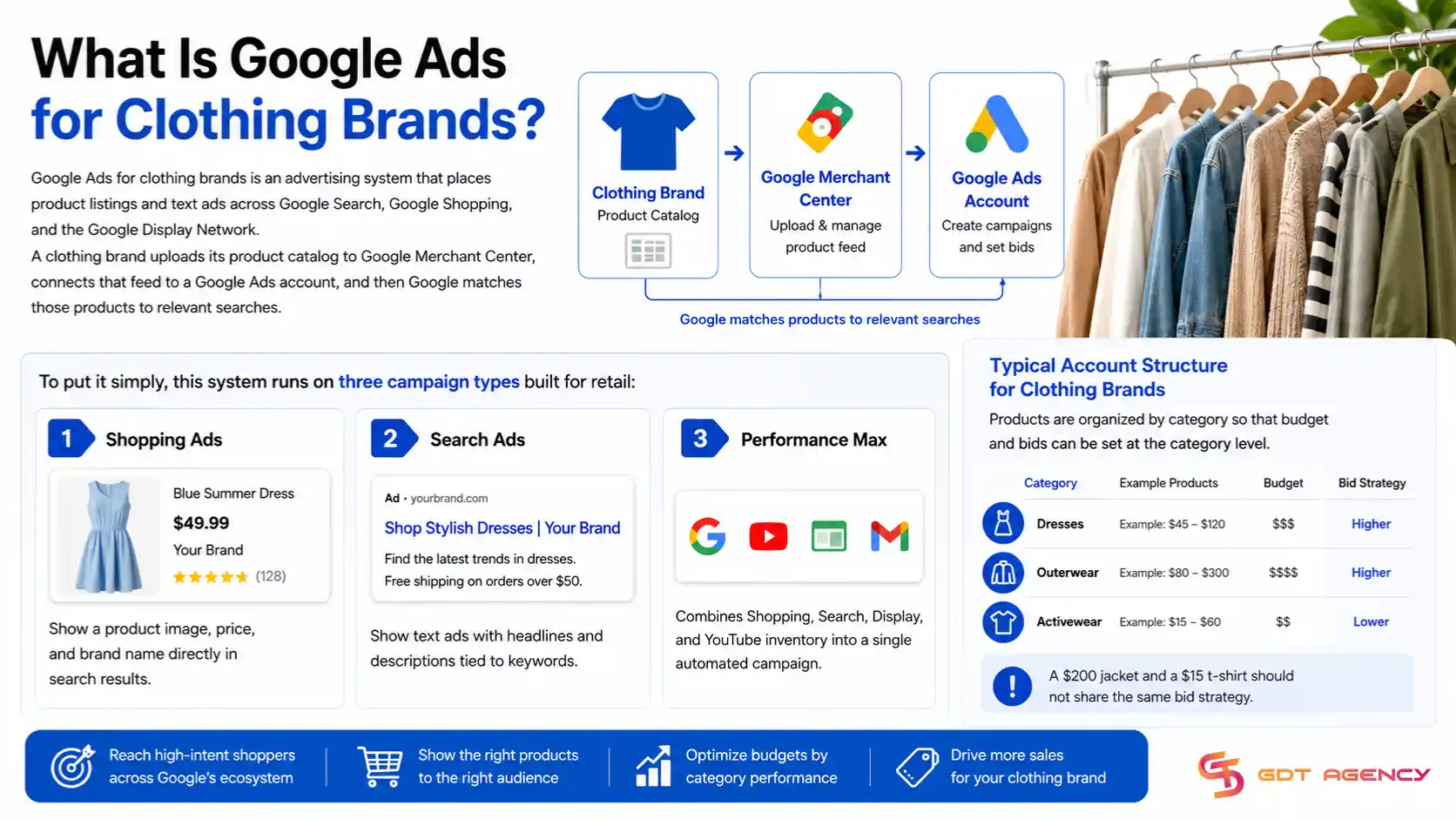
To put it simply, this system runs on three campaign types built for retail: Shopping, Search, and Performance Max. Each one pulls product data from the same feed but shows it in a different format. Shopping ads show a product image, price, and brand name directly in search results. Search ads show text links tied to keywords. Performance Max combines both, plus Display and YouTube inventory, into a single automated campaign.
A clothing brand’s account structure usually organizes products by category (dresses, outerwear, activewear) so that budget and bids can be set at the category level. This structure matters because a $200 jacket and a $15 t-shirt should not share the same bid strategy.
Does Google Ads Work for Clothing Brands?
Yes, Google Ads works for clothing brands, for three main reasons: it captures buyers with active purchase intent, it scales spend efficiently through automated bidding, and it gives visibility even to smaller brands competing against big retailers.
In terms of results, the strongest reason is intent. A person searching for a specific product type has already decided to shop for that category. This gives a clothing brand a warmer lead than most social ad placements, where the shopper is scrolling rather than searching.
Small and mid-sized clothing brands often worry that large retailers will dominate every auction. In practice, Google’s auction rewards relevance and quality score, not just budget size. A niche brand with a tightly optimized feed and specific keywords can win placements against much bigger competitors, because Google rewards ads that match the search closely.
Clothing brands that run Shopping campaigns with an optimized feed typically see stronger return on ad spend than brands running Search-only campaigns, since Shopping ads show the product visually before the click even happens. This upfront visual match reduces wasted clicks from shoppers who click but don’t want that exact product.
What Types of Google Ads Campaigns Work Best for Clothing Brands?
Clothing brands get the most value from five campaign types: Shopping, Search, Performance Max, Display, and Video. Each one plays a different role, split by where a shopper sits in the buying journey.
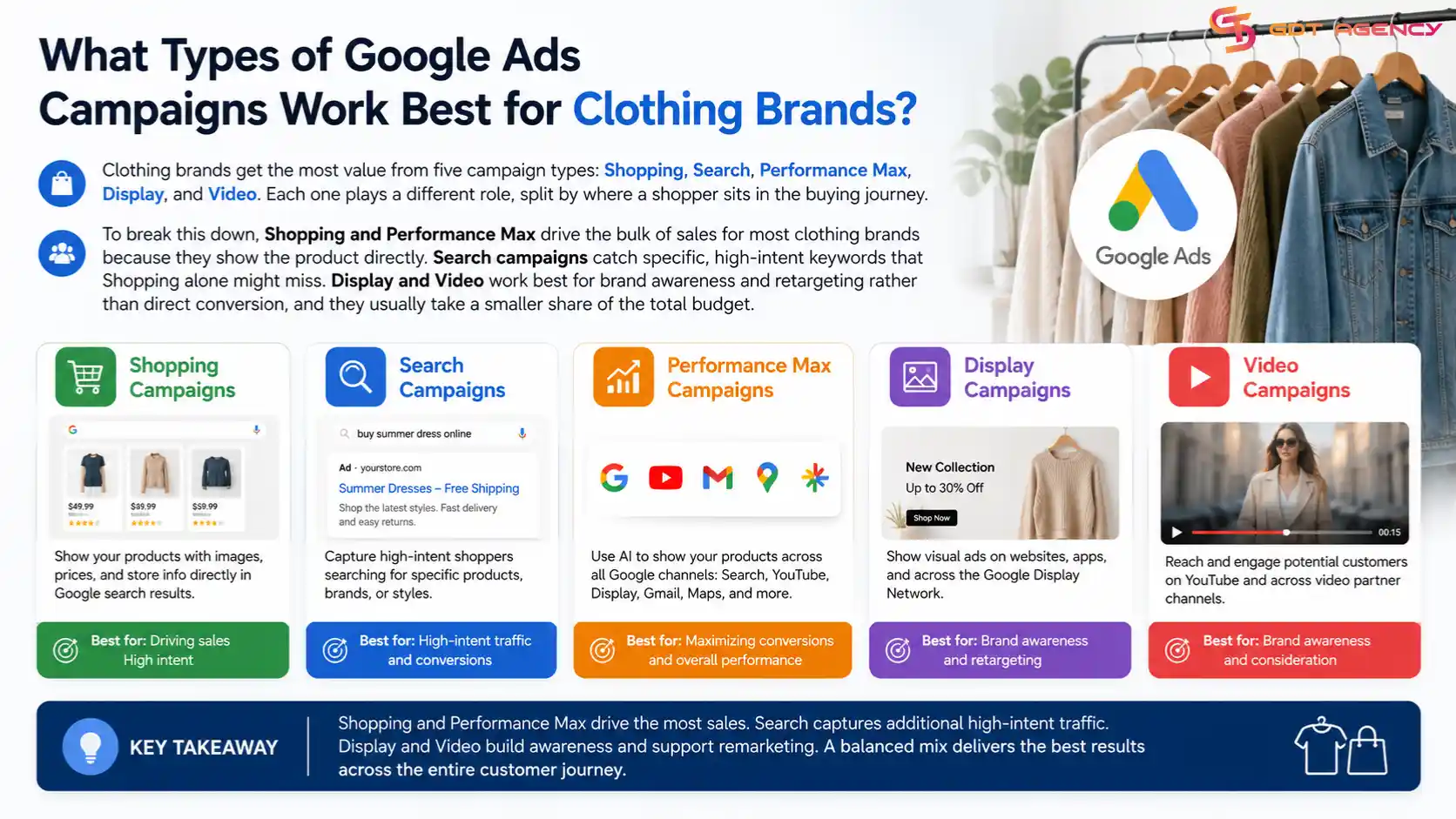
To break this down, Shopping and Performance Max drive the bulk of sales for most clothing brands because they show the product directly. Search campaigns catch specific, high-intent keywords that Shopping alone might miss. Display and Video work best for brand awareness and retargeting rather than direct conversion, and they usually take a smaller share of the total budget.
How Do Google Shopping Ads Work for Clothing Brands?
Google Shopping Ads pull product data (title, image, price, availability) straight from a merchant’s product feed and displays it as a visual listing in search results. A shopper sees the product before clicking, which filters out people who aren’t interested in that specific item.
For a clothing brand, this means the feed itself becomes the ad copy. Product titles need to include the details shoppers search for: color, material, fit, and size range. A feed with “Women’s Blue Cotton Midi Dress” performs differently than one that just says “Dress 4521,” because Google matches search queries against the feed text, not a separate ad headline.
How Does Performance Max Work for Clothing Brands?
Performance Max runs a single campaign across Search, Shopping, Display, YouTube, and Gmail, using Google’s automated bidding to find conversions wherever they happen. A clothing brand feeds it the same product catalog and lets the system decide where to show each product.
This campaign type works well once a brand already has conversion data flowing in, since the automation needs history to make good decisions. Brands that launch Performance Max too early, before the account has any purchase data, often see uneven results in the first few weeks while the system learns.
How Much Does Google Ads Cost for a Clothing Brand?
Google Ads costs for clothing brands typically range from $1,000 to $10,000 per month for small to mid-sized businesses, with average cost-per-click for apparel keywords landing between $0.50 and $2.00 depending on competition and product category.
Digging deeper, the actual cost depends heavily on the specificity of the keyword and the competitiveness of the niche. A broad term like “dresses” costs more per click than a specific term like “linen wrap dress size 12,” because broad terms attract more competing advertisers. Branded keywords, where someone searches your exact brand name, usually cost the least since fewer competitors bid on them.
Budget allocation also shifts with the calendar. A swimwear or summer-clothing brand should plan a heavier budget from March through July, then pull back in the off-season. A winter outerwear brand follows the opposite pattern. Brands that keep a flat monthly budget year-round often overspend in slow months and underspend during peak demand.
| Brand Size | Typical Monthly Budget | Average CPC Range |
| Small (under 100 SKUs) | $1,000 – $3,000 | $0.50 – $1.20 |
| Mid-sized (100-500 SKUs) | $3,000 – $8,000 | $0.80 – $1.80 |
| Larger catalog (500+ SKUs) | $8,000 – $20,000+ | $1.00 – $2.50 |
This table shows rough monthly ad spend and click cost ranges by catalog size, based on common patterns seen across clothing accounts. Actual numbers shift by niche, region, and competition level.
How Do You Set Up a Google Ads Campaign for a Clothing Brand?
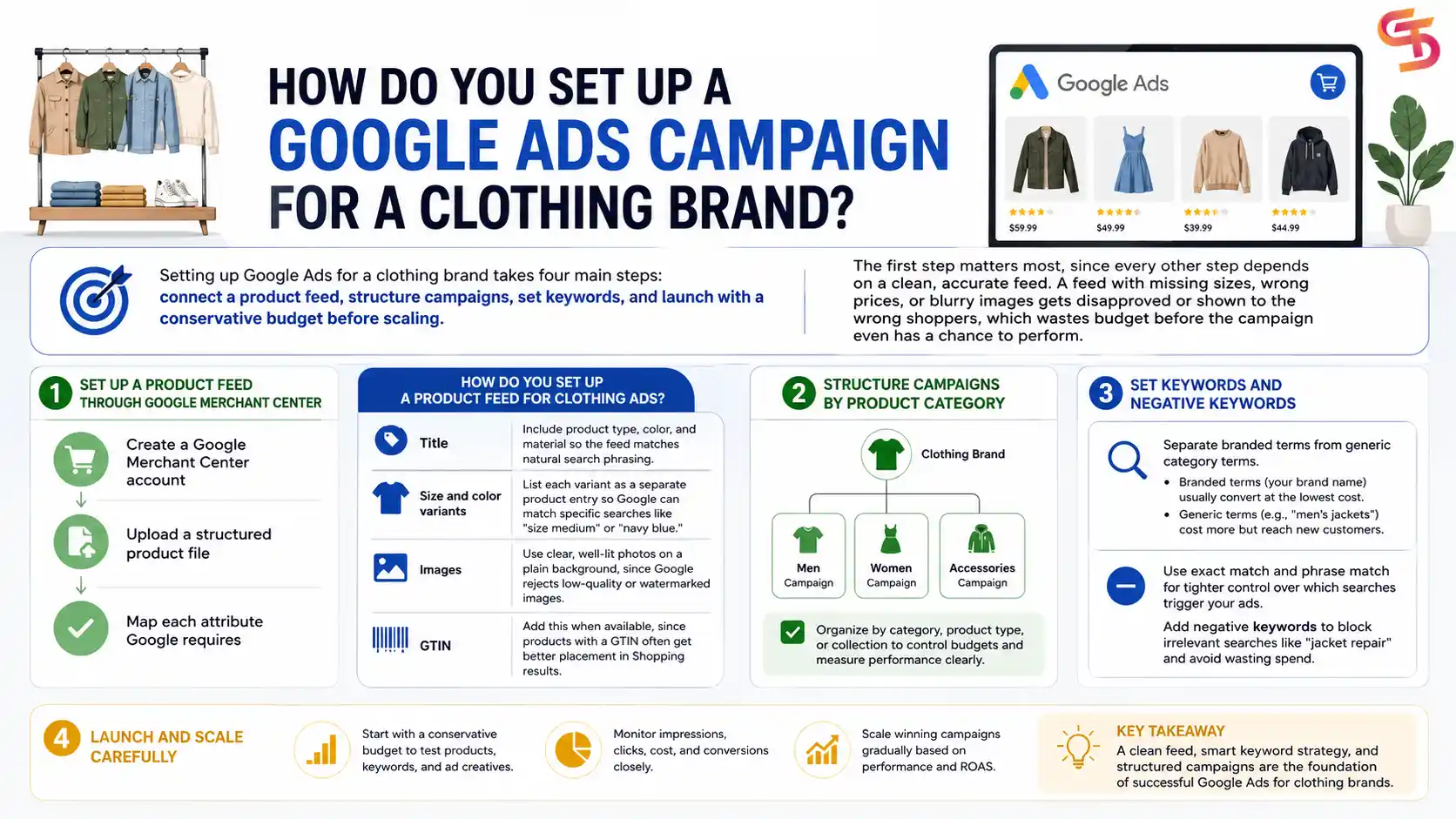
Setting up Google Ads for a clothing brand takes four main steps: connect a product feed through Google Merchant Center, structure campaigns by product category, set keywords and negative keywords, and launch with a conservative budget before scaling.
Working through this, the first step matters most, since every other step depends on a clean, accurate feed. A feed with missing sizes, wrong prices, or blurry images gets disapproved or shown to the wrong shoppers, which wastes budget before the campaign even has a chance to perform.
How Do You Set Up a Product Feed for Clothing Ads?
A clothing brand sets up a product feed by creating a Google Merchant Center account, uploading a structured product file, and mapping each attribute Google requires. Required attributes include product title, description, price, availability, size, color, and GTIN (Global Trade Item Number) where applicable.
- Title: Include product type, color, and material so the feed matches natural search phrasing.
- Size and color variants: List each variant as a separate product entry so Google can match specific searches like “size medium” or “navy blue.”
- Images: Use clear, well-lit photos on a plain background, since Google rejects low-quality or watermarked images.
- GTIN: Add this when available, since products with a GTIN often get better placement in Shopping results.
How Do You Choose Keywords for Clothing Brand Ads?
A clothing brand chooses keywords by separating branded terms from generic category terms, then layering in specific descriptors like size, style, and use case. Branded terms (the brand’s own name) usually convert at the lowest cost, while generic terms like “men’s jackets” cost more but reach new customers.
Match types also shape performance. Exact match and phrase match give tighter control over which searches trigger an ad, which helps a clothing brand avoid wasting spend on irrelevant searches like “jacket repair” when the brand only sells new jackets. Negative keywords close that gap further by blocking terms the brand doesn’t want to pay for.
Google Ads vs Facebook Ads for Clothing Brands: Which Is Better?
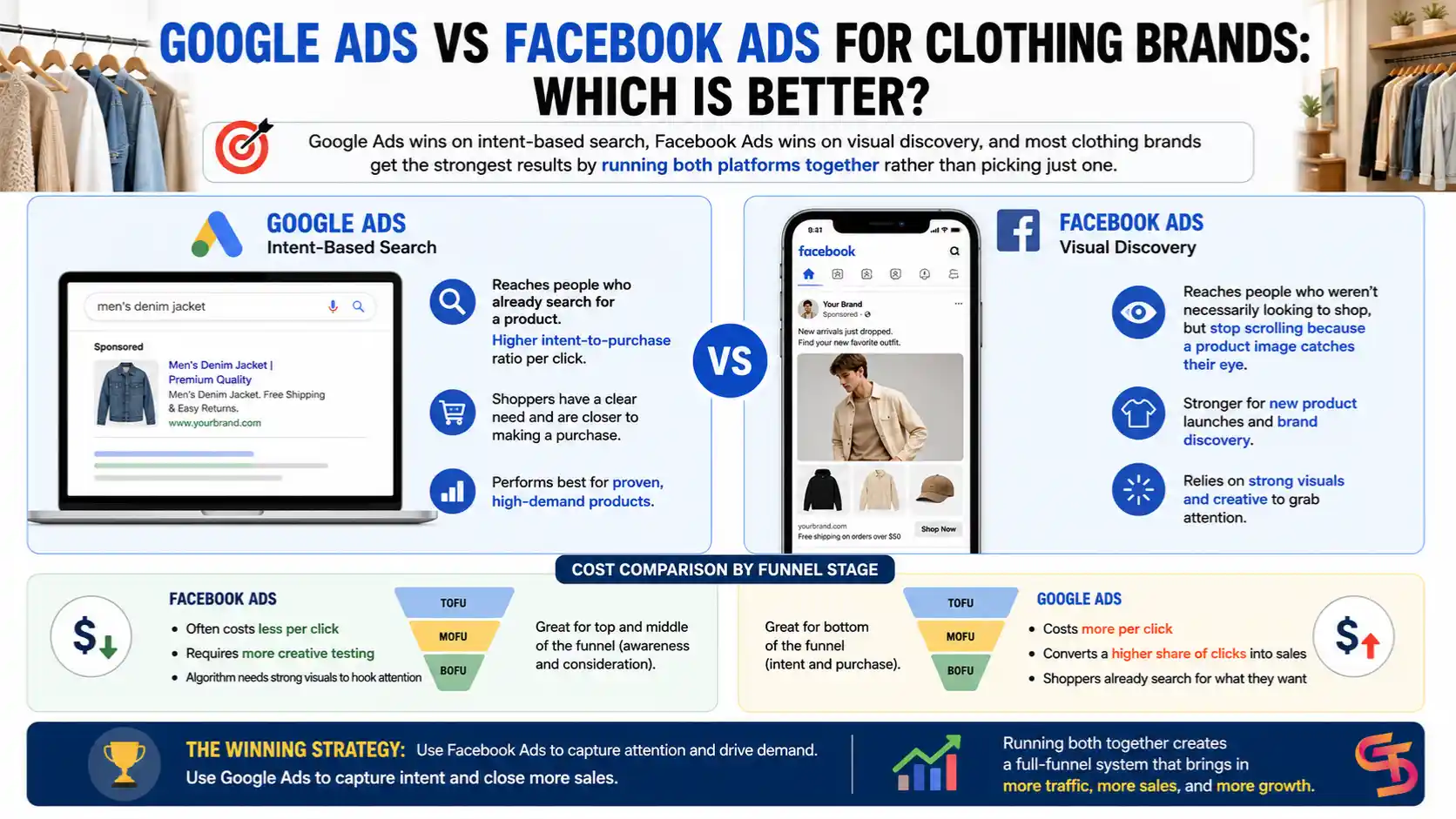
Google Ads wins on intent-based search, Facebook Ads wins on visual discovery, and most clothing brands get the strongest results by running both platforms together rather than picking just one.
Comparing the two, Google Ads reaches people who already search for a product, which tends to produce a higher intent-to-purchase ratio per click. Facebook Ads reaches people who weren’t necessarily looking to shop, but who stop scrolling because a product image catches their eye. This makes Facebook stronger for new product launches and brand discovery, while Google tends to perform better for proven, high-demand products.
Cost also differs by stage of the funnel. Facebook Ads often cost less per click but require more creative testing to find a winning ad, since the algorithm needs strong visuals to hook attention. Google Ads costs more per click on average but converts a higher share of those clicks into sales, since the shopper already typed in exactly what they want.
Case Study: How We Helped a Clothing Brand Turn $19.4K Into $122.2K Within 4 Months
Twenty-Oh-Two, a unisex lifestyle clothing brand founded in 2017, came to us spending around $10K per month on Google Ads with almost no return to show for it. Within months of restructuring the account, monthly ad spend grew to $19.4K while monthly revenue climbed to $122.2K, taking the brand’s ROAS from 1.6 to 6.3 and hitting the exact target it set out to reach.
Twenty-Oh-Two sells everyday basics with bold graphic designs, including T-shirts, shirts, pants, dresses, accessories, and outerwear. The brand moved from brick-and-mortar retail to an online store in 2023 and leaned on Google Ads to build that new e-commerce channel. The problem was that ad spend generated barely any sales, and the account kept getting suspended for policy violations, which cut off traffic right when the brand needed it most.
What Was the Client’s Situation Before the Campaign?
Before working with GDT Agency, Twenty-Oh-Two ran ads with poor keyword management, weak budgeting during peak seasons, and a Google Ads account vulnerable to suspension. Ad spend percentage against revenue sat at 63.8%, and ROAS averaged just 1.6, far below what the brand needed to turn a profit.
The biggest leak came from the product names themselves. Twenty-Oh-Two prints descriptive graphics on its clothes, like sunflower, vanilla, and alligator designs, and those same words were pulling in the product titles. Google matched those terms to completely unrelated searches such as “dune sunflower,” “vanilla bean plant,” and “alligator meat,” which drove up cost per thousand impressions and tanked click-through rate. On top of that, the brand’s marketing team ran ads on new Google Ads accounts, which carry low trust with the platform and get flagged or suspended far more easily than accounts with a long, clean spending history.
What Strategy Did We Use to Scale the Account?
The strategy fixed three problems at once: cleaning up keyword targeting, correcting the budget and bidding approach for seasonal demand, and moving the brand onto stable Google agency ad accounts.
For keywords, we pulled the full search term report and added every irrelevant match to the negative keyword list. Misleading but related terms like “alligator meat” or “alligator skin” got blocked with exact match, while completely unrelated terms like “wiki” and “wikipedia” got blocked with phrase match, so the net covered more variations of the same junk traffic. For budgeting, we reallocated spend and applied a maximum CPC bidding strategy during high-competition periods like the spring equinox, so the brand could still win placements when demand and competition both spiked. For account stability, we moved Twenty-Oh-Two onto reputable, long-standing agency ad accounts that were already whitelisted by Google, which stopped the suspensions that had been cutting off traffic.
What Results Did the Clothing Brand See Month by Month?
Results came in two waves: an immediate jump in click-through rate and conversion rate once the negative keyword list took effect, followed by a much sharper scale-up around the Christmas shopping season.
| Metric | Before | After |
| Monthly ad spend | $8.3K | $19.4K |
| Monthly revenue | $13K | $122.2K |
| Ad spend percentage | 63.8% | 15.9% |
| Average ROAS | 1.6 | 6.3 |
This table lays out the core before-and-after numbers from the engagement. The single biggest scale-up happened around Christmas, the brand’s peak shopping season, when campaigns scaled by roughly 133.7% and sales multiplied more than 9X against the same period the year before. Once the reputable agency accounts were in place, every campaign ran without interruption, which meant none of that seasonal momentum got lost to a suspension.
What Can Other Clothing Brands Learn From This Case?
This case shows that a messy keyword match between product names and unrelated searches can quietly drain a huge share of ad spend, that seasonal bidding needs real budget behind it to win placements during peak demand, and that account stability is not optional once a brand depends on Google Ads for revenue.
The biggest lesson is that fixing targeting and fixing infrastructure have to happen together. Twenty-Oh-Two’s negative keyword cleanup alone would have improved click-through rate, but without stable ad accounts, a single suspension during Christmas week could have wiped out the gain. Brands running Google Ads for apparel should audit both sides of the account, the search terms and the account health, before assuming a bidding strategy alone will fix performance.
Note: The document names a 6-month collaboration timeline and reports the ad spend/revenue jump as the overall result of that period, while the article title still frames it as “within 4 months.” Let me know which timeframe you want reflected in the title and sapo so both stay consistent with the case study.
Final Thoughts
Google Ads gives clothing brands a direct line to shoppers who already want to buy, but the platform only pays off when the product feed, campaign structure, and budget all work together. A brand that fixes the feed first, builds category-level campaigns second, and layers in automation once the data supports it tends to see the kind of jump this case study showed, from $19.4K to $122.2K in four months. The brands that skip straight to automation without that foundation usually just scale their existing problems instead of fixing them.
>>> Maybe you are also interested in: Google Ads for Weight Loss Surgery Clinics: How to Attract High-Value Patients
FAQs
Is Google Ads worth it for a small clothing brand?
Yes, Google Ads works for small clothing brands because the auction rewards relevance over raw budget. A small brand with a clean, well-optimized feed can win placements against larger competitors, especially on specific, less competitive search terms.
How long does it take to see results from Google Ads for a clothing brand?
Most clothing brands see early signals within 4 to 6 weeks, once enough conversion data builds up to guide automated bidding. Full results, especially from Performance Max, tend to show up after 2 to 3 months of consistent optimization.
Do I need a professional product feed to run Shopping ads?
Yes, a professional product feed is required to run Shopping ads well. Google pulls the ad content directly from the feed, so accurate titles, images, sizes, and prices directly affect which searches your products match.
Can I run Google Ads and Facebook Ads at the same time for my clothing brand?
Yes, running both platforms together works well for most clothing brands. Facebook Ads tends to drive discovery and new product awareness, while Google Ads captures the buyers who already decided to purchase, so the two platforms cover different parts of the funnel.
What is a good ROAS for a clothing brand on Google Ads?
A good ROAS for a clothing brand typically falls between 3x and 5x, though the right target depends on profit margin and average order value. Brands with tighter margins need a higher ROAS to stay profitable, while higher-margin brands can accept a lower ROAS and still grow.