Google Ads for IaaS Companies: Campaign Types, Targeting, and Budget Strategy


Google Ads works for IaaS companies when the campaign structure matches the technical buying process, not a generic B2B funnel. IaaS buyers research longer, compare specs harder, and rarely convert on the first click. This guide covers campaign structure, keyword targeting, account setup, bidding, landing pages, and the policy restrictions that catch IaaS advertisers off guard.
Most IaaS companies start with the wrong campaign type. They copy a SaaS playbook built for quick trial signups, then wonder why cost per lead climbs while conversion rate stays flat. The fix starts with keyword strategy, since IaaS search terms carry different intent signals than SaaS terms. A developer searching “dedicated server pricing” wants a number, not a demo booking form.
Account setup causes the second wave of problems. IaaS companies often run multi-region campaigns, sell to enterprise buyers who need procurement approval, and get flagged by Google’s policy systems for reasons unrelated to their actual business, like hosting overlap with VPN or crypto mining services. Getting the account structure right from day one avoids months of review delays later.
Budget and bidding round out the operational side. Below, this guide breaks down each piece in order: what IaaS advertising actually means, how to structure campaigns, which keywords convert, how to set up an account correctly, how to bid and budget, what a converting landing page looks like, and which policy restrictions apply. After that, a real account case shows what happens when an IaaS company hits a spend ceiling and switches to a reseller account.
- What is Google Ads for IaaS Companies?
- How Does Google Ads Campaign Structure Work for IaaS Companies?
- What Campaign Types Should IaaS Companies Use?
- How Should Ad Groups Be Organized by Service Tier?
- What Keywords Should IaaS Companies Target?
- What Are High-Intent Keywords for IaaS Buyers?
- Should IaaS Companies Bid on Competitor Brand Names?
- How Should IaaS Companies Set Up Their Ad Account?
- Do IaaS Companies Need a Verified Business Account?
- What Billing and Access Structure Works Best for Multi-Region Campaigns?
- How Should IaaS Companies Set Budget and Bidding?
- Is Manual CPC or Target CPA Better for IaaS Campaigns?
- How Much Should an IaaS Company Budget for Google Ads?
- What Landing Page Elements Convert IaaS Ad Traffic?
- Are There Policy Restrictions for IaaS Companies on Google Ads?
- How Did HKZ Scale Google Ads Spend Using a Reseller Account?
- What Problems Did HKZ Face on Its Original Google Ads Account?
- What Changed After HKZ Switched to GDT Agency’s Service?
- What Results Did HKZ Achieve After the Switch?
- Why Does a Reseller Account Solve These Problems for IaaS Companies?
- Final Thoughts
- FAQ
- Can IaaS companies run Google Ads without a verified business account?
- Is Performance Max a good fit for IaaS campaigns?
- How long does it take to see results from IaaS Google Ads campaigns?
- What causes most Google Ads account suspensions for IaaS companies?
- Does a reseller account cost more than a standard Google Ads account?
What is Google Ads for IaaS Companies?
Google Ads for IaaS companies means running search, display, and Performance Max campaigns to sell infrastructure services like compute, storage, and networking, targeted at technical buyers rather than general consumers. IaaS differs from SaaS in one key way: the buyer evaluates infrastructure specs, uptime guarantees, and pricing models before they ever fill out a form.
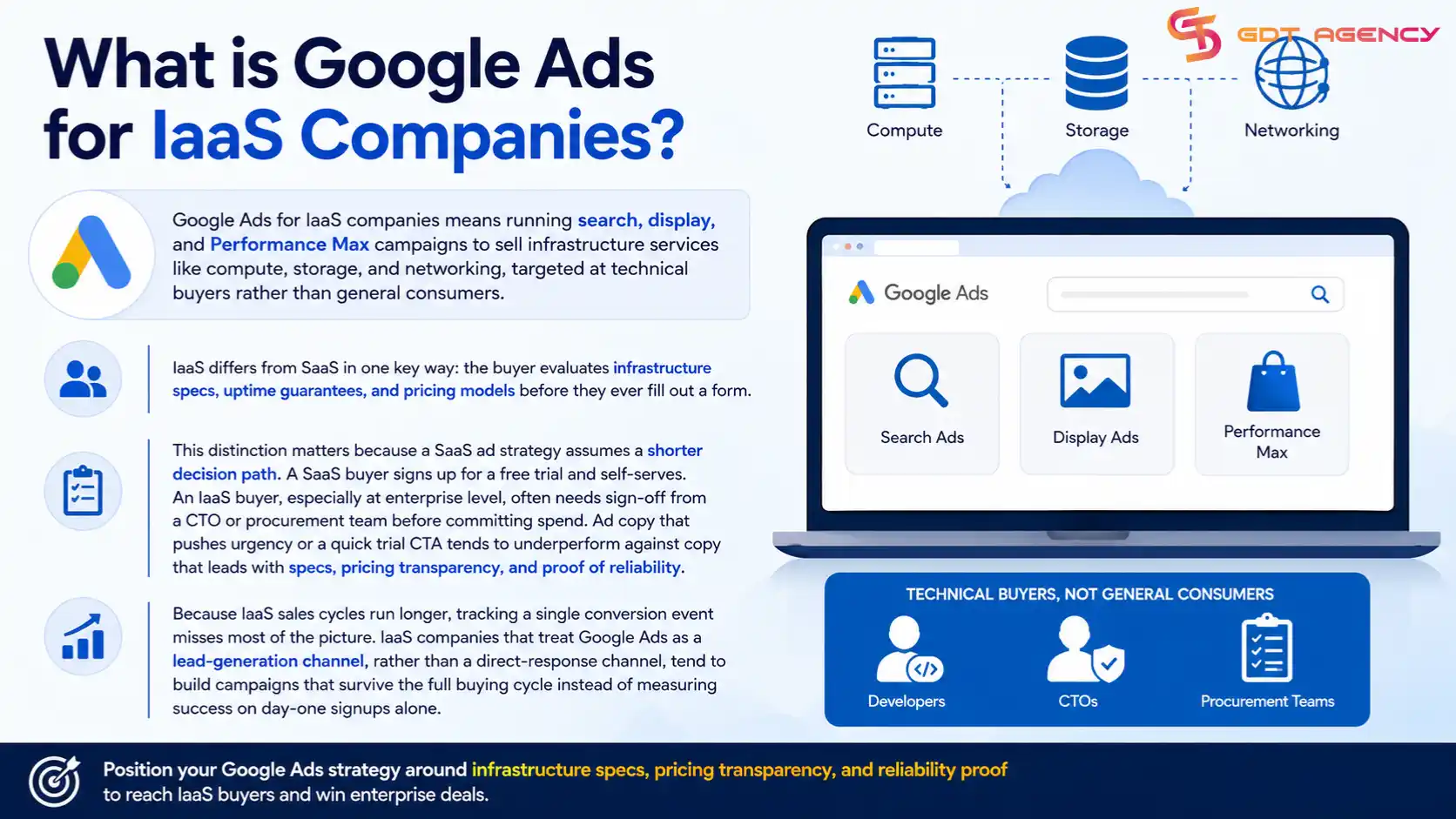
This distinction matters because a SaaS ad strategy assumes a shorter decision path. A SaaS buyer signs up for a free trial and self-serves. An IaaS buyer, especially at enterprise level, often needs sign-off from a CTO or procurement team before committing spend. Ad copy that pushes urgency or a quick trial CTA tends to underperform against copy that leads with specs, pricing transparency, and proof of reliability.
Because IaaS sales cycles run longer, tracking a single conversion event misses most of the picture. IaaS companies that treat Google Ads as a lead-generation channel, rather than a direct-response channel, tend to build campaigns that survive the full buying cycle instead of measuring success on day-one signups alone.
How Does Google Ads Campaign Structure Work for IaaS Companies?
Google Ads campaign structure for IaaS companies works best when built around service tier and buyer intent, using a mix of search campaigns for immediate demand and Performance Max for broader reach. Structure determines whether ad spend reaches the right buyer at the right stage of research.
Next, this structure needs to account for how differently a compute buyer and a storage buyer search. Bundling every service into one ad group dilutes relevance and drags down quality score, which raises cost per click across the account.
What Campaign Types Should IaaS Companies Use?
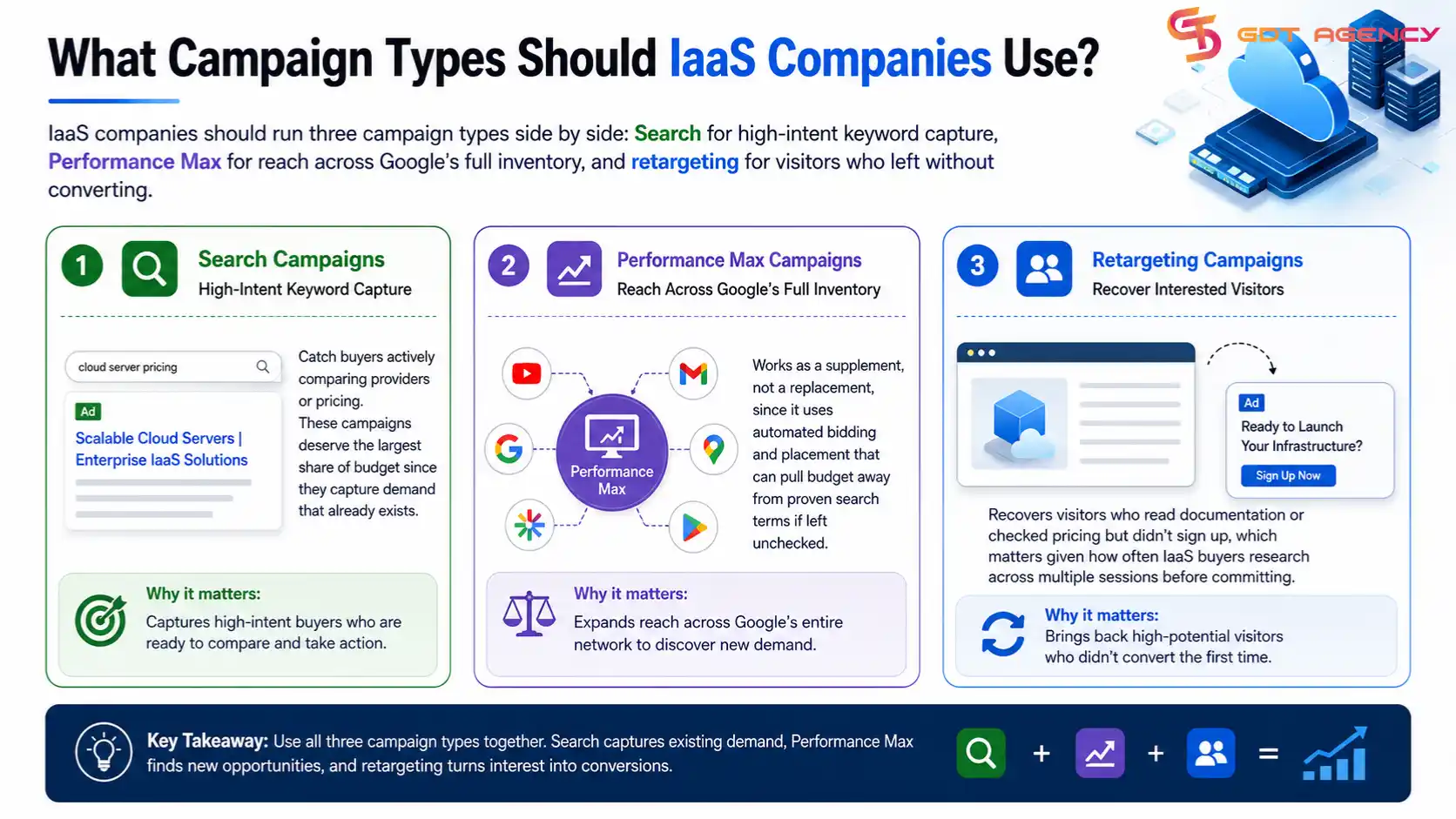
IaaS companies should run three campaign types side by side: Search for high-intent keyword capture, Performance Max for reach across Google’s full inventory, and retargeting for visitors who left without converting.
Search campaigns catch buyers actively comparing providers or pricing. These campaigns deserve the largest share of budget since they capture demand that already exists. Performance Max works as a supplement, not a replacement, since it uses automated bidding and placement that can pull budget away from proven search terms if left unchecked. Retargeting recovers visitors who read documentation or checked pricing but didn’t sign up, which matters given how often IaaS buyers research across multiple sessions before committing.
How Should Ad Groups Be Organized by Service Tier?
Ad groups should split by service tier, meaning compute, storage, networking, and managed services each get their own ad group with matching keywords and ad copy.
A buyer searching for GPU compute instances has nothing in common with a buyer comparing object storage pricing, so grouping them together forces generic ad copy that speaks to neither.
Splitting by tier lets each ad group use language specific to that service, which raises click-through rate and keeps quality score healthy. This structure also makes budget allocation easier to track, since a company can see exactly which service tier drives the most cost-effective conversions.
What Keywords Should IaaS Companies Target?
IaaS companies should target keywords that reflect a technical buyer’s research stage, split between comparison terms, pricing terms, and use-case terms. Keyword selection determines whether an ad reaches someone ready to buy or someone still browsing.
Following that, keyword lists need constant refinement, since IaaS terminology shifts as new service categories emerge, like edge computing or serverless infrastructure. A keyword list built once and left untouched for a year misses new demand and wastes budget on outdated terms.
What Are High-Intent Keywords for IaaS Buyers?
High-intent keywords for IaaS buyers include pricing-focused terms like “cloud server pricing,” comparison terms like “IaaS vs on-premise cost,” and enterprise-specific terms like “dedicated hosting for enterprise.”
These terms signal a buyer close to a decision, since someone searching for pricing or cost comparison has already moved past the awareness stage. IaaS companies should bid these terms aggressively relative to broader awareness terms like “what is cloud infrastructure,” which draw traffic but convert at a much lower rate. Negative keywords matter here too, since terms like “free” or “tutorial” tend to attract students and hobbyists rather than paying enterprise buyers.
Should IaaS Companies Bid on Competitor Brand Names?
Yes, IaaS companies can bid on competitor brand names, since Google Ads policy permits it as long as the ad copy doesn’t misuse the competitor’s trademark in the ad text itself.
This tactic works because IaaS buyers often search a competitor’s name while still comparing providers, meaning the decision isn’t locked in yet. However, this approach carries real trademark risk if a competitor files a complaint, and it typically produces a lower click-through rate than bidding on generic terms, since Google’s algorithm treats brand-mismatch ads less favorably. Companies should test competitor bidding cautiously, starting with a small budget, before committing significant spend to this strategy.
How Should IaaS Companies Set Up Their Ad Account?
IaaS companies should set up their Google Ads account with a verified business identity, a clear billing structure, and access permissions that match how many regions or brands the company operates under. Account setup determines whether campaigns run smoothly or get stuck in review cycles.
Moving forward, account structure becomes especially important for IaaS companies operating across multiple countries, since billing currency, tax settings, and regional compliance requirements all vary by market.
Do IaaS Companies Need a Verified Business Account?
Yes, IaaS companies need a verified business account, since Google’s advertiser identity verification program applies to any business advertising technical or hosting-related services.
Google introduced this verification requirement to reduce fraud and impersonation in ad accounts, and hosting or infrastructure companies fall squarely into categories Google reviews closely. Skipping verification, or submitting incomplete business documentation, leads to ad disapprovals and account suspensions that can take weeks to resolve. IaaS companies should complete verification before launching any campaign, since a suspended account during an active campaign wastes both time and budget.
What Billing and Access Structure Works Best for Multi-Region Campaigns?
A centralized Manager Account, known as an MCC, works best for multi-region campaigns, since it lets one team manage billing and access across multiple country-specific sub-accounts without duplicating setup work.
An MCC structure means an IaaS company running campaigns in the US, Europe, and Southeast Asia doesn’t need three disconnected accounts with three separate logins. Each region can run its own budget and currency settings while reporting rolls up to one dashboard. This structure also simplifies access control, since a company can grant an agency or team member visibility into specific regions without exposing the entire account.
How Should IaaS Companies Set Budget and Bidding?
IaaS companies should set budget and bidding based on sales cycle length, using Target CPA once enough conversion data exists and manual CPC during the early testing phase. Budget and bidding strategy directly affects how much control a company has over cost per acquisition.
In addition, IaaS companies need to budget for a longer data collection period than typical B2B advertisers, since Google’s automated bidding algorithms need a meaningful volume of conversions before they optimize accurately.
Is Manual CPC or Target CPA Better for IaaS Campaigns?
Manual CPC works better in the first few months of a new IaaS campaign, while Target CPA becomes more effective once the account has a stable conversion history, typically after 30 or more conversions in a 30-day window.
Manual CPC gives a company direct control over bids while conversion data is still thin, which matters since automated bidding without enough data tends to make erratic bid adjustments. Once conversion volume stabilizes, Target CPA shifts bidding decisions to Google’s algorithm, which can react to auction-time signals faster than a human manager. Companies that switch to Target CPA too early often see cost per acquisition spike, since the algorithm has no reliable pattern to optimize against yet.
How Much Should an IaaS Company Budget for Google Ads?
An IaaS company should budget based on average deal size and sales cycle length, since a single enterprise contract can justify a much higher cost per lead than a self-serve SaaS product would tolerate.
A company selling dedicated hosting contracts worth $50,000 a year can afford a cost per lead of several hundred dollars, while a company selling small-scale storage plans needs a much lower cost per lead to stay profitable. IaaS companies should model budget against lifetime value rather than copying a flat industry benchmark, since infrastructure deal sizes vary enormously between enterprise and small business buyers.
What Landing Page Elements Convert IaaS Ad Traffic?
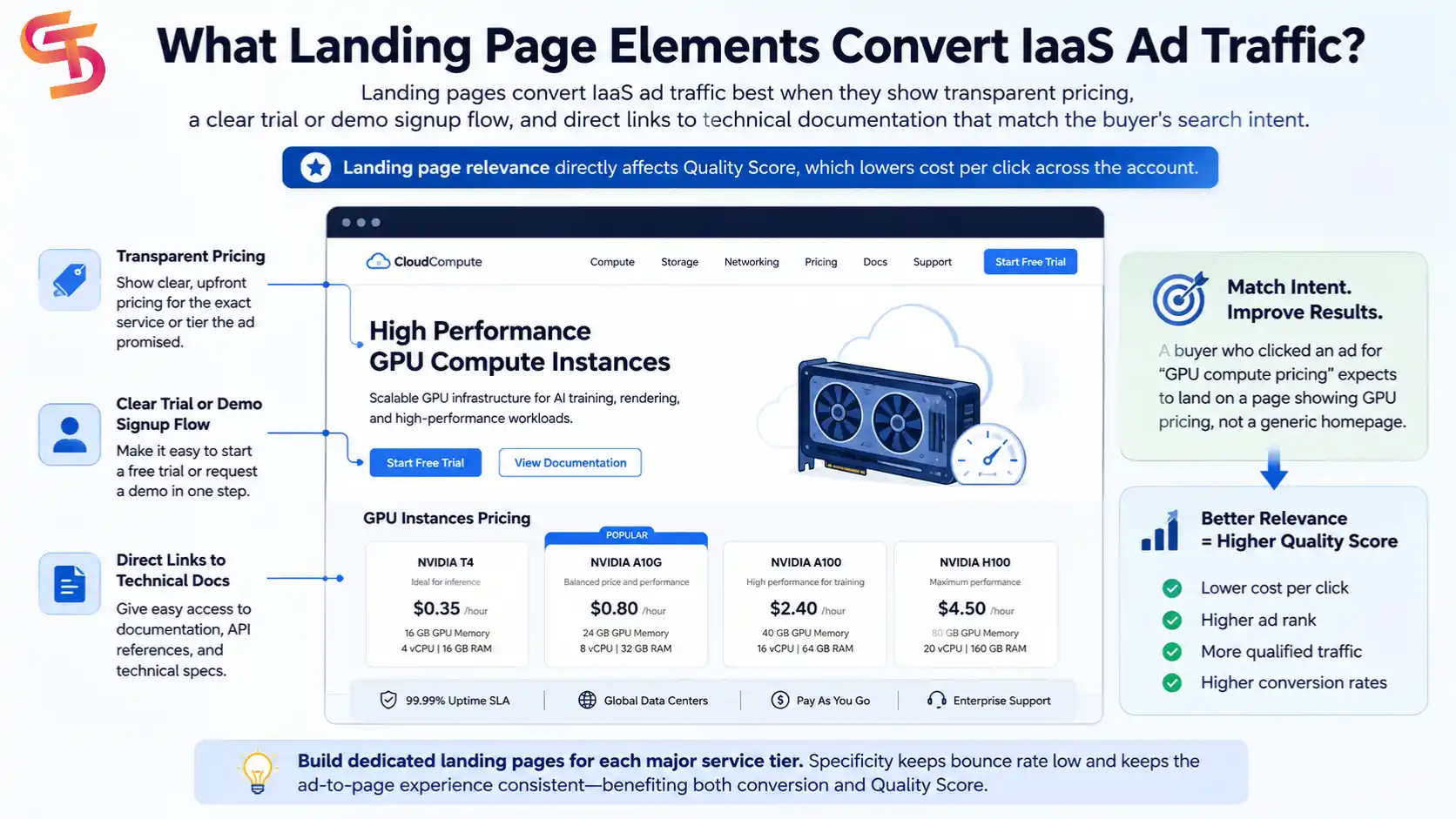
Landing pages convert IaaS ad traffic best when they show transparent pricing, a clear trial or demo signup flow, and direct links to technical documentation that match the buyer’s search intent. Landing page relevance directly affects Quality Score, which lowers cost per click across the account.
A buyer who clicked an ad for “GPU compute pricing” expects to land on a page showing GPU pricing, not a generic homepage. Mismatched landing pages frustrate technical buyers who expect direct answers, and they also hurt Quality Score since Google measures landing page relevance as part of ad rank. IaaS companies should build dedicated landing pages for each major service tier rather than routing all traffic to one general page, since specificity keeps bounce rate low and keeps the ad-to-page experience consistent.
Are There Policy Restrictions for IaaS Companies on Google Ads?
Yes, there are policy restrictions for IaaS companies on Google Ads, mainly around services that overlap with cryptocurrency mining hosting, VPN infrastructure, and proxy services, since Google’s automated review systems flag these categories heavily regardless of actual business intent.
An IaaS company that offers general-purpose compute can get flagged if its service description or landing page mentions terms associated with crypto mining or proxy hosting, even if that’s a small part of the business. Google’s review system tends to apply broad category filters rather than nuanced case-by-case judgment, which means legitimate infrastructure companies sometimes get caught by rules meant for bad actors. Clear, specific service descriptions in both ad copy and landing pages reduce the chance of a false flag, and appealing a suspension requires detailed documentation proving the business operates outside the restricted category.
How Did HKZ Scale Google Ads Spend Using a Reseller Account?
HKZ scaled its Google Ads spend by switching from a standard advertiser account to a white-label Google agency account managed through GDT Agency, which removed the daily spend cap that had been blocking its campaign growth. This case shows what happens when an IaaS company hits a structural ceiling that no amount of bid optimization can fix.
To understand why this switch mattered, the account problems HKZ faced before the switch need context first.
What Problems Did HKZ Face on Its Original Google Ads Account?
HKZ’s original account capped daily spend at $250, which meant no campaign, regardless of how well it performed, could scale past that ceiling.
This cap created a direct bottleneck. Even when HKZ found keywords and ad copy that converted well, the account structure itself prevented further investment. On top of the spend cap, HKZ’s account experienced frequent card declines, which triggered automatic page bans and forced the team into repeated review loops just to keep campaigns live. Compounding the problem, HKZ had zero dedicated support from Google during this period, meaning every appeal went through an automated system with a standard wait time of 7 days. For a company trying to move fast, a week-long wait for each appeal made consistent campaign management nearly impossible.
What Changed After HKZ Switched to GDT Agency’s Service?
After switching to GDT Agency’s white-label account, HKZ scaled its daily spend to $15,000 within 72 hours of activation.
This jump happened because a reseller-managed account operates under different account infrastructure than a standard self-serve advertiser account. Alongside the spend increase, HKZ gained secure banking integration with instant line-of-credit balance loading, which solved the card decline issue that had been triggering bans. HKZ also received direct internal access to platform partners, including staff inside Google’s MCC partner program, which replaced the automated appeal queue with a real point of contact.
What Results Did HKZ Achieve After the Switch?
HKZ achieved a 60x increase in ad spend scale compared to its original account limit, generated $450K in monthly profit following the switch, and completed the entire account setup process in 24 hours.
These numbers reflect what becomes possible once the account-level bottleneck disappears. HKZ didn’t need to change its product, its targeting, or its offer to hit these results. The limiting factor the whole time had been account infrastructure, not campaign strategy.
Why Does a Reseller Account Solve These Problems for IaaS Companies?
A reseller account solves these problems by replacing the fixed spend cap and card-based billing of a standard account with a credit-based structure and direct platform support, both of which remove the two biggest scaling blockers for growing IaaS advertisers.
Standard self-serve Google Ads accounts are built for small and mid-size advertisers, which means the spend caps and support systems assume a lower volume of activity than a scaling IaaS company generates. A white-label reseller account, run through an agency with established platform relationships, operates under a different tier of infrastructure built for exactly this kind of volume. For IaaS companies that have already validated their campaigns and keyword strategy but keep hitting an account-level ceiling, switching to a reseller account addresses the actual bottleneck rather than continuing to optimize a campaign that was never the real problem.
Final Thoughts
Google Ads works for IaaS companies when campaign structure, keyword targeting, and account setup all match the realities of a technical, longer sales cycle. Most of the friction IaaS companies hit isn’t a targeting problem. It’s an account infrastructure problem, as HKZ’s case shows clearly. Getting the account right, from verification through billing to spend capacity, often matters more than any single bid adjustment or ad copy change.
>>> Maybe you are also interested in: Google Ads for Weight Loss Surgery Clinics: How to Attract High-Value Patients
FAQ
Can IaaS companies run Google Ads without a verified business account?
No, verification is required for hosting and infrastructure businesses, and running campaigns without it risks disapprovals and suspensions.
Is Performance Max a good fit for IaaS campaigns?
Performance Max works as a supplement to Search campaigns, not a replacement, since Search captures existing high-intent demand more reliably.
How long does it take to see results from IaaS Google Ads campaigns?
Results vary by deal size and sales cycle, but IaaS companies typically need 30 or more conversions before automated bidding strategies like Target CPA perform reliably.
What causes most Google Ads account suspensions for IaaS companies?
Category overlap with restricted services like crypto mining hosting, VPN infrastructure, or proxy services triggers most suspensions, even for legitimate infrastructure businesses.
Does a reseller account cost more than a standard Google Ads account?
A reseller account typically involves a management fee, but it removes spend caps and billing restrictions that otherwise limit how much a growing IaaS company can invest in ads.