
Google Ads for Clothing Brand: A Complete Guide to Setting Up and Running Campaigns
Google Ads works for clothing brands because it puts products in front of people who already search for them. A shopper types “women’s linen dress”…
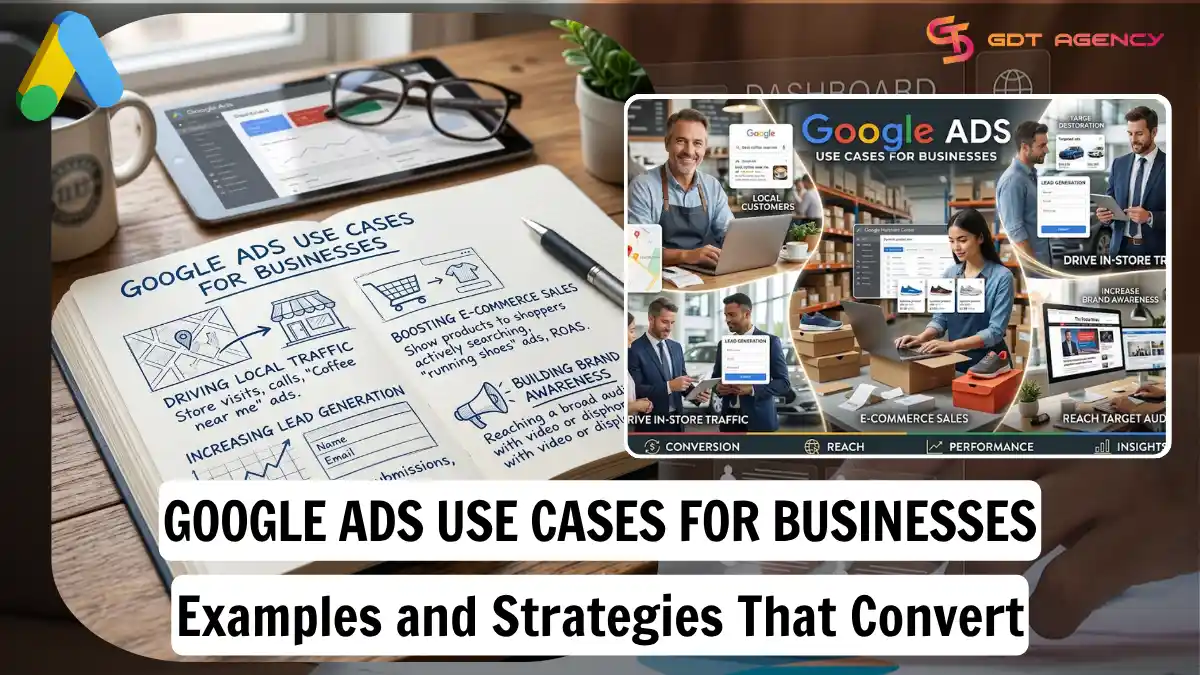
Businesses across almost every industry use Google Ads to reach new customers and grow sales. A roofing company can generate local leads through Search ads, while a clothing brand can drive online sales through Shopping ads. Each business type has its own use case, but the goal stays the same: turn ad spend into measurable results.
Different businesses apply Google Ads in different ways depending on their goals and industry. A local service company often relies on Search ads with call extensions, while an e-commerce store leans on Shopping campaigns to showcase products directly in search results. B2B companies often mix Search and Display to build awareness before a sale happens.
The strategies behind these use cases matter as much as the use cases themselves. Smart Bidding, Responsive Search Ads, and well-structured landing pages all play a role in whether a campaign converts or wastes budget. Businesses that understand these strategies get more value from every dollar they spend.
As an expert at GDT Agency with years of experience working with Google ads, Google ads account, and Google Ads agency accounts, I understand the importance of choosing the right account setup & Structure for a business. Besides, choosing the right campaign type is often the first decision a business has to make, and it shapes everything that follows.
Below, we break down what Google Ads use cases look like in practice, which industries are seeing strong results, the strategies that drive conversions, and how to pick the campaign type that fits your business.
A Google Ads use case shows how a business applies Google Ads to reach a goal, such as generating leads, selling products, or building brand awareness. Businesses choose a use case based on their industry, their customers, and what they want the campaign to achieve.
Every use case starts with a goal. A restaurant might want more phone bookings, while a software company might want more demo requests. Once the goal is clear, the business picks the campaign type, targeting method, and ad format that fit that goal best.
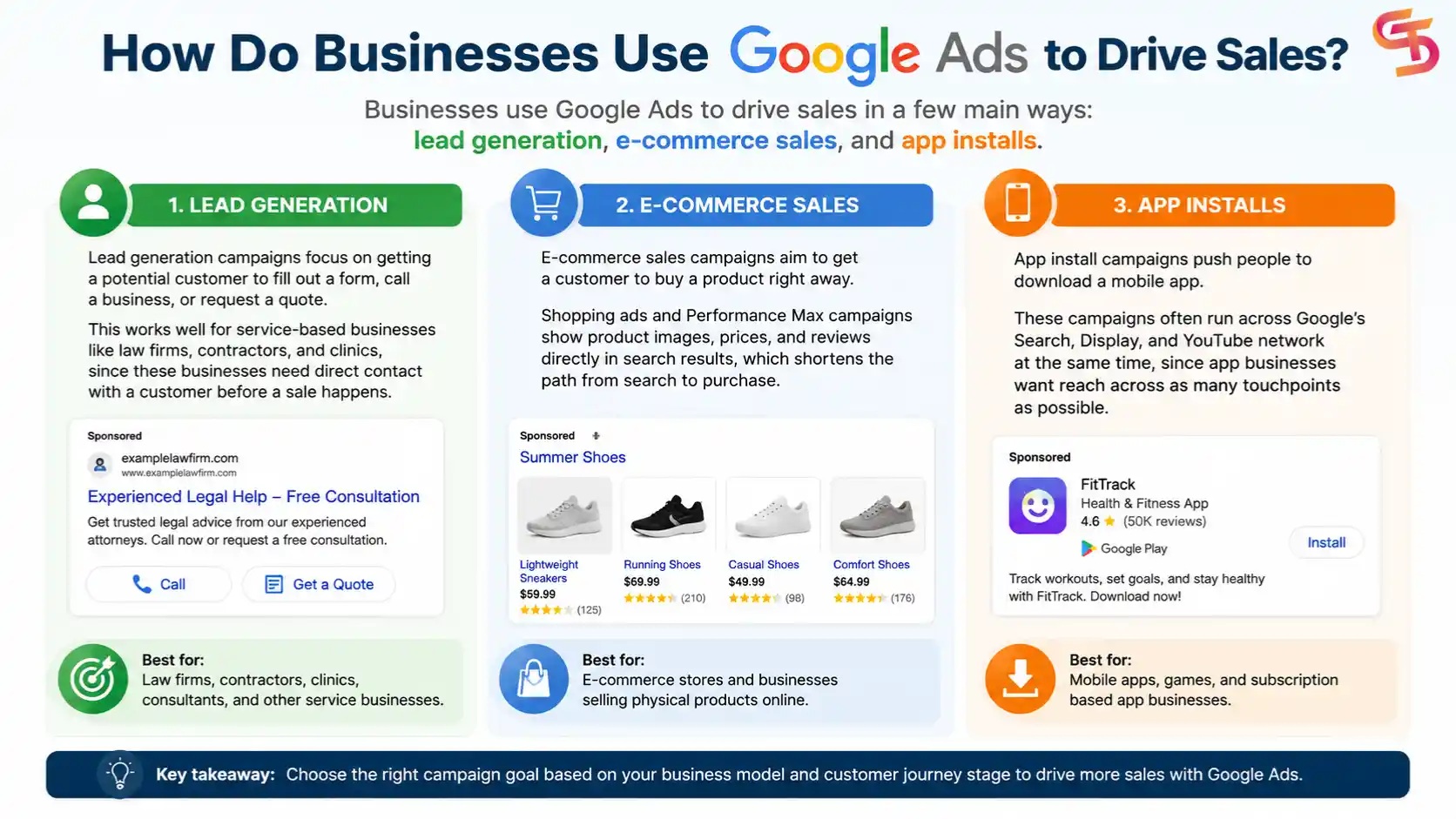
Businesses use Google Ads to drive sales in a few main ways: lead generation, e-commerce sales, and app installs. Each approach targets a different point in the customer journey.
Lead generation campaigns focus on getting a potential customer to fill out a form, call a business, or request a quote. This works well for service-based businesses like law firms, contractors, and clinics, since these businesses need direct contact with a customer before a sale happens.
E-commerce sales campaigns aim to get a customer to buy a product right away. Shopping ads and Performance Max campaigns show product images, prices, and reviews directly in search results, which shortens the path from search to purchase.
App install campaigns push people to download a mobile app. These campaigns often run across Google's Search, Display, and YouTube network at the same time, since app businesses want reach across as many touchpoints as possible.
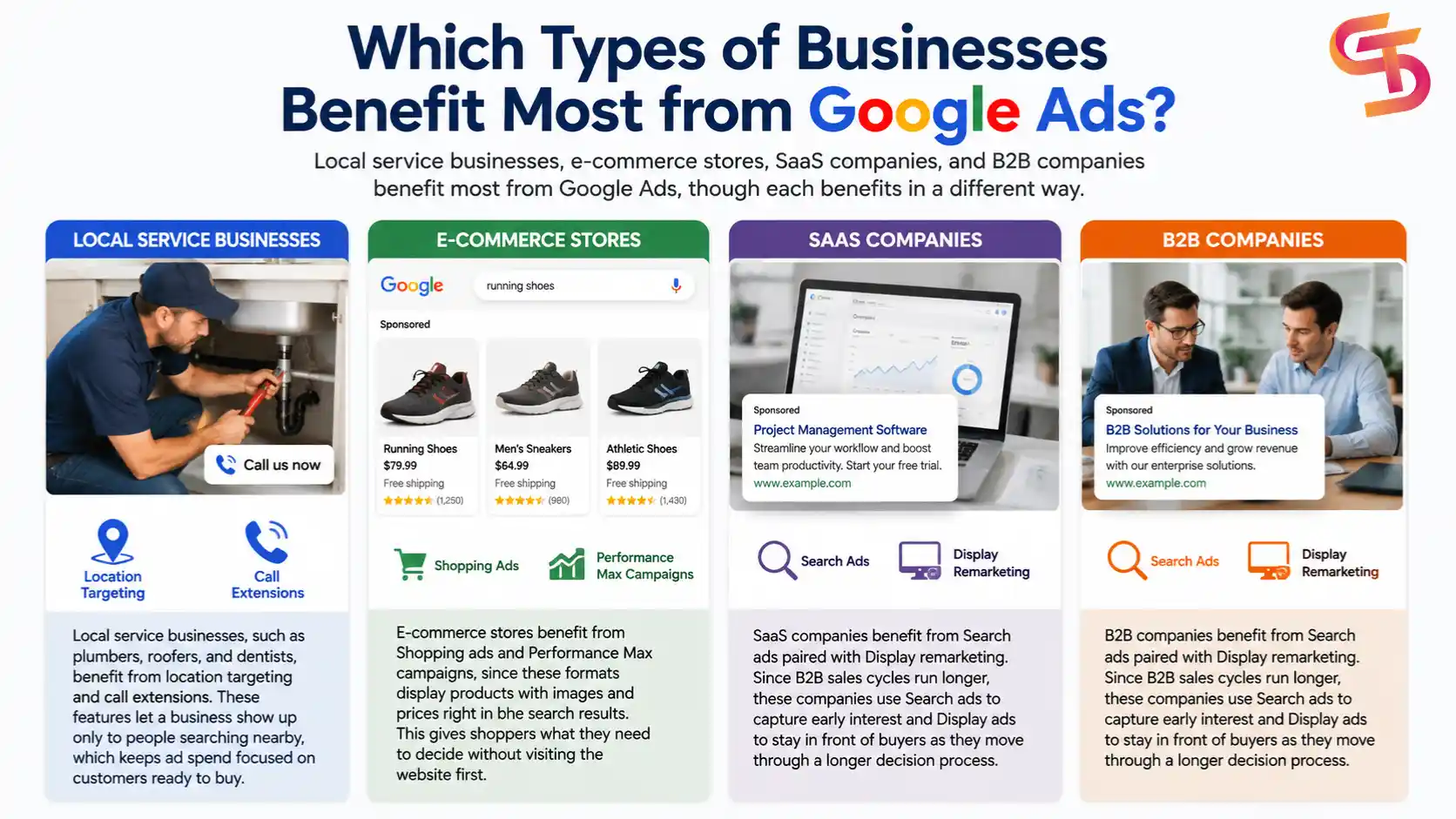
Local service businesses, e-commerce stores, SaaS companies, and B2B companies benefit most from Google Ads, though each benefits in a different way.
Local service businesses, such as plumbers, roofers, and dentists, benefit from location targeting and call extensions. These features let a business show up only to people searching nearby, which keeps ad spend focused on customers ready to buy.
E-commerce stores benefit from Shopping ads and Performance Max campaigns, since these formats display products with images and prices right in the search results. This gives shoppers what they need to decide without visiting the website first.
SaaS and B2B companies benefit from Search ads paired with Display remarketing. Since B2B sales cycles run longer, these companies use Search ads to capture early interest and Display ads to stay in front of buyers as they move through a longer decision process.
Businesses across many industries run Google Ads successfully, each with a use case built around their own customers and sales process. Below are a few examples of how different industries put Google Ads to work.
More industries continue to find success with Google Ads as campaign types and targeting options improve. Businesses in new sectors can apply the same principles: match the campaign type to the sales process, and match the targeting to the customer.
Bidding strategy, ad copy testing, and landing page optimization are the three factors that make Google Ads campaigns convert. Businesses that get these three right tend to see lower cost per lead and higher return on ad spend.
Bidding strategy decides how much a business pays and who sees its ads. Ad copy testing decides how compelling the message is once someone sees it. Landing page optimization decides whether that person acts after clicking. Weak performance in any one of these areas can drag down an otherwise solid campaign.
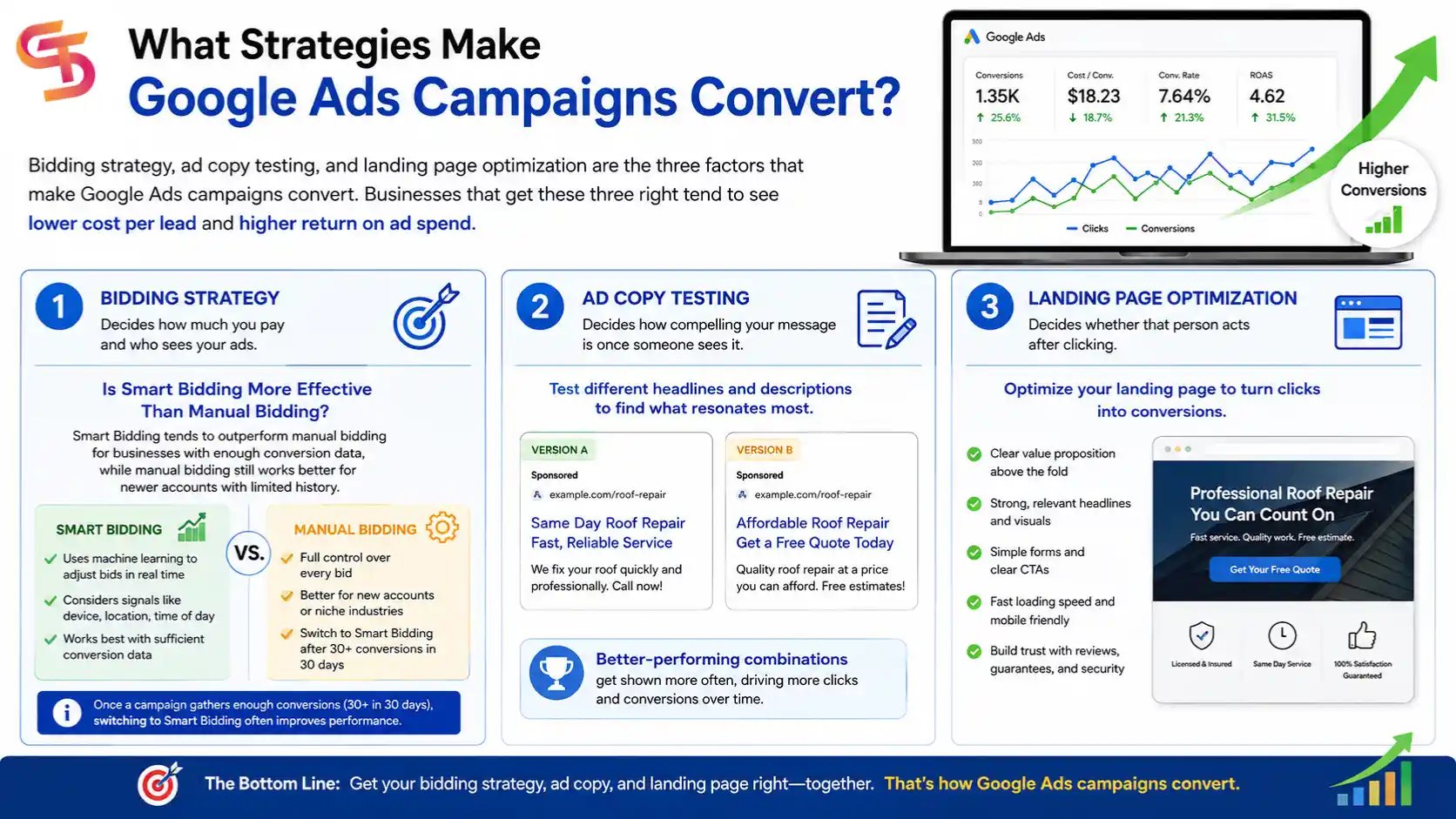
Smart Bidding tends to outperform manual bidding for businesses with enough conversion data, while manual bidding still works better for newer accounts with limited history.
Smart Bidding uses machine learning to adjust bids in real time based on signals like device, location, and time of day. This works well once a campaign has built up conversion history, since Google's system needs data to make accurate predictions.
Manual bidding gives a business full control over every bid. New accounts or accounts in niche industries often start here, since there isn't enough data yet for Smart Bidding to perform reliably. Once a campaign gathers enough conversions, usually 30 or more within a 30-day window, a business can shift to Smart Bidding and often see a lift in performance.
Responsive Search Ads improve conversion rates by testing multiple headline and description combinations, then showing the combination that performs best for each search.
A Responsive Search Ad lets a business enter up to 15 headlines and 4 descriptions. Google's system mixes and matches these components and learns which combinations drive the most clicks and conversions for a given search query.
This matters because different searchers respond to different messages. Someone searching for "same day roof repair" might respond better to a headline about speed, while someone searching for "roof repair cost" might respond better to a headline about pricing. Responsive Search Ads let a business cover both without running separate campaigns.
Search campaigns work best for lead generation, Shopping campaigns work best for e-commerce sales, Performance Max works best for businesses that want reach across multiple channels, and Display works best for brand awareness.
Search campaigns show text ads when someone types a query into Google. This campaign type fits businesses that want to catch people actively looking for a service, which makes it a strong fit for local service businesses and B2B companies.
Shopping campaigns show product listings with images, prices, and store names. This campaign type fits online retailers, since it puts the product in front of a shopper without requiring extra clicks to compare options.
Performance Max campaigns run across Search, Display, YouTube, Gmail, and Discover from a single campaign. This campaign type fits businesses that want maximum reach and are comfortable letting Google's automation handle placement decisions.
Display campaigns show visual ads across websites in Google's ad network. This campaign type fits businesses focused on awareness rather than immediate conversions, such as a new brand trying to build recognition before asking for a sale.
Businesses often don't have to pick just one. Many run Search and Shopping together, or pair Search with Display remarketing, to cover both the immediate buyer and the customer still deciding.
Beyond the common examples above, some businesses run Google Ads in less typical ways, shaped by unique rules, audiences, or channel combinations. These use cases show how flexible the platform can be outside standard e-commerce and lead generation setups.
Non-profits use Google Ads through the Google Ad Grants program, which gives eligible organizations up to $10,000 per month in free search advertising.
This program lets non-profits run Search campaigns without paying for clicks, as long as they follow rules around bidding, click-through rate, and keyword quality. Organizations use this budget to drive donations, recruit volunteers, and promote awareness campaigns, without the cost pressure a typical business faces.
Legal and healthcare businesses run compliant Google Ads by following strict rules around claims, certifications, and sensitive personal information.
Google requires healthcare advertisers to get certified before running ads for certain treatments, and it restricts remarketing based on sensitive health data. Legal advertisers face their own limits, particularly around practice areas like bankruptcy or personal injury, which sometimes require certification depending on the country. Businesses in these industries need to review Google's advertising policies before launching a campaign, since violations can lead to ad disapproval or account suspension.
Google Ads works better for businesses targeting people already searching for a solution, while Facebook Ads works better for businesses trying to create demand among people who aren't searching yet.
A plumbing company benefits more from Google Ads, since customers usually search for a plumber only when they already have a problem. A new skincare brand often benefits more from Facebook Ads, since most people aren't searching for a brand they've never heard of. Many businesses use both platforms together, letting Google Ads capture search intent and Facebook Ads build awareness earlier in the funnel.
Performance Max runs ads across Search, Display, YouTube, Gmail, Discover, and Maps from one campaign.
Instead of managing separate campaigns for each channel, a business feeds Performance Max a set of assets, such as images, videos, headlines, and descriptions. Google's system decides where and when to show these assets to reach the best-performing audience across all its properties. This use case fits businesses that want broad reach without managing multiple campaign types individually.
Google Ads works differently for every business, but the businesses that succeed share the same approach. They pick a campaign type that matches their sales process, test their ad copy and bidding strategy over time, and send traffic to a landing page built to convert. Whether you run a local roofing company, an IaaS platform, a weight loss surgery clinic, or a clothing brand, the same principles apply. Start with a clear goal, choose the right campaign type for that goal, and refine your strategy as your data grows.
Yes, Google Ads works well for small businesses, especially local service businesses that use Search ads with location targeting. Since a business only pays when someone clicks, small budgets can still generate leads if the campaign is set up correctly.
Budget depends on the industry and the competitiveness of the keywords involved. A local service business might start with a few hundred dollars a month, while a competitive e-commerce niche might need a larger budget for consistent results.
A business can send traffic to a homepage, but a dedicated landing page almost always converts better. A landing page built around one offer removes distractions and gives visitors one obvious next step to take.
Search campaigns can generate clicks and leads within days, but it usually takes a few weeks of data before Smart Bidding and ad copy testing start improving performance. Businesses should plan for at least a full month before judging a campaign's true performance.
Not always, but many businesses work with an agency once campaigns grow complex or budgets increase, since ongoing bid management, ad testing, and account structure take consistent time and attention to get right.
Google Ads works for clothing brands because it puts products in front of people who already search for them. A shopper types “women’s linen dress”…
Google Ads gives weight loss surgery clinics a direct way to reach patients who already search for bariatric procedures, consultation costs, and nearby surgeons. A…
Google Ads works for IaaS companies when the campaign structure matches the technical buying process, not a generic B2B funnel. IaaS buyers research longer, compare…
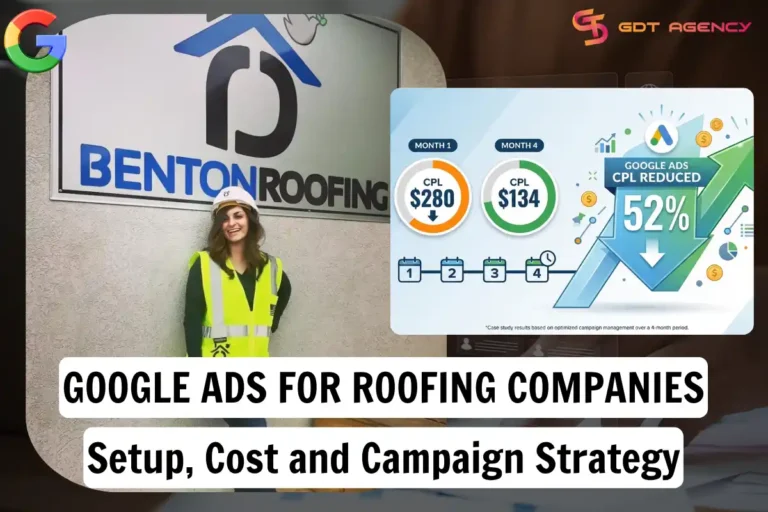
Google Ads works well for roofing companies because it puts your business in front of homeowners at the exact moment they search for a roofer.…