
How to Buy a Verified Google Ads Account Safely: Top Providers Compared
You can buy verified Google Ads account safely by checking the seller’s business history, confirming payment terms in writing, and testing the account with a…
You can buy a Google Ads agency account safely from established agencies with a verified track record, from vetted marketplaces that screen sellers, or through referrals from other advertisers who've already used the seller. Each source carries a different level of risk, so the safest option always comes down to how much you can verify before you pay.
A trustworthy seller shows clear signs before you commit any money. They provide account history, answer questions directly, and don't pressure you into a rushed decision. Spotting these signs early protects you from the sellers who disappear after payment clears.
This matters more than most buyers expect, since a Google Ads agency account carries real financial risk the moment money changes hands. Unlike buying a physical product, you can't inspect an account fully until you already have some level of access, which makes the seller's reputation the main thing standing between you and a bad purchase.
Once you find a seller you trust, the purchase itself still needs a safe process. This means verifying the account's history, confirming ownership terms in writing, and using a payment method that protects both sides if something goes wrong.
Beyond the purchase itself, legal protection matters just as much. A written agreement, a clear refund policy, and defined post-sale support all determine what happens if the account runs into trouble after you own it. The sections below walk through where to buy, how to verify an account, what steps keep the purchase safe, and what protections you should have in place before you sign anything.
You can safely buy a Google Ads agency account from three main sources: established digital marketing agencies, vetted account marketplaces, and trusted referrals from other advertisers. Each source offers a different balance of safety, cost, and speed.
Understanding what makes a seller trustworthy comes first, since the source matters less than the specific seller's reputation within it.
A trustworthy seller shows transparent pricing, provides real account history, and has a documented track record of past sales without major complaints. These three signals separate legitimate sellers from those looking for a quick payout.
Transparent pricing means the seller states the full cost upfront, including any fees for account transfer or ongoing support. Real account history means they show you actual data, not just claims, about the account's age, spending pattern, and verification status. A documented track record means other buyers can confirm the seller delivered what they promised, whether through reviews, case studies, or direct references.
Buying from an established agency gives you more protection through business accountability, while buying from a private individual seller often costs less but carries higher risk. The choice depends on how much you value safety versus price.
An agency operates as a registered business with a reputation to protect, which means they have more incentive to deliver a working account and stand behind the sale. A private individual seller may offer a lower price, since they don't carry the overhead of running a business, but they also have less to lose if the deal falls through. For businesses that plan to run the account long-term, working with an agency usually justifies the higher cost, since the added accountability reduces the chance of losing your investment to a bad transaction.
The size of your ad budget also plays a role in this decision. A business planning to spend a large monthly budget through the account has more to lose from a failed transaction, which makes an agency's added accountability worth the extra cost. A smaller advertiser testing a single campaign might reasonably accept more risk in exchange for a lower price, as long as they still verify the basics before paying.
Three providers worth comparing when you're ready to buy or rent a Google Ads agency account are GDT Agency, SpeedX Agency, and Agrowth. Each takes a slightly different approach to pricing, platform coverage, and support, so the right fit depends on your budget and how many platforms you plan to run ads on.
Provider | Platforms Covered | Standout Feature | Best For |
| GDT Agency | Facebook/Meta, Google Ads, TikTok, across 18+ countries | Documented client case studies with real spend data, dedicated account infrastructure by vertical | Advertisers who want multi-platform coverage backed by verifiable client history |
| SpeedX Agency | Google, Facebook, TikTok | Free onboarding training and promo codes on account purchase, active reviews on Trustpilot and Clutch | Advertisers who want an established provider with a visible public review trail |
| Agrowth | Google, Meta, TikTok | Tiered pricing from 3-5% of top-up, free account replacement if Google flags the account | Advertisers who want flexible, spend-based pricing and a built-in replacement policy |
Table breakdown: this table compares three Google Ads agency account providers across the platforms they support, their standout feature, and the type of advertiser each one suits best, so you can match a provider to your specific campaign needs.
Whichever provider you choose, apply the same verification steps covered in the next section: check spend history, confirm compliance status, and get the transfer terms in writing before you pay.
→ Some businesses discover that buying an agency account requires a larger upfront investment than expected. If you are comparing ownership with a rental option, read our Google Ads Account Rental Costs: Pricing and Fees Guide 2026 to understand typical rental fees, management costs, and which pricing model fits different advertising budgets before making a decision.
You verify a Google Ads agency account before buying by requesting account documentation, checking its spending history, and confirming its compliance status directly with the seller. Skipping this step is the most common reason buyers end up with a suspended or unusable account.
Verification starts with knowing exactly what documents or information a legitimate seller should be willing to provide.
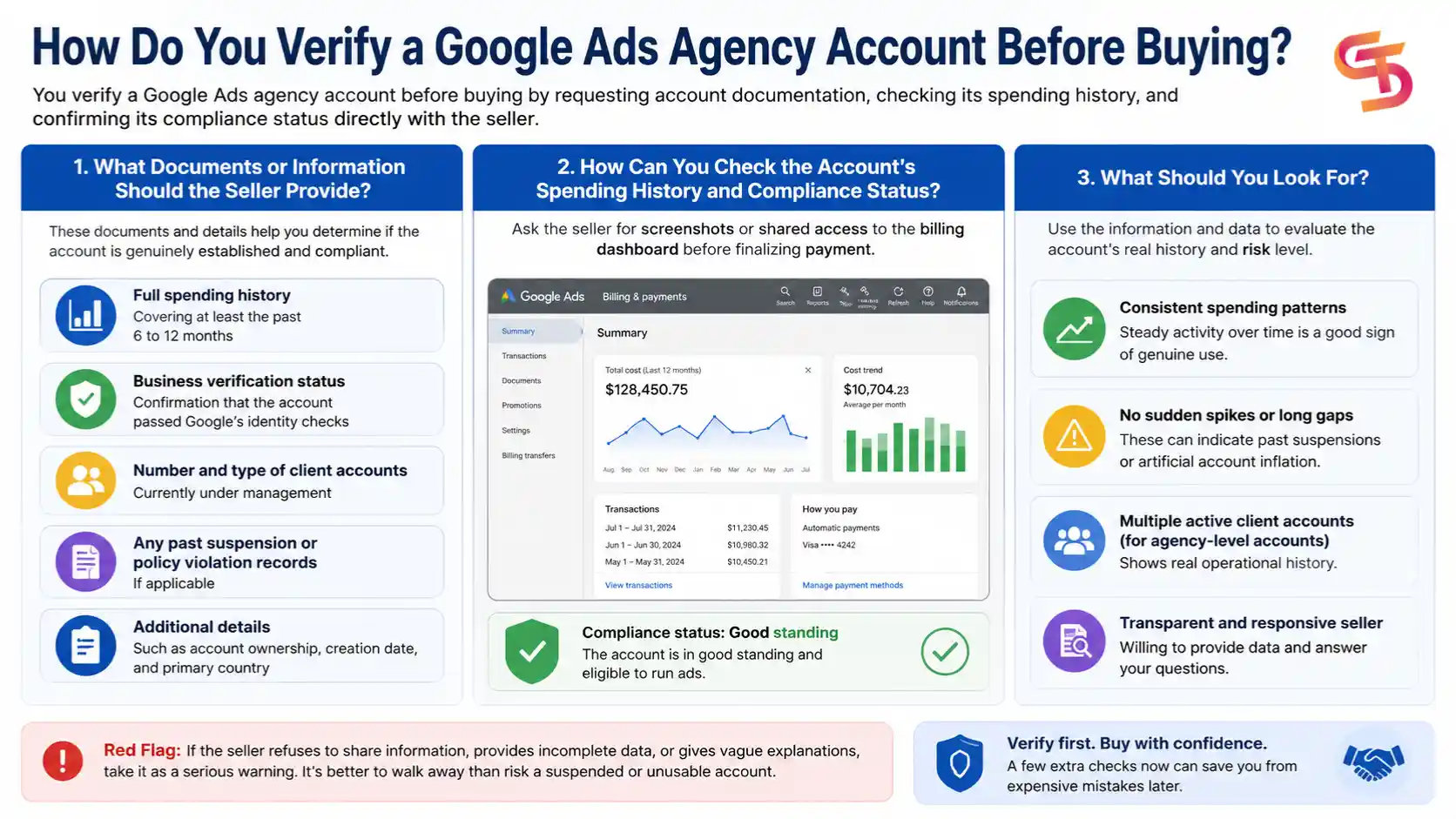
The seller should provide the account's spending history, its business verification status, and details on how many client accounts it currently manages. This information tells you whether the account is genuinely established or newly created to look aged.
Spending history shows how long the account has run active campaigns and how consistently it stayed within Google's policies. Business verification status confirms whether the account passed Google's identity checks, which affects how much scrutiny it faces going forward. Details on managed client accounts matter if you're buying an agency-level account meant to oversee multiple sub-accounts, since an account already managing several clients demonstrates real operational history rather than a manufactured one.
You can check an account's spending history and compliance status by asking the seller for screenshots or shared access to the billing dashboard before finalizing payment. This step confirms the account's claims match what Google's system actually shows.
Screenshots give you a snapshot, but shared access, even temporary and read-only, gives you a clearer picture of real activity over time. Look specifically for consistent spending patterns without sudden spikes or long gaps, since both can signal past suspensions or artificial account inflation. If the seller resists sharing this information or offers vague explanations instead of data, that hesitation itself is a signal worth taking seriously.
A safe purchase process follows three main steps: verifying the account first, confirming the ownership transfer process in writing, and using a secure payment method like an escrow service. Skipping any one of these steps increases your exposure to fraud.
Once verification confirms the account looks legitimate, the next step is understanding exactly how ownership changes hands.
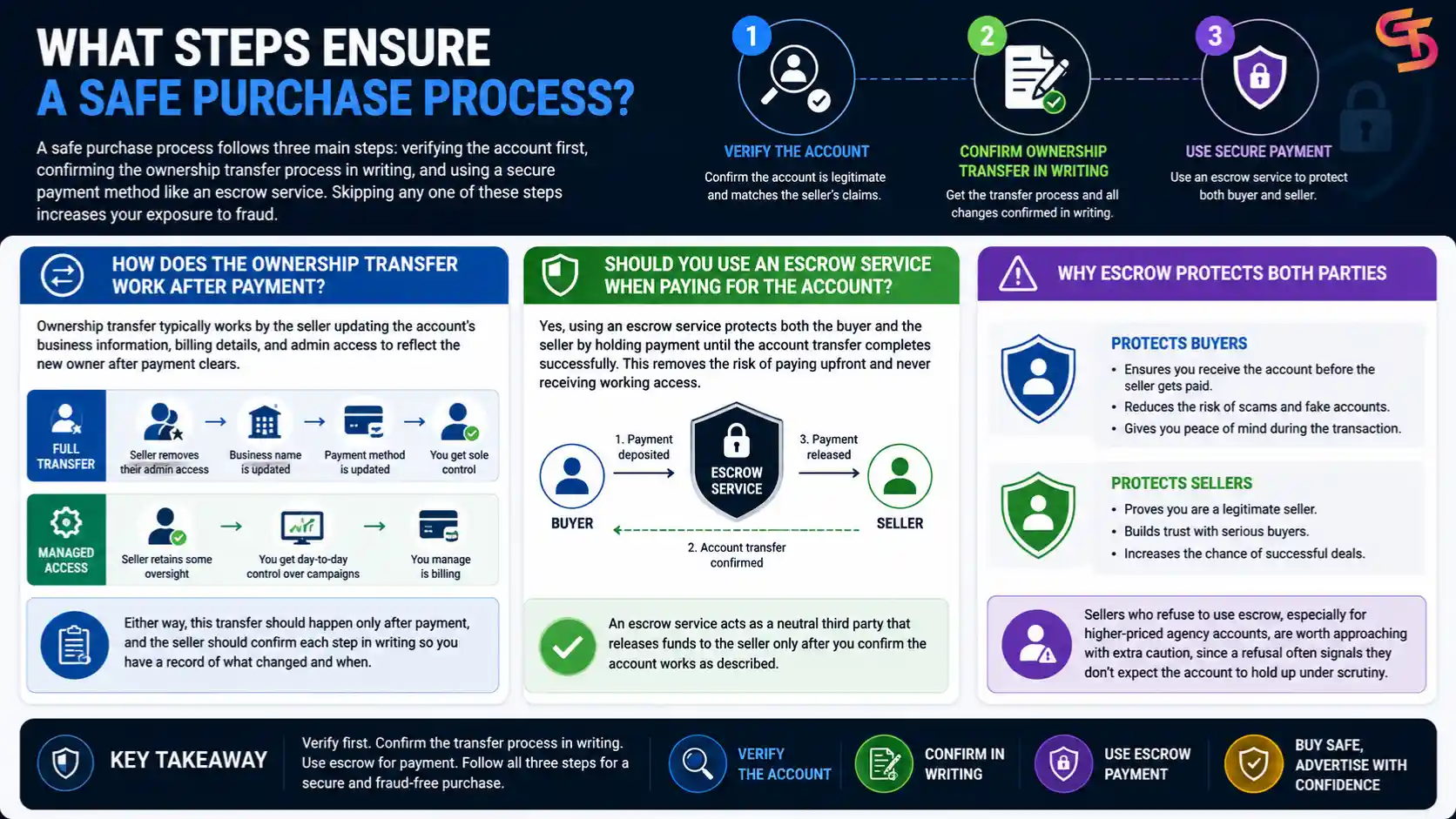
Ownership transfer typically works by the seller updating the account's business information, billing details, and admin access to reflect the new owner after payment clears. The exact process varies depending on whether you're buying full ownership or gaining managed access.
For a full transfer, the seller removes their own admin access and grants you sole control, along with updating the business name and payment method tied to the account. For managed access arrangements, the seller may retain some level of oversight while granting you day-to-day control over campaigns and billing. Either way, this transfer should happen only after payment, and the seller should confirm each step in writing so you have a record of what changed and when.
→ Ownership transfer typically works by the seller updating the account's business information, billing details, and admin access to reflect the new owner after payment clears. If you're unfamiliar with how permissions, billing profiles, and account administration work, read our Google Ads Account Explained: Setup, Access & Management guide before completing the transfer.
Yes, using an escrow service protects both the buyer and the seller by holding payment until the account transfer completes successfully. This removes the risk of paying upfront and never receiving working access.
An escrow service acts as a neutral third party that releases funds to the seller only after you confirm the account works as described. This setup benefits legitimate sellers too, since it proves to buyers that they aren't trying to disappear with the payment. Sellers who refuse to use escrow, especially for higher-priced agency accounts, are worth approaching with extra caution, since a refusal often signals they don't expect the account to hold up under scrutiny.
Yes, buying a Google Ads agency account is safe if you verify the seller, confirm the account's history, and use a secure payment method throughout the transaction. The risk comes not from the act of buying itself, but from skipping the verification steps that separate safe purchases from scams.
Knowing the specific warning signs of an unsafe seller rounds out the picture, since even careful buyers can miss red flags if they don't know what to look for.
The clearest warning signs include prices far below market rate, refusal to share account history, and pressure to pay immediately without time to verify anything. These signs often appear together, since scam sellers rely on urgency to prevent buyers from checking their claims.
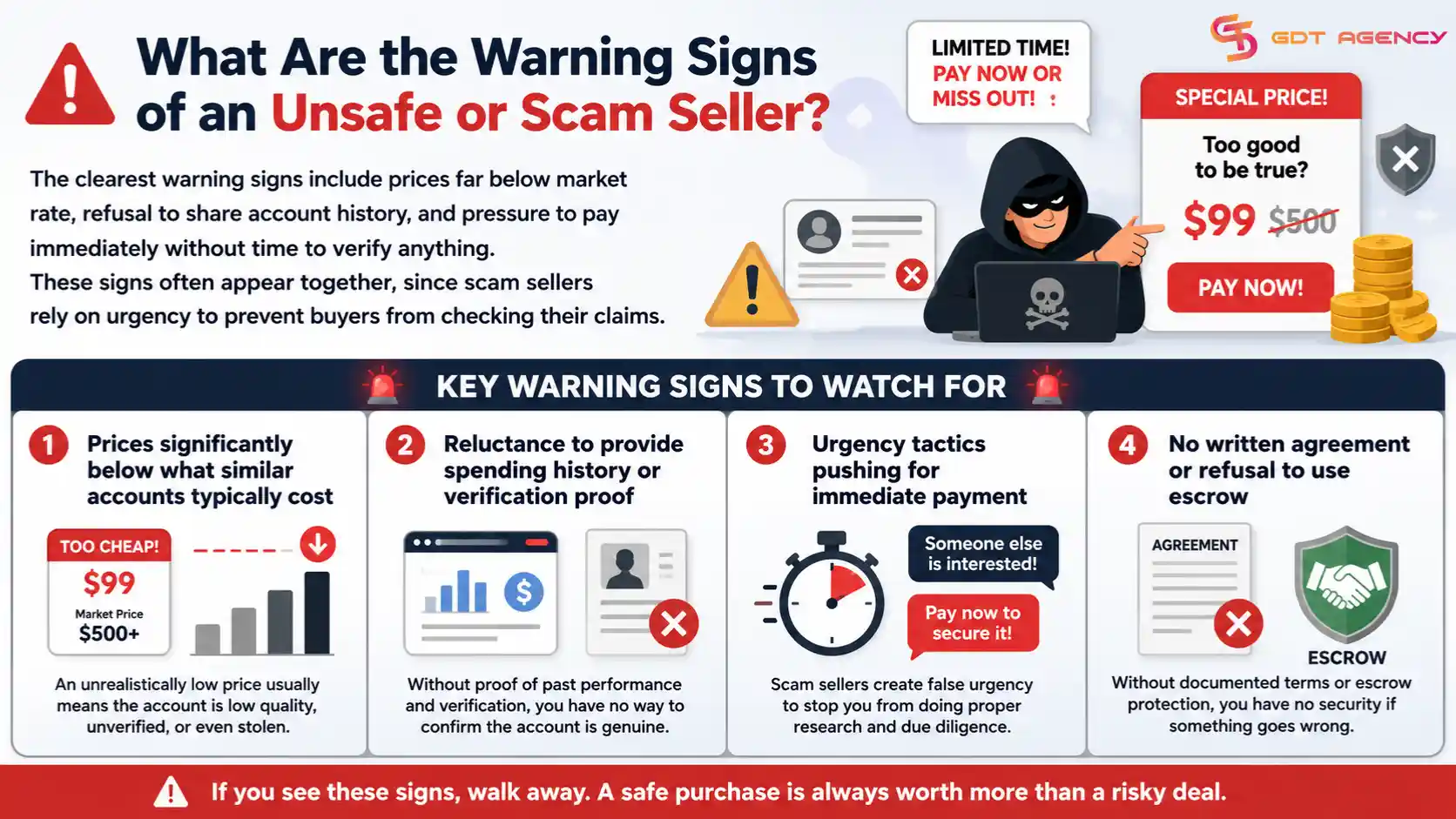
A price that seems too good to be true usually is, since a genuinely aged, well-verified account takes time and effort to build, and sellers know its real value. Refusal to share account history, whether through vague excuses or outright avoidance, means you have no way to confirm the account is what they claim. Pressure to pay immediately, often paired with claims that "someone else is interested," is a classic tactic to short-circuit due diligence before a buyer notices something's wrong.
You have legal protection through a written purchase agreement, a clear refund policy, and defined post-sale support terms agreed upon before payment. These protections matter because Google's own policies don't formally recognize third-party account transfers, which means your only real recourse comes from the agreement you make with the seller.
Knowing what belongs in that agreement helps you avoid disputes if something goes wrong after the sale.
A purchase agreement should include the account's price, transfer timeline, ownership terms, and what happens if the account gets suspended shortly after the sale. Without these terms in writing, you have little to fall back on if a dispute arises.
The agreement should state the exact date ownership transfers and what specifically transfers, whether that's full account control or managed access. It should also spell out the seller's responsibilities if the account fails to work as described, including any refund or replacement terms. A contract that leaves these details vague, or skips them entirely, offers you no real protection even if the seller seemed trustworthy at first.
The seller should offer support for account setup questions, guidance on maintaining compliance, and a clear point of contact if issues come up shortly after the transfer. Support after the sale separates sellers who stand behind their product from those who treat the transaction as a one-time payout.
Good sellers stay reachable for at least a set period after the sale, since new owners often have questions about account settings or Google's policies that weren't obvious before the purchase. This ongoing availability also gives you someone to contact quickly if Google flags the account for review shortly after you take over, rather than leaving you to handle an unfamiliar account entirely on your own.
Whether you get a refund if the account gets suspended shortly after purchase depends entirely on what the purchase agreement states, since Google itself won't reverse a suspension based on a private sale dispute. This is exactly why the contract terms matter more than any verbal promise from the seller.
Some sellers offer a replacement account or partial refund if a suspension happens within a short window after the sale, treating it as evidence the account had a hidden issue. Others offer no protection at all once the transfer completes, which shifts the entire risk to the buyer. Confirming this policy before payment, rather than assuming good faith, protects you from losing your investment to a problem you had no way to predict.
You set up Business Manager access after buying the account by having the seller add you as an admin, then removing their own access once you confirm control works correctly. This step finalizes your ownership and locks out the previous owner from making further changes.
Start by asking the seller to grant admin-level access rather than a lower permission tier, since limited access can prevent you from managing billing or adding your own team members later. Once you confirm you can access campaigns, billing, and account settings without issues, ask the seller to remove their own access entirely. Waiting to complete this last step until you've verified everything works protects you from a scenario where the seller regains control after claiming the sale is final.
Buying a Google Ads agency account safely comes down to three things: choosing a trustworthy seller, verifying the account thoroughly, and protecting the transaction with a written agreement and secure payment method. Skipping any of these steps opens the door to the exact risks that make advertisers hesitant to buy in the first place.
Take the time to check spending history, confirm compliance status, and insist on escrow for larger purchases. A seller who welcomes this scrutiny is worth your business. A seller who resists it is telling you something important before you've even paid.
Prices vary based on the account's age, spending history, and verification status, with well-established accounts costing more than newer ones. Buyers should compare several sellers to get a sense of fair market pricing before committing.
No, Google requires business verification for agency accounts, so the account will need to reflect your business information after the transfer. Any seller claiming you can stay fully anonymous is likely overstating what's actually possible under Google's policies.
If Google flags the account after purchase, the outcome depends on your purchase agreement and whether the seller offers support or a refund for issues arising shortly after the sale. This is why confirming these terms before payment matters so much.
An aged account with a clean history usually faces less scrutiny from Google and supports higher spending limits sooner, though it costs more upfront. A newer account costs less but may face stricter review during its first few campaigns.
Some agencies offer payment plans or rental arrangements instead of requiring a full upfront payment, which can lower the initial cost. This option suits buyers who want to test the account before committing to a full purchase.
You can buy verified Google Ads account safely by checking the seller’s business history, confirming payment terms in writing, and testing the account with a…