How to Choose a Google Ads Account Rental Provider

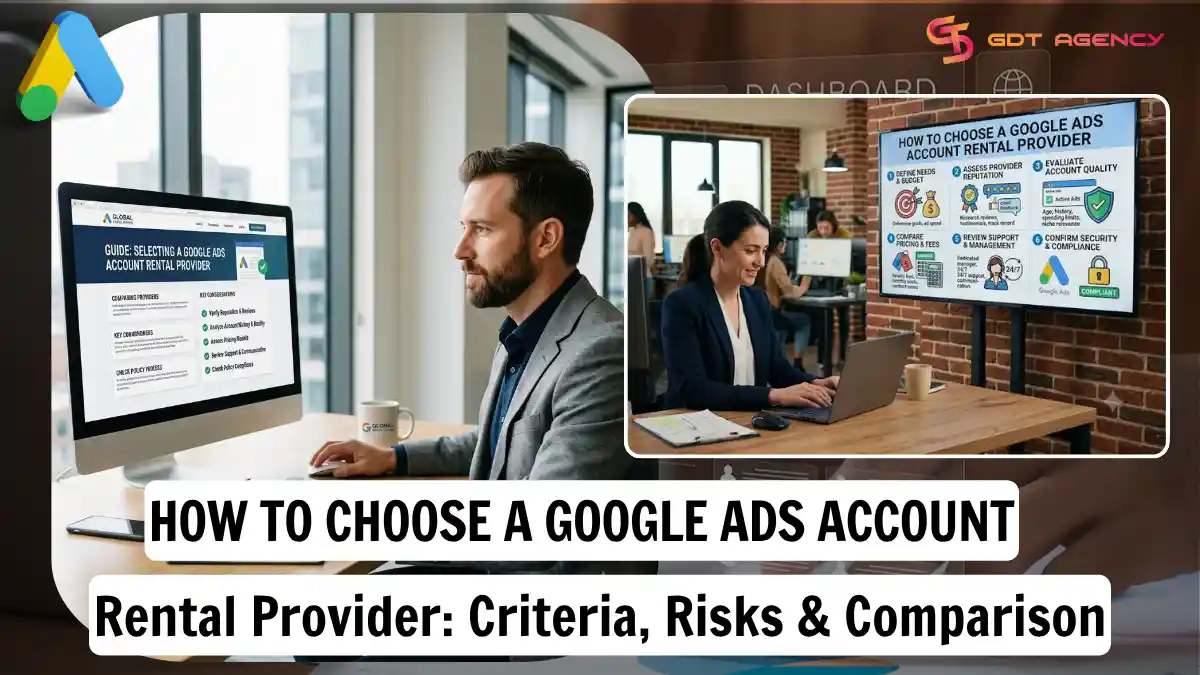
Choosing a Google Ads account rental provider comes down to following a clear sequence: define your use case, shortlist candidates, verify trust score and spending history, confirm pricing and payment flexibility, review the contract, and test with a small campaign before committing long-term. Specifically, most advertisers who skip one of these steps end up with an unstable account, an unclear fee structure, or no recourse when something goes wrong. Beyond the selection process, the right provider is judged against a consistent set of criteria: pricing model, account spending limit, trust score, payment method support, and support responsiveness — each of which determines whether the rented account will actually perform under real campaign pressure.
Renting a Google Ads account also carries risk that many advertisers underestimate. Account suspension, loss of ownership control, hidden fees, and unclear liability for policy violations are the most common failure points, and a provider's willingness to address them upfront is usually the clearest signal of reliability. In parallel, it's worth weighing rental against the alternative of applying for and building your own agency-level account, since the two paths differ sharply in setup time, cost, spending capacity, and long-term control.
To make this decision practical, the sections below walk through the exact steps to follow, the criteria to score each provider against, the risks worth stress-testing before you sign, and a side-by-side comparison between renting and owning an account — so you can match the right approach to your spend level and risk tolerance.
- How to Choose a Google Ads Account Rental Provider?
- What Should You Check Before Signing Up With a Provider?
- How Do You Test a Provider Before Committing Long-Term?
- What Criteria Should You Use to Evaluate a Google Ads Account Rental Provider?
- How Important Is the Provider's Pricing and Fee Structure?
- How Do You Verify an Account's Spending Limit and Trust Score?
- What Payment Methods Should a Reliable Provider Support?
- What Are the Risks of Renting a Google Ads Account?
- Does the Provider Offer Any Guarantee If the Account Gets Banned?
- How Transparent Is the Provider About Account Origin and Ownership?
- How Does Google Ads Account Rental Compare to Applying for Your Own Agency Account?
- What Should Be Included in a Google Ads Account Rental Contract or Agreement?
- Can You Rent a Google Ads Account for Restricted Industries Like Gambling or Forex?
- What Is the Difference Between Renting a Google Ads Account and Using an MCC Sub-account?
- How Do You Transfer Campaigns If You Switch Rental Providers?
- Final Thoughts
- FAQs
- Is it legal to rent a Google Ads account?
- How much does it typically cost to rent a Google Ads account?
- How long does it take to get access to a rented account?
- What happens to my campaign data if the rented account gets suspended?
- Can a rental account be upgraded into an MCC-managed structure later?
How to Choose a Google Ads Account Rental Provider?
Choosing a Google Ads account rental provider involves seven sequential steps: defining your use case, shortlisting providers, verifying account trust score, checking the pricing model, confirming payment support, reviewing the contract, and running a small test campaign.
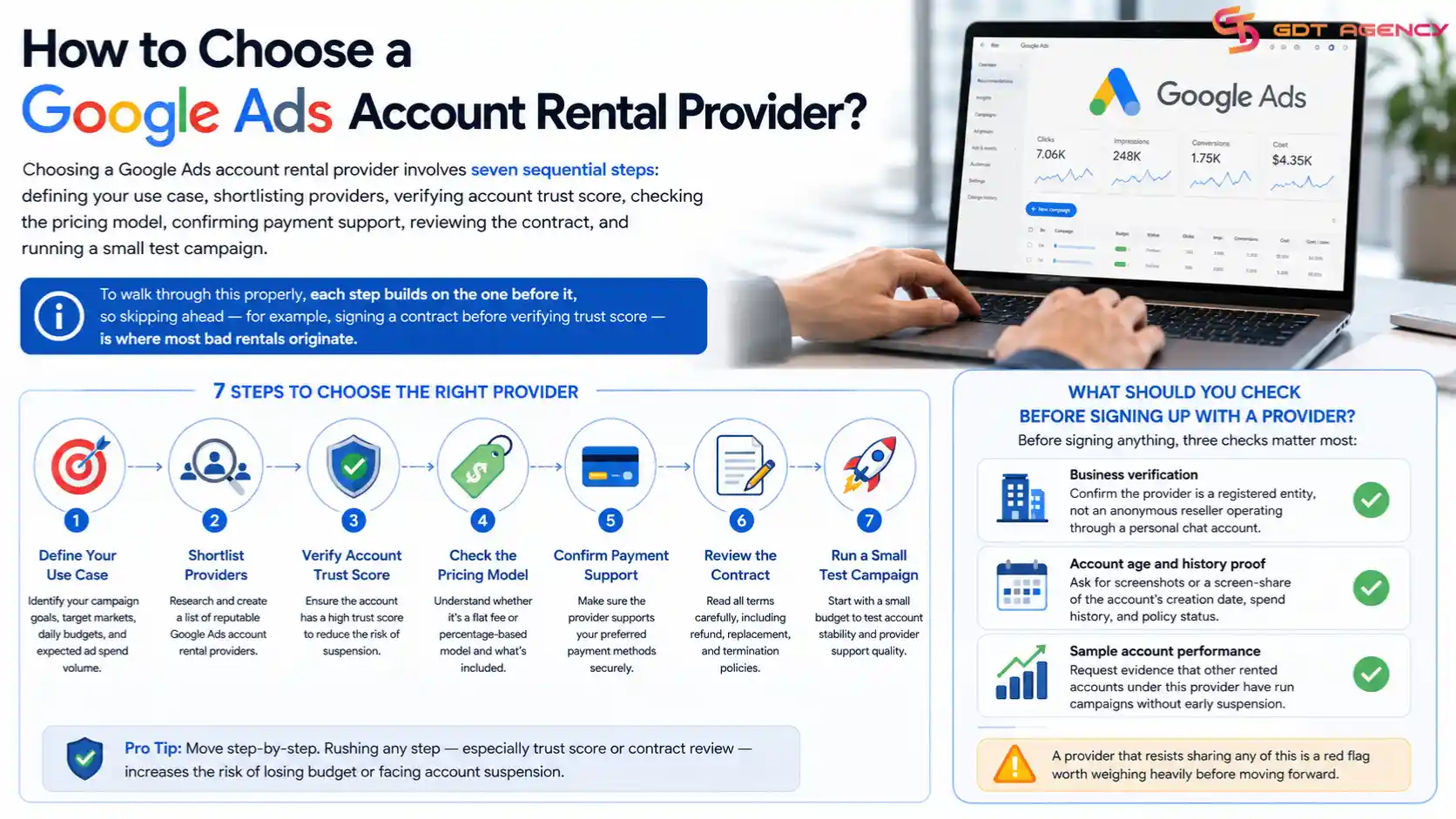
To walk through this properly, each step builds on the one before it, so skipping ahead — for example, signing a contract before verifying trust score — is where most bad rentals originate.
If you're new to Google Ads accounts, start with our Google Ads Account Explained: Setup, Access & Management guide. It explains how Google Ads accounts are structured, how access works, and the key management settings you'll need to understand before renting an agency account.
What Should You Check Before Signing Up With a Provider?
As an expert with years of experience working with multiple ad accounts, from standard to Google Ads agency ad accounts at GDT Agency, I have had chances to work with many advertisers and heard their stories when they worked with other agencies before and how they were being scammed.
Based on my experience, before signing anything, here are three checks that matter most:
- Business verification: confirm the provider is a registered entity, not an anonymous reseller operating through a personal chat account.
- Account age and history proof: ask for screenshots or a screen-share of the account's creation date, spend history, and policy status.
- Sample account performance: request evidence that other rented accounts under this provider have run campaigns without early suspension.
A provider that resists sharing any of this is a red flag worth weighing heavily before moving forward.
How Do You Test a Provider Before Committing Long-Term?
The safest way to validate a provider is to run a small-budget trial campaign (typically one to two weeks at a modest daily spend) before signing a longer agreement. During this window, you can observe how quickly the account approves ads, how the provider responds to policy flags, and whether reporting access matches what was promised. If the trial period surfaces delays, unexplained restrictions, or unresponsive support, that's the moment to walk away, not after a full month's fee has already been paid.
What Criteria Should You Use to Evaluate a Google Ads Account Rental Provider?
The core criteria for evaluating a Google Ads account rental provider are pricing structure, account spending limit, trust score, payment method flexibility, and support responsiveness.
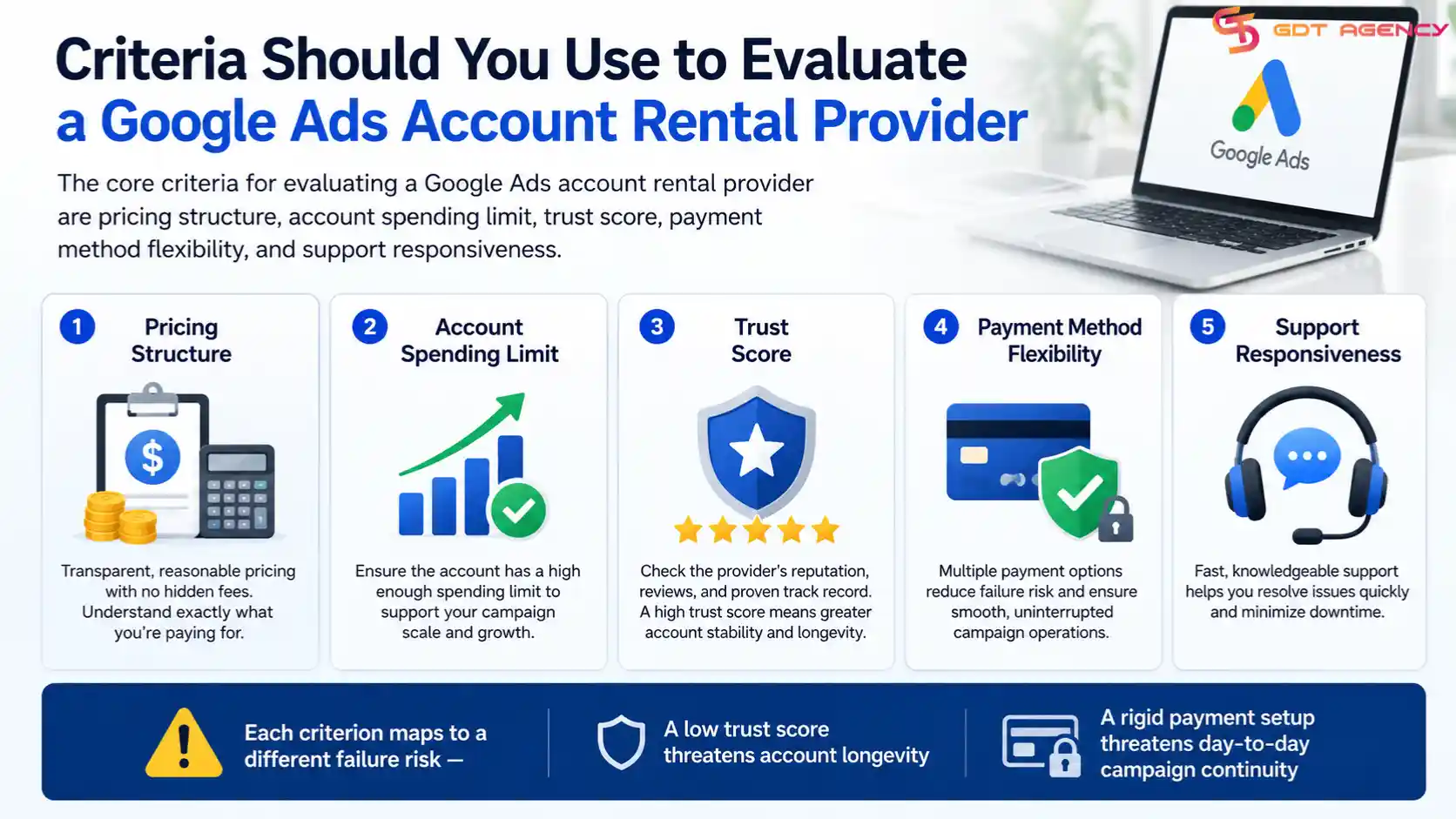
To break this down further, each criterion maps to a different failure risk — a low trust score threatens account longevity, while a rigid payment setup threatens day-to-day campaign continuity.
How Important Is the Provider's Pricing and Fee Structure?
Pricing structure directly affects your effective cost per campaign, so it deserves scrutiny before any other criterion. Providers typically charge one of three ways:
Pricing Model | How It Works | Best For |
| Flat monthly fee | Fixed cost regardless of spend | Predictable, mid-size budgets |
| Percentage of ad spend | Fee scales with monthly spend (commonly 5–15%) | High-spend advertisers seeking volume discounts |
| Deposit-based | Upfront deposit held against account, refundable on exit | Short-term or trial rentals |
The table above compares the three most common pricing structures advertisers encounter, so the choice ultimately depends on whether your spend is stable, seasonal, or still being tested.
Before comparing providers, it's helpful to understand the full cost of renting an account. Read Google Ads Account Rental Costs: Pricing and Fees Guide 2026 to learn about common pricing models, setup fees, hidden charges, and what you should expect to pay based on your advertising budget.
How Do You Verify an Account's Spending Limit and Trust Score?
You verify an account's spending limit and trust score by requesting direct proof like account history screenshots, spend caps shown in the billing dashboard, and any record of past policy strikes.
Concretely, a provider should be able to show the account's current daily spending cap and confirm whether it has ever been suspended and reinstated, since a history of reinstatement often signals a fragile trust score even if the account is currently active.
What Payment Methods Should a Reliable Provider Support?
A reliable provider should support at least card payment, wire transfer, and one regional payment option relevant to your market, since limited payment flexibility often becomes an operational bottleneck once campaigns scale. Providers serving advertisers in restricted-vertical or emerging markets frequently also support crypto payment as a workaround for banking limitations — a detail worth confirming if your business falls into that category.
What Are the Risks of Renting a Google Ads Account?
The main risks of renting a Google Ads account are unexpected suspension, lack of ownership control, hidden fees buried in the agreement, and unclear liability when a policy violation occurs.
Naturally, these risks compound each other - an account with a weak trust score is more likely to be suspended, and a vague contract makes it harder to hold the provider accountable when that happens.
Does the Provider Offer Any Guarantee If the Account Gets Banned?
A trustworthy provider offers some form of guarantee (typically a free replacement account or a partial refund) if the rented account is banned through no fault of the renter. However, the terms of that guarantee matter more than its existence: check whether it covers bans tied to Google's own policy tightening, or only bans caused by the provider's account setup, since providers often narrow the guarantee's scope in the fine print.
How Transparent Is the Provider About Account Origin and Ownership?
Transparency about account origin means the provider clearly discloses how the account was created, who legally owns it, and what happens to campaign data if the rental ends.
In contrast to providers who stay vague on these points, a reliable one will put ownership and data-handling terms in writing, because unclear ownership is what leaves renters with no recourse if Google later flags the account for irregular usage patterns.
How Does Google Ads Account Rental Compare to Applying for Your Own Agency Account?
Account rental wins on setup speed, an owned agency account wins on long-term control, and the right choice depends on how quickly you need to launch versus how much stability you need over time. The table below compares the two paths across the factors that matter most when deciding between them.
| Factor | Rented Account | Owned Agency Account |
| Setup time | Days | Weeks to months |
| Upfront cost | Lower (fee or deposit) | Higher (verification, compliance overhead) |
| Spending limit | Often higher, pre-established | Starts low, grows gradually |
| Risk of suspension | Higher (shared account history) | Lower (full control over compliance) |
| Ownership control | Limited, provider-dependent | Full |
As the comparison shows, rental suits advertisers who need to launch quickly or operate in a restricted vertical, while an owned account suits those prioritizing long-term stability and full control over billing, data, and compliance history.
What Should Be Included in a Google Ads Account Rental Contract or Agreement?
A Google Ads account rental agreement should clearly define liability for policy violations, restrictions on account usage, data access terms, and exit conditions if either party wants to end the arrangement.
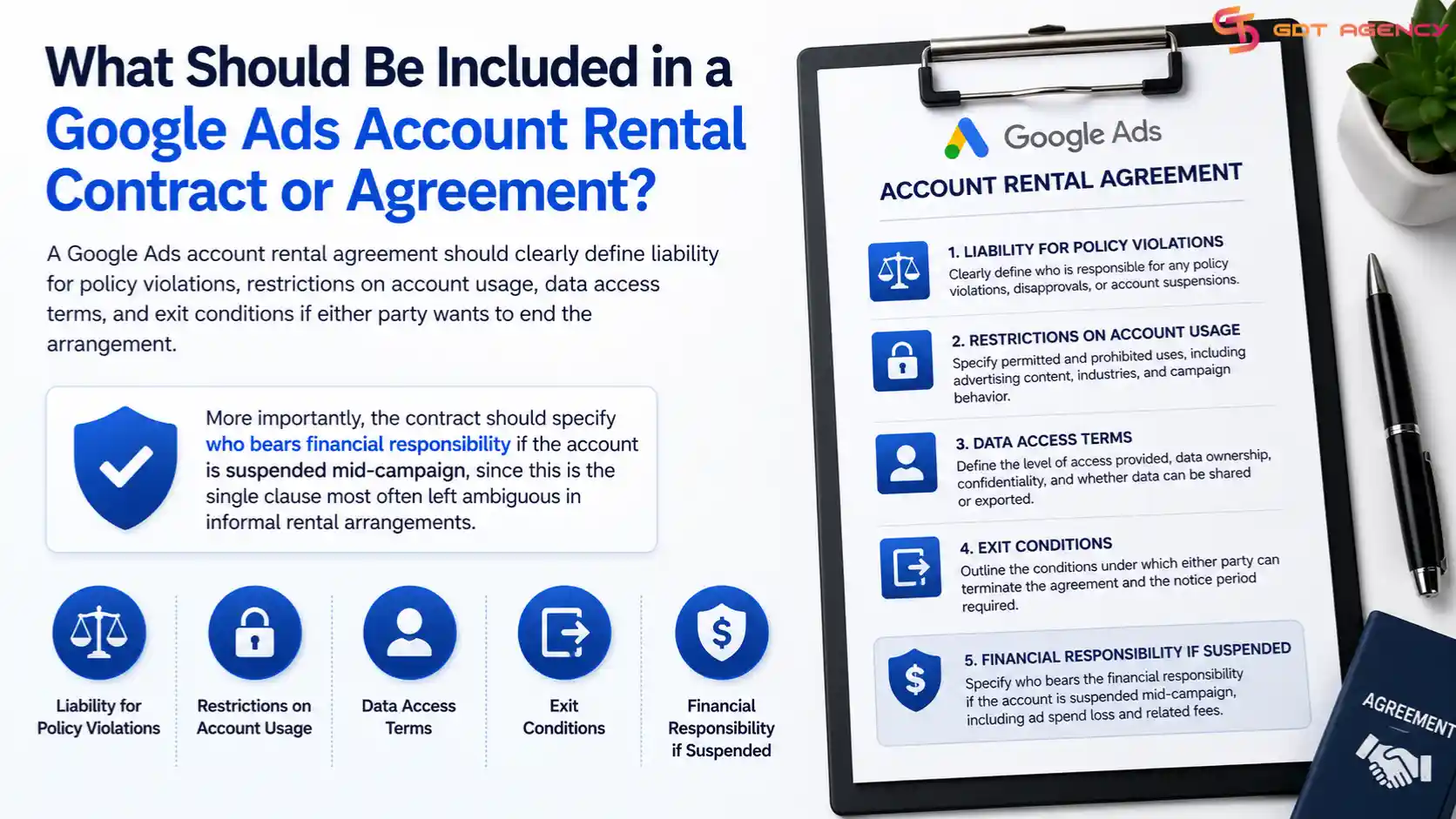
More importantly, the contract should specify who bears financial responsibility if the account is suspended mid-campaign, since this is the single clause most often left ambiguous in informal rental arrangements.
Can You Rent a Google Ads Account for Restricted Industries Like Gambling or Forex?
Yes, some providers specifically serve restricted verticals such as gambling, forex, and dating, though availability is narrower and pricing typically runs higher due to the added compliance risk the provider absorbs. Advertisers in these categories should expect more scrutiny during the verification step described earlier, since providers screening for restricted-vertical clients often require additional documentation before approving access.
What Is the Difference Between Renting a Google Ads Account and Using an MCC Sub-account?
A rented account is a separate, provider-owned account granted to you for a fee, whereas an MCC (My Client Center) sub-account is a native Google structure where an agency manages a client's own account under a linked hierarchy. Unlike rental arrangements, MCC sub-accounts preserve the client's direct ownership and billing relationship with Google, making them the standard structure for agencies managing accounts they don't personally own.
How Do You Transfer Campaigns If You Switch Rental Providers?
Transferring campaigns between rental providers typically means exporting campaign settings, ad copy, and audience data through Google Ads Editor or the API, then rebuilding them inside the new account, since campaign history and Quality Score do not transfer between separate accounts. This is why testing a provider thoroughly before committing, as outlined in the steps above, matters more than it might for a platform where switching costs are lower.
Final Thoughts
Choosing the right Google Ads account rental provider ultimately comes down to discipline in the selection process — following the seven steps, scoring each candidate against pricing, trust score, and payment flexibility, and stress-testing the relationship with a small campaign before signing anything long-term. Just as important, weighing rental against building your own agency account keeps the decision grounded in your actual spend level and risk tolerance, rather than defaulting to whichever option seems fastest. A provider that is transparent about account origin, offers a real guarantee against suspension, and puts liability terms in writing is the one worth building a long-term relationship with — everything else in this guide exists to help you filter down to that provider with confidence.
FAQs
Is it legal to rent a Google Ads account?
Renting an account isn't illegal in most jurisdictions, but it does sit outside Google's intended account-ownership model, which is why some rented accounts face closer policy scrutiny than accounts an advertiser creates and verifies themselves.
How much does it typically cost to rent a Google Ads account?
Costs vary by pricing model — flat monthly fees, a percentage of ad spend (commonly 5–15%), or a refundable deposit — so the right comparison depends on your expected monthly spend rather than the headline price alone.
How long does it take to get access to a rented account?
Access is usually granted within a few days once verification and payment are complete, which is significantly faster than the weeks-to-months timeline of building and verifying an owned agency account.
What happens to my campaign data if the rented account gets suspended?
This depends entirely on the contract terms discussed earlier — a well-drafted agreement should specify whether you retain export access to campaign data and creative assets even after a suspension or account handover.
Can a rental account be upgraded into an MCC-managed structure later?
Not directly — since a rented account is provider-owned, migrating to your own MCC-managed account means rebuilding campaigns from scratch under your own verified account, following the same export-and-rebuild process used when switching providers.
Articles in the category Google Ads Account Rental Provider
No articles found in this category yet.