How to Buy a Verified Google Ads Account Safely: Top Providers Compared

You can buy verified Google Ads account safely by checking the seller’s business history, confirming payment terms in writing, and testing the account with a small campaign before you commit to a full budget. This process protects your money and keeps your campaigns running without sudden interruptions. Beyond the buying process itself, you also need to know who the trustworthy providers are, since not every seller in this market delivers what they promise.
The market for verified accounts includes several types of providers, and each one comes with a different price point and risk level. Some sellers offer prepaid accounts built for small advertisers, while others offer aged agency accounts with higher spending limits for bigger campaigns. Knowing the difference helps you avoid paying for features you don’t need.
A verified Google Ads account itself is not a mysterious product. It is simply an account that has already passed Google’s identity and business checks, which saves you the wait time that comes with setting up a brand-new account. That said, buying one carries real risks, including the chance of a suspension if Google flags unusual account activity after the transfer.
Below, this guide walks through the full buying process, compares the main providers in the market, and explains the risks you should weigh before you spend a single dollar. It also covers whether renting an agency account might serve you better than an outright purchase, so you can pick the option that fits your business.
- How Do You Buy a Verified Google Ads Account Safely?
- What Is a Verified Google Ads Account?
- What Documents Do You Need for Verification?
- What Are the Best Providers to Buy a Verified Google Ads Account?
- What Makes a Provider Trustworthy?
- How Do Prices Compare Across Providers?
- Is It Safe to Buy a Verified Google Ads Account?
- What Are the Risks of Buying a Google Ads Account?
- Can a Bought Google Ads Account Get Banned?
- Should You Buy or Rent a Google Ads Account?
- How Do Agency Ad Account Rentals Differ from Buying?
- Final Thoughts
- FAQs
- Is it legal to buy a Google Ads account?
- How much does a verified Google Ads account cost?
- Can I get my money back if a purchased account gets banned?
- What’s the difference between buying and renting a Google Ads account?
- Do I need an anti-detect browser to use a purchased account?
How Do You Buy a Verified Google Ads Account Safely?
You buy a verified Google Ads account safely by following four steps: vetting the seller, preparing your verification documents, agreeing on a secure payment method, and testing the account before scaling your spend. Skipping any of these steps raises your chance of losing money or losing the account entirely.
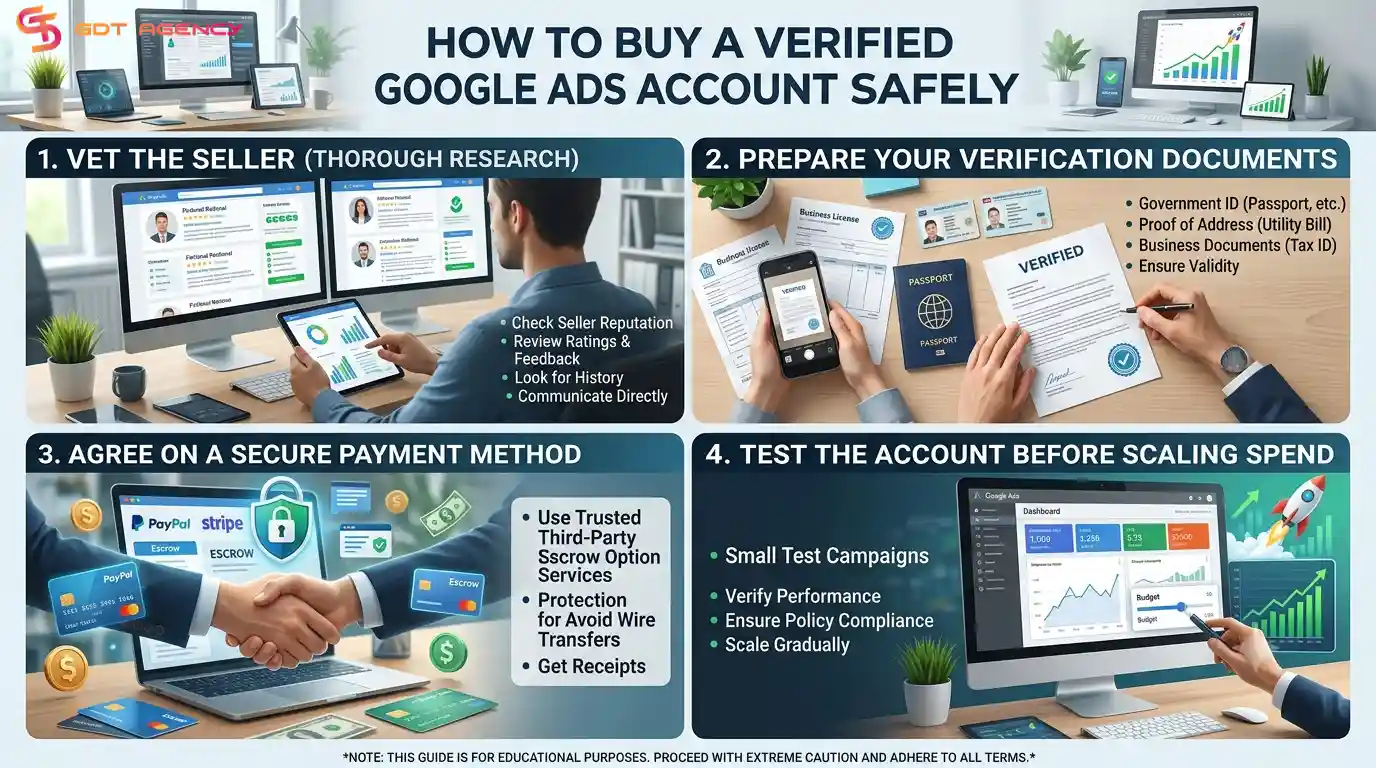
Each step protects a different part of the transaction, and together they form a checklist you can run through with any provider you consider.
What Is a Verified Google Ads Account?
As an expert at GDT Agency with years of experience working with multiple Google Ads accounts, from the standard to Google Ads agency accounts, I will explain that a verified Google Ads account is an advertising account that has already passed Google’s identity and business verification checks, giving the account holder the ability to run ads without the waiting period that new accounts face.
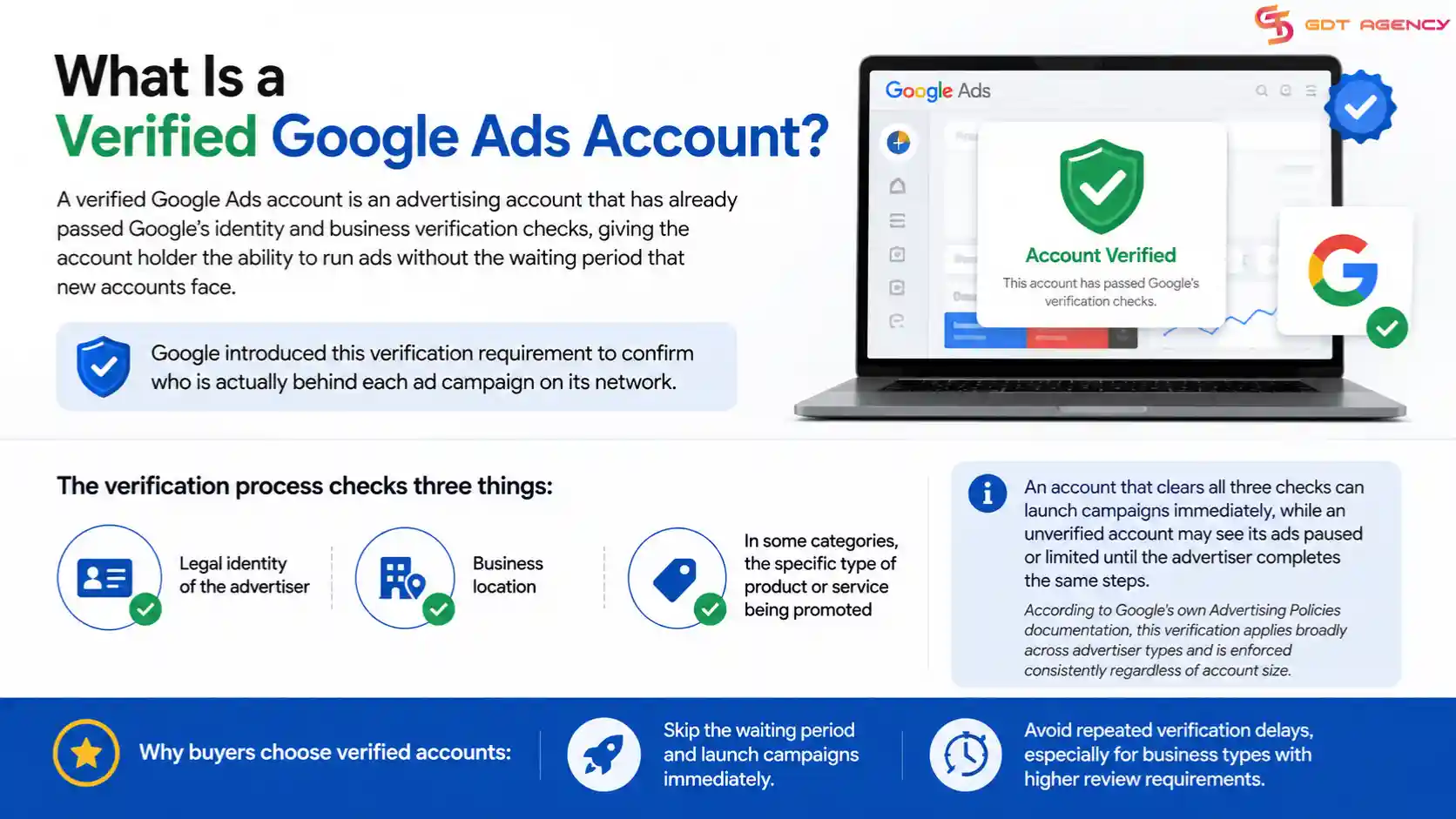
Google introduced this verification requirement to confirm who is actually behind each ad campaign on its network. The verification process itself checks 3 things: the legal identity of the advertiser, the business location, and, in some categories, the specific type of product or service being promoted.
An account that clears all three checks can launch campaigns immediately, while an unverified account may see its ads paused or limited until the advertiser completes the same steps. According to Google’s own Advertising Policies documentation, this verification applies broadly across advertiser types and is enforced consistently regardless of account size.
Buyers pursue verified accounts mainly to skip this waiting period, particularly when they need a campaign live on a tight deadline or when their business type has faced repeated verification delays in the past.
What Documents Do You Need for Verification?
You need a small set of business documents ready before Google or the seller finishes the verification step, and having them prepared in advance speeds up the whole process.
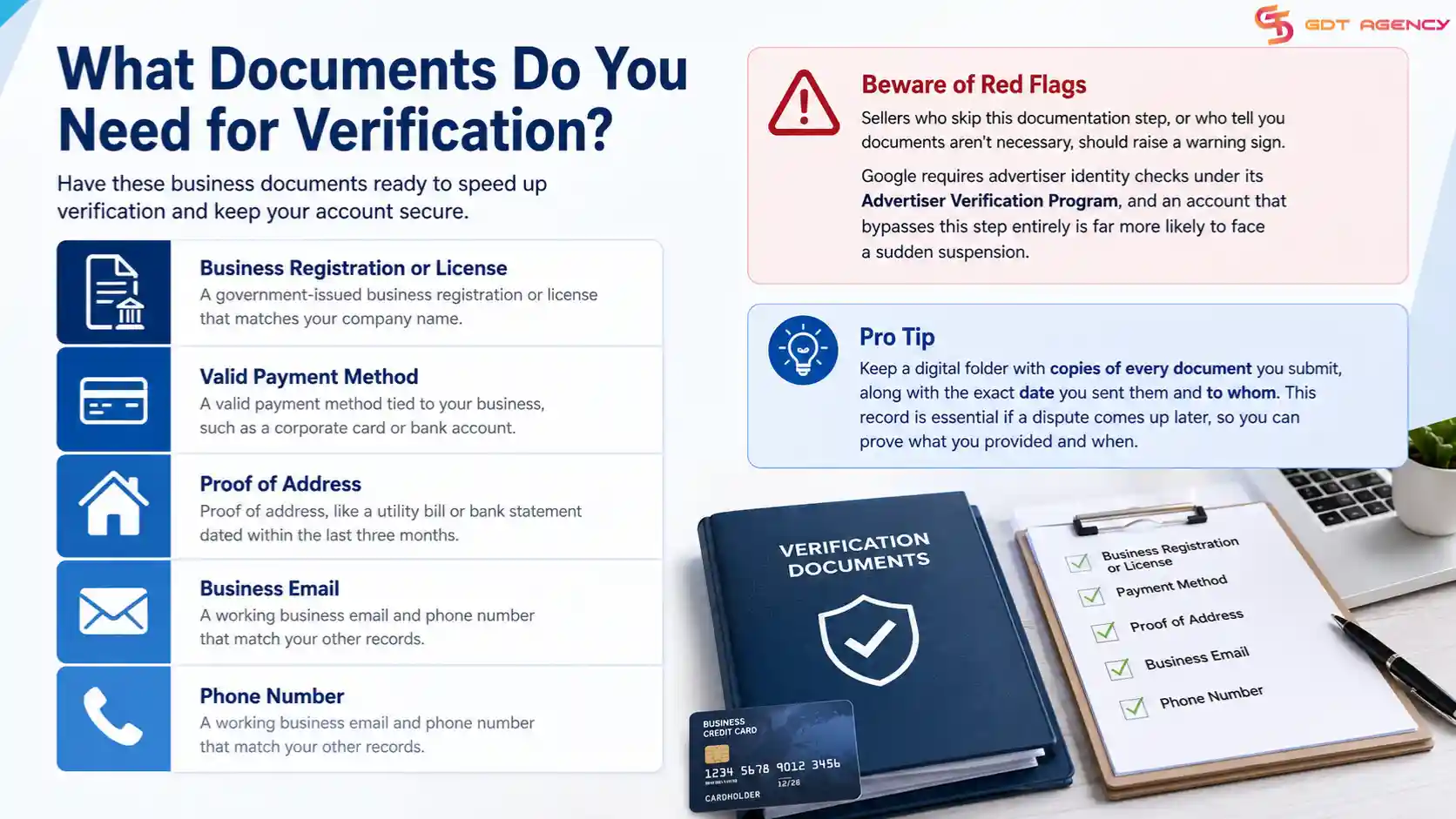
- A government-issued business registration or license that matches your company name
- A valid payment method tied to your business, such as a corporate card or bank account
- Proof of address, like a utility bill or bank statement dated within the last three months
- A working business email and phone number that match your other records
Sellers who skip this documentation step, or who tell you documents aren’t necessary, should raise a warning sign. Google requires advertiser identity checks under its Advertiser Verification Program, and an account that bypasses this step entirely is far more likely to face a sudden suspension.
It also helps to keep a digital folder with copies of every document you submit, along with the exact date you sent them and to whom. This record becomes useful if a dispute comes up later, since you’ll be able to show what information you provided and when. Buyers who skip this small organizational step often struggle to prove their side of the story if the seller becomes unresponsive or the account runs into a review.
What Are the Best Providers to Buy a Verified Google Ads Account?
The best providers to buy a verified Google Ads account fall into 3 groups: established agency-model sellers, marketplace platforms like Fiverr, and independent regional sellers, and each group suits a different type of buyer.
Agency-model sellers work best for advertisers who need ongoing support, while marketplace platforms suit one-off, lower-cost purchases.
Sorting providers this way helps you match your budget and risk tolerance to the right type of seller instead of picking blindly from search results.
What Makes a Provider Trustworthy?
A trustworthy provider shows a consistent track record, transparent pricing, and a clear policy for what happens if your account gets suspended after the sale.
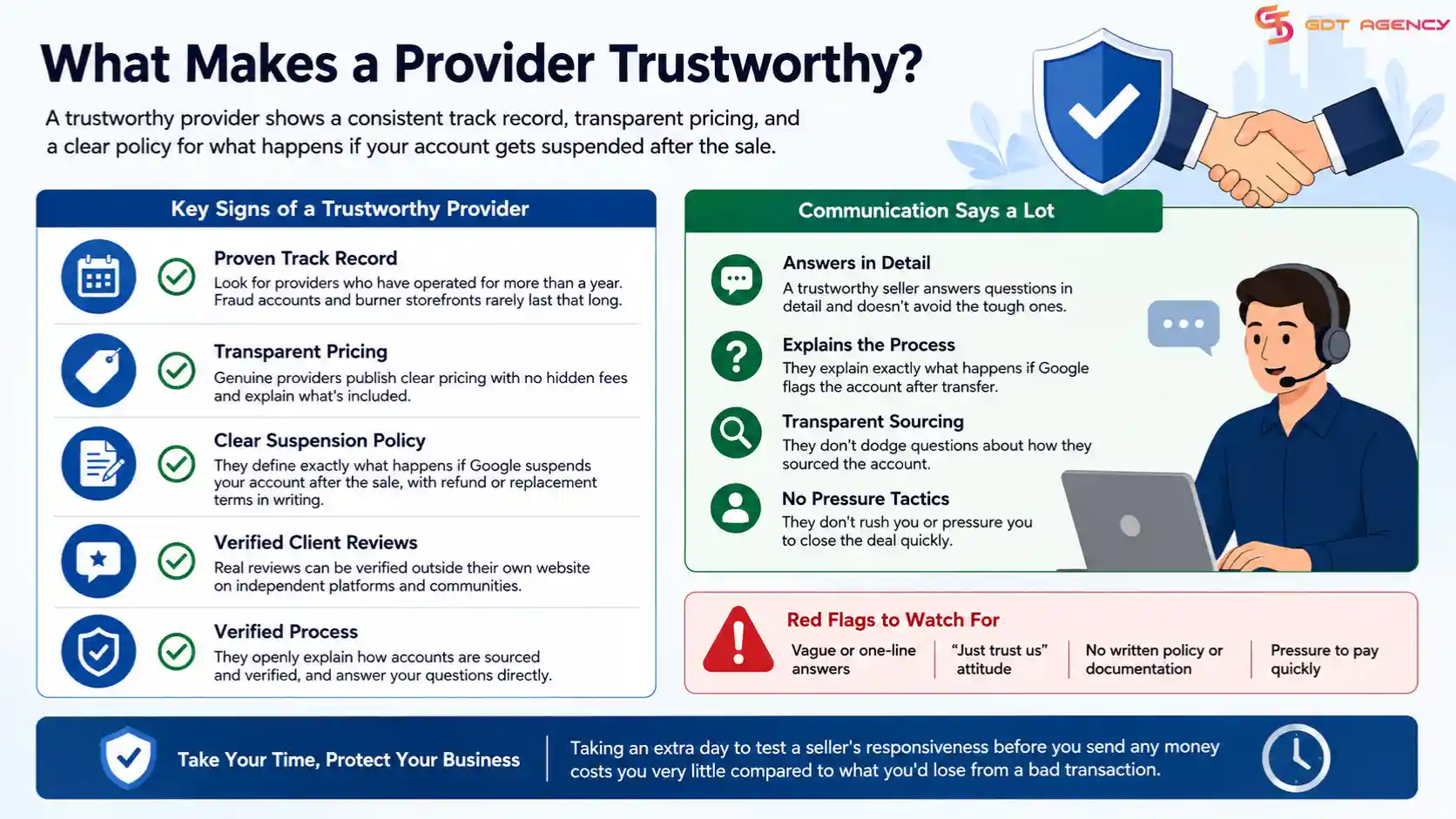
Look for sellers who have operated for more than a year, since fraud accounts and burner storefronts rarely last that long. Genuine sellers also publish real client reviews you can verify outside their own website, answer direct questions about their verification process, and put refund or replacement terms in writing before you pay. A provider who avoids these details, or who pressures you to close the deal quickly, usually isn’t worth the risk.
Communication style also tells you a lot about a provider’s reliability. A trustworthy seller answers questions in detail, explains exactly what happens if Google flags the account after transfer, and doesn’t dodge questions about how they sourced the account in the first place. Sellers who give vague, one-line answers or who redirect every question back to “just trust us” tend to disappear the moment a problem shows up. Taking an extra day to test a seller’s responsiveness before you send any money costs you very little compared to what you’d lose from a bad transaction.
How Do Prices Compare Across Providers?
Prices for verified Google Ads accounts range widely, from around 30 to 100 dollars for basic prepaid accounts on marketplace platforms, up to several hundred dollars for aged agency accounts with higher spending thresholds.
| Provider Type | Typical Price Range | Best For |
| Marketplace sellers (e.g. Fiverr-style) | $30–$100 | Small, one-off campaigns |
| Regional agency resellers | $150 – $400 | Mid-size advertisers needing support |
| Aged agency accounts | $350 – $1200+ | Larger budgets, higher spend limits |
This table breaks down the three common pricing tiers you’ll run into during a provider search, along with the type of advertiser each tier fits best. The gap in price usually reflects account age, spending history, and the level of ongoing support the seller offers after the sale.
Is It Safe to Buy a Verified Google Ads Account?
Buying a verified Google Ads account carries real safety concerns, and the answer depends heavily on the seller you choose, the documentation behind the account, and how closely your usage matches what Google expects from a legitimate advertiser. It is not inherently safe, but it is not automatically dangerous either.
The biggest safety factor comes down to account history. An account with a clean spending record and consistent ownership documentation carries far less risk than one that has changed hands multiple times or shows gaps in its verification trail. Buyers who work with transparent sellers, keep their business information consistent with what’s on file, and avoid drastic changes in spending behavior right after the purchase tend to see fewer problems.
However, Google’s fraud detection systems actively look for signs of account transfers, mismatched business details, or sudden changes in advertiser behavior. When these systems flag an account, the result is often a suspension with little warning, and appeals can take weeks to resolve. This is the core trade-off buyers accept: speed and convenience now, against the chance of losing the account later.
What Are the Risks of Buying a Google Ads Account?
The main risks of buying a Google Ads account include sudden suspension, loss of ad spend if the account gets frozen mid-campaign, and limited recourse if the seller disappears after the sale. These risks apply regardless of how careful you are during the buying process, since some of them sit outside your control entirely.
Understanding each risk in detail helps you decide how much of your budget you’re willing to put behind a purchased account before you commit further.
Can a Bought Google Ads Account Get Banned?
Yes, a bought Google Ads account can get banned, and this remains one of the most common outcomes buyers report after a purchase. Google’s automated systems track ownership signals, billing patterns, and login behavior, and a mismatch between these signals and your usage often triggers a review.
Common triggers include logging in from a new location immediately after purchase, changing billing details too quickly, or running ad categories that differ sharply from the account’s prior history. Buyers who ease into their new account, keep changes gradual, and avoid combining several red flags at once tend to reduce their chance of a ban, though they can’t eliminate it completely.
Should You Buy or Rent a Google Ads Account?
You should buy a Google Ads account if you want full, permanent ownership and plan to run campaigns long-term, but you should rent an agency account if you want lower upfront cost, built-in support, and less exposure if something goes wrong. Neither option removes risk entirely, but each fits a different business situation.
Buying puts you in full control of the account and its history, which matters if you’re building a long-term advertising asset for your business. Renting, on the other hand, shifts more of the compliance burden onto the agency, since agency-level accounts often come with higher trust scores, dedicated account managers, and faster issue resolution when something goes wrong. Rented accounts typically cost less upfront and scale more easily for advertisers who need to launch campaigns across multiple markets.
Advertisers running short-term campaigns, testing new products, or managing lower budgets generally get more value from renting. Advertisers who need a permanent, standalone account tied directly to their business tend to lean toward buying instead.
>>> Related article: Where to Buy Google Ads Agency Account Safely for Your Business?
How Do Agency Ad Account Rentals Differ from Buying?
Agency ad account rentals differ from buying in 3 main ways: ownership stays with the agency, support comes built into the rental, and the financial exposure if something goes wrong is typically lower for the advertiser. Buying transfers full ownership and full responsibility to you.
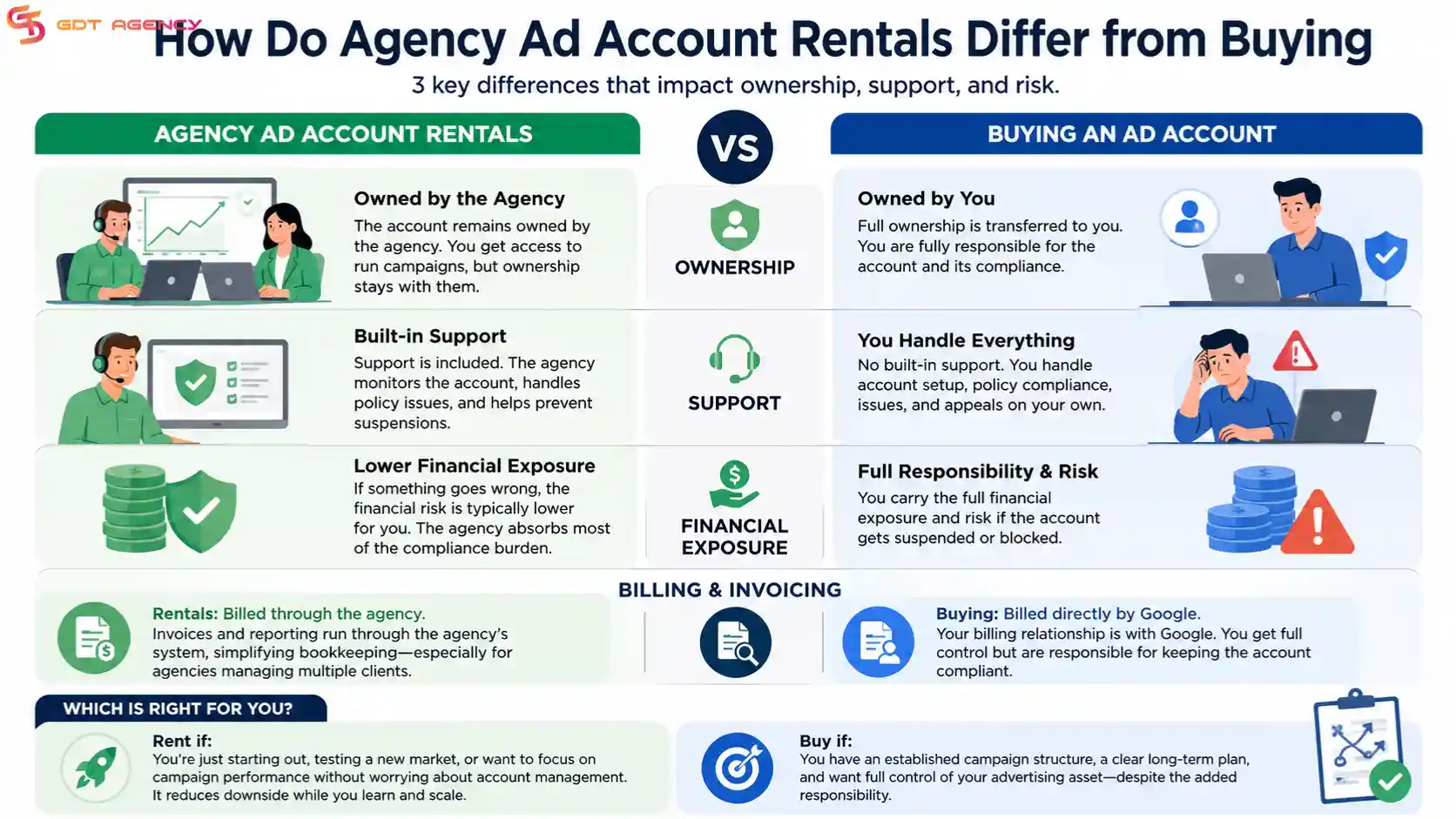
When you rent through an agency, the agency’s own verified account absorbs most of the compliance burden, and their team usually monitors the account for policy issues before they escalate into a suspension. This arrangement suits advertisers who want to focus on campaign performance rather than account management. Buying suits advertisers who want to eventually own a standalone advertising asset and are willing to handle account maintenance themselves.
The billing structure also differs between the two paths. Rentals typically bill through the agency, which means your invoices and reporting run through their system rather than a personal Google Ads billing profile. This can simplify bookkeeping for agencies managing several clients, but it also means you depend on the rental provider staying in business and keeping their own account in good standing. A bought account removes that dependency, since the billing relationship sits directly between you and Google, though you still carry the full weight of keeping the account compliant on your own.
Ultimately, the right choice comes down to how much control you want versus how much support you need. Advertisers just starting out, or those testing a new market before committing serious budget, often find that renting reduces their downside while they learn what works. Advertisers with an established campaign structure and a clear long-term plan tend to get more value from owning their account outright, even with the added responsibility that comes with it.
Final Thoughts
Buying a verified Google Ads account can save you time, but it never removes risk entirely. The steps that matter most are simple: check the seller’s track record, keep your documentation in order, agree on payment terms in writing, and ease into the account instead of scaling spend right away. Buyers who skip these steps tend to be the ones who lose money.
If you’re not ready to take on full ownership, renting through an agency account gives you a lower-risk path with built-in support, and it often makes more sense for short-term campaigns or advertisers still testing a new market. Either way, treat the account, bought or rented, as a working business tool that needs ongoing attention, not a one-time purchase you can set and forget.
FAQs
Is it legal to buy a Google Ads account?
Buying an account isn’t illegal on its own, but it does go against Google’s own advertiser terms, which tie each account to a single verified identity. This means the account can be suspended at Google’s discretion, even though no law is being broken.
How much does a verified Google Ads account cost?
Prices range from around 30 to 100 dollars for basic prepaid accounts on marketplace platforms, up to several hundred dollars for aged agency accounts with higher spending limits.
Can I get my money back if a purchased account gets banned?
It depends entirely on the seller’s refund policy. Providers who put replacement or refund terms in writing before the sale are far more likely to honor them than sellers who avoid the topic.
What’s the difference between buying and renting a Google Ads account?
Buying gives you full, permanent ownership and full responsibility for keeping the account compliant. Renting keeps ownership with the agency, which usually means lower upfront cost and built-in support if the account runs into a problem.
Do I need an anti-detect browser to use a purchased account?
No, not for managing a single account. Anti-detect browsers matter mainly for agencies or resellers running many accounts from the same device, since that pattern is more likely to trigger Google’s multi-account detection.