Google Ads Monthly Invoicing Requirements Complete Guide 2026


Google Ads monthly invoicing lets qualified advertisers run campaigns first and pay for the cost later, based on a line of credit that Google extends after a review. To qualify in 2026, an advertiser needs a strong payment history, a stable ad spend, and an account that meets Google’s internal review standards. Google Ads monthly invoicing requirements protect Google from unpaid balances, so the company only extends this credit line to accounts that show consistent and reliable spending patterns.
The application process itself moves through a few clear steps. An advertiser submits business information, waits for a Google review, and then receives a decision along with an assigned credit limit. Agencies managing several client accounts face a slightly different path, since Google evaluates their overall billing history across the accounts they run.
Monthly invoicing also differs from a standard line of credit in a few important ways, even though people often use the two terms interchangeably. The payment settings share a similar structure, but the terms and conditions tied to each one can vary depending on the advertiser’s account type and location.
Below, this guide breaks down what monthly invoicing means, what Google expects from applicants, how the approval process works, and how this payment option compares to other ways of paying for Google Ads. Agencies and advertisers who want to move away from manual card payments will find a clear path through each of these questions.
- What Is Google Ads Monthly Invoicing?
- How Does Monthly Invoicing Work?
- Who Typically Uses Monthly Invoicing?
- What Are the Requirements to Qualify for Google Ads Monthly Invoicing in 2026?
- What Is the Minimum Ad Spend Required?
- How Long Must the Account History Be?
- Does Payment History Affect Eligibility?
- How Do You Apply for a Google Ads Credit Line?
- What Documents Are Needed for the Application?
- How Long Does Approval Take?
- Is Monthly Invoicing the Same as a Line of Credit?
- How Does Monthly Invoicing Compare to Other Google Ads Payment Methods?
- What Is the Difference Between Monthly Invoicing and Manual Payments?
- Can Agencies Set Up Monthly Invoicing for Multiple Client Accounts?
- Are There Regional Differences in Monthly Invoicing Eligibility?
- Which Industries Face Extra Review for Monthly Invoicing Approval?
- What Happens If You Miss a Monthly Invoicing Payment?
- Final Thoughts
- FAQs
- Can a new Google Ads account apply for monthly invoicing right away?
- Does Google charge interest on monthly invoicing balances?
- Can an advertiser switch back to manual payments after approval?
- Does monthly invoicing affect ad account performance or delivery?
- What currencies does Google Ads support for monthly invoicing?
What Is Google Ads Monthly Invoicing?
As an expert at GDT Agency with nearly 10 years of experience working with Google Ads through multiple types of accounts, from standard to Google Ads agency accounts, I also have the chance to access multiple types of payment settings as well.
Based on my knowledge and experience, Google Ads monthly invoicing is a payment setting that lets advertisers pay for ad costs after the ads have already run, instead of paying upfront. Google grants a credit limit and bills the advertiser once a month or once the credit limit is reached, whichever comes first.
This setup shifts the payment order compared to standard prepaid billing. Google Ads typically charges an advertiser’s card automatically as costs accrue, but monthly invoicing removes that immediate charge and replaces it with a scheduled bill.
How Does Monthly Invoicing Work?
Monthly invoicing works by giving the advertiser a credit line that covers their ad spend, then billing them for that spend on a set cycle. Google tracks the advertiser’s costs throughout the month and generates an invoice once the billing period closes or once the account hits its credit threshold.
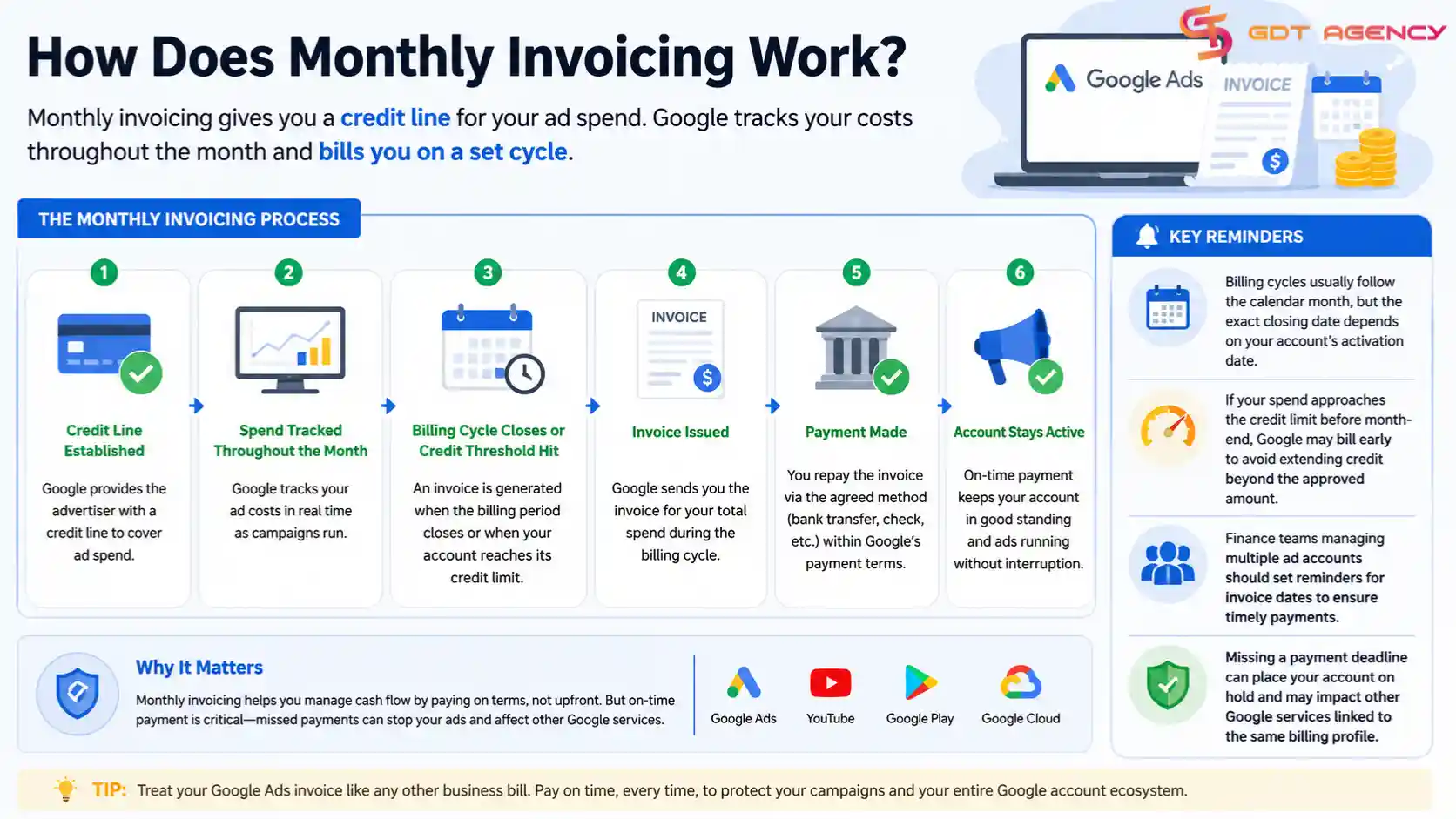
The advertiser then repays the invoice through an agreed method, such as a bank transfer or check, within the terms Google sets for that account. Missing a payment deadline can trigger a hold on the account, so advertisers need to treat the invoice the same way they would treat any other business bill with a due date.
Google usually sets the billing cycle to align with the calendar month, though the exact closing date can shift based on when the account first activated invoicing. Some accounts also see a shorter cycle if their spend approaches the assigned credit limit before the month ends, since Google bills early to avoid extending credit beyond the approved amount. This early trigger protects both sides: Google limits its exposure, and the advertiser avoids a surprise where ads stop mid-campaign because the balance hit its cap.
Finance teams that manage several ad accounts often set up internal reminders around these invoice dates, since a missed payment affects more than just Google Ads. A payment default on one product can sometimes carry over to other Google services tied to the same billing profile, which makes on-time payment a priority beyond the immediate ad account.
Who Typically Uses Monthly Invoicing?
Large advertisers and agencies use monthly invoicing more often than small businesses, mainly because Google reserves this option for accounts with a proven spending history. A marketing agency running ads for several clients benefits from the flexibility, since it consolidates billing instead of managing multiple cards.
Enterprise companies with predictable, high-volume ad budgets also rely on this setting to simplify their internal accounting. Finance teams often prefer an invoice they can reconcile on a monthly basis over a stream of smaller card transactions spread throughout the month.
→ Many agencies that qualify for monthly invoicing also use Google Ads agency accounts to simplify billing and account management across multiple clients. If you’re evaluating this option, our guide on How to Rent a Google Ads Agency Account: Process, Requirements, and Benefits explains how the rental process works, who qualifies, and the advantages of using an agency account for larger advertising operations.
What Are the Requirements to Qualify for Google Ads Monthly Invoicing in 2026?
Qualifying for Google Ads monthly invoicing in 2026 requires a consistent spending history, a stable account in good standing, and approval from Google’s internal credit review. Google does not publish one fixed set of numbers that applies to every account, since the review considers the advertiser’s spend pattern, payment reliability, and business profile together.
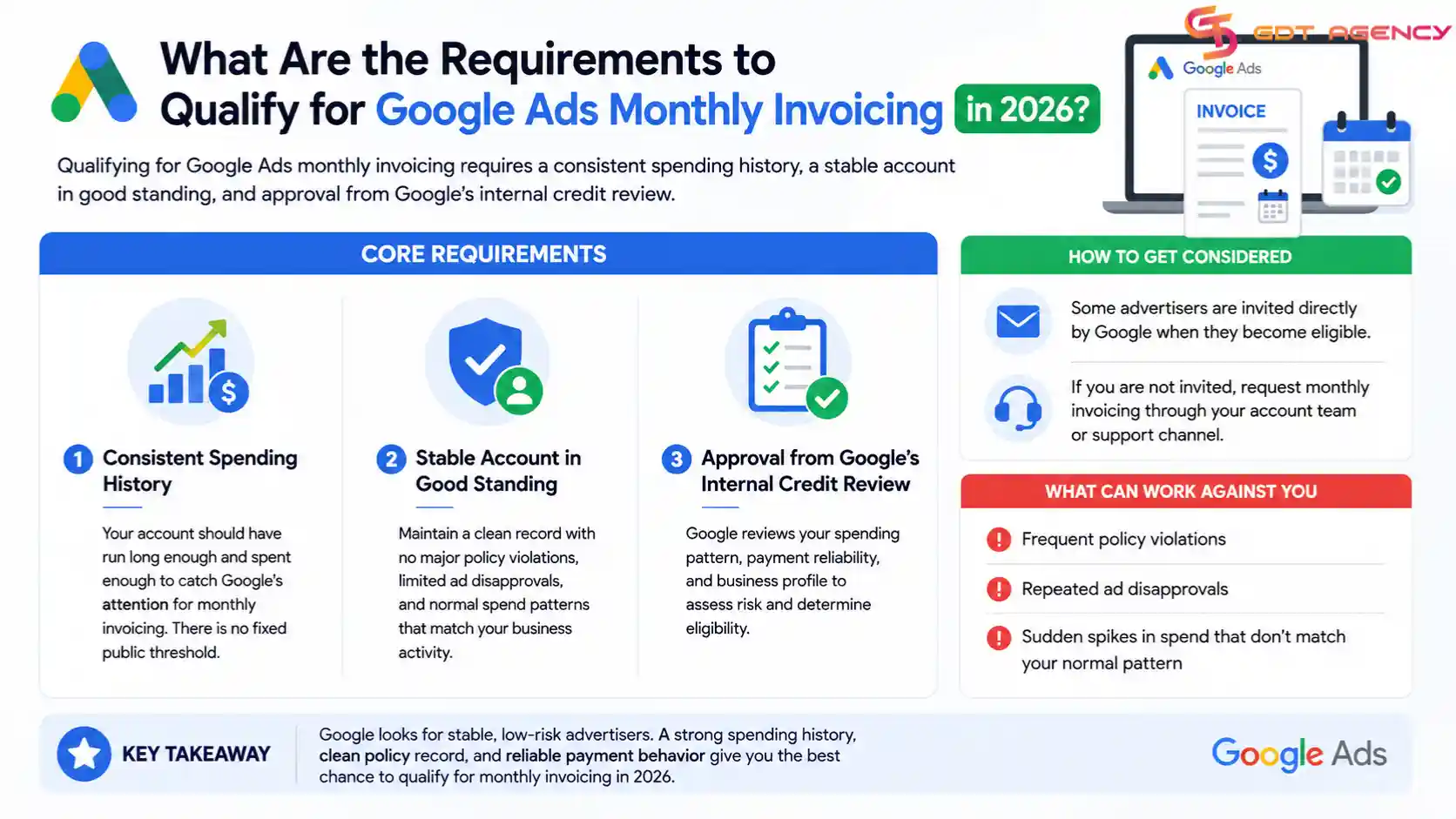
An advertiser who wants to move from manual payments to monthly invoicing should first check whether their account has run long enough and spent enough to catch Google’s attention for this offer. Google sometimes invites eligible advertisers directly, while others need to request the change through their account team or support channel.
Beyond spend and history, Google also looks at how the account behaves day to day. Frequent policy violations, repeated ad disapprovals, or sudden spikes in spend that don’t match the account’s normal pattern can all work against an application, even if the raw numbers look strong on paper. Google’s review process tries to separate advertisers who represent a stable, low-risk business from accounts that show signs of instability, so a clean policy record matters just as much as a healthy budget.
What Is the Minimum Ad Spend Required?
Google does not publish one universal minimum spend figure for monthly invoicing, since the threshold depends on the account’s history and the market it operates in. Advertisers commonly report that consistent monthly spend in the thousands of dollars, sustained over several months, puts them in a stronger position for approval.
A higher and more predictable spend signals to Google that the account represents a lower credit risk. Advertisers who scale their budget gradually, rather than spiking it suddenly, tend to build a cleaner track record for this kind of review.
How Long Must the Account History Be?
Google typically expects an account to run for several months before it considers monthly invoicing, though the exact duration varies by account and region. A longer history gives Google more data points to judge whether the advertiser pays reliably and spends within a predictable range.
New accounts with only a few weeks of activity rarely qualify, since Google has not yet seen enough billing cycles to assess risk. Advertisers who plan ahead for monthly invoicing should treat the first several months of an account as a track record they are actively building, not just a startup phase to get through.
Does Payment History Affect Eligibility?
Yes, payment history plays a central role in monthly invoicing eligibility, since it directly shows Google whether an advertiser pays on time. An account with a clean record of on-time payments through its existing payment method stands a much better chance of approval.
Late payments, failed charges, or disputed transactions on the current billing method work against an advertiser’s case. Google’s review process weighs this history heavily, because monthly invoicing extends real credit, and any past sign of payment risk raises a flag during that review.
How Do You Apply for a Google Ads Credit Line?
Advertisers apply for a Google Ads credit line by submitting their business and billing details through their account, then waiting for Google’s credit team to review the request. The process typically starts either from an invitation Google sends to eligible accounts or from a direct request submitted through account support.
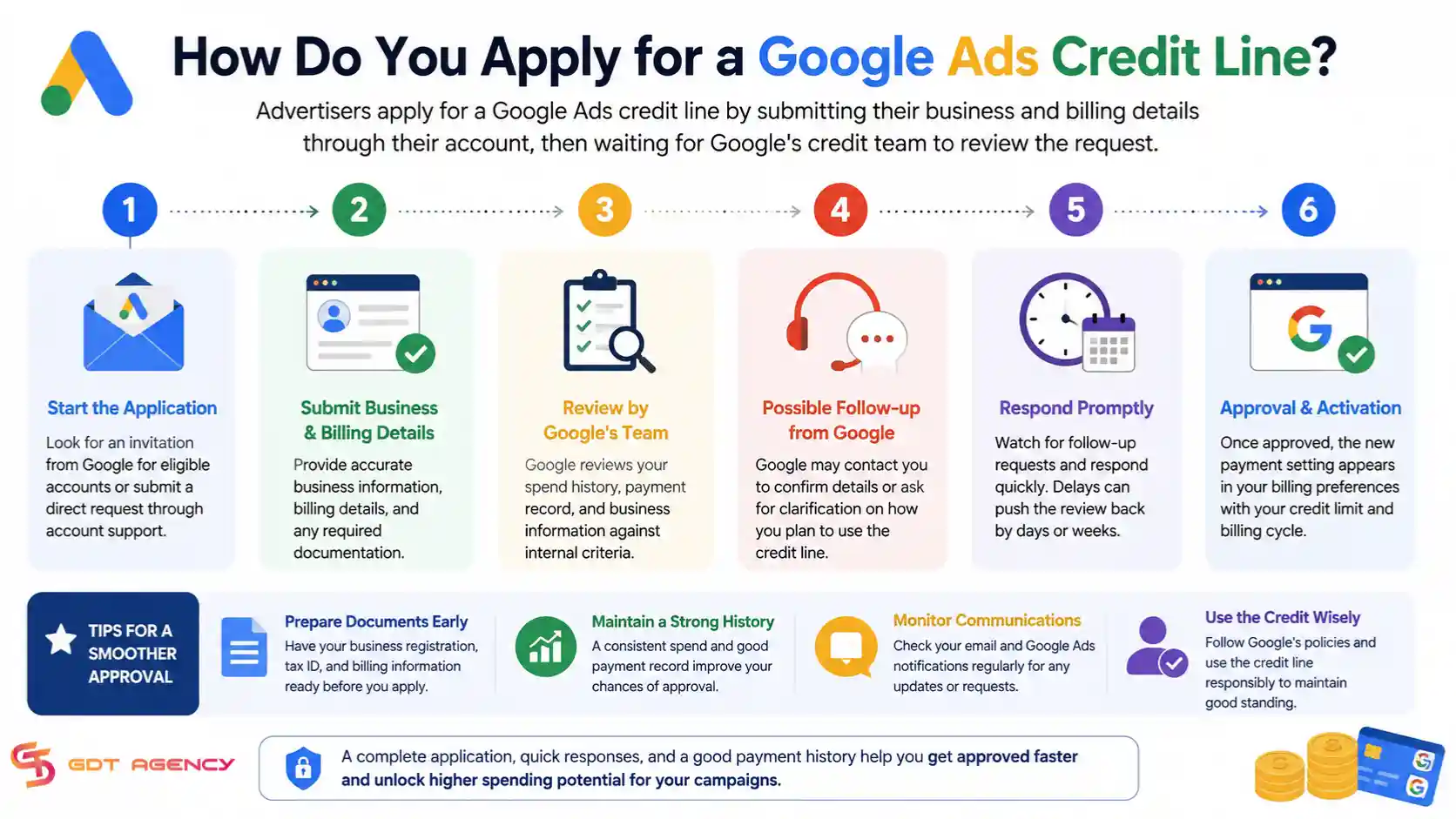
Once submitted, the application moves into a review stage where Google checks the account’s spend history, payment record, and business information against its internal criteria. Advertisers who prepare their documentation ahead of time tend to move through this stage faster than those who scramble to gather details after starting the request.
During this stage, Google may also contact the advertiser directly to confirm business details or ask for clarification on how the account plans to use the credit line going forward. Advertisers should watch for these follow-up requests closely, since a slow response can push the review back by days or weeks. Once Google approves the application, the account owner usually sees the new payment setting appear in their billing preferences, along with the assigned credit limit and the billing cycle Google has set for that account.
What Documents Are Needed for the Application?
The application usually requires proof of business identity, such as a registered business name and tax information, along with billing details tied to the account. Google may also ask for information about the company’s size, industry, and expected ad spend going forward.
Agencies applying on behalf of multiple clients often need to provide details for each account under review, since Google evaluates the overall relationship rather than a single isolated account. Having this information organized in advance shortens the back-and-forth that can otherwise stretch the review timeline.
Before you submit your application, make sure your documents match the information on your Google Ads billing profile and business records. Even small differences in your business name or tax details can delay approval. Our guide on Google Ads Verification Documents explains which documents Google accepts, how to prepare them correctly, and the most common reasons verification requests are rejected.
How Long Does Approval Take?
Approval timelines vary, but many advertisers report a wait of a few weeks from submission to a final decision. The exact duration depends on how quickly Google’s team can verify the business details and how complete the initial application was.
Advertisers who submit incomplete information often face delays, since Google’s team needs to follow up and request the missing pieces before finishing the review. A clean, complete submission on the first attempt remains the most reliable way to keep the timeline short.
Is Monthly Invoicing the Same as a Line of Credit?
No, monthly invoicing is not exactly the same as a line of credit, though the two concepts overlap closely in how Google Ads implements them. Monthly invoicing describes the payment setting the advertiser sees and manages, while the line of credit refers to the underlying credit arrangement that makes that setting possible.
Google effectively bundles the two together for most advertisers, since qualifying for monthly invoicing means Google has already extended a credit line behind the scenes. The credit limit tied to that line determines how much ad spend the advertiser can accumulate before Google requires payment, which links the two terms in practice even though they describe slightly different parts of the same system.
How Does Monthly Invoicing Compare to Other Google Ads Payment Methods?
Monthly invoicing wins on cash flow flexibility, manual payments win on setup simplicity, and automatic payments win on convenience for smaller, steady spenders. Each method fits a different kind of advertiser, depending on how much control they want over timing and how much administrative work they can handle.
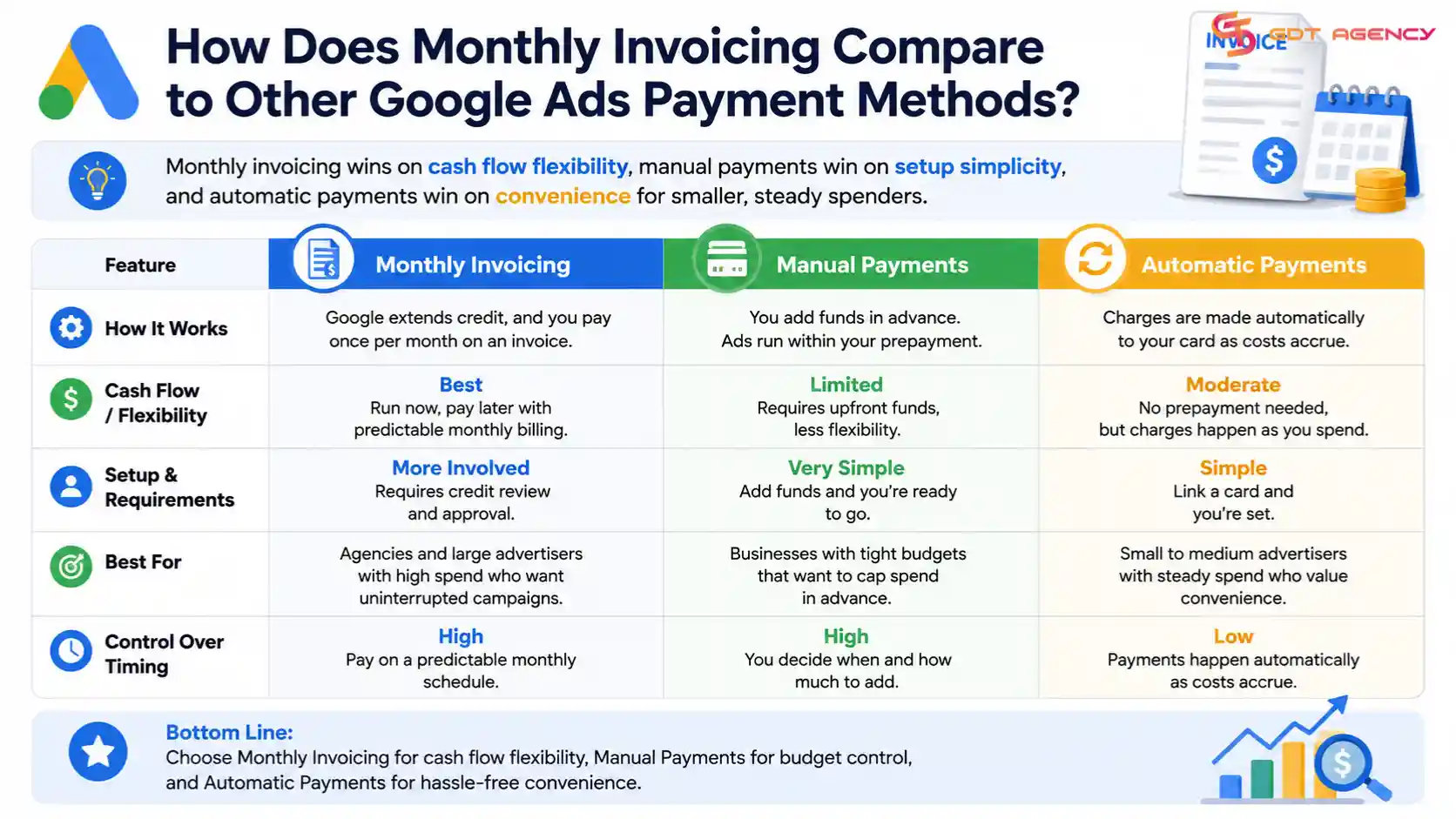
Manual payments require the advertiser to add funds before ads run, which suits businesses with tighter budgets that want to cap spend in advance. Automatic payments charge a card as costs accrue, which works well for smaller accounts that do not need the extra credit review that monthly invoicing demands. Monthly invoicing, by contrast, suits agencies and large advertisers who want to run campaigns without interruption and settle the bill on a predictable monthly schedule.
What Is the Difference Between Monthly Invoicing and Manual Payments?
Monthly invoicing bills the advertiser after ads have already run, while manual payments require the advertiser to load funds before any ad spend occurs. This difference in timing changes how each method affects cash flow and day-to-day account management.
Manual payments give the advertiser tighter control over the exact amount available for spending at any given time, since ads stop running once the balance runs out. Monthly invoicing removes that hard stop and instead relies on the credit limit Google assigns, which lets campaigns continue running without the risk of a sudden pause caused by an empty balance.
Can Agencies Set Up Monthly Invoicing for Multiple Client Accounts?
Yes, agencies can set up monthly invoicing across multiple client accounts, typically by managing them through a Manager Account (MCC) structure. This setup lets an agency consolidate billing for several clients under one review process with Google, rather than negotiating separate terms for each account.
Google still evaluates the overall relationship, including the combined spend and payment history across the linked accounts, before approving this kind of arrangement. Agencies that manage dozens of client accounts often find this consolidation valuable, since it reduces the administrative overhead of tracking separate invoices for each client.
Are There Regional Differences in Monthly Invoicing Eligibility?
Yes, monthly invoicing eligibility can differ by region, since Google adjusts its credit review process based on local business regulations and market conditions. An advertiser applying from the United States may face different documentation requirements than one applying from another country.
Currency, local tax rules, and regional payment infrastructure also shape how Google structures the invoicing terms for a given market. Advertisers operating across several countries should expect some variation in the exact terms Google offers, even when their overall account performance looks similar across regions.
Which Industries Face Extra Review for Monthly Invoicing Approval?
Industries considered higher risk, such as those tied to financial services, gambling, or other tightly regulated sectors, often face extra scrutiny during monthly invoicing approval. Google applies stricter checks to these categories because they carry a higher chance of billing disputes or regulatory complications.
Advertisers in these industries should prepare more detailed business documentation before applying, since Google’s review team typically asks more questions before extending credit. This extra step takes longer, but advertisers who anticipate it and respond quickly to requests can still move through the process without major delays.
What Happens If You Miss a Monthly Invoicing Payment?
Missing a monthly invoicing payment can lead to a suspended account, restricted ad delivery, or a downgrade back to manual payment methods. Google treats a missed payment as a signal that the credit arrangement carries more risk than expected, which puts the advertiser’s standing at risk.
Repeated late payments can also lower the advertiser’s credit limit or end the monthly invoicing privilege entirely, forcing a return to prepaid billing. Advertisers who anticipate cash flow issues should reach out to Google support before a payment deadline passes, since addressing the issue early tends to produce a better outcome than letting an account slip into default.
Final Thoughts
Google Ads monthly invoicing gives qualified advertisers a way to run campaigns without the friction of prepaying for every dollar spent. The requirements center on a proven spend history, a clean payment record, and a stable account that Google’s review team trusts to handle credit responsibly.
Advertisers who want to move toward this payment setting should treat their account history as an ongoing application, not a one-time form. Steady spend, on-time payments, and a clean policy record all build the case Google looks for, whether the advertiser applies directly or waits for an invitation. Agencies managing multiple clients gain the most from this setup, since it consolidates billing and removes the daily friction of manual card payments across several accounts.
FAQs
Can a new Google Ads account apply for monthly invoicing right away?
No, a new account typically cannot apply right away, since Google wants to see several months of consistent spend and payment history before it considers the request.
Does Google charge interest on monthly invoicing balances?
No, Google Ads monthly invoicing does not function like a traditional loan with interest charges. Advertisers repay the exact amount billed for their ad spend within the agreed payment terms.
Can an advertiser switch back to manual payments after approval?
Yes, an advertiser can request a switch back to manual payments, though the process usually goes through Google Ads support and may take some time to complete.
Does monthly invoicing affect ad account performance or delivery?
No, monthly invoicing only changes how an advertiser pays for ads. It does not affect ad delivery, targeting, or campaign performance in any direct way.
What currencies does Google Ads support for monthly invoicing?
Google Ads supports monthly invoicing in several major currencies, though availability depends on the advertiser’s country and billing profile. Advertisers should check their account settings or contact Google support to confirm which currency applies to their invoicing setup.