
TikTok Ads for E-commerce: A Complete Guide to Formats, Cost, and Setup
TikTok Ads for e-commerce works as a paid promotion system that helps online stores reach buyers through short-form video on one of the fastest-growing platforms…
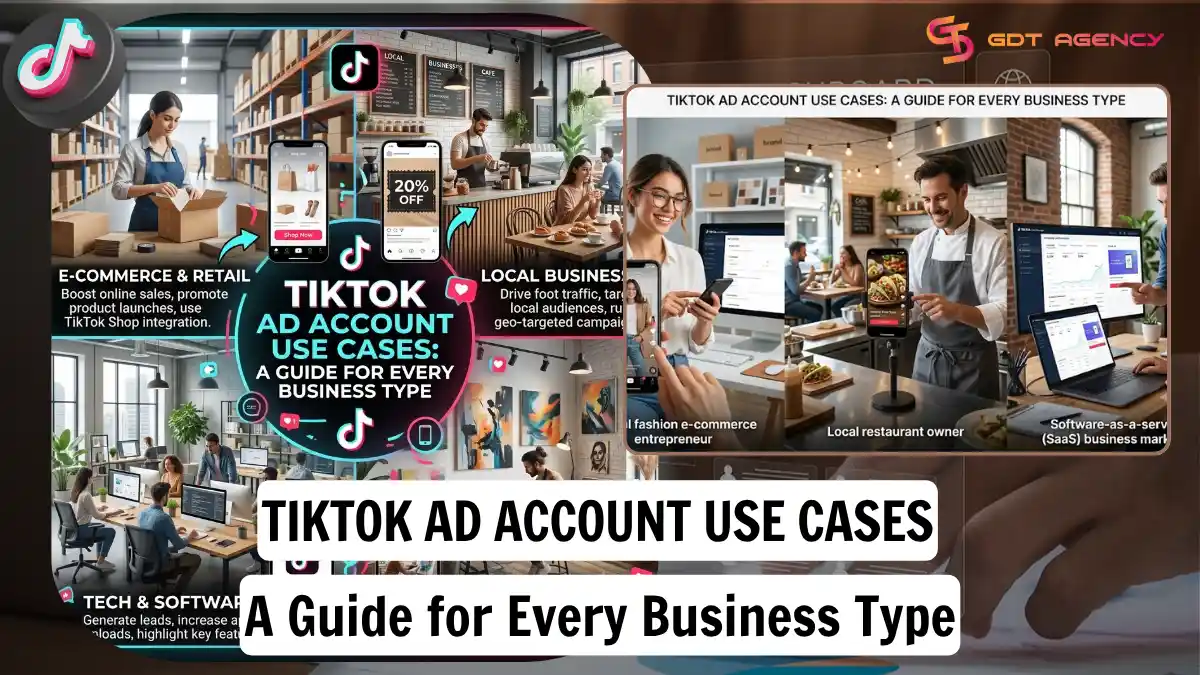
A TikTok ad account works for almost any business type, from e-commerce stores to financial services to online education brands, once the business meets platform verification and content policy rules. Industries face different levels of scrutiny during setup: a clothing brand can usually launch ads within a day, while a lending company needs extra documents and a longer review. Requirements also shift with account type, since agency-rented accounts often carry stronger trust signals than a brand-new self-managed account. Below, we break down the main business categories, their setup requirements, and what happens when an industry runs into approval trouble.
As an expert at GDT Agency with years of experience working with TikTok ad accounts, from standard to TikTok agency ad accounts, there is one thing I can make sure that TikTok ad account holds everything a business needs to create, launch, and manage TikTok Ads campaigns. It lets a business set budgets, choose targeting options, upload creative assets, and track results in the TikTok Ads Manager dashboard.
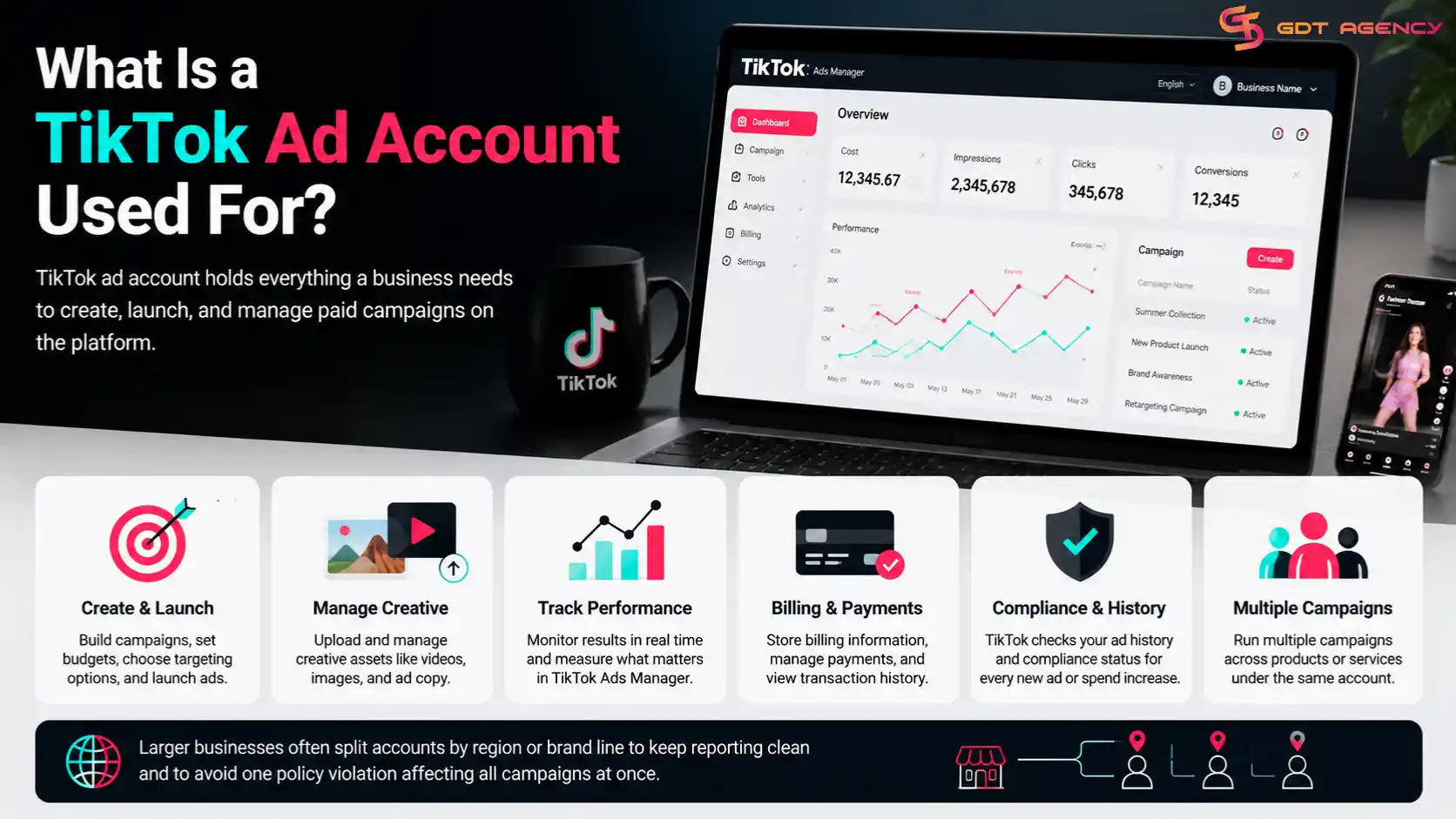
The account also stores a business's billing information, ad history, and compliance status. This history matters, since TikTok checks it every time a business submits a new ad or requests a spend increase.
A single ad account can run multiple campaigns at once, across different products or services under the same business entity. Larger businesses often split accounts by region or brand line to keep reporting clean and to avoid one policy violation affecting all campaigns at once.
Nearly every business type can open a TikTok ad account, but the platform sorts them into three groups based on approval difficulty: standard-risk, restricted or high-scrutiny, and emerging or niche categories. This grouping determines how fast an account gets approved and how much documentation a business submits upfront.
Knowing which group a business falls into saves time before setup even starts. A business that prepares the right documents for its category avoids the most common cause of rejection, which is submitting a generic application without industry-specific proof.
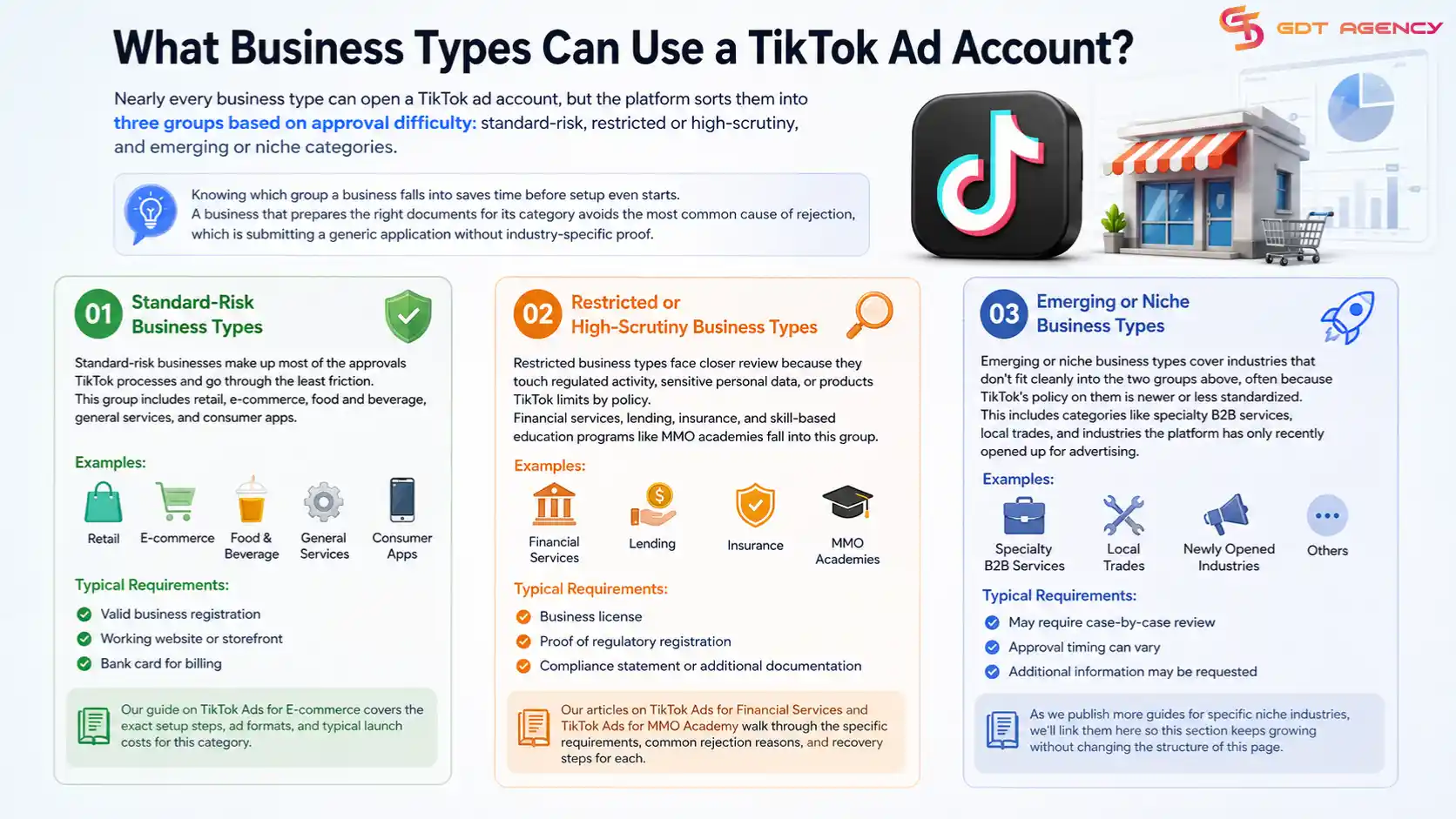
Standard-risk businesses make up most of the approvals TikTok processes and go through the least friction. This group includes retail, e-commerce, food and beverage, general services, and consumer apps.
These businesses usually need a valid business registration, a working website or storefront, and a bank card for billing. Our guide on TikTok Ads for E-commerce covers the exact setup steps, ad formats, and typical launch costs for this category.
Restricted business types face closer review because they touch regulated activity, sensitive personal data, or products TikTok limits by policy. Financial services, lending, insurance, and skill-based education programs like MMO academies fall into this group.
These businesses often need extra proof such as a business license, proof of regulatory registration, or a compliance statement before TikTok clears any ad spend. Our articles on TikTok Ads for Financial Services and TikTok Ads for MMO Academy walk through the specific requirements, common rejection reasons, and recovery steps for each.
Emerging or niche business types cover industries that don't fit cleanly into the two groups above, often because TikTok's policy on them is newer or less standardized. This includes categories like specialty B2B services, local trades, and industries the platform has only recently opened up for advertising.
These businesses sometimes need a case-by-case review from TikTok support, and approval timing can vary more than with established categories. As we publish more guides for specific niche industries, we'll link them here so this section keeps growing without changing the structure of this page.
No, TikTok ad account requirements are not the same across industries, and the difference comes down to three things: documentation, review time, and ongoing monitoring. A standard-risk business might clear review in a few hours, while a restricted business can wait several days for the same step.
The documentation gap is the clearest difference between groups. Standard-risk businesses submit basic company information, while restricted businesses often submit licenses, certifications, or third-party verification tied to their specific regulated activity.
Review time follows the same pattern. TikTok's automated systems handle most standard-risk approvals without human review, but restricted categories usually get flagged for manual checks, which adds days rather than hours to the process.
Ongoing monitoring also differs once an account is live. Restricted industries face more frequent policy re-checks on their running ads, since a single non-compliant claim in an ad script can trigger a review of the whole account, not just that one ad.
TikTok ad account use cases differ mainly in minimum ad spend expectations, creative restrictions, and how strictly each industry's claims get checked. A retail brand can usually test a campaign with a small daily budget, while a financial services brand may need a higher starting budget tied to a business account tier.
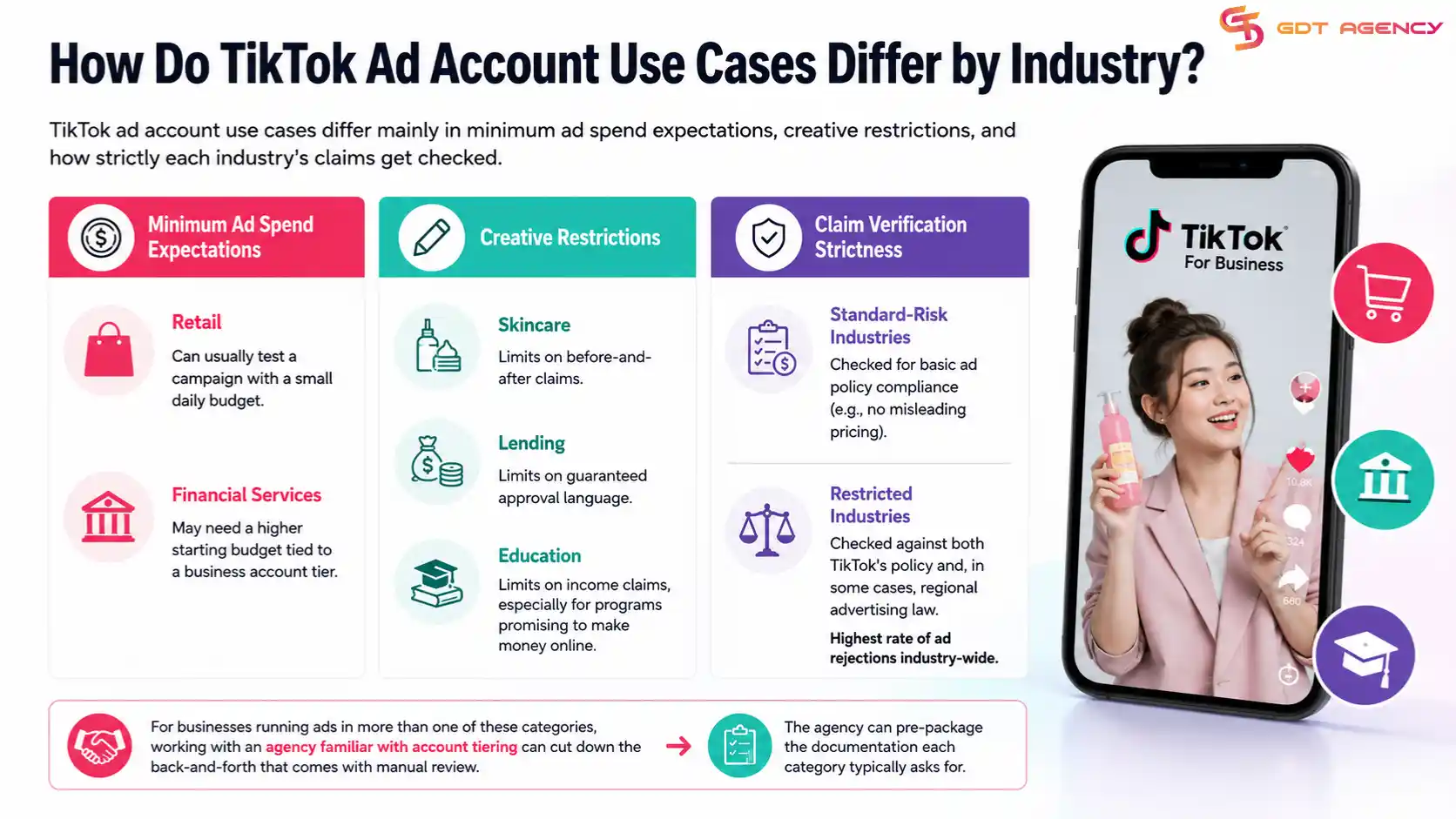
Creative restrictions vary just as much. A skincare brand faces limits on before-and-after claims, a lending business faces limits on guaranteed approval language, and an education brand faces limits on income claims, especially for programs positioned as ways to make money online.
Claim verification adds another layer of difference. Standard-risk industries mostly get checked for basic ad policy compliance, like no misleading pricing. Restricted industries get checked against both TikTok's policy and, in some cases, regional advertising law, which is why financial and health-adjacent categories see the highest rate of ad rejections industry-wide.
For businesses running ads in more than one of these categories at once, working with an agency familiar with account tiering can cut down the back-and-forth that comes with manual review, since the agency can pre-package the documentation each category typically asks for.
A few situations don't fit neatly under industry type but still shape how a business uses its TikTok ad account day to day. These come up often, even though they sit outside the main setup and approval process above.
One TikTok ad account can technically run campaigns for more than one business type, but TikTok expects the account's registered business category to match what's actually being advertised. Running unrelated products under one mismatched category is a common reason accounts get flagged during a routine review.
Businesses that operate across categories, like a company selling both physical products and a paid course, usually get better results running separate accounts per business line. This keeps each account's compliance history clean and tied to one type of scrutiny instead of mixing standard-risk and restricted signals together.
Advertising in an unapproved industry usually leads to an immediate ad rejection, and repeated attempts can result in the account getting suspended or permanently banned. TikTok's system flags mismatched category and content combinations quickly, especially for categories under close regulatory watch.
A suspended account loses its ad history and any trust built up from prior spend, which means starting over from a lower-trust position even after the underlying issue gets fixed. Businesses unsure whether their industry needs pre-approval should check their category status before spending on creative production, not after.
Business verification directly affects what use cases an account can run, since an unverified account faces lower spend limits and fewer ad formats regardless of industry. Verification confirms the business as a real, registered entity and lowers the risk TikTok assigns to the account.
Once verified, a business typically unlocks higher daily spend caps, access to more advanced targeting options, and eligibility for certain ad formats that unverified accounts can't use at all. This step matters even for standard-risk businesses, since skipping it can cap growth long before an actual policy issue comes up.
A restricted industry can work with an agency that provides an established, pre-vetted ad account instead of building one from scratch. These agency-rented accounts often carry existing spend history and verification status, which can shorten the review delays restricted businesses usually face.
This route works especially well for businesses in categories like financial services or MMO academies, where a first-time account from a new business entity draws more scrutiny by default. Pairing a rented account with the industry-specific setup steps in our category guides above gives a restricted business a faster, more predictable path to running compliant ads.
A TikTok ad account works for almost any business, but the path to running ads looks different depending on the industry. Standard-risk businesses move fast with basic paperwork, restricted businesses need extra documentation and patience, and emerging categories require more back-and-forth with TikTok support.
The fastest way to avoid delays is to match your business to the right group before setup starts, gather the documents that group typically asks for, and get business verification done early. If your industry sits in the restricted category, a pre-vetted agency account can save weeks of review time compared to building trust from a brand-new one.
No, a personal TikTok account can't run paid ads. A business needs a dedicated TikTok Ads Manager account, separate from a personal or creator profile, to access campaign tools and billing.
Approval usually takes a few hours for standard-risk businesses and several days for restricted businesses. Emerging or niche categories can take longer, since TikTok often reviews these case by case.
No, not every business needs a license. Standard-risk businesses like retail or e-commerce typically only need a business registration, while restricted industries such as financial services often need a license or regulatory proof.
A suspended account can sometimes be recovered by appealing directly through TikTok support and fixing the policy issue that caused the suspension. Recovery isn't guaranteed, and the account usually loses its prior trust level even after reinstatement.
Yes, an agency-rented account is safe when it comes from a reputable provider with a clean compliance history. These accounts often carry existing verification and spend history, which can reduce approval delays for restricted or high-scrutiny businesses.
TikTok Ads for e-commerce works as a paid promotion system that helps online stores reach buyers through short-form video on one of the fastest-growing platforms…

Running TikTok ads for an MMO academy takes more careful planning than most niches. TikTok’s ad platform rewards fast-moving, high-engagement content, so an MMO academy…
Financial service brands can run ads on TikTok, but the platform holds these advertisers to a stricter standard than most industries. Banks, insurance companies, lenders,…