


9 Proven Strategies to Beat Facebook Ad Fatigue


Facebook ad fatigue or creative fatigue occurs when an audience has seen the same creative too many times. When people see the exact same ad on repeat, they lost interest in your ads, leading to the performance dropping and your once-winning creative suddenly stops working. To quickly escape Facebook ad fatigue, here are 9 proven strategies to beat Facebook ad fatigue and keep your Facebook campaigns fresh, efficient, and profitable.
Key Takeaways:
- Core Definition: Facebook Ad Fatigue (or creative fatigue) is the phenomenon where ad performance declines because the target audience has seen the same creative too many times, leading to a loss of interest.
- Inevitability: Creative fatigue is a natural part of the ad lifecycle; it will eventually impact every active campaign regardless of its initial success.
- Critical Warning Signs: You can identify fatigue early by monitoring for “Creative Fatigue” notifications in Ad Manager, observing a dramatic drop in Click-Through Rate (CTR), or seeing a significant rise in CPC and CPM.
- Proven Impact: Implementing expert strategies to beat fatigue can help reduce CPM by 20-35%, increase CTR by 15-40%, and extend a campaign’s lifespan by 2-3 times.
- Top Recovery Strategies: Creative Rotation through at least 5 different ad versions every 3 days; Audience Exclusions by using Custom Audiences to exclude users who have already purchased or engaged in the last 30-60 days; Hook Refreshing by testing different hooks.
- Risk of Inaction: Failing to address high ad frequency can lead to audience boredom, increased reports of your ads as spam, and potentially the suspension of your Facebook Ads Manager account.
9 Strategies To Escape Facebook Ad Fatigue Quickly
Facebook ad fatigue can be simply understood as the situation where Facebook audiences begin to lose interest in your ads, leading to decreased click-through rates, increased cost-per-click, and decreased conversions because your ads appear too frequently.

To beat Facebook ad fatigue, here are 9 proven strategies that GDT Agency experts have researched and tested through extensive internal campaigns across multiple industries and ad accounts, consistently helping clients reduce CPM by 20-35%, increase CTR by 15-40%, and extend campaign lifespan by 2-3x without resetting the learning phase.
| Strategy | Summary |
| Use Creative Rotation to Keep Ads Fresh | Create 5 different versions of your ad and change it every 3 days. |
| Exclusion Audiences | Create a Custom Audience of people who have purchased and engaged in the last 30 to 60 days, and exclude this list from your active campaigns. |
| Adjust Budgets Based on Creative Performance | Adjust budgets early by shifting spend away from declining creatives and toward strong performers to maintain stable results and delay creative fatigue. |
| Using Varied Ad Format | Using a mix of formats gives your creative more chances to connect. |
| Try Meta Advantage+ Creative | Use Advantage+ creative to automatically create variations of your ad |
| Refresh Key Elements | Refresh key elements like hooks, visuals, and ad copy to keep your ads engaging and delay creative fatigue without changing the core idea. |
| Show Ads on Schedule & Set Frequency Cap | Show different ads to customers on different days. Set the frequency cap to limit the number of times ad sets appear |
| Adjust Campaign Objectives | Changing objectives helps you reach new users and keep your ads from feeling repetitive |
| Optimize Placement Management | Track where your ads show most often and adjust delivery |
1. Use Creative Rotation to Keep Ads Fresh
People getting tired of an ad is referred to as ad fatigue. Meta delivers ads faster now, so even strong creatives lose impact sooner. Therefore, do not display the same ad to the entire audience!
A consistent refresh cycle keeps performance stable. You can create 5 different versions of your ad and change it every 3 days. When the frequency of one ad gets near 3, stop it and start using the next variation. This is enough to keep the viewers carried away.

2. Use Exclusion Audiences
One of the most effective ways to prevent fatigue is to stop showing ads to people who have already converted or previously engaged.
You can create a Custom Audience of people who have purchased in the last 30 to 60 days, or someone has watched, clicked, or engaged several times, and then exclude this list from your active campaigns.

By doing this, your budget is always focused on “fresh” prospects rather than annoying existing customers.
3. Adjust Budgets Proactively Based on Creative Performance
A creative can lose momentum over time, especially when delivery focuses too much on one placement or audience. In this situation, keeping the same budget can speed up the decline.
If you see certain areas moving outside their normal range, a small budget adjustment can help stabilize performance and give Meta more flexibility to find responsive users.

You do not need large changes. Just reduce spending on weaker creatives to avoid wasting impressions and increase spending on strong creatives to extend their performance. This approach spreads spending more evenly and gives your creatives more time before fatigue sets in.
4. Using Varied Ad Format
Using a mix of formats is another simple method for refreshing your ads that creates more chances to connect with customers. It also gives you more reliable insights than an isolated ad format.
If you were previously using a single image ad, change it into a vertical cut for Reels, a carousel that breaks the message into steps, and a motion version that animates a static concept.
Each ad format will reach people differently. Though it won’t replace creative updates, it gives your campaigns more flexibility.

>>> You can find out more about Facebook ad formats via our dedicated blog: Facebook Ad Formats: A Comprehensive Guide to Boost ROI in 2026.
5. Try Meta Advantage+ Creative
According to the official document released by Meta, when you turn on Advantage+ creative in Meta Ads Manager and Meta Business Suite, Advantage+ creative automatically creates variations of your ad using a single image or video and shows a personalised ad to each person based on what it appears that they are most likely to respond to.
However, Advantage+ creative is only available for campaigns using the traffic or sales objectives with a website destination.
6. Refresh Key Elements
Refresh key elements like hooks, visuals, and ad copy to keep your ads engaging and delay creative fatigue without changing the core idea.
- Ad Creatives: Convert to a new format, adjust colors, reverse your image, or use a different image, …
- Ad copy: Changing the ad copy is a small but effective way to make your ads new. If your existing ad is short, try longer copy. You can try adding emojis or changing the CTA button if another one suits your product or service better.
- The “Hook” Refresh: You don’t always need to produce an entirely new video. Often, only the first few seconds (the hook) are what people get tired of. By testing three different hooks with the same body content, you can extend the lifespan of a high-performing creative by weeks or even months.
7. Show Ads on Schedule & Set a Frequency Cap
This built-in feature of most ad platforms, like Facebook or Google, will display different ads to customers on different days. In simple words, if you are not showing an ad daily but only once a week, the audience will not get tired of it that fast.
And finally, set a frequency cap. You can limit the number of times a specific ad or ad sets appear on your consumer’s feed.
8. Adjust Campaign Objectives to Avoid Fatigue
Your campaign objective controls who sees your ads and how often they see them. Reach targets a wide audience, while conversion focuses on a smaller, high-intent group. Fatigue happens faster when the same people see your ads too often.
Switching objectives changes how Meta delivers your ads. You can start with reach or video views to expand your audience, then move to conversion to drive results.
Objectives also affect placements. Video spreads ads across more places, while conversion focuses on a few. Changing objectives helps you reach new users and keep your ads from feeling repetitive.
9. Optimize Placement Management
Placements perform differently over time, and fatigue often appears first where impressions cluster. Some placements handle repeated exposure better, while others drop in performance quickly.
You need to track where your ads show most often and adjust delivery when one placement takes too much share, so you can keep exposure balanced and delay fatigue. Uneven delivery usually signals early fatigue.
Why Does Facebook Ad Fatigue Occur?
Facebook ad fatigue does not happen randomly. It builds up when your audience sees the same message too often and stops paying attention. Performance starts to drop, costs begin to rise, and your results become less stable.
Here are the key reasons why Facebook ad fatigue occurs:
High Frequency
This is the most common cause of ad fatigue. A high ad frequency indicates that individuals in your target audience are seeing your ad multiple times. And when people see your ad too many times, they get bored and lose interest, and are less likely to engage.
So, how much advertising frequency is good? There is no correct answer for this quiz. However, to know when your frequency is effective, you can use an A/B Test.
This is even more serious if you do not handle it promptly. If the density of ads appears too dense, Facebook will sometimes misunderstand that you are spamming. And it can cause your Facebook Ads Manager to go down or be suspended.
Narrow Targeting
Maybe you didn’t pay attention to Audience Size when implementing the target, but a small or narrow audience can experience fatigue more quickly. Basically, if you target too narrowly, there are fewer people to show the ad to, which will lead to overexposure for the same group.
Facebook always ensures balance and gives good suggestions in the Learning Machine phase. However, if the Audience Size is too small, it will also have to show the ad again to those audiences. And that’s when you lose money.

The ad campaign takes too long
If your ad campaign takes too long to run. There is a high possibility that you may also experience Ad Fatigue.
A campaign that runs for many days may show up to old audiences, and of course, they won’t feel comfortable if they see too many of your ads over many days.
Your content is no longer engaging
If your ad content is no longer fresh and attractive, people will no longer want to click on it.
In my opinion, this situation is often due to a lack of creativity and not searching for trending content. Leading to a lack of ideas for advertising content.
How To Recognize Creative Ad Fatigue?
Facebook Ad fatigue doesn’t come with flashing lights or pop-ups to warn you. However, Facebook will give you plenty of clues to combat ad fatigue. You just have to know where to look. Here are 3 signs to help you recognize:
Automatic Notifications
When Facebook believes that your audience has seen the same ad too many times, you will see Creative limited or Creative fatigue in the Delivery column status for your ad set or ad.
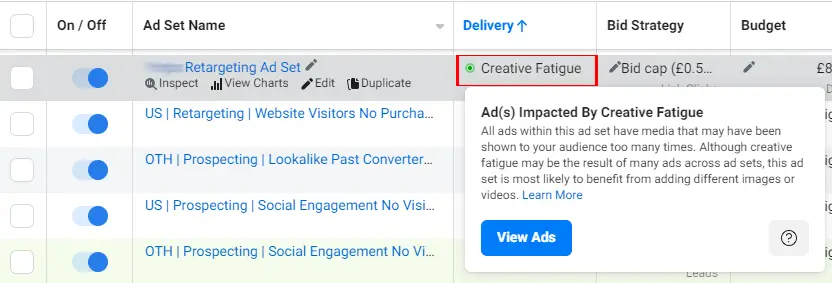
Meta will consider all recent exposures of the ad’s image or video, including those from other campaigns from your Page, as well as the ad’s cost per result.
- When the cost per result is more than ads that you’ve run in the past, but less than twice as much, you will see a Creative limited status.
- When the cost per result is more than or equal to twice as much as the ads that you ran in the past, you will see a Creative fatigue status.
Increase CPC and CPM, Reduce CTR
As an expert at GDT Agency who has spent more than 5 years working with Facebook ads, I can affirm that this is one of the most obvious signs of Facebook ad fatigue.
- Reduce CTR: When people see your ad too many times, they’re less likely to click on it. It’s even more obvious if your CTR is very good, but after a period of time, it drops dramatically. There is a high possibility that Facebook Ad Fatigue will happen.
- Increase CPC: When CTR decreases, CPC will usually increase because Facebook will charge more to show your ad to people who are less likely to click on it. If Facebook Ad Fatigue happens, the CPC will be very high.

- Increase CPM: if your CPM is rising alongside your Frequency, it’s a sign that Meta is finding it harder to place your ad in a competitive auction because of low user engagement. You will need to review your ad by trying to optimize everything to make it stable again.
Reduce Conversions
If your ads no longer appeal to your target audience, they will be less likely to take the desired conversion action (purchase, sign up, etc.). This leads to a significant decrease in Conversion Rate. If this index drops, then you also need to review your ads again. Ad Fatigue most likely happened.
Besides, if Facebook Ad Fatigue happens, your ad will definitely experience a serious decrease in interaction. There are no more likes, reactions, comments, or shares.
This situation is definitely dangerous because it also causes your audience to skip the ad or report the ad. If they report too many times, it can also cause the ad to become unstable or the account to be restricted.
FAQs
1. What is the first sign of Facebook Ad Fatigue?
The most common early indicator is a sharp decline in Click-Through Rate (CTR) accompanied by a rising Frequency score. When users see your ad too many times without clicking, Meta’s algorithm perceives the content as stale, leading to higher costs.
2. How often should I change my Facebook ad creatives?
For most campaigns, it is recommended to rotate or update your creatives every 1 to 2 weeks. However, if you are targeting a small audience with a high budget, you may need to refresh them every 3 to 5 days to prevent your frequency from spiking.
3. Does increasing the budget fix Ad Fatigue?
No, increasing the budget can actually worsen ad fatigue. A higher budget pushes the same ad to the same audience more frequently, causing the fatigue to set in even faster. You should focus on refreshing the creative or expanding the audience before scaling the budget.
4. Can I reuse a creative that previously suffered from fatigue?
Yes, but you should wait at least 30 to 60 days before reintroducing it. Alternatively, you can make slight modifications—such as changing the background color, the headline, or the first 3 seconds of a video—to make it appear “new” to the Facebook algorithm.
5. How does Ad Fatigue affect my Facebook Ad Account health?
High levels of ad fatigue lead to low engagement and a higher rate of users clicking “Hide Ad” or reporting it as “Repetitive.” This negatively impacts your Account Quality score, which can lead to higher CPMs across all your campaigns or, in extreme cases, account restriction.
6. Is there a specific Frequency number that triggers fatigue?
While it varies by industry, a Frequency of 3.0 or higher within a 7-day window is generally a red flag. At this point, the average person has seen your ad three times, and the likelihood of them taking action significantly decreases.
Final Words
Facebook ad fatigue is not something you can fully avoid, but you can control how fast it happens and how much it impacts your results. By following the instructions in this article, you can keep your ad campaigns fresh, attractive, and avoid Facebook Ad Fatigue easily.
If you have any questions, need additional help, or are interested in Facebook agency account, feel free to contact GDT Agency. Our expert teams with seasoned experience are always ready to help you.

Follow if you find it useful


You can contact us, with our experience in successfully deploying thousands of conversion advertising campaigns, GDT Agency confidently believes we can help you optimize effectiveness and maximize cost savings with advertising operations.

How To Create A Facebook Prepaid Ad Account In 5 Minutes (2026)
A Facebook prepaid ad account is a manual payment account that requires advertisers to add
15/06/2026

Facebook Postpaid Ad Account: How It Works and When You Should Use It
A Facebook postpaid ad account is a billing model that lets advertisers run campaigns first
15/06/2026

Facebook BM2500: What It Really Means And How To Get It 2026
Facebook BM2500, also known as Business Manager 2500, is a high-level Meta Business Manager account
13/06/2026


