What is A Good CPC Facebook Ads in 2025 and How To Optimize Costs to Maximize ROI


Cost Per Click (CPC) Facebook Ads remain one of the most practical ways to pay for engagement in 2025. It’s hard to deny that mastering the CPC is the key to creating profitable campaigns, but most advertisers don’t actually understand what drives their CPC. CPC isn’t just about paying per click, but it’s also about efficiency, targeting, and scaling campaigns without wasting budget. In this article on CPC Facebook Ads, I’ll show you everything to help you understand not only what CPC is, but also the way Facebook interprets it to help you optimize costs and maximize ROI.
What Is CPC Facebook Ads?
CPC, or Cost Per Click, is exactly what it sounds like: the cost per click on your Ads. In simple words, it refers to the amount of money you pay for Meta for each click on your Ads. CPC is a metric used in the online advertising industry for benchmarking ad efficiency and performance.
But, have one thing most advertisers miss that Facebook has 3 different types of clicks that are:

- All clicks: which includes everything that can clickable like Link clicks to your website, Clicks on your profile, Clicks to expand the image, Clicks on comments, Reaction clicks
- Link click: Only counts clicks that go to your destination URL.
- Outbound click: Clicks that take people off Facebook entirely, usually to your website.
So, the question is CPC is the cost for which types of clicks? Let’s explore the answer in how to calculate CPC.
>>>Maybe you are also interested in: What Is CPA Facebook Ads? How To Calculate and optimize This Metric?
How Facebook Actually Calculates Your CPC?
Facebook doesn’t set your CPC. The CPC is also calculated based on the link cliTo determine CPC Facebook Ads, you just need to divide your campaign’s total cost by the number of link clicks.

Let me make it easy for you to understand, if your spend was $200 and you got 50 link clicks, your cost per link click was $4 ($200/50=$2.00).
6 Factors Influencing Your Average CPC For Facebook Ads
After managing thousands of ad accounts across 18 countries and spending millions in ad budgets, I’ve conducted an analysis of hundreds of campaigns that succeeded and failed. These factors are:
Factor #1: Audience Targeting Precision
Your Facebook Ad CPC reflects the demographics, income, and buyer profiles of your target audience:
- If your target audience is too broad (10M+ audience), you will have high CPC and low engagement.
- In contrast, if your target audience is too narrow (under 100K), you will have a high CPC but limited reach.
Therefore, your target audience should lie in the range of 500k to 1M, where you can get the best CPC and best performance.
We used to have a client as a skincare client who spent $500/day at $2.40 CPC with a 15M audience size. After considering their performance report, we decided to split into 3 segments:
- Ages 25-34, skincare interested, engaged shoppers: 1.2M audience, $0.89 CPC
- Ages 35-44, anti-aging interested, high income: 800K audience, $1.12 CPC
- Ages 45-54, premium beauty buyers: 400K audience, $1.35 CPC
And the result doesn’t let us down. The overall CPC dropped to $1.05 average. With the same budget, but when dividing the audience instead of throwing all into one massive targeting group, we can achieve a 56% cost reduction.
Factor #2: Creative Quality and Freshness
Creative Quality and Freshness are the #1 factor that influences CPC for Facebook Ads. This “quality score” is determined by examining your ad’s targeting, visuals, and text, as well as how users interact with it.
As higher quality means more engaging ads result in lower CPC, therefore, you need to focus on improving the quality and the freshness of the creative. You need to focus on the Original footage, a Strong visual hook that stops the scroll, Mobile-optimized, …
Factor #3: Campaign Objective Alignment
The campaign objective tells Facebook what to optimize for. You need to consider carefully, because picking the wrong one can make your CPC explode. From my experience:
- Traffic objective (optimized for link clicks): $0.50-1.20 CPC
- Engagement objective: $0.20-0.60 CPC (optimizes for reactions/comments)
- Conversions objective: $0.80-2.50 CPC (optimizes for purchases)
- Lead generation objective: $1.20-3.50 CPC (optimizes for form fills)
Factor #4: Competition and Seasonality
Facebook Ads costs vary based on timing. Due to seasonal holidays and other special days for shopping seasons like Black Friday, Christmas, Back to School , … the CPC metrics can increase from 30%-80%.
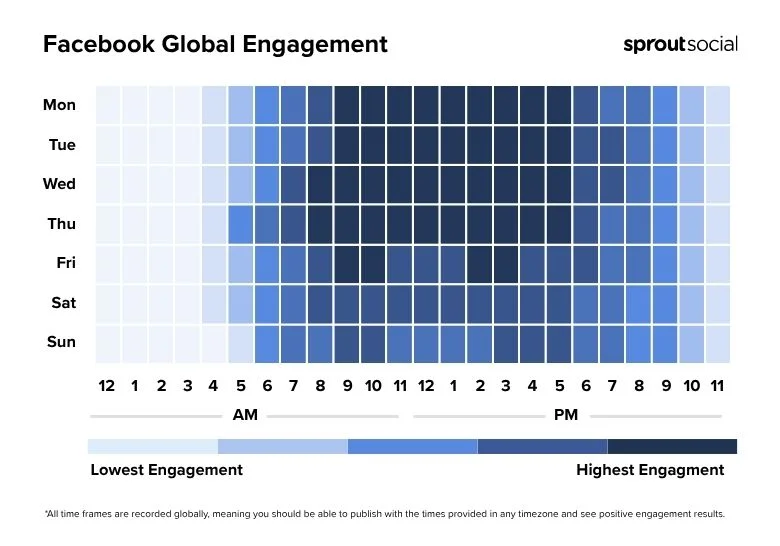
Not only that, but Facebook Ads performance can vary based on time slots. According to the research on Best times to post on Facebook published on SproutBlog in October 2025, posting Monday through Thursday between 9am to 6pm can be more effective.
Factor #5: Placement Strategy
It could be difficult to believe, but where your ad shows up has a major impact on CPC. In fact, the 2025 report by Affect Group revealed that the use of Advantage+ Placements is the main reason for the drop in CPC as a result of the increased efficiency of the inventory.
On the other hand, the manual selection of just a few placements leads to an increase in CPC due to limited optimization flexibility. I used to test by placing an advertisement with the same creative, same copy, CTR in different place in Facebook respectively in 1 month and here is what I’ve got 1 month:
- Advantage+ placements: $0.95 average CPC
- Feed only: $1.42 average CPC
- Stories only: $1.18 average CPC
- Reels only: $0.88 average CPC
- Audience Network included: $0.73 average CPC (but watch quality)
You can start Advantage+ Placements and let Facebook find the cheapest one. After 7 days, you can review all the placements to evaluate the best.
Factor #6: Other Factors
Besides these factors above, there is something you need to note:
- Bidding strategy: Your bidding strategy (can be manual, goal-based, or budget-based) can determine your CPC.
- Location: Where you live in the world can affect your average Facebook CPC.
- Ad Formats: Match your Facebook ad format to your desired user interaction. Experimenting with different formats can increase clickability.
What Is A Good CPC For Facebook Ads?
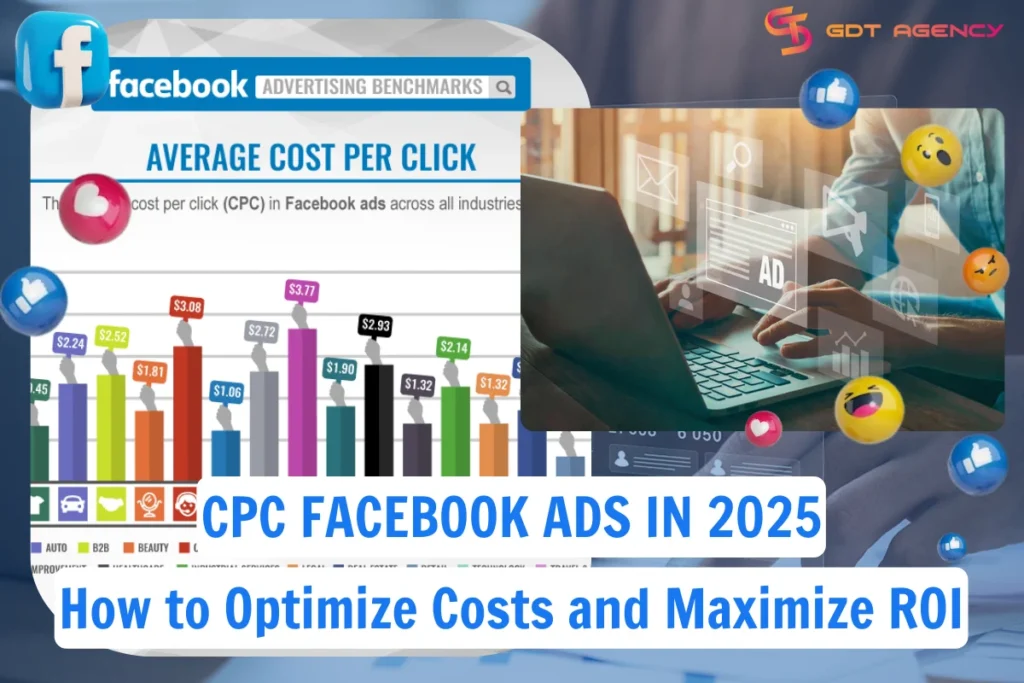
To be honestly, a good CPC on Facebook is always going to be different from an advertiser to another all the time. According to Wordstream, the average CPC of 2025 for Facebook ads across all industries is approximately $1.72. However, this cost can vary significantly based on the industry, target audience, and other factors.

Facebook ad expenses are continuously changing, so how can we keep ahead of the curve? We rely on reliable sources to collect and evaluate data, giving us useful benchmarks to inform our advertising selections.
It is crucial to understand that different sources may provide disparate results because of variances in data collection procedures. This emphasizes the importance of critically analyzing multiple sources and considering the context of these differences to have a complete understanding.
6 Tactics To Reduce Average CPC For Facebook Ads
Lowering your average CPC can significantly impact your Facebook Ad ROI. These 6 tactics will show you how to achieve cost savings and maximize your results. Here’s my proven framework from managing thousands of campaigns:
Tactic #1: Implement the 3-3-3 Creative Testing Method
As the name of the tactics, 3-3-3 creative testing is the method that you’re constantly feeding Facebook fresh creative before ad fatigue happens. It’s quite easy: every week, you test: 3 new image variations, 3 new video hooks, and 3 new headlines or copy angles.

Then keep the winner with the best performance, and eliminate the losers. And repeat this process.
Let me explain it for you with the simple spreadsheet we use for one of our clients:
|
Week |
Creative Test | CPC | Winner |
| Week 1 | A, B, C | $0.92, $1.45, $0.78 | C |
| Week 2 | D, E, F | $0.81, $1.02, $0.69 | D |
| Week 3 | G, H, I | $0.73, $0.88, $0.71 |
I |
Over 3 weeks, you can see the CPC dropped from $0.92 to $0.71 through systematic testing.
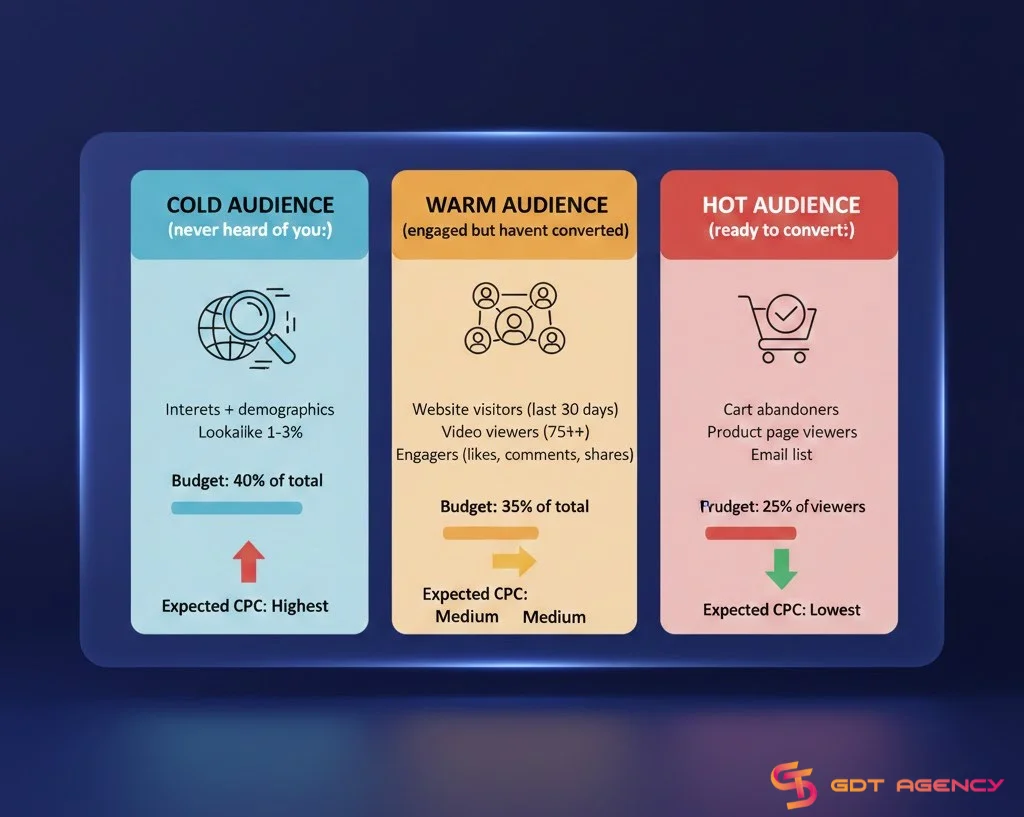
Tactic #2: Audience Segmentation by Temperature
Segmenting audiences by engagement level (cold, warm, hot) is crucial for efficiency. Budgets aligned by audience temperature optimize spend according to expected CPC and conversion likelihood.
With this method, you can decrease the average CPC while conversion rates rise because you’re targeting more qualified prospects with warmer segments.
You can refer to our standard structure below:
Tactic #3: Optimize your ad CTR
Boosting your average CTR for Facebook Ads is crucial for both cost efficiency and relevance. A higher CTR signals to Facebook that your ad resonates with your target audience, leading to a higher relevance score and lower ad costs.
To achieve this, I recommend focusing on three key areas:
-
Strategic Ad Placement: Utilize the desktop newsfeed ad placement, which tends to generate higher CTRs over time.
-
Compelling Call-to-Action (CTA) Buttons: Tailor your CTA to your audience. For example, for cold audiences unfamiliar with your brand, the “Learn More” button can be more effective than a more direct CTA like “Shop Now.”
-
Clear and Concise Ad Copy: Craft straightforward, compelling copy that communicates your message and the value proposition of your offer.
A high CTR indicates that your ad reaches the right audience and resonates with their interests, resulting in lower costs per click (CPC). Conversely, a low CTR suggests irrelevance, leading to increased CPC as Facebook deems your ad less valuable to users.
By focusing on strategic ad placement, compelling CTAs, and clear ad copy, and diligently tracking your CTR using a social media dashboard, you can significantly improve your Facebook ad performance and achieve your marketing goals more efficiently.
Tactic #4: Launch Retargeting Campaigns
The Meta pixel collects useful information about your website users, such as their browsing history and interactions, and connects it to their Facebook profiles. This data enables you to generate highly personalized retargeting adverts that are relevant to their interests and needs.
Re-engage your audience with personalized Facebook retargeting Ads.
- Abandoned Cart Ads: Remind customers of the products they left behind and inspire them to finish their purchases.
- Landing Page Ads: Tailored messages, depending on the particular pages users viewed on your website, should highlight pertinent goods or services.
- Recent Visitor Ads: Keep top-of-mind with recent website visitors to support continuous offers or promotions and enhance brand awareness.

Tactic #5: Mobile-First Everything
Optimizing for mobile is critical, especially when taking into consideration trends and user behavior currently. Traffic campaigns optimized for mobile typically achieve CPCs between $0.50-0.90, while desktop-focused campaigns often see 30-50% higher costs.
The comprehensive checklist below will tackle the typical mobile UX issues that can increase your cost per click and lower your conversion rates.
- Vertical 9:16 video for Stories/Reels
- Text overlay (80% watch without sound)
- Headline under 40 characters
- Landing page loads under 2 seconds on mobile
- Large tap targets (buttons, CTAs)
- Single column layout
Tactic #6: Focus on post-click experiences
Driving clicks with an engaging Facebook ad is only the first step. A smooth and engaging post-click experience is critical for turning clicks into valuable actions. A website that loads slowly or offers a confusing user experience can ruin even the most effective advertising campaign.
Improve Your Post-Click Experience for Facebook Ad Success.
- Tailored Landing Pages: Create specialized landing pages that seamlessly carry the user journey from your Facebook ad, delivering a relevant and engaging experience.
- Optimize for Speed: Reduce load times to avoid user irritation and abandonment. Enhance website performance by compressing graphics, streamlining code, and limiting third-party programs.
- Mobile Responsiveness: Make sure your website adapts smoothly to different screen sizes, giving a favorable experience for the vast majority of Facebook users who browse on mobile devices.
- Simplified Checkout: Use one-click solutions like Shop Pay to reduce friction at checkout, streamlining the buying process and increasing conversions.
How To Monitor Your Facebook CPC
Want to keep a close eye on your Facebook ad costs? Head to your Meta Ads Manager and customize your columns to display your CPC. Here’s how: click the column button with three vertical lines, then select “Customize columns” and choose the relevant metrics.

Enter CPC in the text field and choose either CPC (All) to track all link clicks, including comments, shares, and likes, or CPC (link clicks) to track only clicks related to your ad target. You can rearrange the columns by dragging them up and down the gray column on the far right of the window. When you are ready, click “Apply”.

FAQs About CPC Facebook Ads
1. What really is CPC in Facebook Ads?
CPC (Cost Per Click) is what you pay each time someone clicks on your ad, on any Facebook Ads placement. It’s calculated by dividing your total spend by the number of clicks received.
2. What’s considered a good CPC for Facebook ads in 2025?
A good CPC on Facebook will always differ from one advertiser to another as good performance is relative to the industry, the product, the audience, etc.
3. Why is my Facebook ad CPC suddenly increasing?
Several factors affect CPC: your audience targeting, competition in your industry, campaign objective alignment, and creative performance, place strategy. If your ad isn’t getting engagement or relevance is low, CPC tends to increase.
4. Do desktop and mobile Facebook ads have different CPCs?
Yes, there’s a noticeable difference between platforms. Mobile CPCs often run lower than desktop.
5. Should I optimize my campaigns for CPC or conversions?
For most businesses, optimizing for conversions will deliver much better ROI than focusing purely on CPC. A low CPC is meaningless if those clicks don’t convert. However, if you’re running awareness campaigns or some kind of content promotion, CPC optimization might potentially make sense, although most experts have switched to conversion optimization by now.
Conclusion
After all, I hope you understand everything about CPC Facebook Ads, from how to set the CPC to the way to lower the average CPC for Facebook Ads. I hope this information has been useful to you.
If you have any questions about Facebook Advertising or need additional help, please contact GDT Agency immediately. We’re always ready to help you.

Follow if you find it useful


Was this helpful?
Thanks for your feedback!
You can contact us, with our experience in successfully deploying thousands of conversion advertising campaigns, GDT Agency confidently believes we can help you optimize effectiveness and maximize cost savings with advertising operations.