What Is CPA Facebook Ads? How To Calculate, Optimize This Metric?


After handling more than 3,500 ad accounts and spending millions of dollars across 18 countries, I can tell you that Cost Per Action (CPA) is the most reliable metric to evaluate the campaign’s state. In this article on CPA Facebook Ads, I will show you everything from what is CPA Facebook ads to the latest rules and helpful techniques to reduce your cost per action.

What Is CPA Facebook Ads?
CPA, which stands for Cost Per Action or Cost Per Acquisition, is an advertising metric that measures the average amount you have to pay each time a user completes a desired action through your ad.
Desired actions can be:
- Purchase (e-commerce)
- Lead submission (form fills)
- Registration (sign-ups)
- App install (mobile apps)
- Add to cart (e-commerce funnel tracking)
- Book an appointment (service businesses)
- Download (digital products)
Why is CPA Important for Advertisers?
If CPC (cost per click) metric shows the amount you pay when someone clicks (no matter they convert or not), and CPM (cost per thousand impressions) shows the amount you pay for the ability, CPA tells you the real costs of acquiring customers or leads.

With CPA, you can:
- Direct Measurement of Campaign Effectiveness: CPA is a clear and direct indicator that shows how much it costs to attract a new customer or achieve a specific goal.
- Optimization of Ad Spend: CPA monitoring allows advertisers to spend their funds more wisely by directing them towards those campaigns that produce the most effective results.
- Setting Realistic Goals: CPA helps advertisers set achievable targets for their campaigns.
- Improving Campaign Performance: With the help of CPA data analysis, advertisers can determine where to make improvements and thus make changes based on data.
- Measuring ROI: CPA is a key component in calculating Return on Investment, allowing advertisers to assess the profitability of their campaigns.
In short, for Facebook advertisers, CPA is an essential indicator since it not only sheds light on the performance of the campaign but also assists in the proper allocation of ad spend and the making of data-driven decisions.
Example from a real campaign:
One of our e-commerce clients at GDT Agency used to think they were winning and celebrating a 2.5% CTR. But they don’t know that their CPA was $85 for a product with $60 average order value. It means they were losing $25 per sale.
After we fixed their landing page (slow load time, confusing checkout), CPA dropped to $38. With the same ads, same targeting, same CTR, but the result is different when having more clicks actually converted into purchases.
That’s why I emphasized that CPA matters more than vanity metrics.
How To Calculate CPA In Facebook Ads
Facebook CPA is measured by dividing the cost of the advertisement by the number of successful conversions. You can calculate CPA following the formula below:

In simple words, if you’ve invested $200 in your advertising campaign and you’ve gotten 10 desired actions. In this case, your CPA would be $200 divided by 10, which equals $20.
>>>Learn More: Facebook Ads Reporting Full Detailed Guide For All Advertisers
What Is A Good CPA for Facebook Ads?
Based on data from thousands of campaigns we manage at GDT Agency and industry reports, a good CPA for Facebook ads in 2025 varies significantly by industry, with the overall average across all industries about $19.68/action.
According to the report on Facebook Ad Statistics that was published on SQMegazine in October 2025, Pets & Animals has the highest CPA at $56.89, followed by the Finance industry with $44.23 CPA, and Business & Industrial at $41.28.
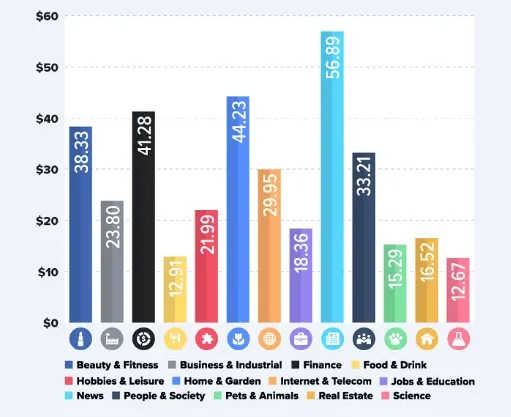
The CPA of the Beauty & Fitness industry averages $38.33, while the Real Estate industry averages $33.21. People & Society Industry has a CPA of $29.95, and Jobs & Education stands at $23.80.
Home & Garden is $21.99, News and Internet & Telecom have the lower CPAs at $18.36 and $15.29, respectively. The lowest CPA belongs to the Science Industry with just $12.67, followed by Food & Drink at $12.91.
However, that average number is almost useless because CPA varies dramatically by:
- Industry and competition level
- Ad format and creative quality
- Geographic targeting
- Funnel optimization
- Whether you’re running cold traffic or retargeting
How CPA Facebook Ads Changed in 2025?
2025 witness a significant change in the way to run Facebook ads, and of course CPA Facebook ads metric is not exempt. Here’s what changed:
1. Stricter Targeting and Anti-Discrimination Policies
Meta’s privacy protection measures have been significantly strengthened and their targeting options drastically reduced, especially with regard to restricted categories that cover housing, employment, credit and financial services, social issues, elections, or politics.
For these categories, the limitations include that you are not allowed to target by Age (only 18-65+), Gender, ZIP code, or radius less than 15 miles, and even some of the interest categories, so that your targeting will not be hyper-specific anymore.
Currently, Meta wants you to use Broad audiences, Advantage+ audience, Large custom audiences from your pixel or customer lists, and Lookalike audiences based on quality data.
2. Sensitive Industries Face Stricter Compliance
If you’re in healthcare, financial services, real estate, or other regulated industries, compliance has become a critical factor in CPA. Meta now reviews your ad copy and claims, your content on the landing page, and your business verification very carefully.
The non-compliant ads will have lower delivery (less reach for the same budget), higher auction costs, and be restricted to potential accounts. Therefore, if you’re in a regulated industry, my recommendation for you is that you should invest in proper compliance infrastructure first.
3. AI-Driven Optimization Is Now the Default
Meta’s AI systems have gotten dramatically better at optimizing delivery. Now AI handles automatically in bid adjustments in real-time, the budget allocation across ad sets, delivery timing, audience exploration, and creative rotation to show better-performing.
In 2025, the algorithm does most of the heavy lifting that advertisers used to do manually. Manual optimization is becoming less effective than letting the AI work. Fighting the algorithm usually increases CPA.
4. Video Content Gets Algorithmic Priority
Due to the reasons that Meta rewards the ads that keep people on the platform longer, Meta’s algorithm in 2025 heavily favors video content, especially short-form formats that drive engagement, because it does this better than static images.
The algorithm gives better delivery (lower CPMs, better placement) to ads that are considered “high quality.” At GDT Agency, we tested identical offers with static images vs. video creative across 20 campaigns in Q1 2025, and we realized that:
- Video campaigns averaged 32% lower CPA, got 2.3x more engagement, and 40% lower CPM.
- While running static image ads makes us pay 30-50% more than we should.
How To Reduce CPA Facebook Ads?
Optimizing CPA means you will optimize your advertising to be low cost but still bring high conversion efficiency. To reduce CPA and save advertising costs, improve results, and increase ROI, you can refer to these methods I use across client accounts at GDT Agency that consistently drive CPA down, tested across different industries and budgets.
Adapt Your Targeting Strategy to New Privacy Rules
As I mentioned previously, when Meta removes the detailed targeting options, you can’t rely on hyper-specific targeting anymore. However, you can try:
1. Use Broad Audiences: You can start with just age, gender, and country. I know it sounds a little bit scary, but it will deliver lower CPAs than narrow targeting. Just let Meta’s algorithm find converters within that broad group.
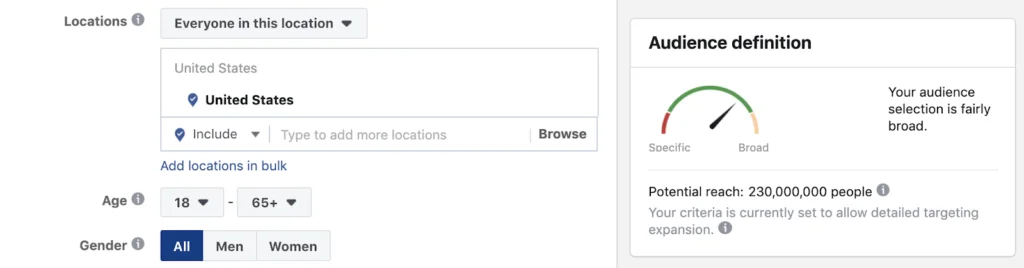
Real example: We had an e-commerce client selling women’s activewear. They were targeting:
- Women 25-45
- Interest: Yoga + Fitness + Healthy Lifestyle + Specific activewear brands
- CPA: $42
We tested broadly:
- Women 25-45
- United States
- No other targeting
CPA dropped to $31 in 14 days. The algorithm found yoga enthusiasts, gym-goers, and buyers we never would have thought to target.
2. Build Large Custom Audiences: You can also upload customer lists, create website custom audiences with longer windows (180 days instead of 30), and feed Meta with the data about who actually converts.
3. Create Quality Lookalikes: To build lookalike audiences from the best customers (not all), I often use:
- Top 25% customers by lifetime value
- Recent purchasers (last 90 days)
- People who purchased specific high-margin products
4. Implement Conversion API properly: iOS privacy changes mean pixel tracking is incomplete. Conversion API sends conversion data directly from your server to Meta, bypassing browser restrictions.
Properly implemented Conversion API typically improves CPA by 15-25% just from better data.
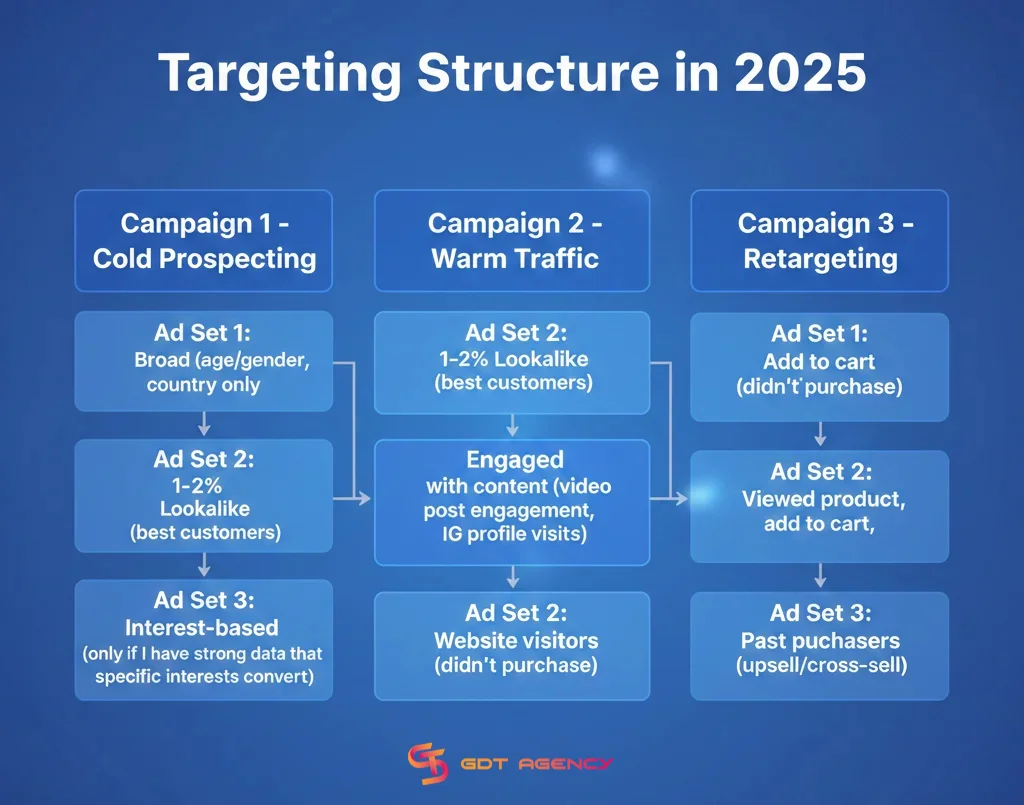
You can also refer to my targeting structure in 2025 below:
Improve Creative Quality (Especially Video)
Improving the quality of the creative seems to be the most effective way to lower CPA due to the priority of Meta’s algorithm for content that engages people and keeps them on the platform, especially video. To create content that engages people, you can:
1. Applying the 3-second rule: Before people scroll past one video, you will have 3 seconds to hook their attention, and these 3 seconds determine everything. Here are some ways to create a hook that I think are effective:
- Pattern interrupts (like unexpected visuals or statements)
- Direct benefit statements (like “Here’s how I lost 15 pounds in 30 days”)
- Curiosity gaps (like “The one thing dermatologists don’t want you to know”)
- Relatable problems (like “Tired of acne products that don’t work?”
2. UGC-style content wins: User-generated content is expected to outperform polished advertising in 2025.
3. Video format priorities: Here are some remarkable notes when using video format priorities:
- Using Vertical video (9:16 ratio): You need to take advantage of vertical video to be native to mobile and get the best delivery on Reels and Stories.
- The duration is about 15-60 seconds: This time is enough for attention and message delivery.
- Priority Mobile-first: 90%+ of Facebook users are on mobile. Therefore, you need to design for small screens.
You can also refer to my creative production process below:
- Week 1: Create 5 new video concepts
- Week 2: Launch all 5, equal budget, let the algorithm test
- Week 3: Identify the winner (lowest CPA, best engagement)
- Week 4: Create 3 variations of the winner, test again
- Repeat forever
This continuous testing is the way we keep CPA low, even as audiences fatigue and competition increases.
Strengthen Tracking and Funnel Structure
No matter how perfect your ads and targeting are, if your tracking is broken or your funnel has problems, your CPA will be terrible. To strengthen tracking and funnel structure:
- Meta Pixel must fire correctly: using Facebook’s Pixel Helper Chrome extension to test your Meta Pixel.
- Conversion API is non-negotiable: With iOS privacy changes, pixel-only tracking misses 30-40% of conversions. Conversion API fixes this by sending data server-side.
- Proper event setup: Make sure you’re tracking the right events.
- Event verification: In Events Manager, you need to verify receiving data, matching between pixel and conversion API, and attributing correctly in all your events.
- Optimize your landing pages: You need to optimize your landing pages to ensure fast loading, what you’re offering, minimal friction, and form collecting only essential information.
Use Meta’s AI and Automation Tools Properly
You can use some tools to help you work easily:
1. Advantage+ Shopping Campaigns: You can use this tool to handle audience targeting, Ad placement, Creative optimization, and Budget distribution.
2. Campaign Budget Optimization (CBO): CBO typically reduces CPA by automatically shifting budget to winning ad sets faster than human optimization. Instead of manually setting ad set budgets, let Facebook distribute the budget across ad sets based on performance.
3. Dynamic Creative: With this tool, you can upload multiple headlines, primary text options, images./videos, and CTAs. Facebook will automatically test these combinations and show the best performance.
4. Advantage+ Placements: With this tool, Facebook will show your ads across all placements and automatically allocate them to the best-performing.
>>>Related article:
FAQs About CPA Facebook Ads
1. What is CPA in Facebook Ads?
The term CPA stands for Cost Per Action, which is the fee charged by the platform for every action performed by the user that you are optimizing for, like a purchase, registration, or lead generation etc.
2. Why is my CPA so high?
Some of the major reasons include low quality of creative, landing pages with slow loading time, broken tracking, very tight targeting, not enough budget allotted for the learning phase, and high competition in your niche.
3. Does retargeting always lower CPA?
Typically, yes, as you are connecting with people already aware of your brand. The usual retargeting CPA is 30-60% lower than that of cold traffic. If yours is not, then look into your pixel tracking and funnel.
4. How do I reduce CPA quickly?
Strategies for the quickest wins are: enhance your creative (especially video hooks), resolve any tracking problems, experiment with wider audiences, and smooth the landing page for visitors. These 4 usually result in a 20-30% reduction of CPA within two weeks.
5. How long should I wait before judging CPA?
New campaigns should be allowed at least 5-7 days and 50 conversion events before major decisions are made. The algorithm takes time to learn. Early performance is often not an accurate predictor of final performance.
Bottom Line
I hope that my share on CPA Facebook ads can help you get ready to take your Facebook advertising to the next level. By understanding and optimizing your CPA, you can unlock the full potential of your campaigns. Remember, the key to success lies in data-driven decision-making and a relentless pursuit of improvement.
If you have questions related to Facebook Advertising or need additional help, feel free to contact GDT Agency. Our seasoned expert team will immediately support you in the game of Advertising.

Follow if you find it useful


Was this helpful?
Thanks for your feedback!
You can contact us, with our experience in successfully deploying thousands of conversion advertising campaigns, GDT Agency confidently believes we can help you optimize effectiveness and maximize cost savings with advertising operations.