How to Run Facebook Ads for Photographers and Book More Clients

Photographers can run Facebook Ads successfully when they combine clear targeting, strong creative, and a tested follow-up process. This method works because Facebook still holds the largest local audience pool for service-based businesses in the United States, and photographers can reach couples, families, and business owners who are actively planning a shoot. Many photographers try ads once, get a few bad leads, and give up before they understand the setup.
Photography businesses face a specific challenge with Facebook Ads. Their buyers do not purchase often, so the ad account needs a longer runway to collect data and optimize. This means budget, patience, and account stability all matter more than they do for a typical e-commerce store.
Cost also becomes a common concern for photographers who want to test ads without wasting their marketing budget. A photographer does not need thousands of dollars to start, but the budget must match the goal, whether that goal is inquiries, bookings, or brand awareness in a new city.
Below, this guide walks through the full process step by step, from campaign setup to tracking results, and includes a real case study from an agency that scaled Facebook Ads for a working photographer. Photographers who follow this process gain a repeatable system instead of a one-time experiment.
- What Is Facebook Ads for Photographers?
- Do Facebook Ads Actually Work for Photographers?
- How Do You Set Up a Facebook Ad Campaign for Your Photography Business?
- How Do You Define Your Campaign Objective and Target Audience?
- How Do You Create Ad Creative That Converts Inquiries into Bookings?
- Case Study: 30 Days Turn $1200 to $14500 for Luminus Photography Brand
- Challenges with Luminus Before Working With Us:
- What Luminus Really Wants?
- What GDT Agency Does to Help Luminus Boost Its Revenue?
- 2. Built a Three-Stage Facebook Ads Funnel
- How Much Should Photographers Budget for Facebook Ads?
- What Are the Best Facebook Ad Strategies to Book More Clients?
- How Does Retargeting Help Book More Clients?
- How Does a Lookalike Audience Improve Ad Results?
- How Do You Track and Measure Facebook Ad Performance?
- What Common Facebook Ad Mistakes Should Photographers Avoid?
- How Does Meta Advantage+ Change Facebook Ads for Photographers?
- Facebook Ads vs Instagram Ads: Which Platform Works Better for Photographers?
- What Facebook Ad Strategy Works Best for Wedding Photographers?
- Final Thoughts
- FAQs
- Do Facebook Ads work for wedding photographers specifically?
- How long does it take to see results from Facebook Ads?
- What is a good cost per lead for photography Facebook Ads?
- Can a personal Facebook ad account handle a growing ad budget?
- Should photographers run Facebook Ads or Instagram Ads?
- What is Meta Advantage+ and should photographers use it?
What Is Facebook Ads for Photographers?
Facebook Ads for photographers is a paid promotion system inside Meta Ads Manager that helps photographers reach potential clients based on location, interests, and life events. Unlike a regular Facebook post, an ad reaches people who do not already follow the photographer’s page.
This distinction matters because organic reach on Facebook has dropped for years, and most photography pages now reach a small fraction of their followers without paid support. Facebook Ads solves this gap by putting a photographer’s work in front of new people who match a defined audience profile.
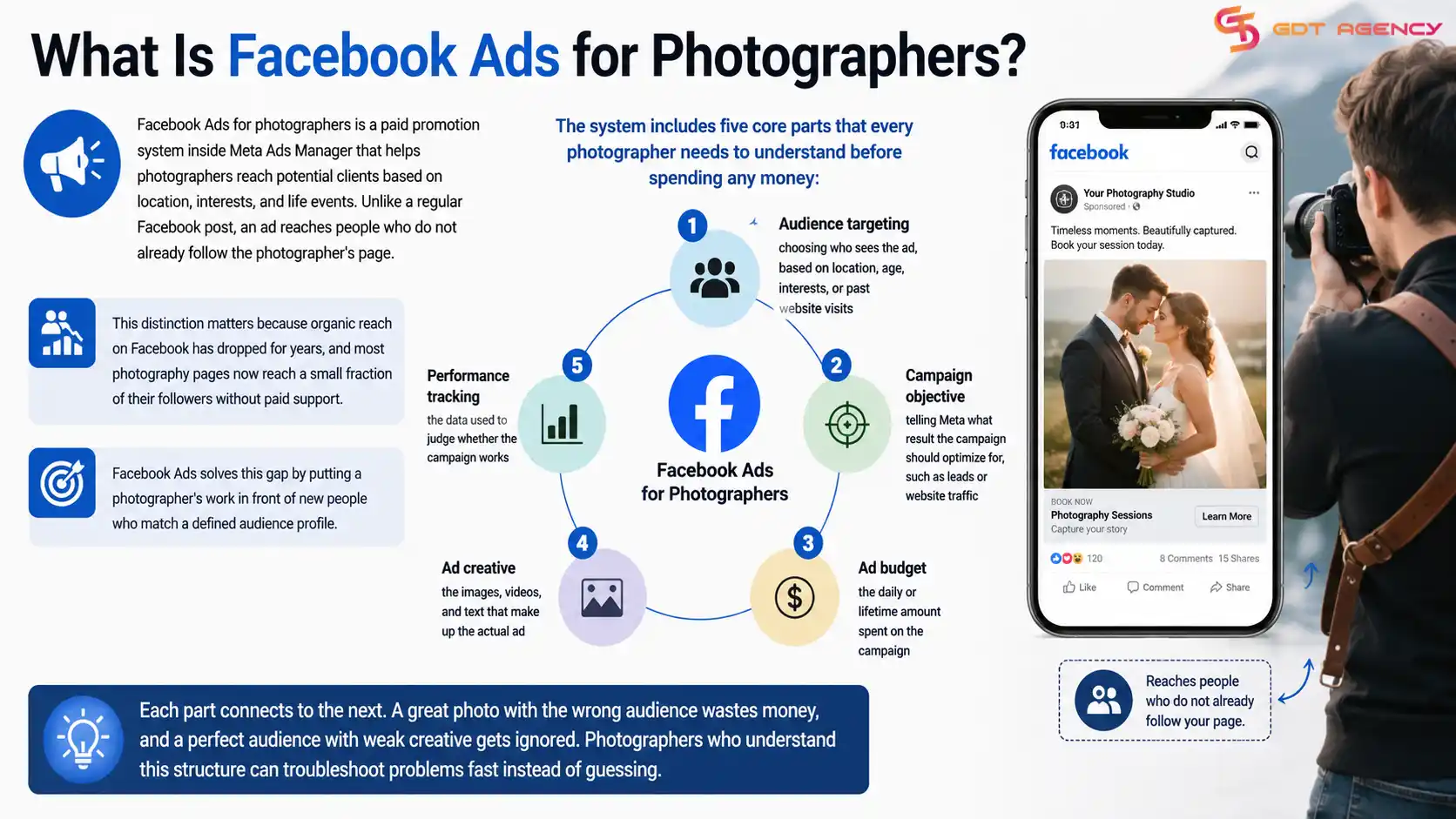
The system includes five core parts that every photographer needs to understand before spending any money:
- Audience targeting: choosing who sees the ad, based on location, age, interests, or past website visits
- Campaign objective: telling Meta what result the campaign should optimize for, such as leads or website traffic
- Ad budget: the daily or lifetime amount spent on the campaign
- Ad creative: the images, videos, and text that make up the actual ad
- Performance tracking: the data used to judge whether the campaign works
Each part connects to the next. A great photo with the wrong audience wastes money, and a perfect audience with weak creative gets ignored. Photographers who understand this structure can troubleshoot problems fast instead of guessing.
→ Photographers are just one of many industries that rely on Facebook Ads to generate qualified leads and bookings. Different business models, including e-commerce stores, real estate agencies, SaaS companies, healthcare providers, and local service businesses, often require different campaign structures, budgets, and account setups. If you want to see how Facebook advertising strategies and ad account requirements vary across industries, explore our guide to Facebook Ad Account by Business Type: Use Cases and Verticals.
Do Facebook Ads Actually Work for Photographers?
Yes, Facebook Ads work for photographers when the campaign targets the right local audience and uses creative that shows real client results. Most wedding brands I used to talk to have the same problem with Facebook ads. They boost a few posts, maybe spend $100-200 on ads to get a couple of likes, but don’t get any real bookings. They eventually consider “Facebook ads don’t work for them.” But it’s not true.
As a CEO and Founder of GDT Agency who’ve spent more than 5 years working with Facebook ads in multiple fields with multiple ad account types like BM or a Facebook agency account, I can affirm that photographers across wedding, family, newborn, and commercial niches use Facebook Ads to fill their booking calendar during slow seasons.
This answer comes with a condition, though. Photographers often ask this question after a failed attempt, so it helps to explain why ads succeed for some and fail for others.
Three factors decide whether Facebook Ads work for a specific photographer:
Audience precision. A wedding photographer who targets “newly engaged” audiences within a 50-mile radius sees far better results than one who targets an entire state.
Creative quality. Photos and videos need to show finished work, not behind-the-scenes shots. Facebook favors visual products, and photography sells itself when the samples look professional.
Response speed. Leads from Facebook Ads expect a fast reply. Photographers who respond within an hour convert far more inquiries than those who wait a day or more.
Photographers who control these three factors give ads a real chance to work. The next section shows exactly how to set that structure up inside Ads Manager.
How Do You Set Up a Facebook Ad Campaign for Your Photography Business?
Photographers set up a Facebook ad campaign in Meta Ads Manager by choosing a campaign objective, defining a target audience, and building ad creative that matches buyer intent. The process takes about 30 to 45 minutes for a first campaign.
Ads Manager organizes every campaign into three levels: campaign, ad set, and ad. Each level controls a different part of the setup, and photographers need to get all three right for the campaign to perform.
How Do You Define Your Campaign Objective and Target Audience?
Photographers should choose the “Leads” or “Messages” objective for most campaigns, since these push Meta to find people likely to inquire, not just click. This choice matters more than most photographers realize, since Meta’s algorithm optimizes toward whatever goal is selected.
Once the objective is set, audience targeting narrows the pool of people who see the ad:
- Location: a radius around the photographer’s service area, usually 15 to 50 miles depending on the niche
- Age range: matched to the buyer type, for example, 24-34 for wedding photography or 28-45 for family photography
- Interests: wedding planning, baby registries, or home renovation, depending on the photography niche
- Custom audiences: people who visited the photographer’s website or engaged with their Instagram or Facebook page
Photographers who skip custom audiences miss one of the strongest tools available, since retargeting a warm audience converts at a much higher rate than reaching cold traffic.
How Do You Create Ad Creative That Converts Inquiries into Bookings?
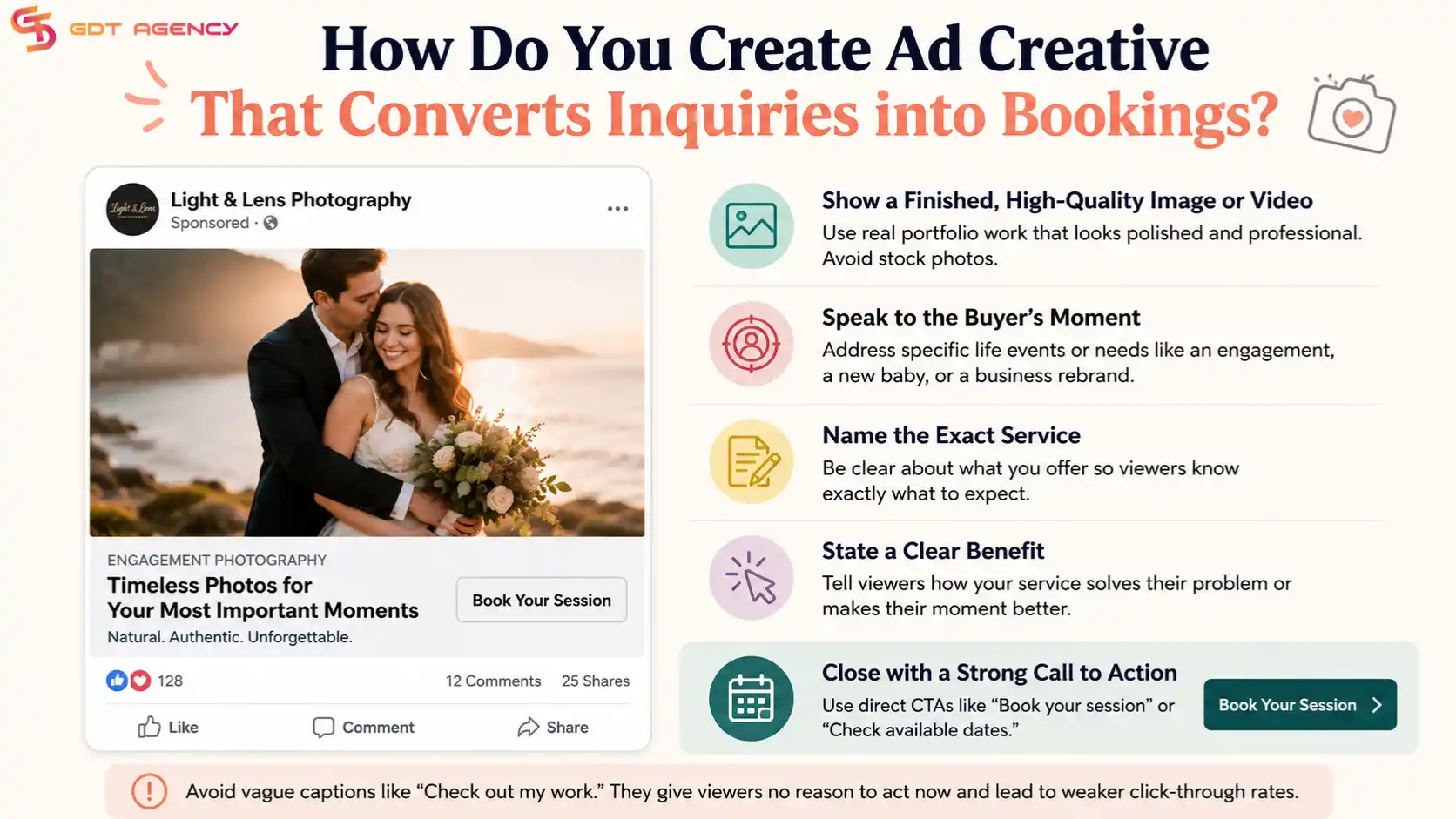
Ad creative should show a finished, high-quality photo or short video with a caption that speaks directly to the buyer’s moment, such as an engagement, a new baby, or a business rebrand. Photographers get the best results when the image looks like a portfolio piece, not a stock photo.
The caption plays an equally important role. A strong caption names the exact service, states a clear benefit, and closes with a direct call to action such as “Book your session” or “Check available dates.” Photographers who write vague captions like “Check out my work” see weaker click-through rates, since the ad gives the viewer no reason to act now.
Case Study: 30 Days Turn $1200 to $14500 for Luminus Photography Brand
Luminus is a wedding and portrait photographer based in Northern California with more than 2 years of experience. Though they have solid work and strong reviews, their lead flow was completely unpredictable, and they reached out to us in mid-2025 with the strong desire to improve.
Challenges with Luminus Before Working With Us:
The problem with this brand is that they almost entirely rely on referrals and word of mouth. Though there are times they’d book 8 – 10 sessions, there are also months they have nothing.
Sometimes they boosted some posts on Instagram and Facebook for $20-$50, but they never saw real bookings come through. They don’t even know their cost per booking or which marketing strategy can bring back the revenue.
No tracking setup. No pixel. No conversion API and no retargeting audiences. Though the wedding season can make their booking highly elevated, they didn’t have a system to maintain their business during the slower months.
What Luminus Really Wants?
After sharing about the current status, to help us understand their challenges. They continually talk about the marketing goal they want to achieve when collaborating with us. Kristina – The CEO of Luminus Brand, shared with us about her expectations that:
“In Luminus, we have talented photographers. We really want to have a predictable lead flow every month, more wedding bookings for the 2025 and 2026 season, and a system to help us run without constantly changing marketing.”
What GDT Agency Does to Help Luminus Boost Its Revenue?
After gathering clear information about Luminus, together, we have analyzed and built a complete system instead of just running some ads. Here’s exactly what we do:
1. Fixed the Technical Foundation
- Moved Luminus from personal ad accounts to a Facebook Agency Ad Account.
- Improved account stability, removed spending limits, reduced restrictions, and gained faster Meta support.
- Set up Meta Pixel, Conversion API (CAPI), custom events, custom audiences, and lookalike audiences to ensure accurate conversion tracking and better optimization.
2. Built a Three-Stage Facebook Ads Funnel
- Top of Funnel (40%): Increased brand awareness with emotional videos, Reels, and storytelling content.
- Middle of Funnel (40%): Generated qualified leads using carousel ads, testimonials, and simple Facebook Lead Forms.
- Bottom of Funnel (20%): Retargeted warm audiences with urgency-based offers to convert leads into bookings.
3. Developed a Smarter Targeting Strategy
- Targeted cold audiences based on life events (engagements), wedding-related interests, and recent engagement.
- Retargeted website visitors, video viewers, and people who opened but didn’t submit lead forms.
- Used 1% and 3% lookalike audiences based on past customers and website visitors to reach similar prospects.
4. Created High-Performing Ad Creatives
- Used story-driven carousel ads to showcase the wedding journey.
- Produced authentic short-form videos featuring real emotional moments to drive engagement.
- Used single hero images with simple messaging for retargeting campaigns.
5. Optimized Budget and Campaign Structure
- Managed a $1,200 monthly budget ($40/day) using a 40-40-20 allocation across awareness, consideration, and conversion campaigns.
- Built three separate campaigns with multiple ad sets and creatives for continuous testing.
- Reviewed performance every few days, paused underperforming ads, and scaled the best-performing creatives and audiences.
The Results: What Happened in 30 Days
To be transparent, the first week was not easy with us. Our initial “Cold Audience” targeting was bringing in leads at $25 each (way too high for our budget).
We realized the broad “Wedding Planning” interest was too noisy, so we advised them to shift to Life Event targeting (people engaged in the last 3 months) and moved more budget into the retargeting phase. By week two, the lead cost dropped significantly as the algorithm began to learn from our custom audience data.
After 30 days, here are the exact numbers Luminus got:
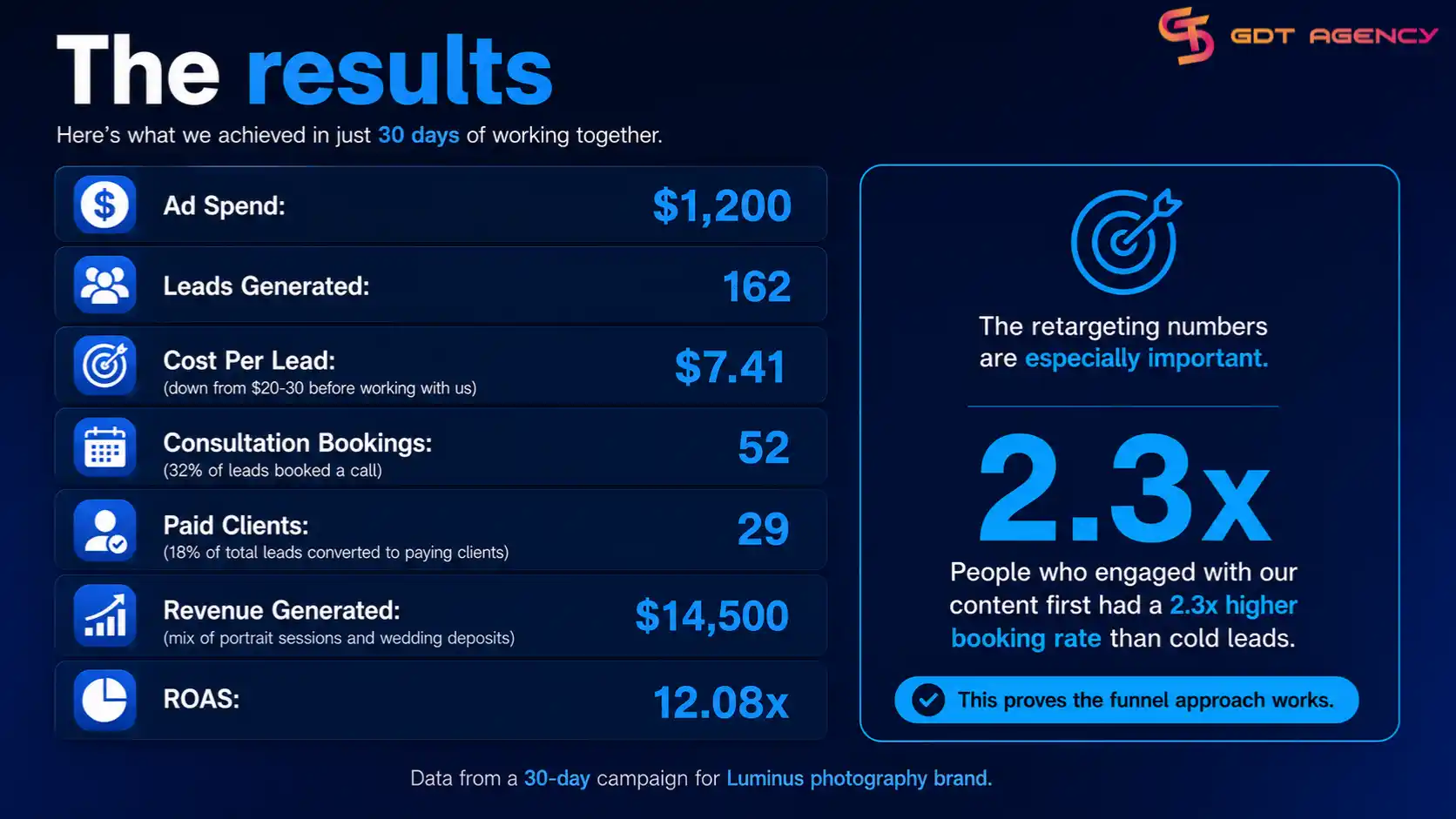
| Ad Spend: | Leads Generated: | Cost Per Lead: | Consultation Bookings: | Paid Clients: | Revenue Generated: | ROAS: |
| $1,200 | 162 | $7.41 (down from $20-30 before working with us) | 52 (32% of leads booked a call) | 29 (18% of total leads converted to paying clients) | $14,500 (mix of portrait sessions and wedding deposits) | 12.08x |
The retargeting numbers are especially important. People who engaged with our content first had a 2.3x higher booking rate than cold leads. This proves the funnel approach works.
How Much Should Photographers Budget for Facebook Ads?
Photographers should budget a minimum of $300 to $500 per month for a new Facebook ad campaign, since this range gives Meta’s algorithm enough data to optimize within four to six weeks. Spending less than this often stretches the learning phase too long to judge real performance.
Budget should scale with cost per lead, not with guesswork. Photographers can calculate a working budget with a simple formula: divide the target number of monthly bookings by the expected conversion rate from lead to client, then multiply that lead count by the average cost per lead in their niche.
For example, a family photographer aiming for 6 bookings a month, with a 30% lead-to-client conversion rate and a $20 cost per lead, needs about 20 leads, which comes out to roughly $400 in monthly spend. Photographers in competitive markets like weddings often see a higher cost per lead, closer to $25 to $40, which raises the required budget.
What Are the Best Facebook Ad Strategies to Book More Clients?
The best Facebook ad strategies for photographers include retargeting website visitors and building lookalike audiences from past clients, since both strategies target people already showing interest or matching a proven buyer profile. These two strategies consistently outperform cold audience targeting alone.
How Does Retargeting Help Book More Clients?
Retargeting shows ads to people who already visited the photographer’s website or engaged with their social media, which keeps the photographer visible during the buyer’s decision window. Most photography buyers do not book on their first visit, so retargeting closes the gap between interest and action.
Photographers set up retargeting by installing the Meta Pixel on their website and creating a custom audience of visitors from the past 30 to 90 days. Ads shown to this group can include client testimonials, limited-time offers, or a direct booking link, since this audience already knows the photographer’s work.
How Does a Lookalike Audience Improve Ad Results?
A lookalike audience improves ad results by finding new people who share traits with the photographer’s existing clients, based on data Meta already has from that client list. This audience type consistently performs better than broad interest targeting, since it starts from real buyer behavior instead of guessed interests.
Photographers build a lookalike audience by uploading a list of past client emails or phone numbers into Ads Manager, then letting Meta match that list against its user base. A 1% lookalike audience, which represents the closest match to the source list, usually performs best for local service businesses like photography.
How Do You Track and Measure Facebook Ad Performance?
Photographers track Facebook ad performance using three core metrics: cost per lead (CPL), click-through rate (CTR), and return on ad spend (ROAS). These three numbers together show whether a campaign attracts attention, generates interest, and produces enough bookings to justify the spend.
Ads Manager displays these metrics on the campaign dashboard, and photographers should check them weekly rather than daily, since daily numbers fluctuate too much to guide real decisions. A campaign needs at least one to two weeks of consistent spend before its numbers become reliable.
Photographers who see a CPL rising steadily over several weeks should review their audience size first, since an audience that is too narrow often gets exhausted and starts costing more per result. A CTR below 1% usually points to a creative problem, not a targeting problem, and calls for new photos or a stronger caption.
>>> Maybe you’re interested in: Facebook Ads for E-Commerce: Setup, Strategy, and Scaling in 2026
What Common Facebook Ad Mistakes Should Photographers Avoid?
Photographers waste money on Facebook Ads most often by targeting an audience that is too broad, using low-quality creative, and turning off campaigns before the learning phase completes. These three mistakes account for most of the failed ad budgets in the photography industry.
A campaign with high ROI shares almost the opposite pattern: a tight, well-defined audience, strong creative built from real client work, and enough patience to let Meta’s algorithm finish its learning phase, which usually takes 50 conversions or one to two weeks. Photographers who stop a campaign after three days rarely see it reach that stage.
How Does Meta Advantage+ Change Facebook Ads for Photographers?
Meta Advantage+ changes Facebook Ads for photographers by using AI to automatically test audience combinations, ad placements, and creative variations within a single campaign. This reduces the manual setup work photographers used to do by hand.
Photographers running campaigns through an agency ad account, such as one managed through GDT Agency, often get earlier access to expanded Advantage+ testing features, since agency-tier accounts typically receive new Meta tools ahead of standard personal accounts.
Facebook Ads vs Instagram Ads: Which Platform Works Better for Photographers?
Facebook Ads work better for reaching a broader local audience across age groups, while Instagram Ads perform better for photographers targeting a younger, visually driven buyer. Both platforms run through the same Ads Manager, so most photographers run both at once rather than choosing one over the other.
Wedding and newborn photographers often see stronger engagement on Instagram, since that platform’s audience skews younger and more visual. Family and business photographers, whose clients span a wider age range, often see steadier results running the same ad on Facebook.
What Facebook Ad Strategy Works Best for Wedding Photographers?
Wedding photographers get the best results by targeting a “newly engaged” audience combined with wedding vendor interests, then showing creative built from full wedding galleries instead of single portrait shots. This niche has a short, high-intent buying window, since couples typically book a photographer within a few months of getting engaged.
Photographers in this niche should also run ads seasonally, increasing budget in January and February when engagement season peaks, since search and inquiry volume for wedding photographers rises sharply during these months.
Final Thoughts
Facebook Ads work for photographers who treat the ad account as part of the business, not a side experiment. The setup process, the budget, and the account infrastructure all decide whether a campaign turns into steady bookings or a frustrating expense.
The case study above shows this clearly. A photographer with strong creative and good targeting still hit a ceiling because her ad account itself kept limiting her spend and pausing her campaigns. Once that infrastructure problem got solved, the same strategy that struggled before started producing real results within weeks.
Photographers who follow this guide should build campaigns in this order: set a clear objective, define a tight local audience, create strong visual ads, watch the core metrics weekly, and give Meta’s algorithm enough time and budget to learn. Skipping any one of these steps usually explains why a past campaign failed.
FAQs
Do Facebook Ads work for wedding photographers specifically?
Yes, Facebook Ads work well for wedding photographers when campaigns target a “newly engaged” audience combined with wedding vendor interests. Wedding photographers should also increase budget during January and February, since engagement season drives the highest inquiry volume.
How long does it take to see results from Facebook Ads?
Photographers typically see reliable data within one to two weeks of consistent spending, since Meta’s algorithm needs time to complete its learning phase. Campaigns judged too early, within the first three to five days, often get shut down before they have a real chance to perform.
What is a good cost per lead for photography Facebook Ads?
Cost per lead varies by niche, with family and portrait photography often ranging from $15 to $25, and wedding photography running higher at $25 to $40. Photographers should compare their own CPL against their booking conversion rate rather than against a fixed industry number.
Can a personal Facebook ad account handle a growing ad budget?
A personal ad account can handle small budgets, but many accounts hit spending limits or face temporary restrictions as spend increases past a few hundred dollars a month. This is the exact problem the case study above addressed by moving to a rented agency ad account with a higher trust score.
Should photographers run Facebook Ads or Instagram Ads?
Most photographers should run both, since they share the same Ads Manager setup and reach different parts of the buyer audience. Facebook reaches a broader age range, while Instagram tends to perform better for younger, visually driven buyers like wedding and newborn clients.
What is Meta Advantage+ and should photographers use it?
Meta Advantage+ is an AI system that automatically tests audience combinations, placements, and creative within a campaign, reducing manual setup work. Photographers new to ads can benefit from turning it on, though agency-managed accounts often get access to expanded testing features earlier than standard personal accounts.