What is a Facebook Ads test account and How to Set Up


A Facebook Ads test account is not a special account type Meta recognizes; it is a regular ad account or campaign used to trial creatives, angles, and targeting on a small budget before scaling spend. It exists to answer one question before real money goes into a full campaign: does this creative, this angle, or this audience actually perform, or does it just look promising on paper?
Setting one up follows five sequential steps: forming a clear hypothesis, isolating one variable, choosing a primary metric, running with a small budget and stop rules, and deciding whether to kill, iterate, or scale, all of which can happen inside your existing Meta Business Manager without creating anything new. Below, this guide breaks down each step, along with how a test account differs from the scaling account it eventually feeds.
- What is a Facebook Ads test account?
- How does a Facebook Ads test account work?
- What are the 2 common structures for a test account?
- How to set up and run a Facebook Ads test account?
- Step 1: Set a clear hypothesis
- Step 2: Change only one variable
- Step 3: Choose your primary metric
- Step 4: Run with a small budget and stop rules
- Step 5: Decide to Kill, Iterate or Scale
- How does a test account differ from a scaling account?
- How does a scaling account work?
- When does a test account move to a scaling account?
- What is the ideal budget split between testing and scaling?
- Final Thoughts
- FAQs
- Is a Facebook ads test account the same as a Meta Sandbox account?
- Do you need a separate ad account just to test Facebook ads?
- Is a small daily budget enough to run a valid ad test?
- Can you test more than one variable at the same time in a test account?
- How long should a Facebook ads test run before you make a decision?
What is a Facebook Ads test account?
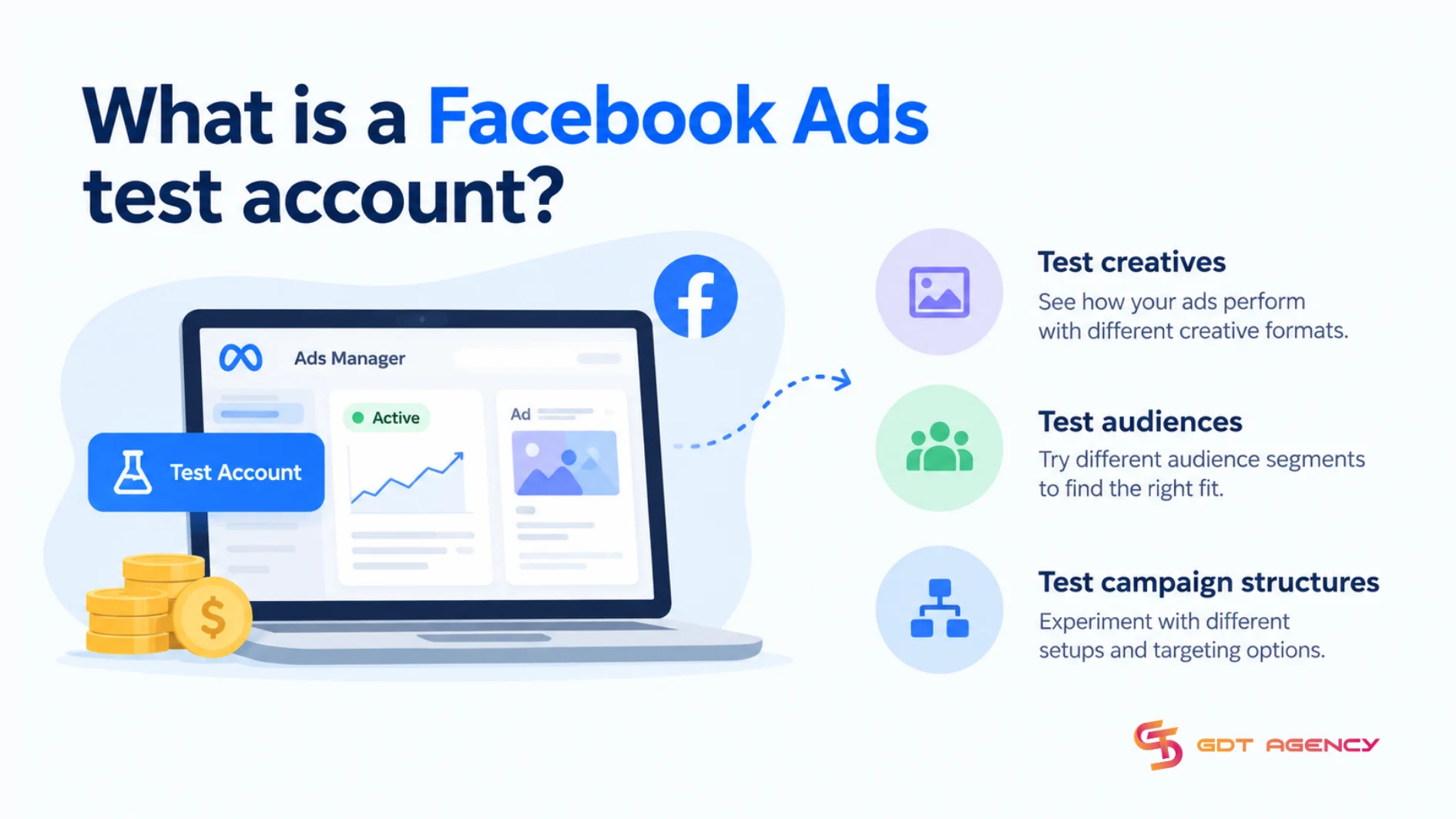
A Facebook Ads test account is not a single official Meta account type. Many advertisers may informally use “test account” to describe a real Meta ad account dedicated to experimentation. In this case, the account can spend real money and reach real users. The practical purpose is to test creatives, audiences or campaign structures under controlled conditions before allocating more budget to a scaling campaign.
As an expert at GDT Agency with 10 years of working with Facebook Ads via multiple account types, from standard to Facebook agency accounts in retail and ecommerce, I have watched brands make the same mistake: they push a brand-new creative straight into a campaign that is already scaling. This can leave marketers unsure whether the issue is the creative, audience, tracking or delivery. Facebook Ads test account helps keep the experiment controlled. With a defined budget, testing period and success criteria, the team can limit downside risk and gather clearer evidence before moving a winning creative into a scaling campaign.
How does a Facebook Ads test account work?
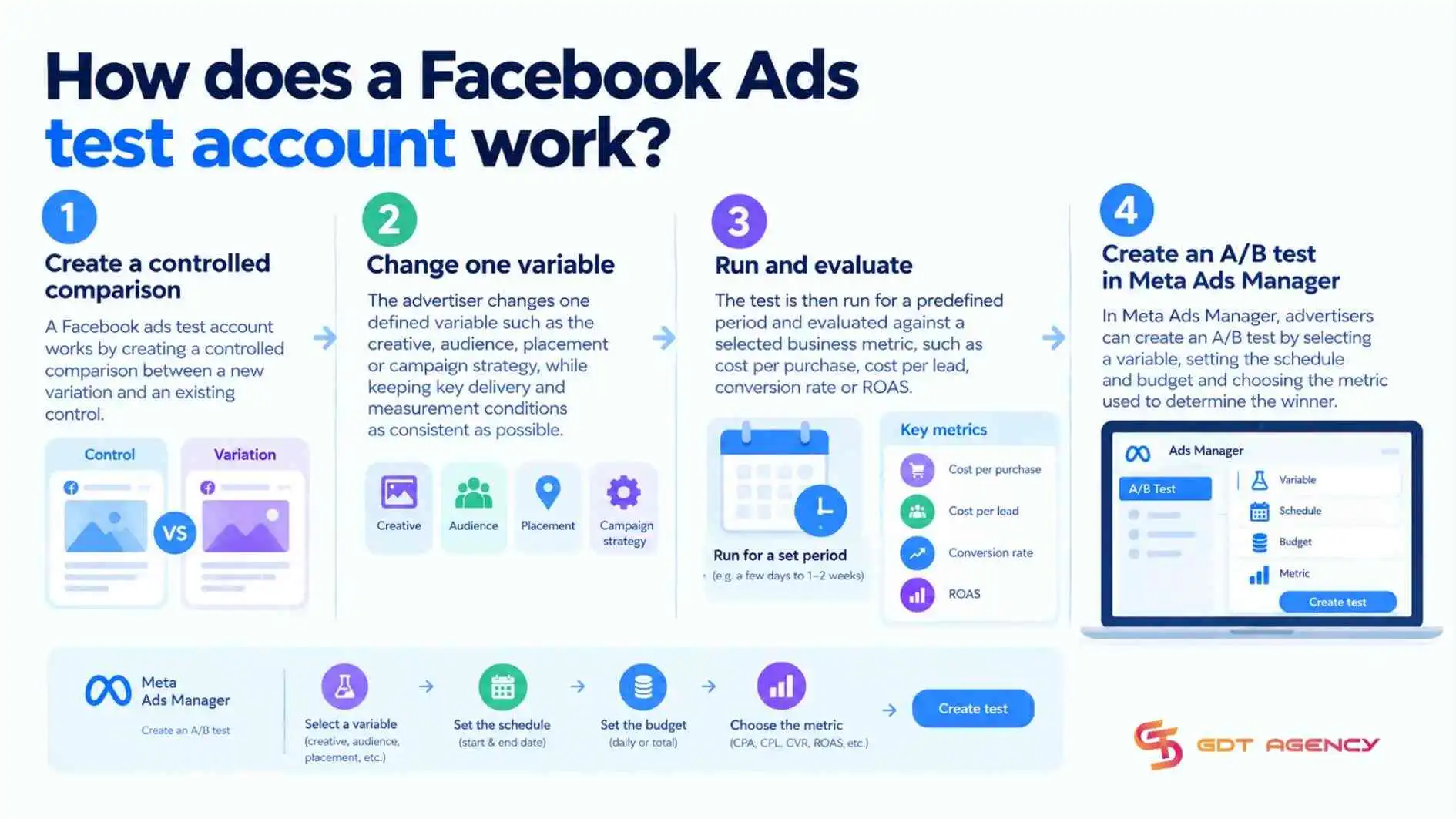
A Facebook Ads test account works by creating a controlled comparison between a new variation and an existing control. The advertiser changes one defined variable such as the creative, audience, placement or campaign strategy, while keeping key delivery and measurement conditions as consistent as possible.
The test is then run for a predefined period and evaluated against a selected business metric, such as cost per purchase, cost per lead, conversion rate or ROAS. In Meta Ads Manager, advertisers can create an A/B test by selecting a variable, setting the schedule and budget and choosing the metric used to determine the winner.
What are the 2 common structures for a test account?
Advertisers commonly build a test account in one of 2 ways, depending on how much separation they want from the main scaling campaign:
- Separate ad account: provides stronger separation for billing, campaign reporting and permissions, but may still share data source, pages, domain, datasets or other business assets.
- Testing campaign or ad set inside the same account: which is usually simpler to operate and compare with scaling activity. ABO gives more explicit control over test budgets, while Campaign Budget Optimization (CBO) allows Meta to redistribute campaign budget dynamically across ad sets.
Many advertisers prefer the second option in 2026 because it keeps reporting, business assets and measurement in one ad account. It may also be easier to reuse existing posts or creative assets. However, advertisers still need to define the control, isolate the test variable, choose the primary metric, control the budget and set a decision rule before launch.
>>> Understanding how Facebook ad account infrastructure works is also important when deciding to set up Facebook Ads test account, connecting tracking, controlling the budget, and evaluating results before scaling.
How to set up and run a Facebook Ads test account?
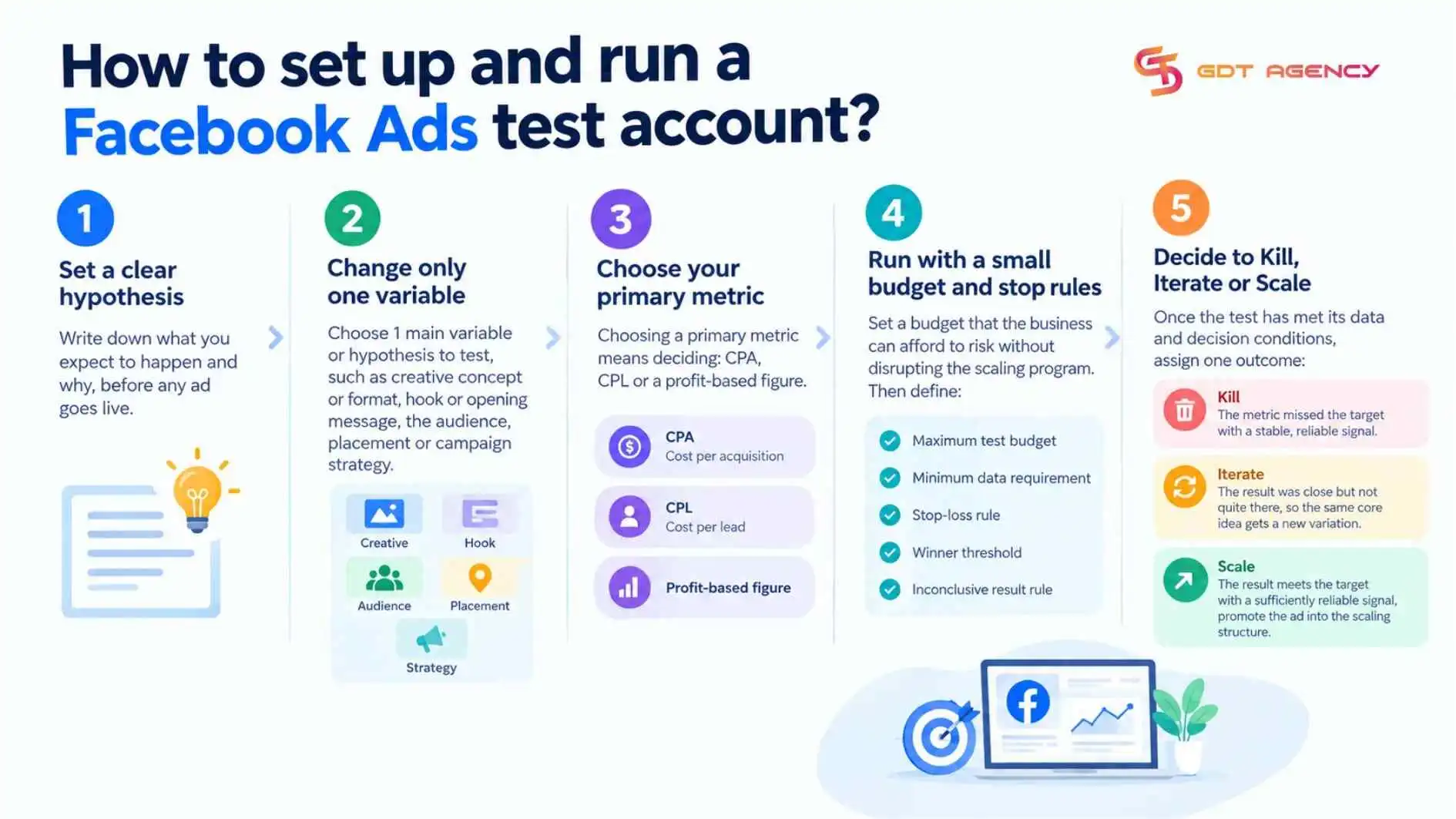
Setting up and running a Facebook test ad account requires 5 steps: form a hypothesis, isolate one variable, pick a primary metric, run on a small budget with stop rules, and decide whether to kill, iterate, or scale the result.
You will need an active Meta Business Manager and at least one existing ad account with a working pixel, since the test account draws on the same tracking setup the scaling account will eventually rely on. With that in place, the process unfolds as follows.
Step 1: Set a clear hypothesis
Write down what you expect to happen and why, before any ad goes live. A hypothesis states a specific belief you’re testing, not just a general idea to explore.
For example, “a testimonial-style video will lower cost per acquisition compared to a static image that leads with the problem” is a real hypothesis, because it names both the format and the expected outcome.
Writing it down first prevents you from unconsciously shifting the goalposts once results start coming in, and gives you a clear answer for what “success ” actually means for this specific test.
Step 2: Change only one variable
Choose 1 main variable or hypothesis to test, such as creative concept or format, hook or opening message, the audience, placement or campaign strategy. Keep the other important delivery and measurement conditions as consistent as possible. If you change the creative and the targeting at the same time, the result will be difficult to attribute to one cause.
Step 3: Choose your primary metric
Choosing a primary metric means deciding, before launch, which single number will determine whether the test wins or loses. For most advertisers running a test account, that number is cost per acquisition (CPA), cost per lead (CPL), or a profit-based figure, depending on the business model. Click-through rate (CTR) and cost per click (CPC) help diagnose why something isn’t working, but they should not determine a conversion test on their own, since a high CTR with a poor conversion rate isn’t a win.
Step 4: Run with a small budget and stop rules
Set a budget that the business can afford to risk without disrupting the scaling program. Then define:
- Maximum test budget
- Minimum data requirement
- Stop-loss rule
- Winner threshold
- Inconclusive result rule
For example: “Pause the test if it spends 3 times the target CPA without producing a purchase, provided tracking is working and the minimum evaluation condition has been met.
Avoid making repeated edits while the ad set is learning, because significant edits can affect delivery and the learning process.
Step 5: Decide to Kill, Iterate or Scale
Once the test has met its data and decision conditions, assign one outcome:
- Kill: the metric missed the target with a stable, reliable signal, so the creative or angle gets retired.
- Iterate: the result was close but not quite there, so the same core idea gets a new variation with one variable changed.
- Scale: the result meets the target with a sufficiently reliable signal, promote the ad into the scaling structure.
The scaling structure may be a campaign in the same ad account or a separate scaling account. Moving a winner doesn’t guarantee that it will retain the same CPA at a larger budget, so monitor delivery, marginal CPA, frequency and profitability after promotion.
How does a test account differ from a scaling account?
A test account and a scaling account differ in 4 ways: the goal each one serves, how budget gets allocated, the budget-optimization mechanism behind it, and the criteria used to decide what happens next.
A test account should not be confused with a demo account, either. Unlike a sandbox ad account, which runs in a sandbox environment with no real spend and no real audience, a test account spends real budget against a real audience, so the CPA or CAC it produces only means something because the risk behind it is real, just kept deliberately small.
A scaling account, by contrast, is a campaign or ad account that holds only creative and targeting already proven inside a test account, funded with a much larger share of total budget and optimized for cost efficiency and stability as spend increases, rather than for learning. Within Meta Ads accounts, these two structures compare across four key criteria, so you know exactly which layer is doing which job before you build either one.
| Criterion | Test Account | Scaling Account |
| Purpose | Find a winner among new creatives, angles, or audiences | Extract cost-efficient volume from a proven winner |
| Budget | Small, often roughly 20-30% of total ad spend | Large, the remaining majority of total ad spend |
| Optimization mechanism | Ad Set Budget Optimization (ABO), locking budget at the ad set level so each variant gets a fair, even share | Campaign Budget Optimization (CBO), letting Meta shift one shared budget toward whichever ad set is performing best |
| Decision criteria | A single primary metric (CPA, CPL or profit) measured against a hypothesis | Stable CPA/CAC and ROAS as spend increases, without triggering the learning phase to reset |
How does a scaling account work?
A scaling account works by concentrating budget to ads, ad sets or campaigns that have already proven themselves in testing. It often uses CBO to distribute a campaign budget toward ad sets with the best predicted opportunities.
Budget increases should be planned according to conversion volume, audience capacity, profitability and delivery stability. Scaling changes the conditions under which an ad operates, so a previous winner must continue to be monitored rather than assumed to remain efficient.
When does a test account move to a scaling account?
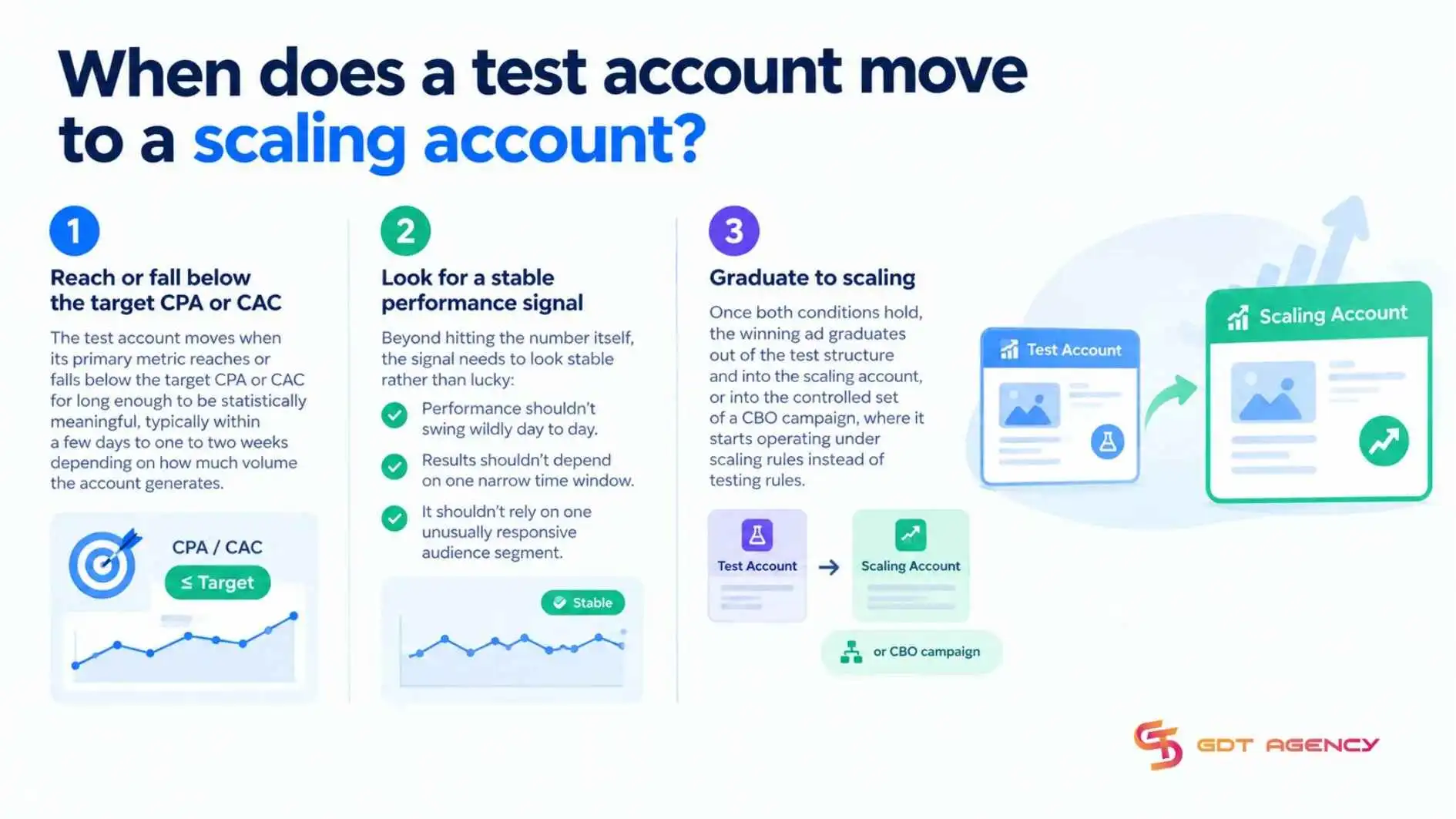
A test account moves to a scaling account when its primary metric reaches or falls below the target CPA or CAC for long enough to be statistically meaningful, typically anywhere from a few days to one to two weeks depending on how much volume the account generates.
Beyond hitting the number itself, the signal needs to look stable rather than lucky: performance shouldn’t swing wildly day to day, and results shouldn’t depend on one narrow time window or one unusually responsive audience segment. Once both conditions hold, the winning ad graduates out of the test structure and into the scaling account, or into the controlled set of a CBO campaign, where it starts operating under scaling rules instead of testing rules.
What is the ideal budget split between testing and scaling?
The ideal budget split allocates roughly 20-30% of total ad spend to testing and the remaining 70% or more to scaling, adjusted up or down based on how many new hypotheses the account needs to validate at a given time.
Once a test graduates, shift budget toward the scaling account in small, deliberate increments, commonly in the range of 20-25% every 24 to 48 hours, rather than in one large jump. This pacing gives Meta’s delivery system enough time to adjust without resetting the learning phase, keeping the cost efficiency the test account worked to earn.
Final Thoughts
Facebook ads test account is a regular ad account or campaign deliberately used to trial creatives, angles, and targeting on a small, controlled budget before real money goes into scaling. Building one follows a 5 step loop: hypothesis, variable, primary metric, a small budget with stop rules, and a clear decision to kill, iterate, or scale. Once a test proves itself with a stable signal, it graduates into a scaling account. For any brand or agency running Facebook Ads at meaningful spend, keeping this separation clean is one of the simplest levers for protecting budget while still finding new winners.
FAQs
Is a Facebook ads test account the same as a Meta Sandbox account?
No, a Facebook ads test account is not the same as a Meta Developer Sandbox. The Sandbox exists purely for API development and never spends real money or reaches a real audience, while a test account runs real ads with a real, though limited, budget.
Do you need a separate ad account just to test Facebook ads?
No, a separate ad account is not required. A single testing campaign or ad set inside your existing ad account, with its own small budget, works just as well for most advertisers and keeps reporting simpler
Is a small daily budget enough to run a valid ad test?
Yes, a small daily budget can produce a valid test, as long as it runs long enough and generates enough results for the primary metric to be statistically meaningful rather than based on a single lucky or unlucky day.
Can you test more than one variable at the same time in a test account?
No, testing more than one variable at once defeats the purpose of a test account, since a win or loss can no longer be traced back to a single cause. Isolating one variable per test is what makes the result usable.
How long should a Facebook ads test run before you make a decision?
A Facebook ads test should run until it reaches your predefined stop rule or hits a minimum number of results needed for statistical meaning, which for most accounts falls somewhere between a few days and one to two weeks depending on spend volume.