How Much Does a Facebook Agency Ad Account Price Cost?


A Facebook agency ad account price typically ranges from $500 to $10000+/month, or a percentage of ad spend that ranges from 1% to 20% in 2026, depending mainly on the provider and the service package. Agencies charge this fee because they take on the account risk, the trust score, and the support that a personal ad account never offers. This guide on Facebook agency ad account prices below will break down each of these price points in detail and flag the warning signs that push the price higher than it should be.
- How Much Is the Facebook Agency Ad Account Price in 2026?
- 1. Percentage of Ad Spend
- Flat Monthly Retainer
- Percentage of Ad Spend
- Hybrid (Base Fee Plus Percentage of Spend)
- Performance-Based and Profit Share
- Hourly or Project-Based Billing
- Facebook Agency Ad Account Price Comparison Across Providers
- What Factors Push the Price Up or Down?
- Final Thoughts
- Frequently Asked Questions
- How much should a small business expect to pay for a Facebook agency ad account?
- Is a Facebook agency ad account worth the extra cost?
- Do all Facebook agencies charge a percentage of ad spend?
- Can the price change after signing a contract?
- Can You Negotiate the Price?
- What happens to the price if the account gets banned?
How Much Is the Facebook Agency Ad Account Price in 2026?
The Facebook agency ad account price in 2026 typically ranges between $500 to $10000, or a percentage of ad spend that can reach 20%, depending on the provider and pricing model.
Facebook agencies price their ad accounts through 5 main models: a percentage of ad spend, a flat monthly retainer, a hybrid of the two, a performance-based structure, and hourly or project-based billing. To see how this range breaks down in practice, the next 5 sections walk through the actual numbers and the factors that move them.
1. Percentage of Ad Spend
A percentage-of-spend model ties the agency’s fee directly to how much the advertiser spends through the account.
To illustrate, GDT Agency structures Facebook agency account pricing as a tiered service fee that automatically decreases as an advertiser’s monthly ad budget grows:
| Monthly Ad Budget Range | Service Fee |
| $0 – $15,000 | 4.0% |
| $15,000-$30,000 | 3.5% |
| $30,000 – $60,000 | 3.0% |
| $60,000-$240,000 | 2.5% |
| $240,000-$450,000 | 2.0% |
| Over $450,000 | 1.5% |
The table above shows GDT Agency’s Facebook agency ad account service fee by monthly ad budget range. The fee rate drops as spend increases, so higher-budget advertisers pay a proportionally smaller percentage.
For example, an advertiser spends $20,000 in a month at GDT Agency. With the rate at 3.5%, the fee for that month comes to $700. This model suits advertisers whose spend changes from month to month, since the fee moves with the budget instead of staying fixed.
Alongside the tiered fee, GDT Agency’s Facebook agency account comes with account opening at no charge, access shared via Business Manager, and a first-time minimum top-up of $200, making the entry cost separate from the ongoing service fee.
Flat Monthly Retainer
With a flat monthly retainer, the advertiser pays a fixed amount each month regardless of how much money goes into Facebook Ads. The contract normally defines what that fee includes, whether that means a certain number of active campaigns, ad sets, audience experiments, or weekly optimization sessions.
This model suits advertisers who run a consistent budget and want a cost they can forecast without surprises. It also suits smaller advertisers, since the fee does not grow just because a campaign performs well and the advertiser decides to spend more.
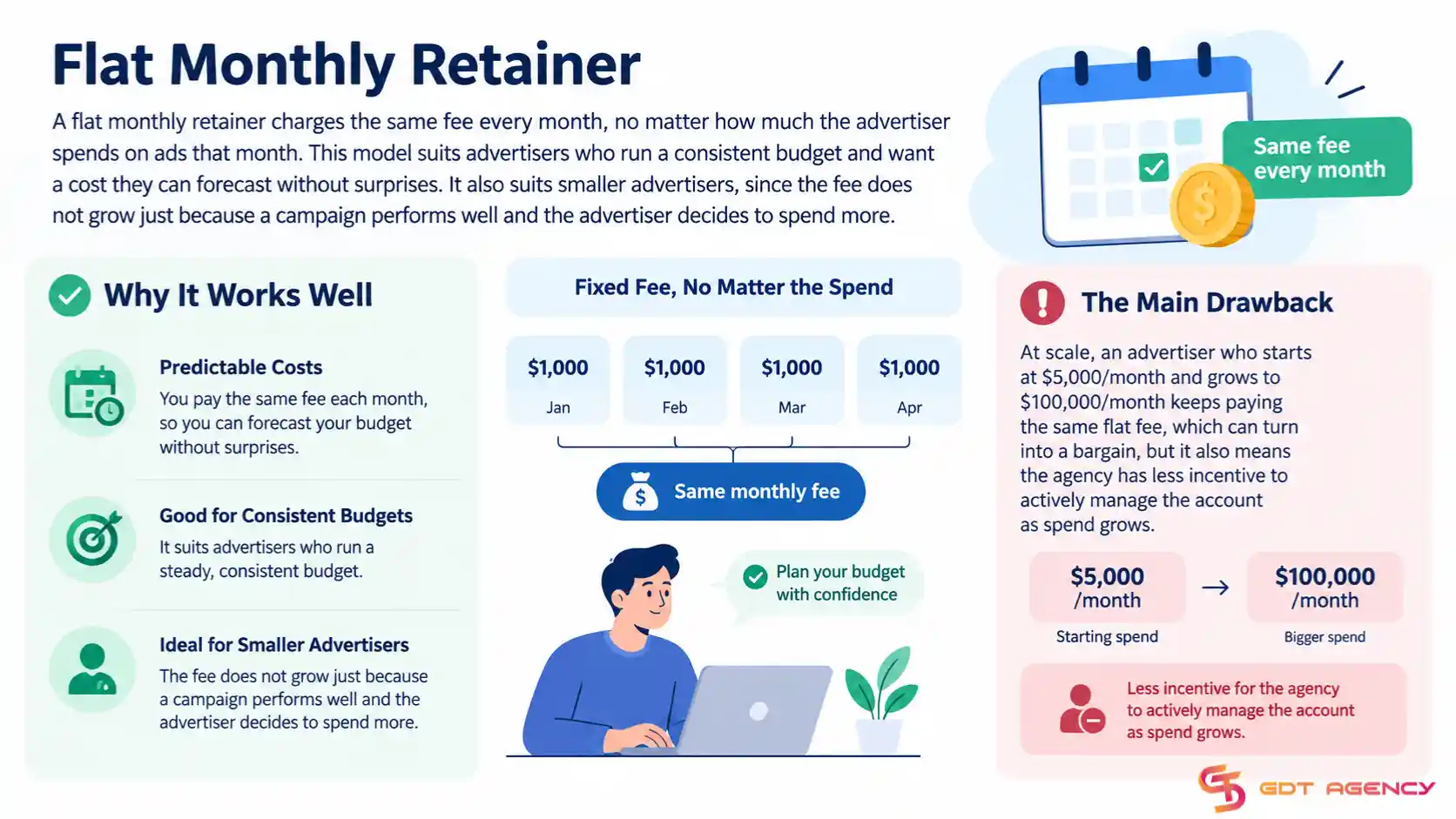
The main drawback shows up at scale. For example, an advertiser who starts at $5,000/month and grows to $100,000/month keeps paying the same flat fee. That can become very cost-effective, although the agency may have less financial motivation to increase its level of account management as the advertiser’s spend grows.
The opposite problem affects smaller advertisers. Someone spending only $1,500 per month while paying a $2,000 retainer is effectively spending more on the agency fee than on advertising itself.
Percentage of Ad Spend
A percentage-of-spend model ties the agency’s fee directly to how much the advertiser spends through the account.

If an advertiser spends $20,000 in a month and the agency charges 10%, the fee for that month comes to $2,000. This model suits advertisers whose spend changes from month to month, since the fee moves with the budget instead of staying fixed.
The advantage for the advertiser is that the agency has a financial reason to keep the account active, stable, and spending. If the account becomes restricted or gets banned, the agency loses part of its own revenue as well. However, the same incentive creates a potential trade-off: the agency earns more as spending increases, even when additional budget starts producing weaker marginal returns.
Hybrid (Base Fee Plus Percentage of Spend)
A hybrid pricing structure uses two components: a fixed base retainer and a percentage fee that applies only after spending reaches a predetermined threshold. For instance, an agency might charge a $1,500 base fee and then take 10% of the spend above the agreed threshold. The base amount helps cover the agency’s fixed operating expenses, while the variable portion allows its compensation to increase as the advertising budget grows.
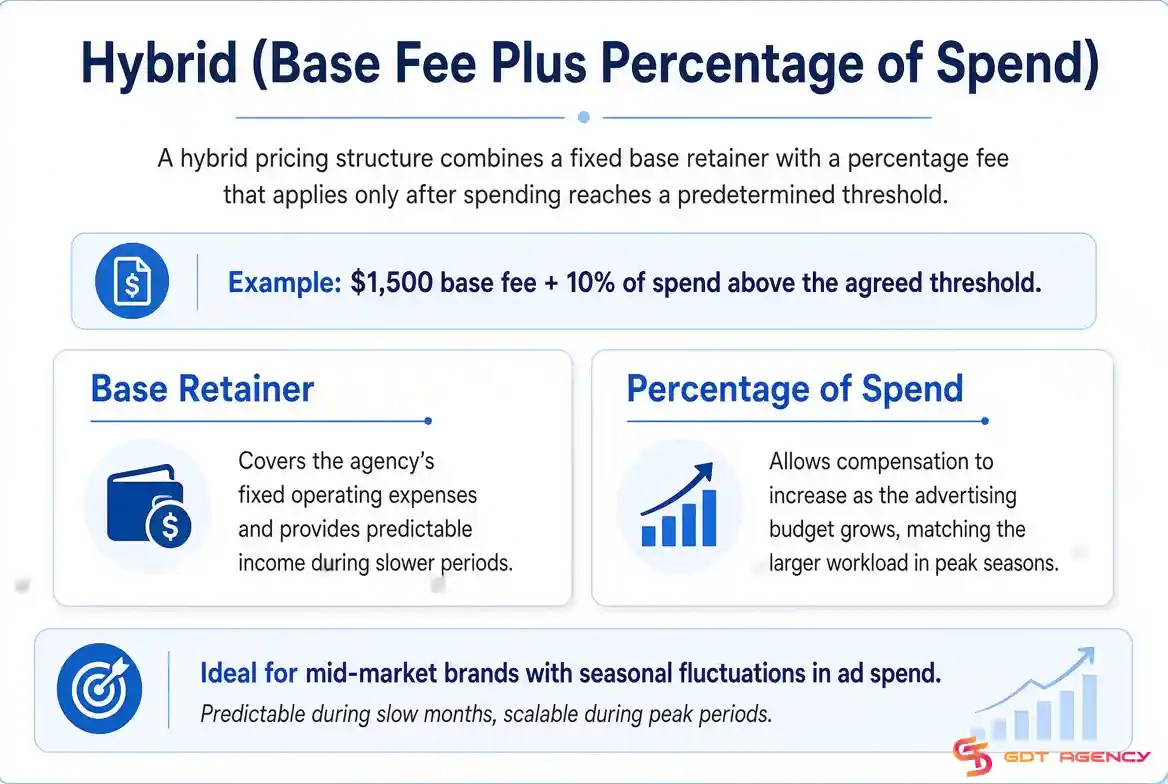
This setup works particularly well for mid-market brands with seasonal fluctuations in advertising spend. During slower periods, the base retainer provides the agency with a predictable level of compensation. When spending rises during peak periods, the percentage component allows the agency to earn more in line with the larger workload and budget.
Performance-Based and Profit Share
A performance-based structure connects the agency’s compensation to specific advertising outcomes. Depending on the agreement, those outcomes may include qualified leads, cost per lead, or net revenue generated from advertising. Agencies using this model often retain a smaller fixed fee, typically between $1,000 and $2,500 per month, to cover their basic operating costs before adding a variable component. That variable payment could be a fixed amount for each qualified lead or a percentage of attributed revenue generated above an agreed baseline return.

The key difference is that the agency’s earning potential depends heavily on campaign performance. Strong results can produce a larger payout, while weak results limit the agency’s upside. The model also requires reliable attribution data to determine which results should be credited to the campaigns. Because of that dependency, many agencies will not use performance-based pricing for brand-new ad accounts, offers without a proven track record, or landing pages that fall outside the agency’s control.
Hourly or Project-Based Billing
Hourly or project-based pricing is designed around a specific piece of work instead of continuous account management. Typical rates range from $100 to $250 per hour, while fixed project fees generally fall between $1,000 and $3,000 depending on the required scope. This approach makes more sense for individual assignments, such as auditing an ad account, setting up the Pixel and Conversion API, or providing a one-time consulting session.
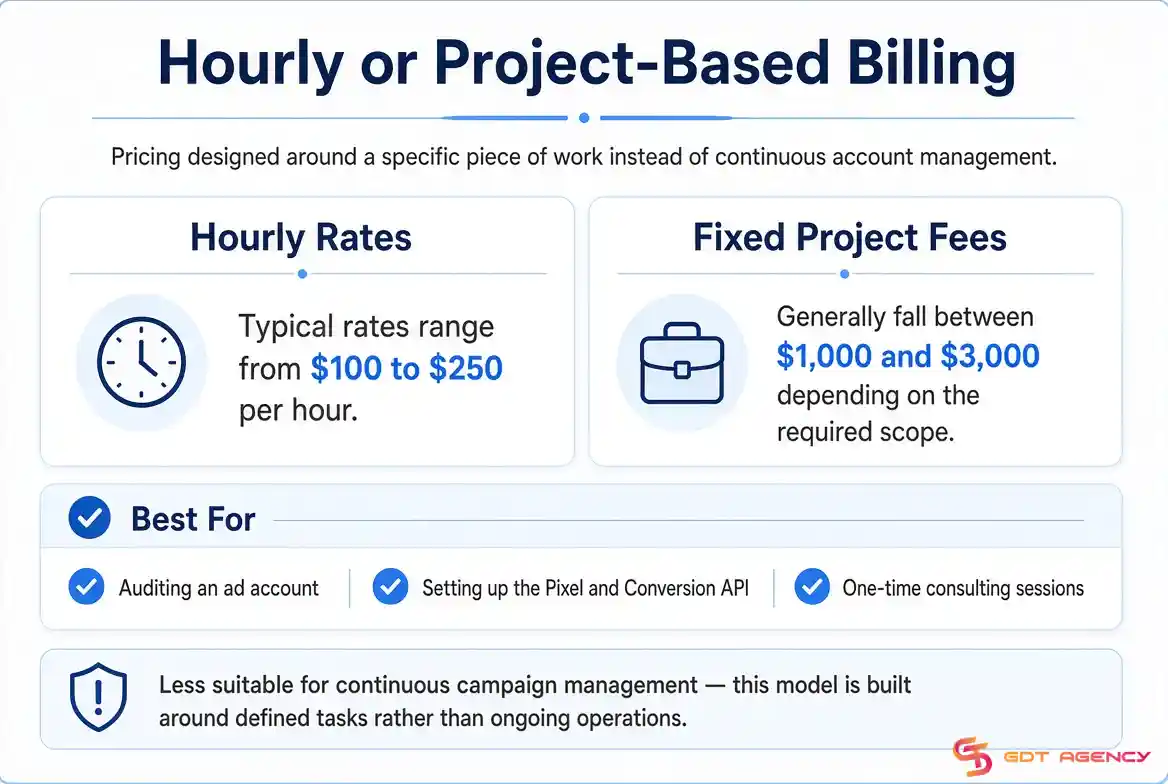
For advertisers who need someone to manage campaigns continuously, however, hourly or project billing is usually less suitable because it is built around defined tasks rather than ongoing campaign operations.
>> If you are not familiar with Facebook agency accounts, you can read the article ”What is a Facebook agency account” to get a clearer understanding of how they work.
Facebook Agency Ad Account Price Comparison Across Providers
Facebook agency ad account prices vary noticeably across providers, with reported models ranging from flat monthly retainers to percentage-based fees and one-time setup charges.
Below, a comparison of publicly listed pricing approaches from several providers illustrates how widely these structures differ.
| Provider | Pricing Module | Service fee | Other fees |
| GDT Agency | Percentage of Ad Spend | $0-$15k/mo: 4% $15k – $30k/mo: 3.5% $30k-$60k/mo: 3% $60k-$240k/mo: 2.5% $240k-$450k/mo: 2% Over $450k/mo: 1.5% | – Free account opening – Account management fee: $200 (If total ad spend is < $5,000) – Minimum Top-up: $200 |
| SpeedX Agency | Percentage of Ad Spend | $25k-$50k/mo: 4% > $50k – $100k/mo: 3.5% $100k-$250k/mo: 3% > $250k/mo: Contact Sales | – Free account opening – Minimum Top-up: $500 |
| Orange Trail | Hybrid | Growth – $595/mo Accelerate – $719/mo Scale – $995/mo | – $0-$100K: 3.5% Ad spend share – $100K – $200K: 3% Ad spend share – $200K+ -2.5% Ad spend share – For policy-violating products: add 5% |
| Uproas | Hybrid | Gold – $299/mo Diamond – $699/mo Platinum – $995/mo Titanium – $1995/mo | For policy-violating products, the price is added: – 4% ad spend share for Gold Package – 3% ad spend share for Platinum Package – 2% ad spend share for Titanium Package |
| Stack Matis | Flat Monthly Retainer | Growth – $2,000/mo: spending 00-$15,000/mo. Scale -$3,500/mo: spending $15,000-$50,000/mo Enterprise – Custom: spend $50,000+/mo | Not public |
What Factors Push the Price Up or Down?
There are 5 factors that move the final price up or down for any given advertiser. Based on my experience at GDT Agency, where I have worked with Facebook agency ad accounts for nearly 10 years, these factors consistently influence how providers structure rental fees and support costs.
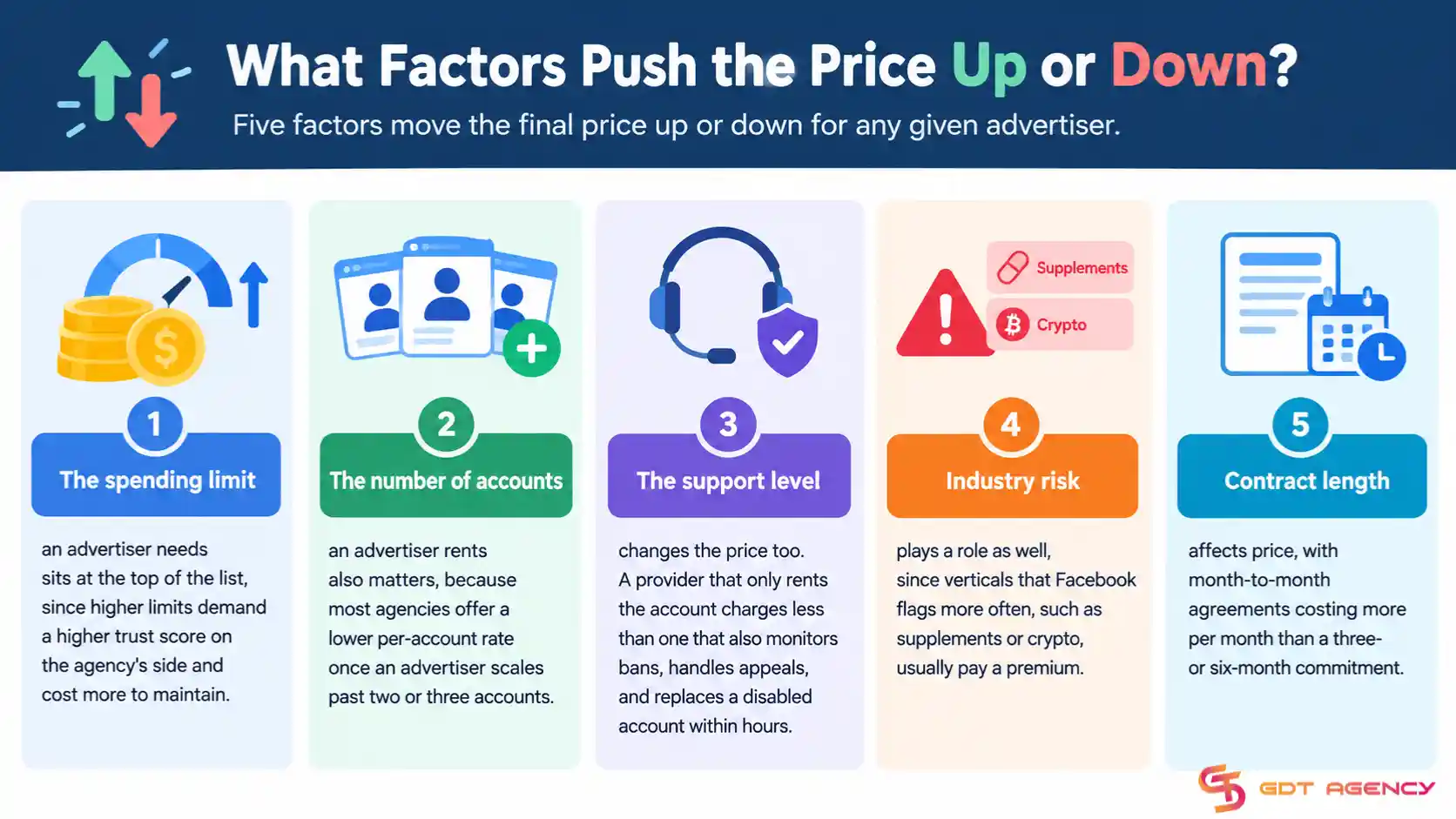
- The spending limit an advertiser needs sits at the top of the list, since higher limits demand a higher trust score on the agency’s side and cost more to maintain.
- The number of accounts an advertiser rents also matters, because most agencies offer a lower per-account rate once an advertiser scales past 2 or 3 accounts.
- Support level changes the price too. A provider that only rents the account charges less than one that also monitors bans, handles appeals, and replaces a disabled account within hours.
- Industry risk plays a role as well, since verticals that Facebook flags more often, such as supplements or crypto, usually pay a premium.
- Finally, contract length affects price, with month-to-month agreements costing more per month than a 3- or 6-month commitment.
>>> The provider you choose also affects the price, support level, and account stability. See our guide to the best Facebook agency ad account providers to compare your options before choosing a provider.
Final Thoughts
Facebook agency ad account pricing in 2026 spans a wide range, from flat retainers around $500 per month to percentage-based fees that can reach 20% of ad spend. The right price for any single advertiser depends on spend volume, industry risk, and how much support the provider bundles into the fee. Advertisers who compare providers on the full package, not just the headline number, end up with a better sense of what they actually pay for. A provider with a lower fee and a proven track record, like the 1.5% rate and case results shown above, often delivers more value than a provider that charges more but cannot back the price with real outcomes.
Frequently Asked Questions
How much should a small business expect to pay for a Facebook agency ad account?
A small business with a modest monthly ad spend should expect to pay a flat retainer between $500 and $1,000 per month, or a percentage fee toward the higher end of the 5% to 20% range, since low spend volume gives less room to negotiate a lower rate.
Is a Facebook agency ad account worth the extra cost?
It depends on how often personal accounts get banned or restricted for a given advertiser. Businesses that face frequent bans, low spending limits, or slow ad approvals usually recover the extra cost through fewer disruptions and faster campaign scaling.
Do all Facebook agencies charge a percentage of ad spend?
No, not all agencies use a percentage model. Many providers, including flat-fee agencies, charge a fixed monthly retainer instead, so advertisers should ask each provider directly which model applies before comparing prices across agencies.
Can the price change after signing a contract?
Yes, the price can change if an advertiser’s spend volume shifts significantly or if the contract includes a review period. Reliable providers state any conditions for a price change in writing before the advertiser signs.
Can You Negotiate the Price?
Yes, advertisers can negotiate the price of a Facebook agency ad account in most cases, especially once their monthly spend passes a meaningful threshold. Agencies that charge a percentage of ad spend often lower that percentage once an advertiser commits to a longer contract or a higher guaranteed spend level. Advertisers who rent multiple accounts from the same provider also gain leverage, since bundling accounts reduces the agency’s cost per account and gives it room to offer a discount.
What happens to the price if the account gets banned?
Most reputable agencies replace a banned account at no extra charge as part of the original fee, since account stability is part of what the fee covers. Advertisers should confirm this policy before signing, since some lower-cost providers charge a separate fee for each replacement.