
How to Set Up a Facebook Agency Ad Account 2026?
Setting up a Facebook agency ad account takes 6 steps: confirm ownership and the access model, establish the partner connection, connect the dataset to the…

A Facebook agency ad account operates under an agency's Business Manager rather than under an individual's personal Facebook profile. This structure gives advertisers access to higher spending limits, a stronger trust score, and more consistent ad delivery compared with a standard personal account. The agency owns and manages the account, while advertisers operate within an infrastructure designed to support larger-scale advertising instead of a setup intended for someone running only a handful of campaigns.
The key difference comes down to ownership and control. The agency keeps ownership of the advertising asset, manages its overall account health, and gives advertisers or clients access through specific permission levels. A personal ad account follows a different model because one person owns the account, handles its funding, and controls its activity through their own Facebook profile. This guide explains what an agency ad account means, how agencies manage it in practice, which advertisers benefit from this setup, and how the model compares with the personal accounts that most advertisers use when they first start running Facebook ads.
A Facebook agency ad account is an advertising account that an agency owns through its Business Manager and provides to advertisers or clients through the agency's existing infrastructure. The account is designed to support greater spending capacity and more stable delivery than a personal account.
Agencies create this type of account because Meta evaluates business-verified, agency-level infrastructure differently from an individual profile that runs advertisements independently. The account can build a broader history through multiple campaigns and clients, and that history can contribute to more consistent delivery and fewer arbitrary restrictions when the account remains well managed.
>>> Curious about the specific advantages this brings compared to running ads on a personal account? See the full breakdown of Facebook agency ad account benefits to explore.
A Facebook agency ad account operates from an ownership structure in which the agency controls the account through its Business Manager. The agency then grants advertisers or clients the permissions they need to create and manage campaigns without transferring ownership of the account itself.
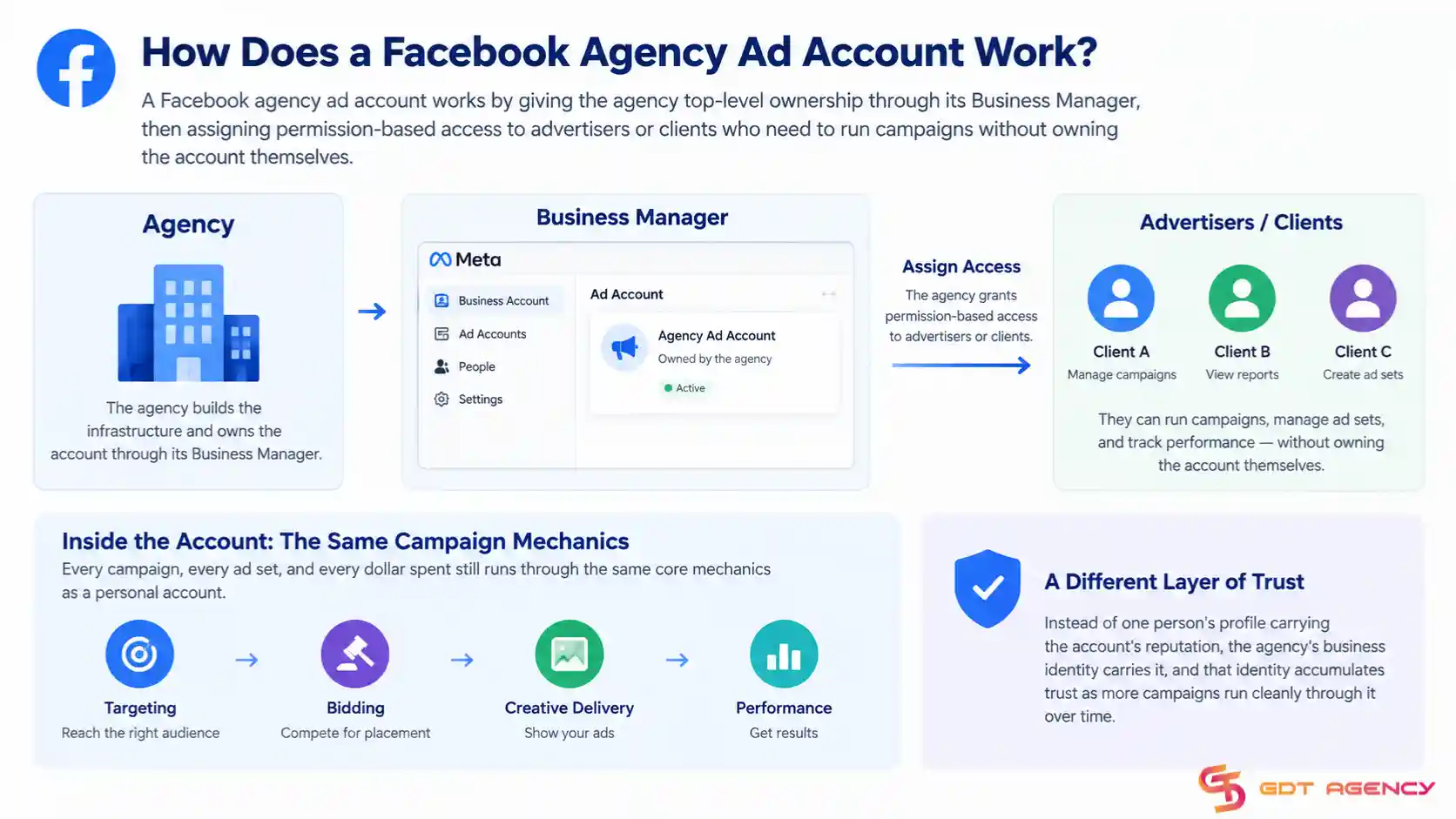
The advertising mechanics remain familiar. Targeting, bidding, creative delivery, campaign management, and ad spending continue to work through the same core Facebook advertising system. The major difference exists above those campaign mechanics. A personal account relies on the reputation associated with one individual's profile, while an agency account operates under the agency's business identity. That identity can accumulate trust as compliant campaigns continue running through the infrastructure.
The agency therefore provides the underlying structure while advertisers perform the day-to-day campaign work inside that structure.
>>> To better understand the structure behind account ownership, access, and management, read our complete guide on Facebook Ad Account Infrastructure: What It Is & How It Works.
During 10 years working at GDT Agency as an advertising expert, there is one question that I have received a lot from advertisers I’m working with, as well as the clients who rent Facebook agency account: “Can we take ownership of an agency ad account?”
The answer is that the agency retains ownership of the ad account through its Business Manager and maintains administrative control over the account. Advertisers and clients receive delegated permissions, but they do not receive ownership rights.
The ownership structure also keeps the account independent from individual personnel and client relationships. A team member can leave the agency without taking the account's history with them. A client can end a contract without causing the account to disappear. The spending history, trust score, and delivery performance remain attached to the agency-owned account because the individual advertiser never owned those assets in the first place.
An agency account uses role-based permissions to determine what each person can access and change. The agency can assign roles such as admin, advertiser, or analyst according to the responsibilities of each user.
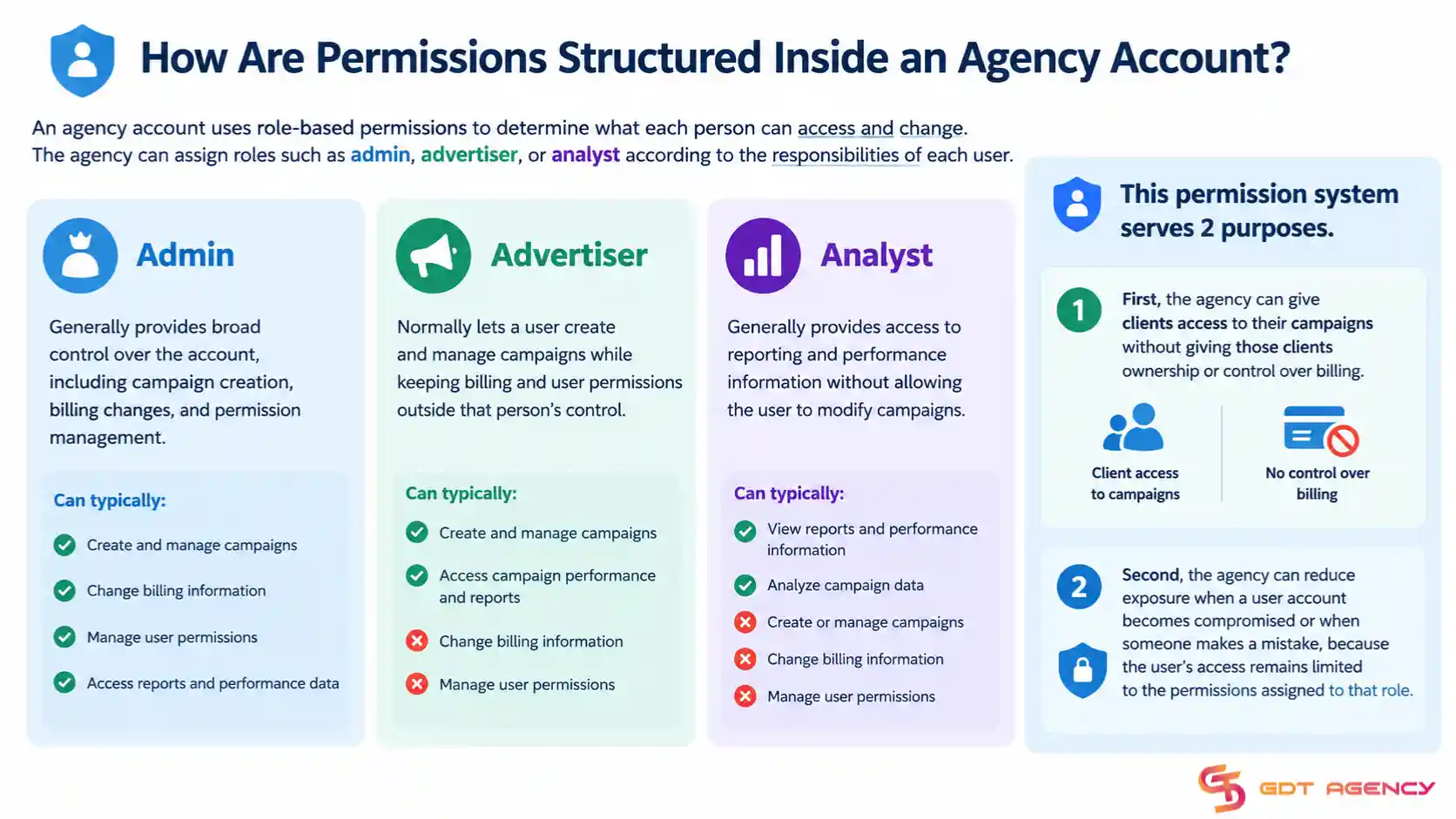
This permission system serves 2 purposes.
For example, an agency could manage advertising for 10 different clients while giving each client's marketing lead an advertiser role. Those marketing leads could manage their own campaigns, while the agency's media buyers could receive analyst access to monitor performance across the accounts. The agency's core administrators would retain control over billing and broader account management.
This arrangement also keeps one client's activity separate from another client's campaigns. Personal accounts usually provide a much less flexible access model because access often becomes an all-or-nothing decision.
>>> For agencies working with multiple clients, setting up the right access structure is also an important part of the onboarding process. See our Facebook Ad Account Agency Client Onboarding guide to understand how agencies can onboard new clients and organize account access more effectively.
A Facebook agency ad account makes the most sense for advertisers and agencies that require higher spending limits, steadier delivery, or centralized campaign management. A person running one small campaign from a personal profile usually has less need for this type of infrastructure.
Several situations can indicate that an agency account fits the advertiser's needs:
Advertisers who are testing Facebook ads for the first time or running one small campaign generally do not require this additional structure. A personal account can handle those situations without introducing the extra management involved with an agency account.
The need for an agency account often becomes clear through recurring friction. Daily spending caps can prevent growth. Long review periods can delay launches. Managing 5 or more personal accounts for different clients can also create ongoing scheduling and security problems. Those issues often become the practical reasons advertisers decide to move toward agency infrastructure.
Advertisers generally have two ways to obtain a Facebook agency ad account: they can build the infrastructure through their own registered agency and Business Manager, or they can rent access to an existing agency account through a third-party provider.
The first option works for businesses that already operate as registered agencies or intend to create their own agency infrastructure.
The second option works for advertisers who want access to agency-level trust and spending limits without creating that infrastructure themselves.
Each approach involves its own costs, setup requirements, and provider considerations.
>>> Curious about the trustworthy provider to rent an agency ad account? Our dedicated blog on Facebook agency ad account providers will help you find the answers to save time.
The setup process for a Facebook agency ad account starts with the Business Manager. The agency configures the Business Manager, establishes user permissions, connects payment methods, and then monitors account health as campaigns begin running.
The agency also needs to manage client access after the account becomes operational. Agencies normally onboard clients through a defined process that establishes the correct permission level and confirms billing arrangements before campaign activity starts.
The main distinction between an agency ad account and a personal ad account involves ownership, spending limits, and stability. An individual owns and controls a personal account, while an agency owns and manages an agency account through its Business Manager. The agency model also provides infrastructure intended for greater scale.
The comparison below shows how these differences appear across the main areas that affect advertisers.
| Factor | Personal Ad Account | Agency Ad Account |
| Ownership | Connected to one individual's Facebook profile | Owned through the agency's Business Manager |
| Spend limits | Starts lower and increases gradually with account history | Often starts higher based on the agency trust score |
| Stability | More exposed to review delays and restrictions | Supported by a longer and broader campaign history |
| Access control | Usually all-or-nothing | Assigned through role-based permissions |
American Van Lines (AVL) provides a practical example of how the two account structures can produce different outcomes. AVL is a moving company and a client of GDT Agency that encountered a spending limitation while trying to scale its advertising activity.
Meta ad account that AVL used had a Daily Spending Limit of just $250. That restriction prevented the company from increasing its campaign volume, even when its offer, targeting, and creative performance supported additional spending.
The main problem did not come from campaign performance. The account had a low trust score, and that score restricted the amount Meta allowed the company to spend each day.
AVL addressed the limitation by moving its advertising activity to GDT Agency's Facebook agency account. The campaigns then operated through an account structure supported by the agency's broader Business Manager history instead of depending only on the trust signals associated with the original account.
The results followed within 90 days. AVL resolved the spending limit problem, achieved a 310% ROI, and reduced its cost per lead by 58%.
The case shows how account infrastructure can affect an advertiser's ability to scale. A personal-style account can become limited by its own history and trust signals. An agency-level account can instead operate within a broader business infrastructure with greater spending capacity and a more established account history.
Facebook BM2500 describes a Business Manager structure that can contain up to 2,500 ad accounts under one setup. The structure matters to agencies because agencies can use it to organize and manage large numbers of client accounts from a centralized infrastructure.
BM2500 and an agency ad account represent two different parts of that structure. The agency ad account represents the individual advertising account that an advertiser or client uses to run campaigns. BM2500 represents the larger container that allows an agency to hold and organize many accounts.
An agency serving dozens or hundreds of clients can use BM2500 infrastructure because a standard Business Manager does not support the same volume of ad accounts.
A Facebook agency ad account gives advertisers an infrastructure designed for needs that can exceed the capabilities of a personal account. The model combines higher spend limits, a stronger trust score, and role-based access for teams or multiple clients. The agency keeps ownership, users receive defined permissions, and the account builds its stability through a campaign history that extends beyond one individual advertiser.
No. A Business Manager provides the structure that organizes ad accounts, Facebook Pages, and users. A Facebook agency ad account represents one advertising account within that structure. The agency owns that ad account through its Business Manager rather than an individual owning it through a personal profile.
Facebook agency ad accounts can still face restrictions based on industry-specific advertising policies. Agency-level infrastructure does not remove those restrictions. Categories such as housing, employment, credit, and regulated products can remain subject to the same policy limitations that affect personal accounts.
It can be safe when the provider manages verification and account health correctly. The advertiser depends on the provider for continued access and account stability, so checking the provider's track record before making a commitment remains important.
No. The agency continues to own the account even when an individual client relationship ends. Losing one client therefore does not remove the account or change its standing with Meta.

Setting up a Facebook agency ad account takes 6 steps: confirm ownership and the access model, establish the partner connection, connect the dataset to the…
A Facebook agency ad account gives advertisers 9 main benefits: unlimited daily spending limits, a high trust score with stable delivery, an auction advantage with…
You onboard a new client onto a Facebook agency ad account through 4 steps: submit assets, pass compliance and setup review, link the Business Manager,…
The 5 best Facebook agency ad account providers for unlimited ad spend in 2026 are GDT Agency, Aurora, Threasury, Squarewave and AdShow. Each of these…

A Facebook agency ad account price typically ranges from $500 to $10000+/month, or a percentage of ad spend that ranges from 1% to 20% in…
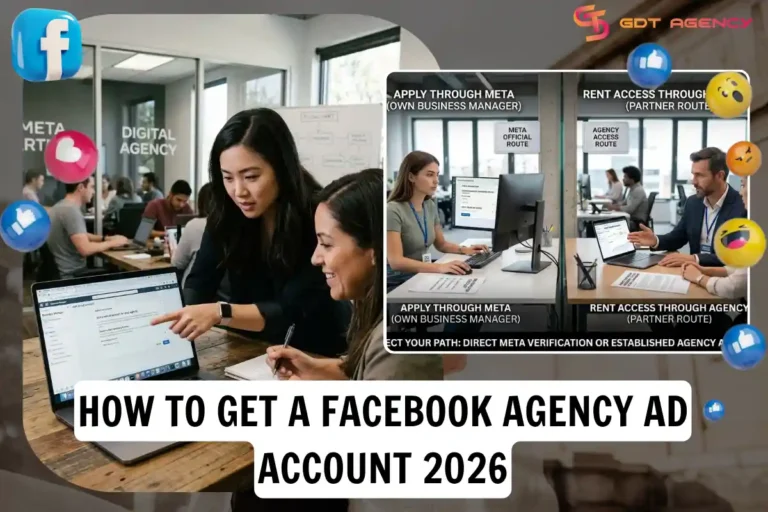
Advertisers can get a Facebook agency ad account through 2 main routes: applying directly to Meta or renting access through an established agency. The direct…