Top 9 Facebook Agency Ad Account Benefits for Advertisers 2026

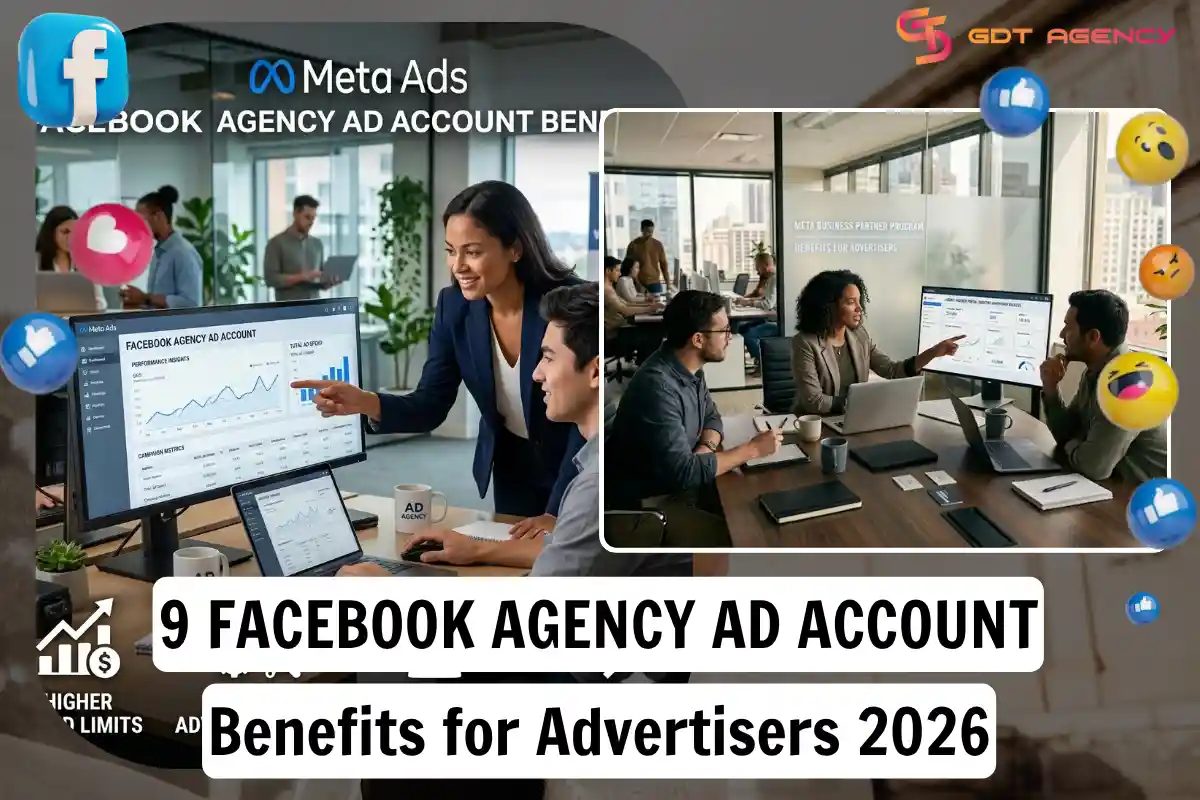
A Facebook agency ad account gives advertisers 9 main benefits: unlimited daily spending limits, a high trust score with stable delivery, an auction advantage with lower CPMs, faster ad review times, complete separation from personal profile risks, instant account replacement with balance transfer, monthly credit lines with flexible billing, direct agency support with Meta rep access, and centralized multi-account scaling. Each of these benefits solves a specific problem that personal ad accounts struggle with, from spending caps to unpredictable bans. Below, this guide on Facebook agency ad account benefits will break down each of the 9 benefits in detail, compare them against what a personal ad account offers, and point to where you can go next once you understand what these accounts bring to the table.
- What Are the Top Benefits of a Facebook Agency Ad Account?
- Unlimited Daily Spending Limits for Rapid Scaling
- High Trust Score & Stable Ad Delivery
- Auction Advantage with Lower CPMs
- Faster Ad Review Times
- Complete Separation from Personal Profile Risks
- Instant Account Replacement & Balance Transfer
- Monthly Credit Lines & Flexible Billing
- Direct Agency Support & Meta Rep Access
- Centralized Multi-Account & Multi-Vertical Scaling
- Do Agency Accounts Cost More Than Personal Accounts?
- How Do You Get These Benefits for Your Business?
- Final Thoughts
- FAQs
- Do you lose any features by switching from a personal account to an agency account?
- How soon do you see these benefits after switching?
- Can a small business with a low ad budget still get these benefits?
- Do these benefits apply to Instagram ads too?
- Can you switch back to a personal account later?
What Are the Top Benefits of a Facebook Agency Ad Account?
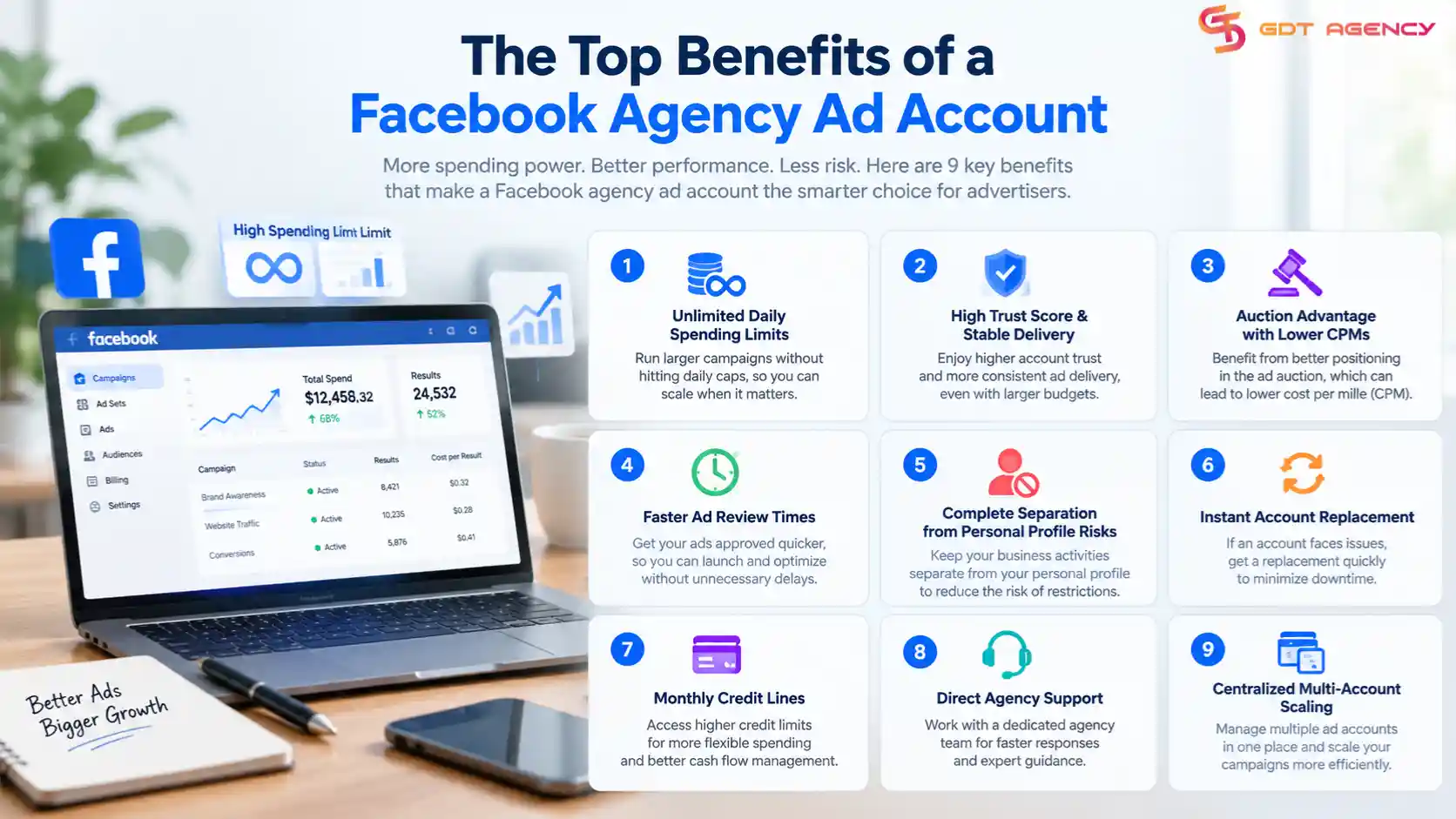
A Facebook agency account offers 9 main benefits: unlimited daily spending limits, high trust score and stable delivery, auction advantage with lower CPMs, faster ad review times, complete separation from personal profile risks, instant account replacement, monthly credit lines, direct agency support, and centralized multi-account scaling. Each benefit addresses a specific pain point advertisers run into on personal accounts.
If you are a beginner and you are not familiar with the concept of a Facebook agency ad account, you can refer to our dedicated article at “What Is Facebook Agency Ad Account” to understand what it is and how it works at first.
To understand why these benefits exist, it helps to look at how Meta treats agency Business Managers differently from personal profiles. Below are the nine benefits broken down individually, with real comparisons against personal accounts and case data where it applies.
Unlimited Daily Spending Limits for Rapid Scaling
A Facebook agency ad account removes the daily spending cap that personal accounts start with. You raise your budget immediately without running into a spending ceiling.
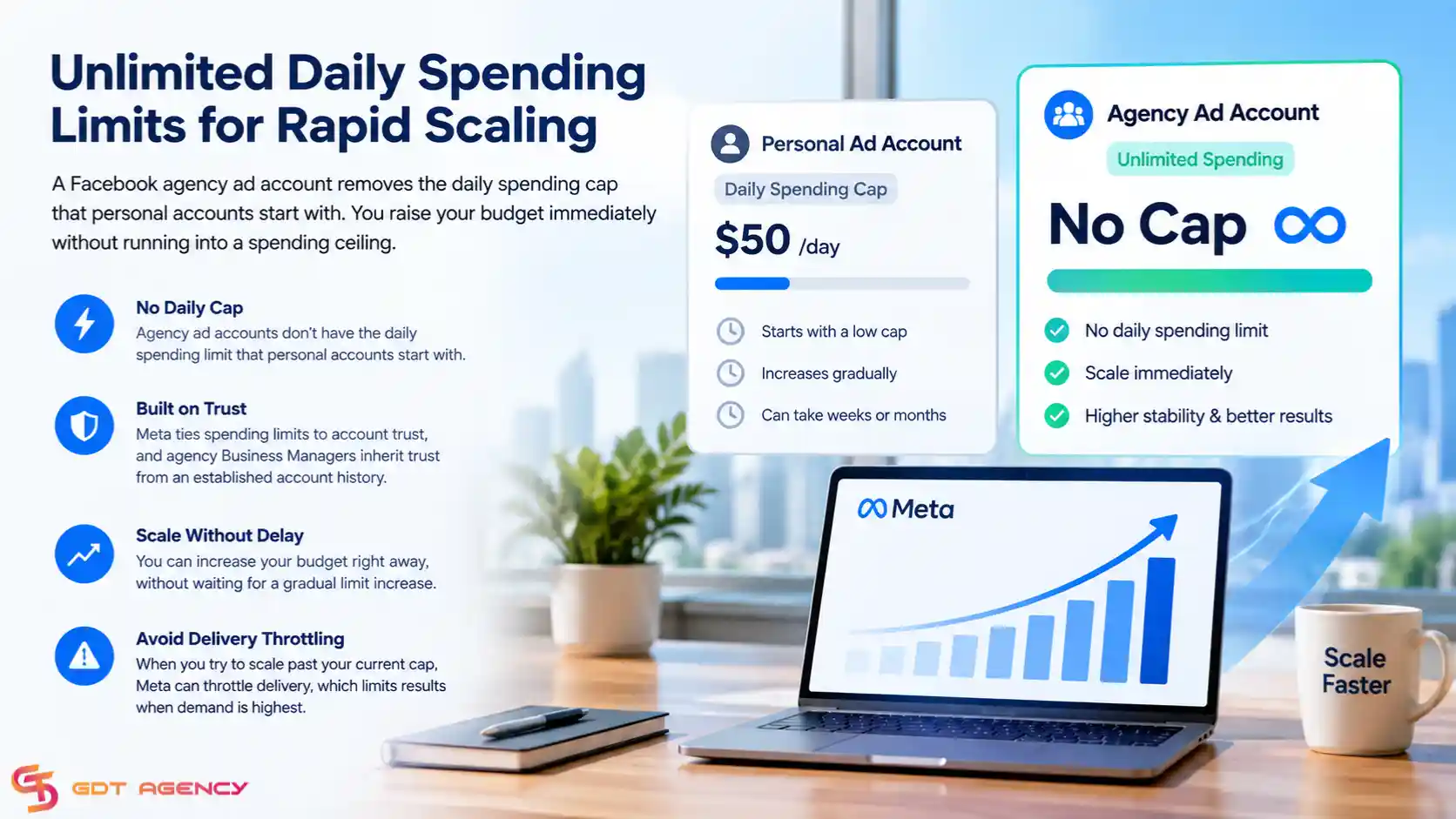
This works because Meta ties spending limits to account trust, and agency Business Managers inherit trust from an account history that’s already established. A personal ad account, by contrast, usually starts with a low daily cap and only raises it gradually as the account builds a clean payment and delivery history. That gradual ramp-up can take weeks or months, which is a real problem for advertisers who need to scale fast.
Advertisers who try to scale a campaign past what their current cap allows often see delivery throttle back automatically, which caps results right when demand is highest.
American Van Lines ran into this exact issue. Their Meta Daily Spending Limit was capped at $250 a day because of a low trust score on their existing account, which choked their ability to scale campaigns. After moving to a GDT Agency account, the cap disappeared, and their campaigns delivered a 310% ROI with a 58% reduction in cost per lead over 90 days. GIP Fulfillment saw a similar outcome at a larger scale: after switching to GDT’s rented accounts, they scaled total ad spend to $180K while their ROI climbed from 1.1x to 3.8x, something the frequent bans on their old accounts made impossible.
High Trust Score & Stable Ad Delivery
An agency ad account carries a higher trust score than a personal account, since it operates inside a Business Manager with an established history. Campaigns keep delivering steadily and avoid sudden pauses caused by review flags.
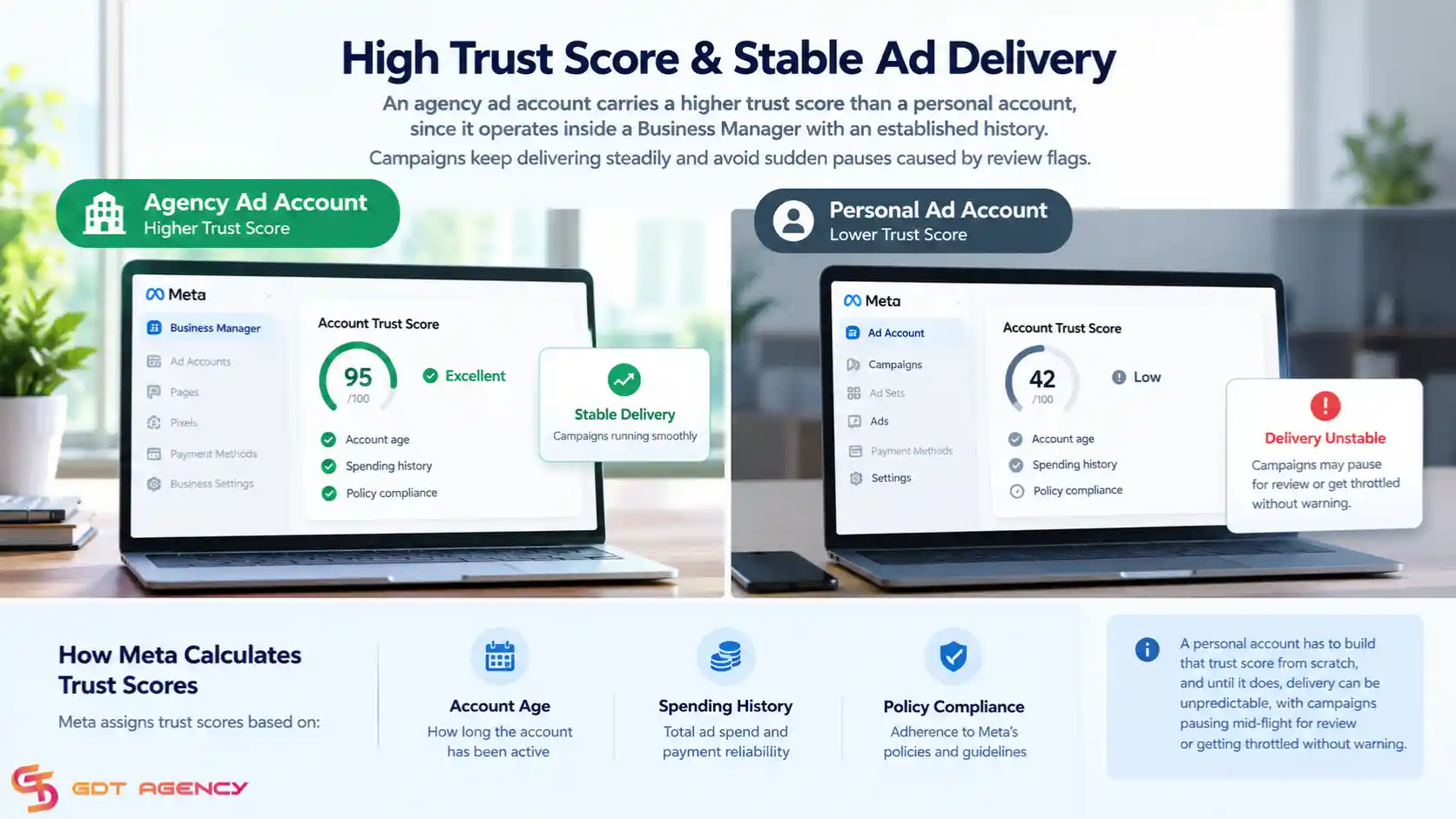
Meta assigns trust scores based on account age, spending history, and policy compliance. A personal account has to build that trust score from scratch, and until it does, delivery can be unpredictable, with campaigns pausing mid-flight for review or getting throttled without warning.
American Van Lines saw their cost per lead drop 58% after their account trust issues were resolved through an agency account. Arbor, a SaaS company running sustainability-focused ads, had a similar experience: long review times on their messaging were slowing delivery, and after migrating to a GDT agency account, they cut cost per lead by 31% while campaigns ran without the same interruptions.
Auction Advantage with Lower CPMs
An established trust profile helps ads win auctions more easily against competing bids. You lower your cost per impression and cost per conversion as a result.
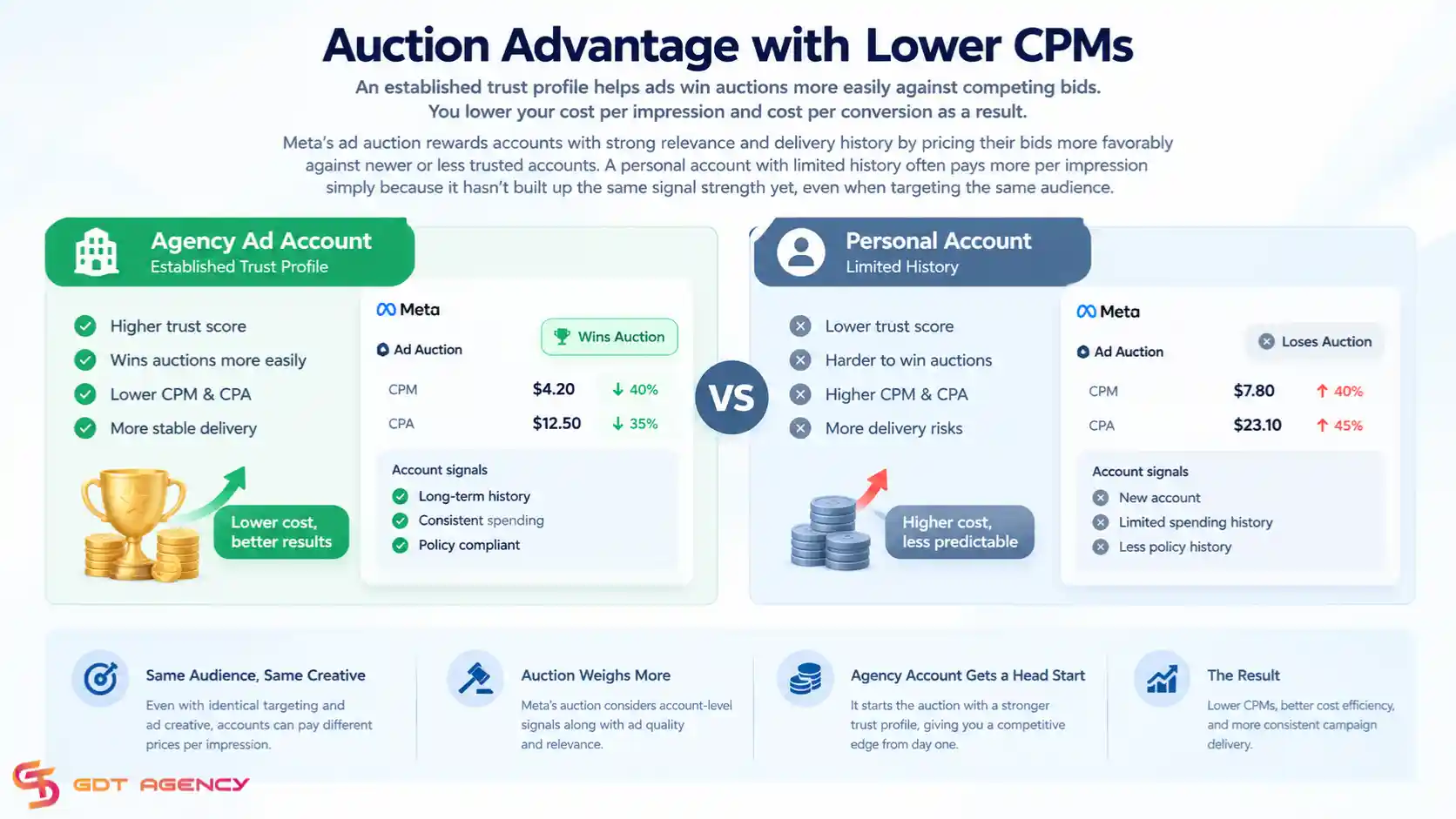
Meta’s ad auction rewards accounts with strong relevance and delivery history by pricing their bids more favorably against newer or less trusted accounts. A personal account with limited history often pays more per impression simply because it hasn’t built up the same signal strength yet, even when targeting the same audience.
2 accounts can target the identical audience with a similar creative and still pay different prices per impression, purely because the auction weighs account-level signals alongside ad quality and relevance. An agency account starts that auction with a head start most personal accounts don’t have.
Faster Ad Review Times
Meta routes agency Business Manager content through a review queue with priority status. Ads get reviewed faster and get flagged incorrectly less often.
This matters because review delays directly cost advertisers time and money. A campaign that sits in review for days instead of hours misses its launch window, and any manual edit resets that clock. A personal account, especially one with limited history, tends to sit in the standard queue longer and gets flagged more often for manual review.
Arbor’s sustainability-focused ad content ran into exactly this problem before switching accounts. Once they moved to a GDT agency account, review times shortened enough to contribute to their 2.4x increase in qualified leads over 90 days.
Complete Separation from Personal Profile Risks
An agency ad account keeps your personal Facebook profile completely separate from your ad account. Your advertising assets carry no risk tied to your personal identity verification.
This separation matters because a personal ad account is tied directly to the Facebook profile that created it. If that account gets flagged, restricted, or banned, the fallout can extend beyond the ad account and affect the personal profile itself, along with anything else linked to it. An agency account structure avoids that entirely by keeping business advertising assets on a completely separate layer from any individual’s personal profile.
For advertisers who run their business page from their own profile, this separation carries extra weight. A restriction on the ad account should never risk locking someone out of their own personal Facebook presence, and an agency structure is built specifically to prevent that overlap.
Instant Account Replacement & Balance Transfer
An agency’s technical team activates a backup account the moment something goes wrong. The system transfers your full balance to the new account without losing funds.
A personal account that gets banned usually means starting over completely: a new account with no history, no trust score, and often a long wait before it can spend at any real scale. An agency structure avoids that downtime by keeping backup accounts ready and moving both the campaign setup and the ad balance over quickly.
GIP Fulfillment is the clearest example of this in practice. Before switching, they were getting banned every 2 to 3 days, with new profiles capped at just $50 a day. After moving to GDT’s rented accounts, they went 4 full months without a single ban.
Monthly Credit Lines & Flexible Billing
An agency provides a clear business credit line instead of relying on a single personal card. You avoid payment holds and card decline issues entirely.
A personal ad account depends on whatever card or payment method is linked to that individual profile, which means a single failed charge, hold, or bank flag can pause an entire campaign. An agency’s billing structure runs through business credit terms instead, which removes that single point of failure and keeps spend running even if one payment method has an issue.
This matters most for advertisers running large monthly budgets, where a single declined charge can pause a campaign at the worst possible moment. A credit line built for business spending removes that risk from the equation.
Direct Agency Support & Meta Rep Access
Agency technicians handle account issues as they come up, working directly with Meta’s representative team to resolve problems. You get support beyond what standard channels offer.
A personal account only has access to Meta’s general support channel, which tends to respond slowly and often can’t resolve account-specific issues quickly. An agency relationship, by contrast, usually comes with a direct line to account managers or Meta representatives who can escalate and resolve problems faster.
For advertisers running time-sensitive campaigns, this direct access shortens the gap between reporting a problem and actually getting it fixed, instead of waiting in a general support queue.
Centralized Multi-Account & Multi-Vertical Scaling
An agency Business Manager lets you run multiple ad accounts under one central system. You allocate budgets and expand into different verticals without hitting account limits.
A personal account typically limits an advertiser to one or two ad accounts, which makes it hard to run separate campaigns for different products, brands, or markets at the same time. A centralized agency structure removes that ceiling, letting a business manage several accounts side by side from one place.
GIP Fulfillment used exactly this setup, running 15 or more rented accounts from GDT in parallel to support their fulfillment business across multiple campaigns at once. That kind of parallel structure would be difficult to manage cleanly with personal accounts, since each one would need its own separate login, payment method, and trust history to build up individually.
Do Agency Accounts Cost More Than Personal Accounts?
Agency accounts do come with a fee that personal accounts don’t have, usually structured as a flat retainer or a percentage of ad spend. GDT Agency, for example, runs a tiered fee starting at 4.0% and dropping to 1.5% as monthly ad budget scales from under $15K to over $450K, with a $200 minimum first top-up and free account opening.
How Do You Get These Benefits for Your Business?
You get these benefits either by applying directly through Meta’s Business Partner program or by going through an established agency that already holds Business Partner status. Most advertisers find the agency route faster since it skips the direct application wait.
→ The full requirements and steps are covered in How to Get a Facebook Agency Ad Account.
Final Thoughts
A Facebook agency ad account solves problems that personal accounts simply aren’t built to handle at scale. Higher spending limits, a stronger trust score, faster reviews, and backup accounts all come from the same source: an established Business Manager history that a personal profile has to build from zero.
The benefits with real GDT case data (spending limits, trust score, review speed, account replacement, and multi-account scaling) show measurable results across American Van Lines, Arbor, and GIP Fulfillment. The remaining benefits (auction advantage, profile separation, credit lines, and direct support) still hold up on mechanism alone, even without a matching case study yet.
If your business is close to hitting the ceiling on a personal account, or has already been hit with a spending cap, a review delay, or a ban, an agency account addresses that directly rather than working around it.
FAQs
Do you lose any features by switching from a personal account to an agency account?
No. An agency account keeps every standard Ads Manager feature: campaign structure, targeting, reporting, and creative tools stay the same. What changes is the account’s trust tier and spending limits, not the toolset.
How soon do you see these benefits after switching?
Spending limit and trust score improvements typically show up within days, since they depend on the Business Manager’s existing history rather than a new account building trust from scratch. Cost and delivery improvements usually take a few weeks to fully show up in the data, as seen in the 90-day case results above.
Can a small business with a low ad budget still get these benefits?
Yes. Providers like GDT Agency scale their fee down as ad budget increases, so a smaller advertiser still gets the same account-level benefits, just at a lower monthly cost. The spending cap removal and trust score benefits apply regardless of budget size.
Do these benefits apply to Instagram ads too?
Yes. Since Instagram ads run through the same Meta Ads Manager and Business Manager structure as Facebook ads, an agency account’s spending limits, trust score, and review speed apply across both platforms together.
Can you switch back to a personal account later?
Technically, yes, but doing so means giving up the trust score and spending limits built under the agency account, since those benefits are tied to the Business Manager, not to the campaigns themselves. Most advertisers who switch to an agency account stay on it once they see the difference in delivery stability.