Difference between Facebook personal and business ad account

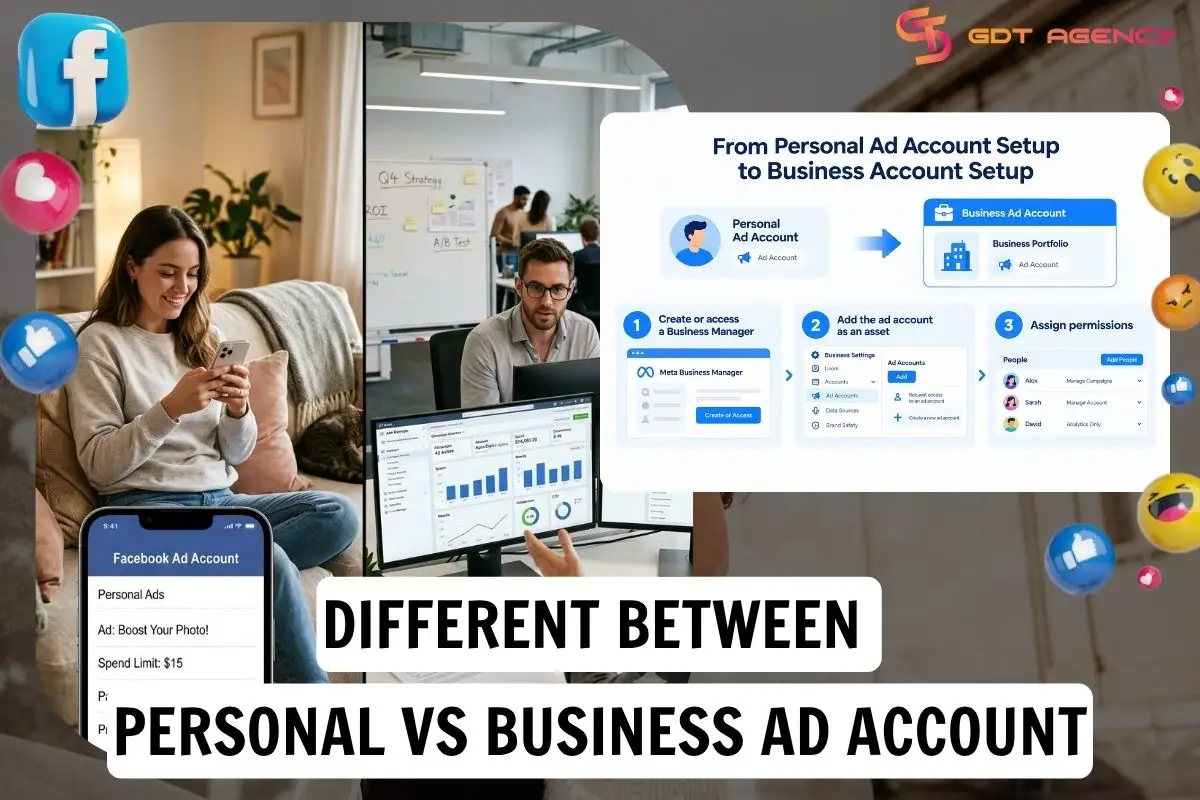
Facebook personal and business ad accounts differ in 5 areas: structure and control, access, spending limits, setup and security. A personal ad account is tied to an individual’s Facebook profile, while a company inside a Meta Business Portfolio owns a business account. Both let you run ads on Facebook and Instagram. The guide below breaks down each account type, when either one still makes sense and what happens when you switch from one to the other
- What is the difference between a Facebook personal and business ad account?
- What is a Personal Ad Account?
- What is a Business Ad Account?
- Should you use a personal ad account or business ad account?
- What else should you know before switching ad account types?
- How do you move from personal ad account setup to business account setup?
- Is switching from a personal to a business ad account permanent?
- What happens to existing campaigns when you switch account types?
- Final Thoughts
- FAQs
- Is a personal ad account free to use?
- Do you need a Facebook page to create a business ad account?
- Should you keep both a personal and a business ad account at the same time?
- Is a business ad account the same as an agency ad account?
- Can one Business Manager control multiple business ad accounts?
What is the difference between a Facebook personal and business ad account?
The core practical difference is how the ad account is structured and managed. A personal ad account is more closely tied to an individual’s Facebook profile, while an ad account managed through a Meta Business Portfolio is organized as part of a company’s shared business-asset structure. This affects how businesses administer ownership and control, grant team access and manage assets, billing and security.
Within Meta’s advertising infrastructure, personal and business-managed ad accounts can be compared across 5 areas: account structure and control, setup, access, spending limits and security. The table below explains the practical differences, while noting that Meta determines spending limits and other available features based on factors such as account history, payment status and policy compliance, not simply by whether the account is personal or business in Facebook Ads.
| Criteria | Personal Ad Account | Business Ad Account |
| Structure and control | Personal Facebook profile | Business Portfolio (Business Manager) |
| Setup requirement | Create in Ads Manager | Requires a Meta Business Portfolio for centralized ownership and management |
| Access | Can be shared, but offers more limits to manage access centrally and delegate authority | Multiple people can receive role and asset specific permissions Spending limits |
| Spending limits | Set or adjusted by Meta based on account and payment history | Based on Meta’s assessment, higher limits are possible |
| Security | Relies mainly on the individual profile’s security settings | Supports business-level permissions, asset roles and partner access |
As an expert at GDT Agency with 10 years of experience working with Facebook Ads from personal accounts to Facebook agency accounts, I’ve seen many advertisers assume a business ad account automatically delivers ads better than personal ad account. In reality, Meta’s delivery engine doesn’t care which account type placed the ad, auction dynamics, the optimization goal, ad quality, conversion signals, budget, audience and policy compliance decide performance. A business ad account’s advantage is operational, not algorithmic. It separates company-owned assets from any individual’s personal profile, making access control, team collaboration, security and asset ownership easier.
What is a Personal Ad Account?
A personal ad account is the default ad account Facebook creates for an individual profile. When you sign up for Facebook, you’re given an ad account and ad account ID. Before advertising, the user may still need to set up a Facebook page, payment method and other required account details.
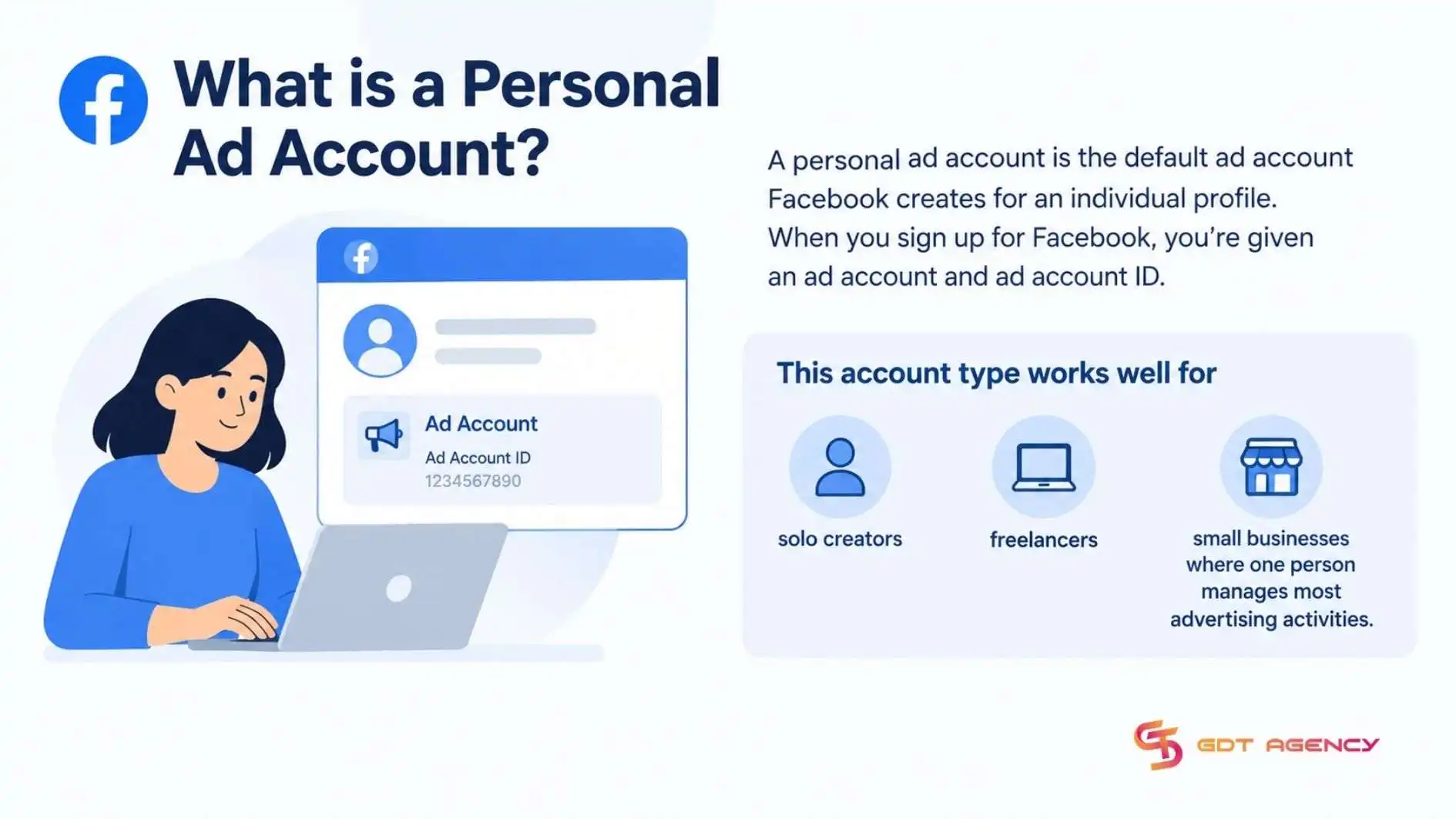
This account type works well for solo creators, freelancers, or small businesses where one person manages most advertising activities. Its practical limitations become more apparent when several employees, clients or agencies need access across multiple assets or accounts. In those cases, a Meta Business Portfolio generally provides a more centralized way to organize business assets and manage people and permissions.
>>> To better understand its role in Facebook advertising, learn more about how Personal Ad Account works before switching to a Business Ad Account.
What is a Business Ad Account?
A business ad account is the ad account type created and owned inside a Business Portfolio, built specifically for teams, agencies and companies that need shared access, defined roles, and centralized billing across every campaign.
Unlike an ad account managed only through one person’s profile, an ad account in a Business Portfolio can be administered by multiple authorized people using their own Facebook profiles or managed Meta accounts. Admins can assign specific permissions, such as campaign creation, billing access, or analytics-only viewing, to different team members or partner agencies without ever sharing a personal password.

Should you use a personal ad account or business ad account?
For businesses that advertise regularly or work with more than one person, managing ad accounts through a Meta Business Portfolio is generally the better operational structure. It centralizes business assets and lets employees, freelancers and agencies use their own authorized logins rather than sharing one person’s Facebook credentials.

The 2 reasons play out like this:
- Shared access: a business ad account lets more than one person work inside it at once, without sharing a single login
- Continuity: campaigns and connected assets stay tied to the business, not to one employee’s personal profile
A personal setup may still be sufficient for a solo freelancer running a small number of campaigns alone. Once a second marketer, client or agency is involved, the benefits of shared administration, controlled access and continuity usually justify setting up a Business Portfolio.
>>> Understanding the difference between personal and business ad accounts is only one part of the picture. To see how ownership, permissions, billing, security, and business assets connect across Meta, learn more about how Facebook Ad Account Infrastructure works.
What else should you know before switching ad account types?
Before moving from a personal ad account setup to a business setup, check 3 things: whether you can keep the existing ad account, whether you can change its ownership or Business Portfolio connection and what will happen to active campaigns and reporting history.
The outcome depends largely on whether you continue using the same ad account or create a new one. If you keep the same account and only change how it is managed or who has access, its existing campaigns, delivery history, creative and billing records remain associated with that account. If you create a new ad account, campaigns do not migrate automatically, though you can duplicate or recreate campaign structures.
Businesses should also verify ownership before changing anything. An ad account already linked to one Meta Business Portfolio cannot simply be moved to another. If another business owns an account, the practical options are usually to request access or create a new ad account in the correct Business Portfolio
How do you move from personal ad account setup to business account setup?
Moving a personal ad account into a business setup requires 3 main steps: create or access a Business Manager, add the account as a shared or claimed asset and assign permissions.
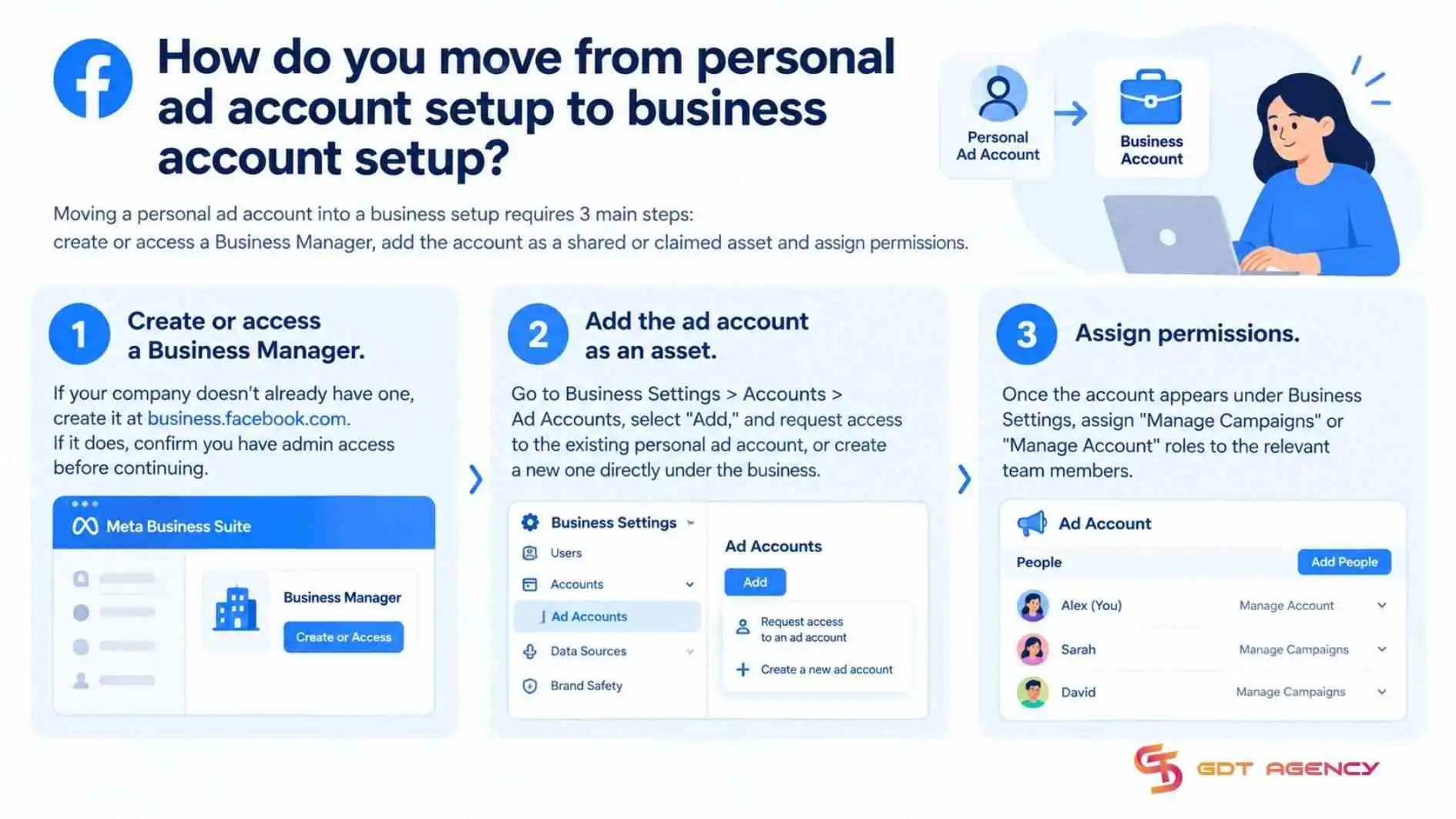
Step 1: Create or access a Business Manager.
- If your company doesn’t already have one, create it at business.facebook.com.
- If it does, confirm you have admin access before continuing.
Step 2: Add the ad account as an asset.
- Go to Business Settings > Accounts > Ad Accounts
- Select “Add,” and request access to the existing personal ad account, or create a new one directly under the business.
Step 3: Assign permissions.
- Once the account appears under Business Settings, assign “Manage Campaigns” or “Manage Account” roles to the relevant team members
This path, sharing or claiming the same ad account rather than creating a brand new one, keeps campaigns, IDs, budgets and performance history intact. Some solo advertisers still choose to run ads on personal Facebook account setups instead, particularly when spend stays low and only one person manages every campaign. That approach can work for a while, but it’s worth weighing against this migration path once a second person or a larger budget enters the picture.
Is switching from a personal to a business ad account permanent?
No, switching from a personal ad account to a business ad account isn’t strictly permanent. Still, Meta gives no simple one-click way back once campaigns are rebuilt under Business Manager. Reversing the move means re-adding the account under a personal profile, reassigning permissions, and in some cases, losing continuity of campaign optimization data tied to the business setup.
For most businesses, this makes the switch a one-way decision in practice, even if it isn’t technically irreversible on Meta’s end. Treating it as permanent from the start avoids the temptation to move back and forth, which tends to disrupt ad delivery and reset learning phases on active campaigns.
What happens to existing campaigns when you switch account types?
When you switch account types, existing campaigns don’t carry over automatically. They stay tied to the ad account they were originally built in, so you typically pause or archive them under the personal account and rebuild the structure fresh under the new business ad account.
This happens because Meta ties campaign history, including delivery data and optimization signals, directly to the ad account ID rather than to the person managing it. Rebuilding campaigns under a business ad account means losing some of that historical learning, so it’s worth timing the switch for a natural break point, such as the start of a new budget cycle, rather than mid-campaign.
Final Thoughts
A personal ad account and a business ad account both let you run ads on Meta, but they differ in who owns the account, how spending limits are set, and what security options are available if something goes wrong. For solo, low-budget testing, a personal ad account is fine; for anything involving a team, real budget, or long-term scale, a business ad account is the safer setup. Switching between the two isn’t difficult, but it isn’t instant either, so it’s worth planning the move rather than reacting to it after a problem forces the decision
FAQs
Is a personal ad account free to use?
Yes, a personal ad account is free to create, since Meta doesn’t charge a setup fee for either account type. Costs only apply once campaigns start running, based on your chosen budget and bidding strategy
Do you need a Facebook page to create a business ad account?
Yes, a Facebook Page is required because Business Manager uses the Page as the core identity for ad creative, audience targeting, and account verification
Should you keep both a personal and a business ad account at the same time?
Yes, you can keep both active at once. Personal ad account is for personal identity and limited individual activity, while using business ad account as the primary account for company, brand or team campaigns.
Is a business ad account the same as an agency ad account?
No, a business ad account and an agency ad account aren’t the same. A business ad account is owned directly by your company, while an agency ad account is provisioned and often owned by a third-party partner managing ads on your behalf.
Can one Business Manager control multiple business ad accounts?
Yes, a single Business Manager can control multiple business ad accounts at once, which is common for companies running separate accounts per brand, region, or retail partnership.